



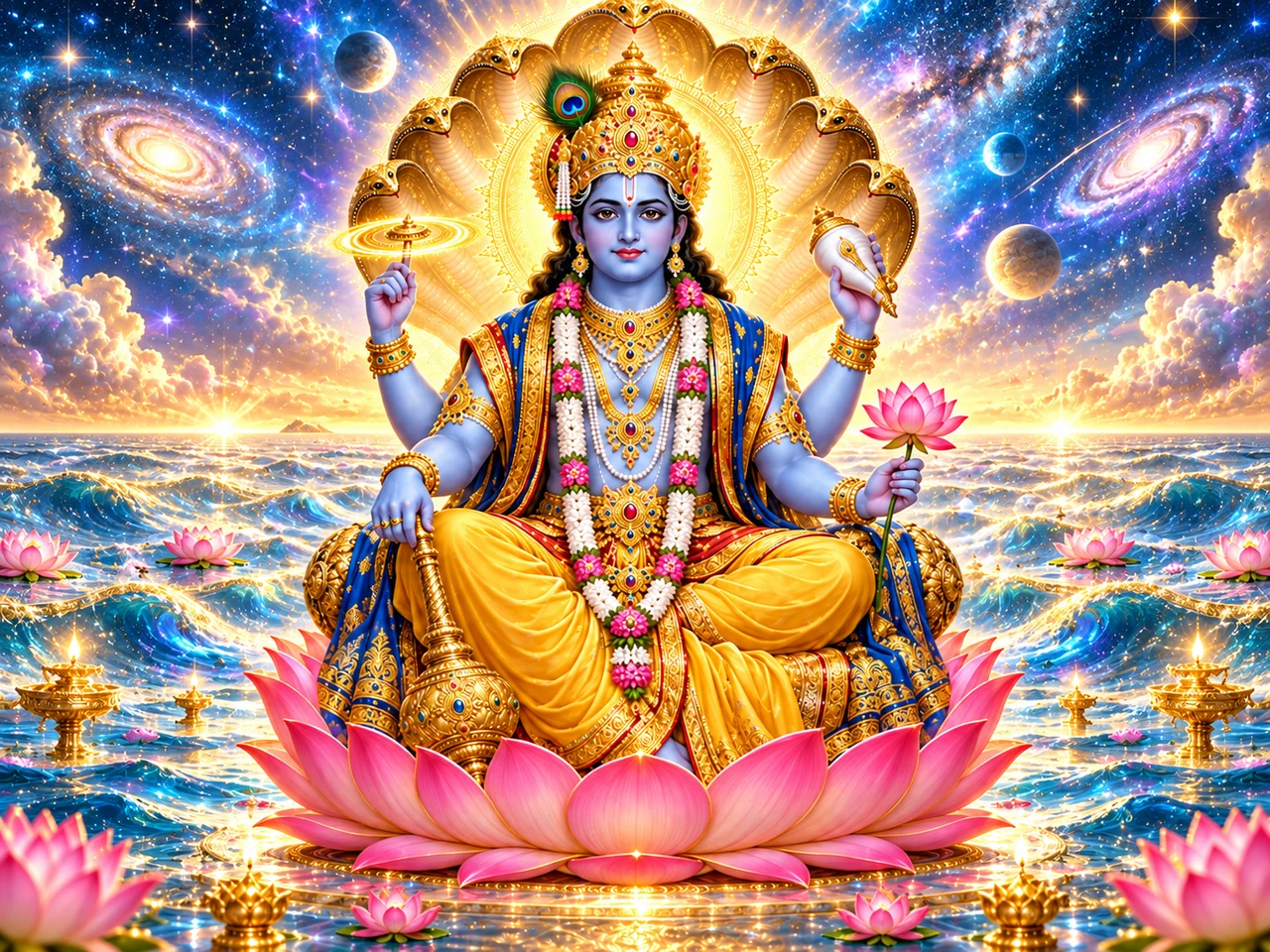
Imagine a universe so immense that even its apparent stability is a question. What holds its patterns together? What happens when power is used without responsibility, when the vulnerable need protection, or when human beings lose sight of dharma, the ethical and cosmic order? Across a great range of Hindu traditions, Vishnu (Vishnu, विष्णु) helps people think about these questions. He is often introduced as the divine (Viṣṇu, विष्णु) helps people think about these questions. He is often introduced as the divine preserver. Yet the word can sound strangely passive for a figure who walks across the cosmos in three strides, descends into stories as a fish, boar or human hero, and addresses a troubled warrior as Krishna. 1 3 6
For many Vaishnavas, Vishnu or Narayana is not merely one member of a cosmic management team: he is supreme reality, the source and refuge of all beings. Other Hindu traditions place ultimate emphasis on Shiva, Devi or nondual reality and understand Vishnu's place differently. These are living theological perspectives, not a historical contest with a single universally agreed winner. This profile introduces Vishnu's texts, narratives, symbols, worship and philosophical diversity without collapsing them into a single version. 2 13
Names, meanings and identities
The Sanskrit name VishnuViṣṇu is commonly connected with the idea of pervading or encompassing; precise etymological claims require philological care. In the RigvedaṚgveda, he is praised as the one who strides widely and measures cosmic regions. The descriptive names Urukrama (wide-strider) and Trivikrama (three-stepper) recall this image. In later devotional speech, Narayana, Hari, Govinda, Keshava, Madhava, Achyuta, Janardana, Padmanabha, Purushottama and Shriman Narayana are especially familiar names, although their usage and explanations differ among texts and communities. 1 2
Some names highlight a story or icon. Padmanabha recalls the lotus associated with his navel; Keshava and Govinda are central in Krishna devotion; Shriman Narayana expresses the intimate relationship with Shri or Lakshmi. Vishnu, Narayana, Vasudeva and Krishna are sometimes used interchangeably in prayer, but they are not interchangeable technical terms in every system of philosophy. Their overlapping histories are part of Vaishnavism's richness. expresses the intimate relationship with Sri or Lakshmi. Vishnu, Narayana, Vasudeva and Krishna are sometimes used interchangeably in prayer, but they are not interchangeable technical terms in every system of philosophy. Their overlapping histories are part of Vaishnavism's richness. 2 3 13
From Vedic hymn to Puranic devotion
Rigveda 1.154Ṛgveda 1.154 is an excellent place to begin. Rather than presenting the familiar four-armed temple image, it celebrates Vishnu's extraordinary strides, his support of the worlds and his highest step. The text belongs to an early Vedic setting; later readings recognize in these cosmic steps an anticipation of Vamana–Trivikrama. It is valuable to notice both continuity and change. We should not project every later avatar story, temple ritual or Vaishnava doctrine directly into a much older hymn. 1
The epics, Puranas, devotional hymns and temple traditions develop Vishnu as Narayana, as the cosmic source, and as a deity approached through affection, reverence and service. The Vishnu PurāṇaViṣṇu Purāṇa invokes Vishnu as the source, support and dissolution of the cosmos. The Bhāgavata Purāṇa opens a long discussion of divine manifestations and the spiritual importance of remembering their deeds. These texts belong to related but not identical literary environments; neither is a neutral summary of all Hindu theology. 2 3 15
Historically datable images offer a different kind of evidence. A Chola-period standing Vishnu, a Kashmir Vaikuntha Vishnu and a pre-Angkor sculpture from the Mekong region demonstrate that Vishnu worship and iconography developed across many centuries and places. A surviving sculpture establishes the existence of an artistic and devotional form at its documented period; it cannot prove that a Puranic miracle occurred literally. 9 10 11
1. The three strides: Vamana meets Bali
King Bali is generous and powerful. At his sacrifice, a youthful brahmin named Vamana asks for just three steps of land. The request seems modest. Yet Vamana is Vishnu in a form whose size does not announce his cosmic identity. In the unfolding narrative, his strides encompass the worlds and confront Bali with a decision about pride, possession and the keeping of one's word. The Bhāgavata Purāṇa describes Vamana's appearance and arrival before Bali in 8.18, then places the actual request for three paces of land in 8.19.16. Its list of manifestations also introduces the episode at 1.3.19. 6 19 3
The story can be read as a lesson in humility, but Bali should not be reduced to a cartoon villain. Devotional retellings may emphasize his generosity, surrender or enduring dignity. The early Vedic hymn and later Bali episode have a recognizable motif in common—the cosmic stride—but different narrative settings. This is a connection across traditions, not proof that the full Puranic episode is told in the RigvedaṚgveda. 1 6
2. The ocean churned: cooperation, conflict and Lakshmi
The gods and asuras churn the ocean in pursuit of nectar. The mountain used as the churning rod needs support, and Kurma, Vishnu's tortoise form, bears its weight in a familiar account. Valuable and dangerous things emerge. Lakshmi appears and chooses Vishnu; the Bhāgavata Purāṇa, book 8, chapter 8, places their union within this turbulent cosmic scene. This is not a simple tale that wealth appears without effort. It describes a world in which desire, competition, patience and divine protection are intertwined. 3 7
Lakshmi is not a decorative accessory to Vishnu. In Shri Vaishnava devotion, Lakshmi is not a decorative accessory to Vishnu. In Sri Vaishnava devotion, ShriSri matters profoundly to how devotees understand divine compassion and access to Narayana. Other traditions give the Goddess a more independent ultimate status. The various ocean-churning versions should be attributed to their own texts instead of combined into a supposedly fixed sequence. 7 13
3. Rama: divine protection through difficult human choices
Rama, the prince of Ayodhya and central figure of the Rāmāyaṇa traditions, is widely understood as an avatar of Vishnu. His story moves through exile, companionship, Sita's abduction, alliances and the war against Ravana. The Bhāgavata Purāṇa explicitly includes Rama among its manifestations at 1.3.22, although the epic's many regional retellings have their own structures, emphases and interpretive debates. 3 13
Rama's significance cannot be reduced to victory in battle. Readers also encounter searching questions about the duties of rulers and family members, loyalty, suffering and the cost of an ethical choice. His companion Hanuman represents devoted service to Rama. Within ShivGoraksh, the Hanuman profile provides the fuller Rama-centered context. Not every Rama devotee begins with the same philosophical explanation of Vishnu, but the traditions have been deeply connected for centuries. 3 13
4. Krishna: the charioteer who speaks of dharma
On the battlefield of Kurukshetra, Arjuna loses confidence in his duty. His charioteer Krishna does not merely encourage him to fight; their dialogue in the Bhagavad Gita examines action, knowledge, devotion, disciplined attention and the nature of the divine. In 4.7–4.8, Krishna describes manifestation when dharma declines and disorder grows. In 18.66, he asks Arjuna to take refuge in him. Across the many commentarial traditions, these teachings have received significantly different philosophical explanations. 4 5 8
A crucial distinction: many Vishnu-centered traditions describe Krishna as Vishnu's avatar, while some Krishna-centered Vaishnava schools understand Krishna as Svayam Bhagavan, the original supreme deity from whom other forms appear. The Bhāgavata Purāṇa 1.3.28 supports that latter devotional reading. Explaining the distinction makes the material more accurate, not less reverent. The Bhagavad Gita has been prepared separately for ShivGoraksh; that project should be linked only after actual publication. 3 13
Dashavatara: ten famous manifestations, many more traditions
The familiar Dashavatara or ten-avatar sequence often names: Matsya (fish), Kurma (tortoise), Varaha (boar), Narasimha (man-lion), Vamana (dwarf), Parashurama, Rama, Krishna, Buddha and the future Kalki. The list is widespread, but not universally fixed: Balarama replaces Buddha in some recensions, and Krishna-centered presentations may organize the relationship of Krishna and other avatars differently. 3 13
The most useful way to read the list is as an introduction, not a ceiling. The Bhāgavata Purāṇa, 1.3, names many divine descents beyond ten and says they are innumerable. Each form speaks to a distinctive crisis: the rescue of the earth in Varaha stories, the protection of Prahlada in Narasimha traditions, the challenge to Bali in Vamana, and the restoration of order in the Rama and Krishna cycles. These are sacred narratives and theological interpretations; they are not a scientifically established sequence of biological evolution or a chronological record of historical events. 3
Nor is an avatara merely a costume. In devotional theology, the descent expresses the possibility that transcendent reality can be encountered in forms people can love, remember and approach. This raises fascinating philosophical questions: how can an unlimited reality act in a limited scene? Different Vaishnava thinkers answer differently. 13
The four arms, lotus, serpent and eagle: how to read Vishnu's imagery
In a familiar standing image, Vishnu holds the shankha (conch), chakra (discus), gada (mace) and padma (lotus). The conch can call worshippers to attention or announce battle; the discus evokes decisive protection and divine authority; the mace suggests strength; and the lotus often evokes auspiciousness or purity. These are common interpretations, not meanings proven automatically by the presence of an object. The placements of attributes and artistic conventions differ in real sculptures. 9 14
Many images show a crown, necklaces, a flower garland and a calm but alert expression. Vishnu's vehicle is Garuda, the eagle-associated divine figure. Other depictions show Vishnu reclining upon the serpent Ananta/Shesha on cosmic waters, a visual expression of rest, continuity and creation between cosmic phases. In lotus-birth narratives, Brahma emerges from a lotus linked to Vishnu; Vaishnava sources use this image to communicate that creating new forms depends upon a deeper divine ground. 15 14
An especially revealing artwork is Kashmir's Vaikuntha Vishnu, whose additional lion and boar faces reference Narasimha and Varaha. Such regional iconography cautions against imagining that every Vishnu image must have precisely the same face, posture or meaning. In sculpture, context matters: dynasty, place, material, companions and ritual function all shape what we see. 10 18
Lakshmi, Brahma, Shiva and the question of cosmic roles
A popular teaching presents Brahma as creator, Vishnu as preserver and Shiva as transformer or dissolver—the Trimurti framework. It is a useful entry point, not a rule that every Hindu school gives those three identical rank or independence. The Vishnu PurāṇaViṣṇu Purāṇa, for example, speaks from a Vaishnava perspective in which the cosmic functions depend ultimately on Vishnu. Shaiva and Shakta sources may describe the same relationships from the standpoint of Shiva or Devi. 2 15
Likewise, Vishnu's relationship with Lakshmi is central but not the same thing as simply saying that he rules wealth. She is closely associated with auspiciousness, flourishing and the intimate divine presence called ShriSri. A South Indian bronze also records Vishnu with Shri Devi and Bhu Devi, a regional iconographic arrangement rather than a rule for every depiction. . A South Indian bronze also records Vishnu with Sri Devi and Bhu Devi, a regional iconographic arrangement rather than a rule for every depiction. 12 Brahma's lotus origin, Shiva's appearance in other theological narratives, and the interaction of divine forms are ways traditions explain cosmology; they should not be forced into one family tree. Related editorial pages: Brahma, Shiva, Shakti and Lakshmi, all pending publication. 7 15
What do Vaishnava philosophies teach?
Vaishnavism is a family of devotional and philosophical traditions, not a single uniform creed. Many understand bhakti as a loving relationship with Vishnu, Narayana, Rama or Krishna, involving remembrance, prayer, ethical living, song and service. Others give particular weight to temple liturgy, textual study or self-surrender (prapatti). The spiritual question is not only which deity is praised, but how the worshipper, world and divine relate to each other. 13
Ramanuja's Vishishtadvaita emphasizes a qualified nondual reality in which individual souls and the world remain meaningful in relation to Brahman understood as the personal divine. Madhva's Dvaita articulates a durable distinction between God and individual souls. Vallabha's Shuddhadvaita and Gaudiya Vaishnavism's achintya-bhedabheda offer other explanations of divine unity and difference. These one-sentence introductions cannot substitute for studying the schools on their own terms. The relation of Krishna to Narayana or Vishnu is also interpreted differently among them. 13
The Tamil Alvar poet-saints gave devotion a lyrical form in southern India. Their heritage lives in temple practice and the Nalayira Divya Prabandham. Traditions of Venkateswara at Tirumala, Jagannath in Puri and other local forms give Vishnu worship distinctive music, stories, iconography and public celebrations. This diversity is precisely why a single temple's explanation should not be presented as everyone else's doctrine. 16 17
Where and how Vishnu is worshipped
Vishnu is present in household shrines, temple sanctums, pilgrimage circuits and seasonal gatherings. Many devotees offer flowers, water, light, food or songs; some recite names of Vishnu, hear a sacred narrative, sing kirtan or reflect on verses of the Gita. Temple rites and the handling of consecrated images depend upon the institution, local practice and ritual training. This overview is educational, not a claim to prescribe a universal or initiation-dependent method. 16 13
At Tirumala, Vishnu is approached as Venkateswara—also known as Srinivasa or Balaji—within a major South Indian temple tradition. At Puri, Jagannath, understood within local traditions as closely identified with Krishna and Vishnu, participates in the celebrated Rath Yatra. These are not copies of the same experience: their histories, languages, ritual communities and ways of seeing the divine are distinctive. Official temple and festival descriptions help document present practice, while their devotional claims remain expressions of faith. 16 17
Festivals and the changing Hindu calendar
Festivals associated with Vishnu and his forms include Vaikuntha Ekadashi in many Shri Vaishnava settings, in many Sri Vaishnava settings, Rama Navami, Krishna Janmashtami, the Rath Yatra of Jagannath, and regional observances such as Onam linked to the Mahabali–Vamana story in Kerala. Not all are celebrated in the same way, nor do all groups interpret their central characters identically. 6 16 17
The important practical point for the ShivGoraksh calendar is that festival dates require a specified year, location and calendar convention. Lunar tithi, sunrise rules and regional calculations can matter, so an evergreen article should not hard-code a permanently fixed Gregorian date. An educational page can describe why a festival matters and link to separately reviewed annual calendar records when those exist. Fasting or elaborate observances may have community-specific boundaries; no promised health or miraculous effects are implied.
Vishnu in scriptures and literature
A reader can approach Vishnu's textual world through several doors. Rigveda 1.154Ṛgveda 1.154 reveals the vast strides. The Vishnu PurāṇaViṣṇu Purāṇa, book 1, develops cosmic origin and preservation. The Bhāgavata Purāṇa, book 1, chapter 3 introduces a many-branched avatar theology, while book 8 contains celebrated Vamana and ocean-churning narratives. The Bhagavad Gita brings questions of action, knowledge and surrender to the foreground through Krishna's dialogue with Arjuna. 1 2 3 4 5 8
ShivGoraksh has prepared a separate Bhagavad Gita project. It should not be labeled as a currently accessible linked publication before deployment. The Devi Mahatmyam (Durga Saptashati) and Ashtavakra Gita projects also exist as prepared editorial work, but this page does not presume they express one Vaishnava theology. Readers benefit when a passage's own context is respected.
Is Vishnu the same as Krishna?
In many Vaishnava accounts Krishna is an avatar of Vishnu. In some Krishna-focused traditions Krishna is understood as the supreme source, with Vishnu as a divine manifestation. Ask which text and which school is speaking before treating one wording as universal. 3 13
Is Vishnu above Shiva, or Shiva above Vishnu?
Different traditions give different theological answers. Vaishnava, Shaiva and Shakta scriptures are not identical, and a respectful educational library can present their positions without declaring that one group has defeated the others. The Trimurti image alone cannot settle the question. 2 15
Are there exactly ten avatars?
No. Ten is a familiar devotional teaching arrangement; the Bhāgavata Purāṇa enumerates additional forms and describes the manifestations as innumerable. The composition of particular ten-avatar lists also varies. 3
Are all Vishnu temples and festivals identical?
No. Venkateswara at Tirumala and Jagannath at Puri are prominent examples of distinctive local histories and traditions. Festival dates and observances likewise vary. 16 17
Does every symbolic object have one fixed meaning?
No. A conch or discus has recognizable associations, but its explanation depends on the object, text, devotional school and artistic setting. A modern illustration should not be used as independent evidence for a textual claim. 9 10