



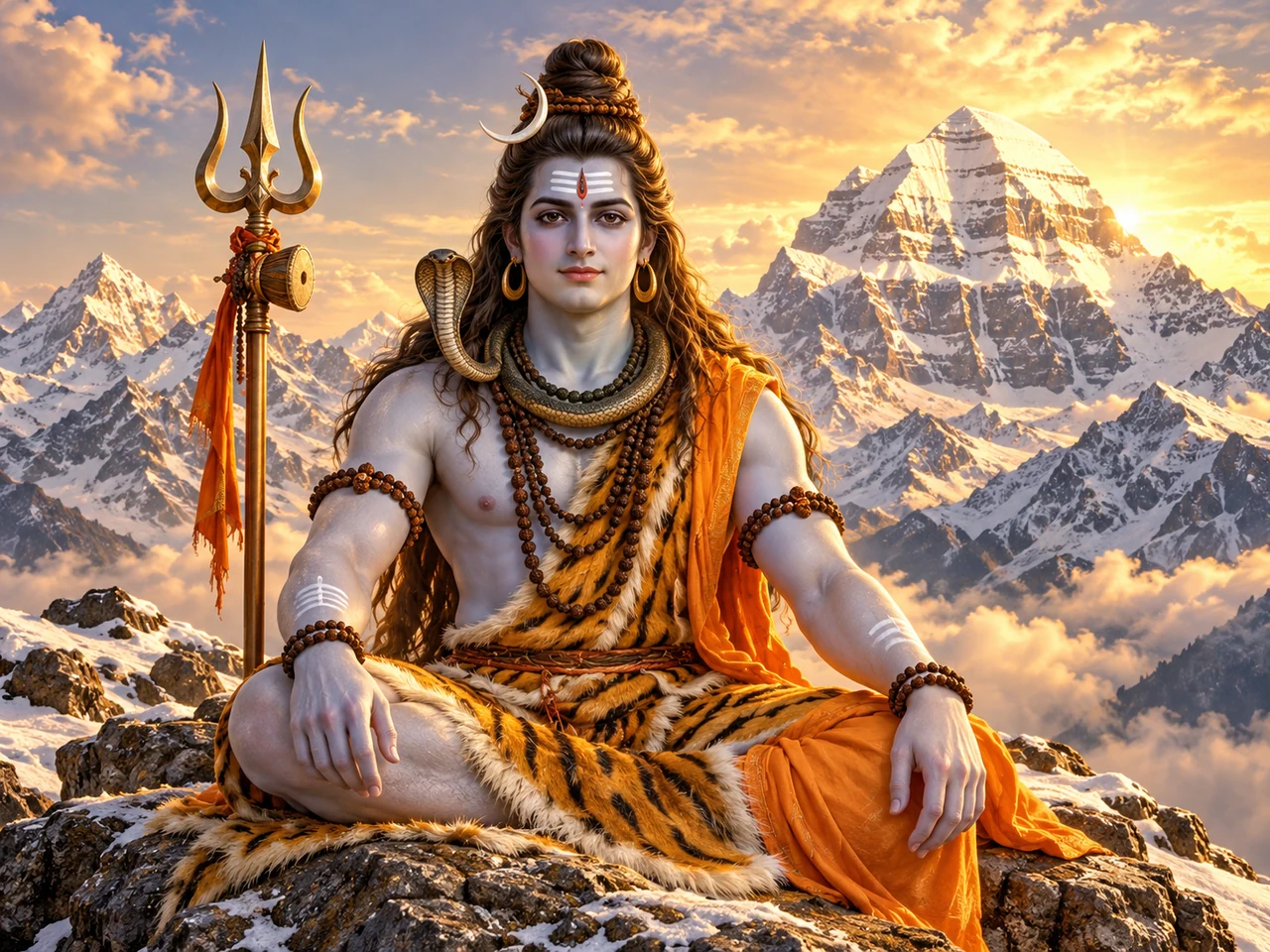
Who is Shankar—and is Shankar different from Shiva?
When someone says Har Har Mahadev, calls out Bholenath, or folds their hands before an image of Shankar Bhagwan, the names may differ but the intended deity is ordinarily Shiva. Shankar (Sanskrit ShankaraŚaṅkara, शंकर/शङ्कर) is among Shiva's well-attested names. Its emphasis is particularly welcoming: the divine as a giver of welfare, happiness and auspiciousness. Traditional Sanskrit dictionaries call Shankara an epithet of , शंकर/शङ्कर) is among Shiva's well-attested names. Its emphasis is particularly welcoming: the divine as a giver of welfare, happiness and auspiciousness. Traditional Sanskrit dictionaries call Śaṅkara an epithet of Rudra or Shiva, rather than the name of another universally separate god. 1 2
ShivGoraksh provides a separate learning page for Shankar because a name can open a different door into a familiar subject. The broader Shiva page introduces the deity's philosophical range, myths and religious history. This page asks how worshippers use names—Rudra, Mahadev, Shambhu, Mahesh, Bholenath, Neelkanth, and others—and why a being invoked as fearsome can also be approached as supremely compassionate. Two pages do not mean two separate divine identities. Particular communities may favor one name or image, but such preferences should not be forced into one universal theological rule.
The distinction matters beyond terminology. A reader searching for “Shankar meaning” may want the roots of a Sanskrit word; someone searching “Shankar vs Shiva” may be puzzled by different portraits; and someone seeking “Neelkanth story” may have encountered a name without knowing its narrative. Each question deserves its own answer without suggesting that art, pronunciation or search-engine categories can determine religious identity.
The name Shankara: meaning, spellings and historyThe name Śaṅkara: meaning, spellings and history
The classical word is commonly written शङ्कर or शंकर, transliterated ShankaraŚaṅkara. English and Indian-language search spellings include Shankar, Shankara, Sankar, and occasionally Shunker. Sanskrit dictionaries explain the compound in terms of bringing about śam—well-being, happiness or auspicious fortune—hence “one who brings welfare” or “the beneficent one.” This is a lexical gloss, not a claim that the name determines every part of Shiva's theology. 1
A basic distinction prevents confusion: ShankaraŚaṅkara also occurs as a human personal name. In particular, Śaṅkarācārya refers to a celebrated Vedanta teacher and to later monastic titles; it does not automatically mean the god Shiva whenever the word appears. Search results for “Shankar philosophy” may concern the philosopher; results for “Shankar Bhagwan” typically concern the deity. A careful educational website should distinguish those intentions instead of redirecting every query to the same article. 1
Historically, the names belonging to the Rudra–Shiva complex accumulated across different periods and genres. An early Vedic hymn to Rudra is not written as a modern dictionary of all Shiva's later forms. Conversely, later devotees may read their beloved Mahadeva in ancient Rudra hymns. Both facts can be respected: historical textual development is an academic question, while devotional continuity is a religious interpretation. 2 4
Other names of Shankar: what do they suggest?
These names are connected, but they are not interchangeable descriptions in every context. Their meanings and the traditions that use them help us notice different aspects of Shiva.
| Name and common search spelling | Basic sense or context | What to remember |
|---|---|---|
| Shiva / Shiva (शिव)Shiva / Śiva (शिव) | Auspicious, benevolent; principal divine name | The broad name covers far more than a single mood or visual form. |
| Shankar / Shankara (शंकर)Shankar / Śaṅkara (शंकर) | Bringer of welfare or auspiciousness | Usually an epithet of Rudra–Shiva; not an independent deity by default. |
| Rudra (रुद्र) | An early Vedic deity with formidable and healing associations | Rudra–Shiva continuity is important, but the Vedic and later portrayals are not historically identical in every detail. |
| Mahadev / Mahadeva (महादेव)Mahadev / Mahādeva (महादेव) | “Great god” | A title of reverence; in Shaiva traditions often expresses Shiva's supremacy. |
| Mahesh / Maheśa; Maheshwar / Maheśvara (महेश/महेश्वर) | Great lord | Highlights lordship; particular iconographic forms also use the title. |
| Shambhu / Śambhu (शम्भु) | Commonly understood as one associated with well-being | A familiar name in Vedic litany and later worship. |
| Bholenath (भोलेनाथ) | An affectionate Hindi/devotional name suggesting the approachable, guileless lord | Its living devotional use is clear; a single precise ancient etymology or first occurrence has not been established here. |
| Neelkanth / Nīlakaṇṭha (नीलकण्ठ) | Blue-throated one | Recalls Shiva accepting the cosmic poison in the ocean-churning story. |
| Pashupati / Paśupati (पशुपति) | Lord of living beings or creatures | Important in Vedic-derived and Shaiva vocabulary; exact readings depend on context. |
| Nataraja / Naṭarāja (नटराज) | Lord of the dance | A defined iconographic and philosophical presentation rather than a different god. |
| Mrityunjaya / Mṛtyuñjaya (मृत्युञ्जय) | Conqueror of death | A devotional name and artistic form; not evidence of guaranteed medical outcomes. |
The Sanskrit Shri RudramŚrī Rudram—part of the Krishna Yajurveda's Taittirīya Saṃhitā—is particularly instructive. In the commonly transmitted Namakam it places salutations to Śambhu, ShankaraŚaṅkara, and ShivaŚiva close together. The vocabulary does not invite readers to construct three unrelated gods. It offers a sequence of ways to praise Rudra. The exact accent and word division must be checked against an approved Vedic edition before publishing any quoted mantra. 3
Why “Bholenath” feels different from “Rudra”
Bholenath is often the name people use in affection: a lord approached as uncomplicated, responsive and close to ordinary troubles. Rudra may evoke power that cannot be taken lightly. The apparent contrast is part of the religious appeal of Shiva. However, it would be misleading to assert that a Sanskrit scripture formally divides them into two independently born personalities called Shankar and Rudra. Popular explanations about Shiva granting boons readily are devotional interpretations, not established universal etymological laws.
From Vedic Rudra to the names of Shiva
The RigvedaṚgveda, especially hymn 2.33, addresses Rudra in language that combines awe with pleas for protection and healing. Later Shaiva readers recognize here a profound ancestor of the Shiva whom they worship. Modern scholarship approaches the relationship historically: Shiva's well-known Puranic and temple identities emerged through many centuries of religious, literary and artistic development. Peter Bisschop's academic overview specifically identifies Shankara and Śambhu among Shiva's important names and cautions against treating one strand as his whole history. , addresses Rudra in language that combines awe with pleas for protection and healing. Later Shaiva readers recognize here a profound ancestor of the Shiva whom they worship. Modern scholarship approaches the relationship historically: Shiva's well-known Puranic and temple identities emerged through many centuries of religious, literary and artistic development. Peter Bisschop's academic overview specifically identifies Śaṅkara and Śambhu among Shiva's important names and cautions against treating one strand as his whole history. 4 2
Another layer appears in the Śvetāśvatara Upaniṣad, notably its third chapter, where Rudra is described in strikingly exalted terms. Such passages have been central to Shaiva theological reading. A philosophical statement about the one divine reality, however, is not the same type of evidence as a dated portrait or an inscription. The text's exact Sanskrit readings and translations need edition-level verification before any long quotation is printed. 5
The later Shiva PurāṇaŚiva Purāṇa speaks in the story-world of Shiva, Parvati, divine marriages, boons and cosmic acts. It is not a straightforward chronological biography of a historical man named Shankar. The Puranic narratives are valuable for understanding religious meaning and worship; historical researchers must still ask when particular versions circulated. The site's two pages make that distinction visible rather than silently collapsing history into legend.
1. Neelkanth: compassion in the story of the poison
During the churning of the ocean, a devastating poison appears before the desired nectar. The assembled beings cannot manage the threat. In the Bhāgavata Purāṇa 8.7, Shiva decides to receive the poison out of concern for living beings. The narrative calls him Mahadeva; the next verse tells how the poison leaves a blue mark upon his throat. Hence the cherished name Nīlakaṇṭha, “blue-throated.” 6 7
The scene gives a vivid meaning to Shankar as benefactor: welfare is not simply granting an easy favor, but accepting a burden for others. Some retellings add the detail that Parvati prevents the poison from descending beyond Shiva's throat; that detail should be attributed to a particular version rather than inserted as though every textual witness says it. The story is a Puranic religious narrative, not a medical or physical claim about swallowing poison. It must never be imitated.
2. The ascetic who becomes a bridegroom
Shiva can be shown absorbed in meditation, ash-covered and indifferent to ornament. Yet the Shiva Purāṇa's Parvati-khaṇḍaŚiva Purāṇa's Pārvatī-khaṇḍa also describes the gods' appeal, Shiva's consent to marry Parvati, the extraordinary wedding procession, and the celebrations involving her parents Himavat and Mena. What seems contradictory—a renunciant becoming a husband—is the narrative's deliberate tension. 8 9
As Uma–Maheshwara, Shiva appears alongside Parvati; as Somaskanda, the couple includes their son Skanda. A surviving Chola bronze in the Metropolitan Museum of Art demonstrates that this familial presentation is not merely a recent calendar-image invention. But it also shows why a visual difference matters less than context: a yogi portrait, a wedding portrait and a family bronze need not depict three different gods. 11
3. The flame without a measurable beginning or end
In a story associated with Lingodbhava, Brahma and Vishnu dispute cosmic priority. Shiva appears as a vast column of fire; one searches upward, the other downward, and neither reaches its limit. Shiva is then revealed as the presence represented by the linga. The Metropolitan Museum connects its medieval Tamil sculpture of this scene to Puranic and Agamic narrative traditions. 10
This is a Shaiva theological story expressing transcendence and the inadequacy of prideful measurement. It should not be used to claim that every Hindu tradition assigns exactly the same cosmic rank to Shiva, Brahma and Vishnu. Nor does the historical existence of a sculpture prove the myth happened as a datable event. It shows that people gave this story artistic form in a particular time and place.
4. The teacher who gives knowledge rather than a weapon
In Dakshinamurti imagery, Shiva sits as a teacher. A twelfth-century Tamil sculpture documented by the Smithsonian shows the lord instructing sages, with symbols of learning and an embodiment of ignorance beneath his foot. This form makes another sense of śaṃ—well-being through clarity—accessible to students. Wisdom, not only miraculous rescue, can be imagined as a divine gift. 12
The museum record concerns Dakshinamurti, not a separate historical teacher called “Shankar.” A popular search for “Shankar guru” can therefore lead either to this Shiva iconography or to Adi Shankaracharya, a human philosopher. The two subjects deserve separate explanations.
How is Shankar represented? Image, attributes and symbols
There is no universal visual test by which one can reliably label an artwork “Shankar, not Shiva.” A trident, a crescent moon, matted hair, the Ganga, a serpent, a blue throat, a tiger-skin garment or Nandi may all appear in images called Shiva or Shankar. Their presence or absence depends on the artistic form, period and region. One must use a trustworthy caption, temple context or textual tradition instead of assigning identity by guesswork.
The trishula is frequently interpreted as authority over threefold processes; precise meanings differ. The damaru suggests sound, rhythm and creative movement. The third eye can point to transcendent perception, while ash and simple dress recall renunciation and impermanence. These are interpretive readings, not laboratory facts built into every image. The Met's Chola Nataraja bronze shows the drum, fire, protective gesture and raised foot in one artistic arrangement; the museum explains their place in the cosmic dance. 13
Mahesh/ Mahesha is another useful example. The Met identifies a tenth-century sculpture as Shiva as Mahesha, a particular multi-faced arrangement with theological meanings drawn from its South Indian context. That record does not make “Mahesh” a universally separate god, nor does it establish that every worshipper interprets the faces identically. 15
The half-male, half-female form Ardhanarishvara expresses a conjunction of Shiva and Parvati in some traditions. A museum object from Kerala documents one artistic example. The theological implications can be rich—complementarity of the divine and the relationship between Shiva and Shakti—without turning an image into proof that every Hindu school shares exactly one metaphysical formula. 16
Shankar's philosophical significance: strength that can be gentle
To say “Shankar brings auspiciousness” need not mean that worshippers imagine a deity who never destroys. In many Shaiva contexts, destruction can mean the ending of obstruction, delusion or a harmful condition; fierce and benevolent dimensions belong to the same divine figure. The name Rudra can recall awe; Shambhu and Shankar can foreground benefit. The contrast offers a way to reflect on fear and trust without inventing an official dual-personality doctrine. 2 3
Shaiva thought is not one philosophy. Some traditions regard Shiva as supreme personal Lord; others develop sophisticated accounts of consciousness and divine power; others emphasize disciplined devotion, temple ritual or yoga. Shiva–Shakti imagery can suggest that awareness and dynamic power are related, but the nature of that relationship is explained differently across Shaiva, Shakta, Smarta and regional settings. A Shaiva reading of “Mahadev” does not automatically settle the viewpoint of a Vaishnava or Shakta reader.
The name Mrityunjaya, “conqueror of death,” also belongs in this larger vocabulary. The Met documents a medieval Bengal sculpture of Shiva under that title, seated in contemplation. A believer may draw courage from it. But a heritage article must not turn devotional ideas into promises that mantras defeat disease or replace medical treatment. 17
One everyday interpretation may be especially useful: calling the god Bholenath brings an immensely powerful divine presence into the language of home and affection. This is a description of devotional experience, not evidence of a separately identifiable historical phase called Bholenath. People may seek peace, moral steadiness and solidarity with others in worship; those human meanings should not be exaggerated into guaranteed supernatural outcomes.
Shankar within families, temples and wider Hindu traditions
In widely familiar iconography Shiva is accompanied by Parvati, and their family often includes Ganesha and Skanda/Kartikeya. Yet not every artwork places everyone together, and regional sources have their own emphases. The Somaskanda image gives special prominence to Skanda, for example; other pictures center the linga, Nandi or the teacher. The user-friendly name Shankar can occur in any of these contexts. 11
In Shaiva devotional settings, names such as Mahadeva and Maheshwara express reverence for the Lord. In Smarta and other settings Shiva can be honored alongside other major divinities. Shakta thinkers may foreground the Goddess and the dynamic power called Shakti; Vaishnava narrative texts may also praise Shiva while arranging divinity differently. Readers need not flatten those histories into either “all traditions are identical” or “the gods have unrelated identities.”
Regional art makes the issue tangible. The South Indian forms Somaskanda, Nataraja, and Dakshinamurti were developed and worshipped in concrete cultural contexts. The image of a peaceful, approachable Shankar found in household pictures may draw on similar symbols but have a different artistic history. No particular Shiva or Shankar picture in the user’s image collection has yet been supplied for direct source or rights verification; it remains an unmapped decorative asset, not proof of theology.
Scripture and literature: where the names appear
The most useful textual pathway for this page is not to claim that one book invented Shankar. It is to compare different types of evidence:
- Rigveda 2.33Ṛgveda 2.33: an early hymn addressed to Rudra, combining awe and appeals for protection; it must be read in its Vedic context. 4
- Taittirīya Saṃhitā 4.5 / Shri RudramTaittirīya Saṃhitā 4.5 / Śrī Rudram: a litany bringing Shambhu, Shankara and Shiva into related invocation; a stronger direct anchor for the name Shankara than a modern quotation graphic. 3
- Śvetāśvatara Upaniṣad 3: language that later Shaiva readers understand as the greatness and unity of Rudra; detailed translation still needs collation. 5
- Bhāgavata Purāṇa 8.7.40–43: the Mahadeva / Neelkanth compassion narrative, told in a Vaishnava Purana; a valuable reminder that cross-tradition reverence is real. 6 7
- Shiva Purāṇa, Rudra-saṃhitā, Parvati-khaṇḍa 24 and 48Śiva Purāṇa, Rudra-saṃhitā, Pārvatī-khaṇḍa 24 and 48: the bridegroom and household narrative; chapter numbers here are tied to the accessed hosted edition, not guaranteed across all recensions. 8 9
ShivGoraksh has prepared separate Bhagavad Gita, Devi Mahatmyam (Durga Saptashati), and Ashtavakra Gita editorial projects. Their publication status has not been established as active here. This Shankar article does not invent a Gita quotation about “Shankar being different from Shiva,” nor should it suggest those three projects are ready to link publicly. Such cross-references require exact passage and route verification.
Worship, festivals and everyday devotion
People address the divine as “Shankar,” “Shambhu,” “Mahadev,” “Bholenath” or “Neelkanth” in songs, remembrance, household worship and temple gatherings. Maha Shivaratri is the prominent annual festival of Shiva, with observances such as vigil, singing and worship of the linga; customs differ considerably by community and temple. The Harvard Pluralism Project describes examples of contemporary communal observance without implying that one local timetable binds all Hindus. 14
Other familiar public forms of devotion include simple greetings, seasonal worship, journeys to Shiva shrines and songs praising Shankar. In popular Hindi, “Har Har Mahadev” and “Bam Bam Bhole” are recognizable expressions of devotion. Their occurrence does not justify claiming that a named chant has a universally prescribed number of repetitions, a medically measurable effect, or a guaranteed result.
Some Shaiva and tantric practices are connected to initiation, ritual lineages and specialized teachers. This page is educational, not a manual for restricted practices. Do not infer mantras, secret diagrams, ritual materials or permissions from a picture of Shankar or from the affectionate meaning of Bholenath.
Are Shiva and Shankar two different gods?
Ordinarily, no. Historical Sanskrit dictionaries identify ShankaraŚaṅkara as an epithet of Shiva/Rudra; the difference between these two ShivGoraksh pages is editorial. Specific local uses may vary, but a universal doctrine of separate beings is not supported here. 1 2
Is Rudra the same as Shankar or Mahadev?
In much later devotion, Rudra is identified with Shiva, who is praised as Shankar and Mahadev. Historically, the earliest Rudra hymns have their own Vedic context and cannot be read as if they already contained every later Purana and temple depiction. 2 4
Why is Shiva called Bholenath?
It is an affectionate devotional way of describing Shiva as accessible, simple-hearted or readily moved by devotion. It should not be treated as evidence of a fixed separate divine birth or a rigorously verified first use in a particular Vedic verse.
Why is Shankar called Neelkanth?
The Puranic ocean-churning story says Shiva receives a dangerous poison to protect beings and it leaves his throat blue. That is why he is known as Nīlakaṇṭha. 6 7
Are Mahesh and Mahadev two more gods?
They are commonly names/titles of Shiva. Some artistic traditions have specially named Mahesha forms, but that is not a license to classify every title as a different deity. 15
Is “Shankar” here the philosopher Adi Shankaracharya?
No. The Sanskrit word has both divine and human uses. This article concerns Shankar Bhagwan, the Shiva-name; a separate article would be appropriate for the historical philosopher. 1
Does each Shiva name have one fixed icon or miracle?
No. Names, stories, gestures and visual conventions differ by text, region, period and community. Images need contextual verification. Neither the name Mrityunjaya nor a ritual formula offers a scientifically verified guarantee of curing illness.
Glossary
- Shankara / Shankar:Śaṅkara / Shankar: one who brings welfare or auspiciousness; a widely used name of Shiva.
- Shiva:Śiva: “auspicious”; the major deity honored across many Shaiva and other Hindu traditions.
- Rudra: deity addressed in early Vedic hymns and identified with Shiva in later traditions.
- Śambhu / Shambhu: a benevolent-sounding epithet invoked in the Rudram and later worship.
- Mahadeva / Mahadev:Mahādeva / Mahadev: great god; reverential title commonly applied to Shiva.
- Maheśa / Mahesh: great lord; name and sometimes a specific artistic presentation of Shiva.
- Bholenath: affectionate Hindi devotional address for Shiva.
- Nīlakaṇṭha / Neelkanth: blue-throated; name linked to the poison episode.
- Pāśupati / Pashupati: lord of creatures/living beings.
- Linga:Liṅga: a major aniconic or symbolic focus of Shiva worship, with diverse interpretations.
- Dakṣiṇāmūrti: Shiva represented as a teacher.
- Ardhanārīśvara: composite Shiva–Parvati form in particular traditions.
- Puranic narrative: traditional religious storytelling, not by itself a verified chronological event.