



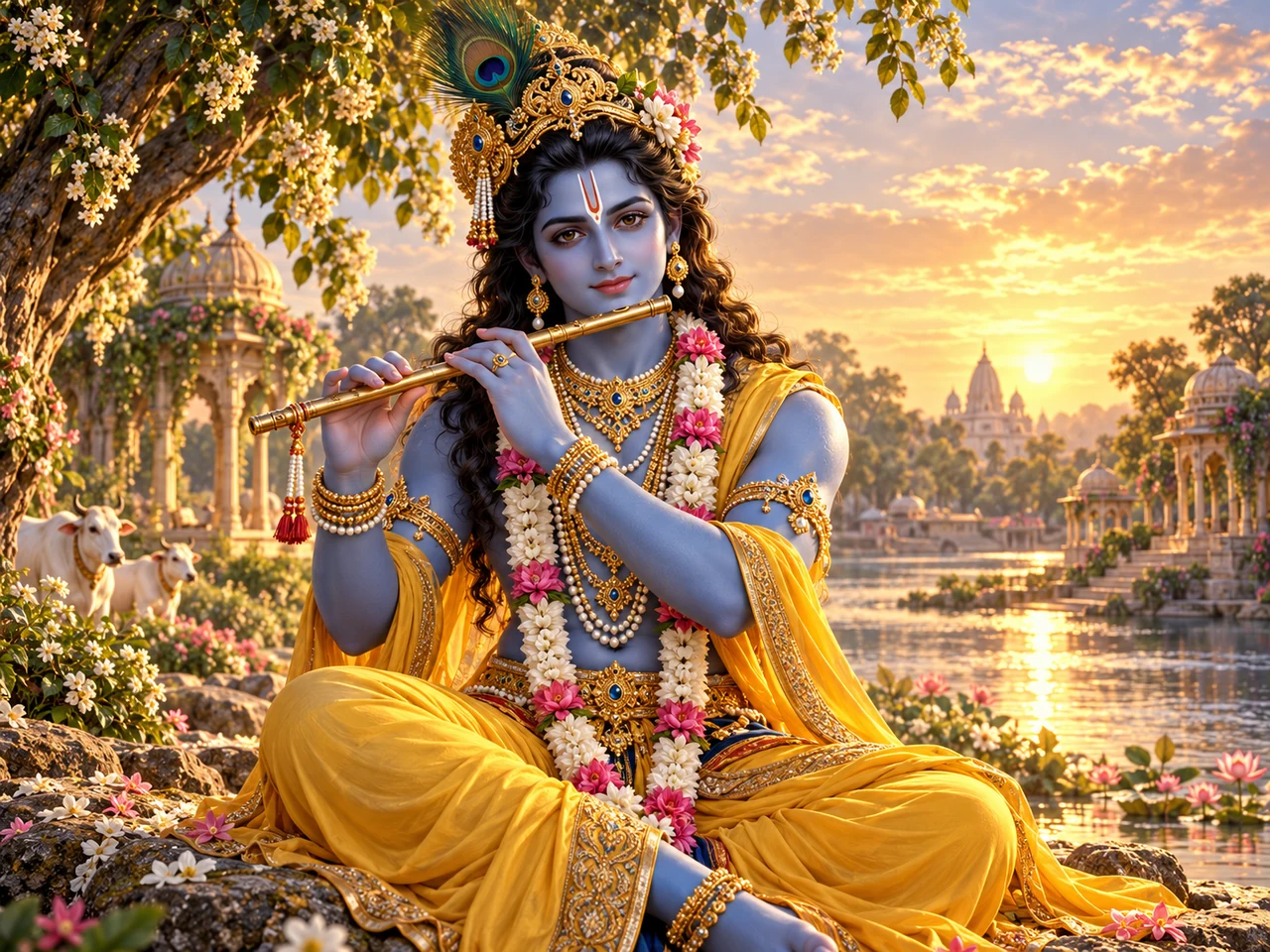
Edition notice. Below is the complete selected mantra in its original Sanskrit words, transliterated into Roman IAST; the words are not translated in this first block. Its source is Śrīmad-Bhāgavata Purāṇa 4.8.54. The four-word formula is digitally cross-checked; no historical Sanskrit print page was independently collated. Reproduction rights and specialist sign-off remain pending. 1 2 3
Original mantra — SG-DEVOTION-Om Namo Bhagavate Vasudevaya-M001
Meaning. Oṃ—reverent homage to the venerable Lord Vāsudeva, understood in Vaiṣṇava traditions as Kṛṣṇa/Viṣṇu. Explanation. This complete twelve-syllable Sanskrit mantra consists of oṃ, namo, bhagavate, and vāsudevāya. In Bhāgavata Purāṇa 4.8.53–54, Nārada introduces a secret recitation to Dhruva and states the formula before explaining an act of worship. Namo expresses reverent salutation and represents the sandhi form of namaḥ. Bhagavate is the dative singular of bhagavat, the venerable or blessed Lord; vāsudevāya is the dative “to Vāsudeva.” The two dative forms address the same divine recipient rather than two separate beings. The traditional twelve-syllable division is oṃ | na-mo | bha-ga-va-te | vā-su-de-vā-ya (1 + 2 + 4 + 5). In devotional reading, this expresses humility, loving remembrance and refuge in Vāsudeva; those attitudes are interpretations, not extra Sanskrit words. The parent Purāṇa includes particular acts of worship and extraordinary claims in its narrative; this educational entry does not issue those as universal ritual directions, eligibility rules, medical benefits, or assured material results. 1 2 4
Word-by-word understanding
Oṃ (ॐ). This single sacred syllable begins the documented Purāṇic formula. In many traditions it is called praṇava and is understood as a solemn spiritual opening. It is not merely an optional musical flourish in this selected twelve-syllable mantra. The distinct Ṛgvedic and Upaniṣadic histories of oṃ are broader topics and are not silently folded into this one Purāṇic quotation. 1 4
Namo (नमो). The sense is “salutation,” “homage,” or an attitude of reverent bowing. Sanskrit namaḥ appears as namo here through sound combination (sandhi); the surface spelling of the mantra must not be “corrected” to its dictionary form. Unlike a command to obtain a particular reward, it expresses the speaker's reverential relation to the addressed being. 1 2
Bhagavate (भगवते). This is the dative singular of bhagavat (“venerable,” “blessed,” or “the Lord possessed of excellence”), hence “to the revered Lord.” In Vaiṣṇava devotional interpretation the title evokes the fullness of divine qualities. That fuller theology is attributed to the tradition and is not claimed as the only possible dictionary gloss of the single word. 2 6
Vāsudevāya (वासुदेवाय). The dative singular “to Vāsudeva” specifies the recipient of the homage. Vaiṣṇavas commonly understand Vāsudeva as Krishna, also identified with Vishnu. The name can refer to Krishna as son of Vasudeva; the father The dative singular “to Vāsudeva” specifies the recipient of the homage. Vaiṣṇavas commonly understand Vāsudeva as Kṛṣṇa, also identified with Viṣṇu. The name can refer to Kṛṣṇa as son of Vasudeva; the father Vasudeva and the devotional divine name Vāsudeva should not be flattened into an indistinguishable English spelling. Both bhagavate and vāsudevāya point to the same recipient in this mantra. 1 2
Why is it called Dvādaśākṣarī? Dvādaśa is twelve and akṣara here denotes a sounded syllabic unit. The traditional breakdown is oṃ (1), na-mo (2), bha-ga-va-te (4), and vā-su-de-vā-ya (5). The sum is 12. The tally is not twelve Roman letters, nor twelve visual Devanagari characters. Bhāgavata 6.8.7 independently calls a relevant formula dvādaśākṣara, beginning with praṇava and ending at ya. It does not repeat the complete four-word mantra verbatim in that verse. 1 4
Where in the Bhāgavata Purāṇa does the mantra appear? Within the story of Dhruva, Nārada offers instruction to the young prince. At 4.8.53 he announces a sacred formula; 4.8.54 opens with “oṃ namo bhagavate vāsudevāya” and continues with advice on worship suited to circumstance. The verse's longer Sanskrit syntax and activities are part of the parent narrative, not missing syllables of the short mantra. It would therefore be wrong either to call this page the entire verse 4.8.54 or to append the surrounding instructions to the mantra itself. 1 2 5
At 6.8.7, the Narayana KavacaNārāyaṇa Kavaca setting describes a twelve-syllable mantra that begins with oṃ and ends in ya. That is useful supporting context, but it belongs to a different chapter and ritual framework. An editorial explanation may mention the reference without turning the kavaca's nyāsa into instructions for this work. 4
Vāsudeva and Krishna in Vaiṣṇava devotionVāsudeva and Kṛṣṇa in Vaiṣṇava devotion
The Bhāgavata's narrative treats Vāsudeva as the object of personal devotion. The address combines reverence toward Bhagavān with an intimately named deity; devotees may hear it as remembrance of Krishna and the Lord whom Vaiṣṇava theologians identify with Vishnu. The spiritual emphasis on surrender, grace and loving remembrance varies among different Vaiṣṇava schools. ShivGoraksh can describe these perspectives while recognizing that Shaiva, Shakta and other traditions do not necessarily phrase their theology in the same way. with an intimately named deity; devotees may hear it as remembrance of Kṛṣṇa and the Lord whom Vaiṣṇava theologians identify with Viṣṇu. The spiritual emphasis on surrender, grace and loving remembrance varies among different Vaiṣṇava schools. ShivGoraksh can describe these perspectives while recognizing that Śaiva, Śākta and other traditions do not necessarily phrase their theology in the same way. 1 6
The popular expression “universal mantra” is sometimes used in general devotional writing. It should not erase living traditions' different relationships to mantra teaching, nor should it be mistaken for a scientific claim that the formula works identically for all people or guarantees an external outcome.
Devotion versus ritual practice
This article offers reading, vocabulary and interpretation, not a formal transmission of a mantra. In the Dhruva narrative Nārada acts as teacher; modern communities differ in how they understand initiation and public name-remembrance. A named Gauḍīya commentary explains a particular initiatory approach, but that account is not a universal decree covering every Vaiṣṇava or other Hindu community. There is no approved instruction here for japa numbers, secrecy rules, breath-control, nyāsa, offerings, or a fixed daily schedule. 2 4 6
Some Purāṇic contexts narrate striking supernatural outcomes. Such statements belong to the religious literary world of the source and should not be presented as evidence that chanting can treat an illness, replace medical care, guarantee wealth or produce a verifiable miracle.
Textual boundaries, variants and uncertainty
- Oṃ and punctuation. Digital pages show ॐ or ओं and may end the mantra with ।, a quote mark or no explicit terminal sign before the next pāda. This reader uses oṃ / ॐ and adds ॥ as a reader endpoint, not as a manuscript-specific sound. 1 2 3
- Namo / namaḥ. The latter is the grammatical lemma; the former is the attested four-word reading. This is primarily a grammar-and-sandhi distinction, not a proven pair of historical manuscript variants. 1 2
- Bhagavate / bhagavat. The dative ending belongs to the mantra. Do not substitute a dictionary headword and call it a textual emendation. 2
- Vāsudeva / Vasudeva. Preserve the IAST long ā in the deity name. An unaccented Roman form on some modern websites need not signal a source-level variant. 1 3
- Eight- versus twelve-syllable mantra. Oṃ namo nārāyaṇāya is the different Aṣṭākṣarī in Om Namo Narayanaya; neither is a continuation of the other. 4
- Historical source limitation. Several modern electronic copies agree, but their agreement alone is not proof of an independently verified specific print or manuscript tradition. The core phrase directs attention away from self-importance and toward a chosen object of reverence. It contains no personal name of the reciter, transactional request or promise of material gain. A reader might therefore use its meaning to reflect on gratitude, humility or trust; these are ShivGoraksh's own interpretive suggestions, not newly discovered ancient verses or mandatory ritual rules.
Frequently asked questions
Is this the complete original? Yes, the complete selected short mantra, consisting of four Sanskrit words. The rest of Bhāgavata 4.8.54 and the broader story of Dhruva are not included as part of its wording. 1
What is its literal meaning? A reverential “Oṃ, salutations to the blessed Lord Vāsudeva.” 2
Why twelve syllables? One + two + four + five = twelve pronounced units. 4
Does this refer to Krishna or Vishnu?Does this refer to Kṛṣṇa or Viṣṇu? Vaiṣṇava communities commonly understand Vāsudeva as Krishna and relate him theologically to Vishnu. The precise devotional interpretation depends on the tradition. Vaiṣṇava communities commonly understand Vāsudeva as Kṛṣṇa and relate him theologically to Viṣṇu. The precise devotional interpretation depends on the tradition. 6
Is this the Narayana Aṣṭākṣarī?Is this the Nārāyaṇa Aṣṭākṣarī? No. That is the distinct eight-syllable mantra included in Om Namo Narayanaya. Must everyone receive initiation before reading this line? Formal practice rules vary by lineage. Reading a public text for understanding is not equivalent to initiation; no universal rule is established by this page. 6
Are 108 repetitions or special rituals prescribed here? This article makes no such prescription. The Purāṇic narrative contains ritual material but this entry does not teach operational practice. 1 4