



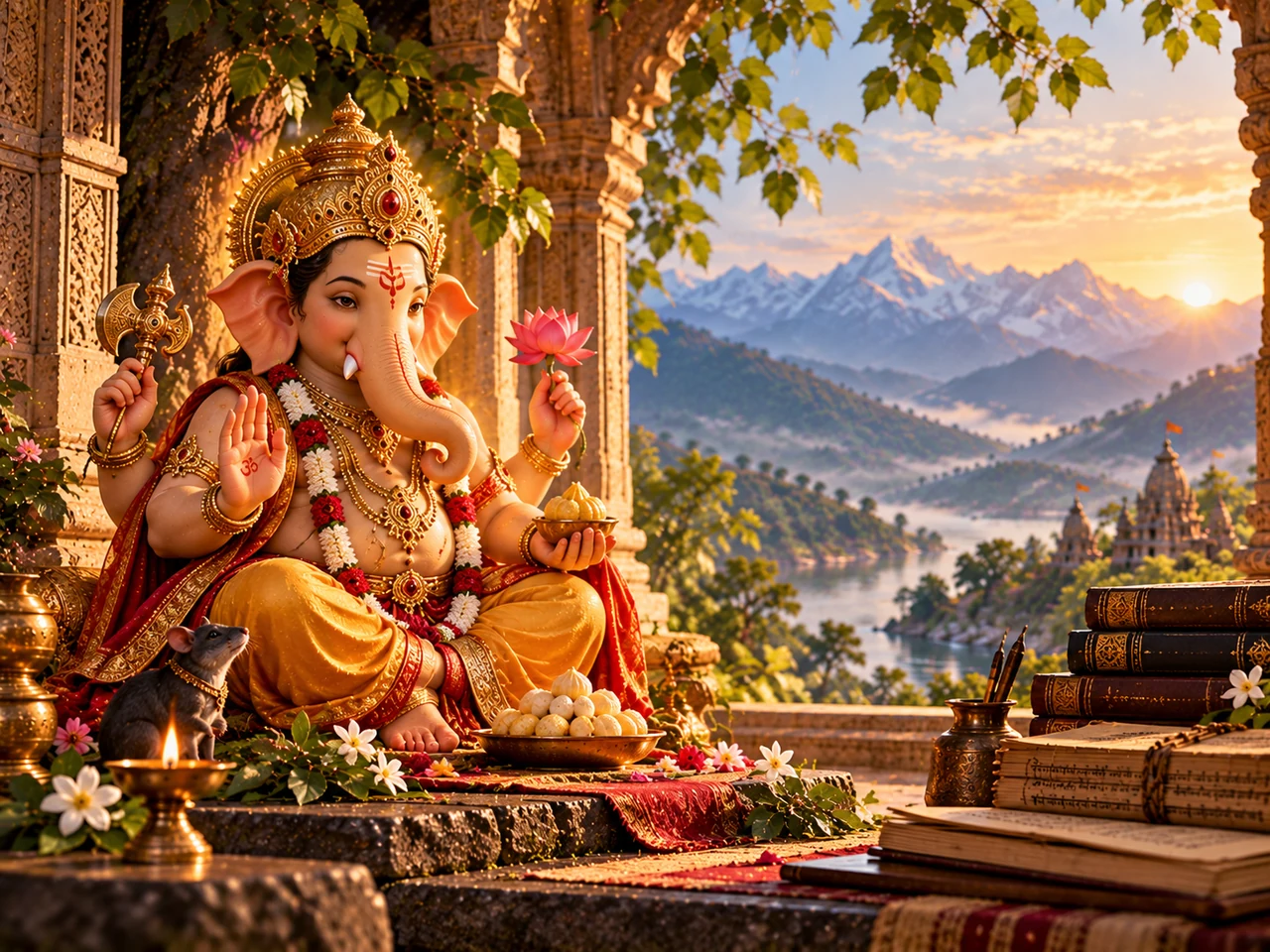
Who is Ganesha, and why does he matter?
A new notebook, a journey, the opening of a shop, a wedding, or the first page of an important work: many Hindu families turn to Ganesha at such moments. His elephant head is instantly recognizable, yet the affection surrounding him is not merely about an unusual appearance. Ganesha represents a hope that a beginning can be made with intelligence, steadiness, good judgment, and grace. Often called the remover of obstacles, he is also understood in religious tradition as the one who governs obstacles: a difficulty may sometimes call for attention rather than simply disappearance. The British Museum identifies both dimensions of his role. 5[s5]
He is commonly regarded as the son of Shiva and Parvati and the brother of Skanda or Kartikeya. For Shaiva worshippers he belongs intimately to Shiva's household; for other Hindus he is beloved in his own right, and in Ganapatya traditions he may be honored as supreme divinity. These positions need not be flattened into a single formula. A family image, a philosophical hymn, and a temple sculpture can each illuminate a different aspect of the same enduring figure. 5[s5] 12[s12]
Names, meanings, and identities
Ganesha (GaneshaGaṇeśa) joins gaṇa—a group or company, often Shiva's attendants—with īśa, lord. Ganapati (GanapatiGaṇapati) similarly means lord of the groups. Vinayaka is another established name. Vighneshvara or Vighnaraja associates him with mastery over obstacles; Ekadanta, “one-tusked,” points to a distinctive feature; Lambodara, “large-bellied,” evokes a familiar visual form. In Tamil settings Pillaiyar is especially affectionate and widely used. The British Museum records these overlapping identities rather than treating them as separate gods. 5[s5]
Names may function differently in devotional poetry, philosophical discussion, and ordinary speech. Calling him Bappa often expresses closeness rather than a technical theological claim. Transliteration also varies: Ganesh, GaneshaGanesa, Ganesha, and GaneshaGaṇeśa ordinarily refer to the same deity. Some narratives describe him as the son created directly by Parvati; others emphasize Shiva's acknowledgment of him as his own. Both belong to living sacred storytelling and should be named as such. 1[s1] 3[s3]
From early evidence to a widely recognized deity
Ganesha has an extensive religious history, but no single confidently established date can be assigned to his “origin.” A particularly important distinction concerns the famous expression ganapatigaṇapati in the Rigveda 2.23.1Ṛgveda 2.23.1. In its hymn context the address belongs to Brahmanaspati; the occurrence of a title meaning “lord of groups” cannot, by itself, demonstrate that the later elephant-headed Ganesha was already being depicted or worshipped in exactly the same form. Scholars continue to discuss how earlier vocabulary and later devotional identity relate. The verse is therefore evidence for a word in a particular Vedic setting, not a simple birth certificate for the present iconography. 10[s10] 14[s14]
Archaeological objects establish a more concrete visual history. The Indian Museum, Kolkata, catalogues an elephant-headed Ganesha from Bhumara, Madhya Pradesh, as approximately fifth century CE. A twelfth-century Chola bronze in the Metropolitan Museum of Art and its tenth-century dancing Ganesha from central India reveal how varied his iconography became. Sculptures associated with Thailand show that devotion and artistic interpretation traveled well beyond modern India's borders. The dates belong to those specific objects, not to the composition of every Ganesha story. 9[s9] 6[s6] 7[s7] 8[s8]
The Shiva Purana, dedicated liturgical works, and regional narratives preserve increasingly rich accounts of his family, powers, and worship. They did not all emerge at once. Their devotional truth for practitioners and their textual histories are two different questions; a reader can appreciate the first while being precise about the second.
1. The child who guarded his mother's door
In the Shiva Purana, Rudra-samhita, Kumara-khanda, chapter 13, Parvati wishes to have someone who answers directly to her. She creates a boy from substance taken from her own body, cherishes him as her son, and gives him the task of guarding her private entrance. When Shiva approaches, the child refuses entry because he has received no permission from his mother. He does not recognize Shiva, and a confrontation begins. The narration gives Parvati agency: the guard is hers, and his loyalty is not presented as a trivial misunderstanding. 1[s1]
The conflict grows into a battle. Later chapters describe Ganesha's beheading during the struggle, Parvati's grief and fury, and his restoration with an elephant's head. Shiva and the gods recognize the revived child; he becomes the honored chief of the ganas. The restoration matters as much as the conflict: the story moves from competing authorities and a painful rupture toward reconciliation, acknowledgment, and a place of honor. Those are reflective readings of the narrative, not a claim that every commentator assigns exactly the same symbolism. 2[s2] 3[s3]
Even within the Shiva Purana, chapter 13 acknowledges more than one birth account, including a version that involves Shani's gaze. We should therefore avoid presenting one contemporary retelling as the only authentic Hindu account. The exact sequence and agents differ across texts and regions. 1[s1]
2. Wisdom and the journey around the world
Another memorable episode concerns Ganesha and his brother Kartikeya. In Shiva Purana, Kumara-khanda, chapter 19, their parents propose that the son who first circles the earth will receive the marriage honor at stake. Kartikeya sets off on the long route. Ganesha pauses, considers what the demand means, and walks reverently around Shiva and Parvati instead. For him, honoring his parents expresses the sacred significance of the world in a more immediate way. His parents accept his reasoning. 4[s4]
The lesson is not simply “cleverness defeats speed.” It asks whether a person's understanding of an obligation can matter as much as the visible exertion. It is also a story shaped by its own traditional assumptions about filial duty; it should not be forced into a universal rule about every modern family situation. In the continuation of this textual sequence (chapter 20), Ganesha's marriage is associated with Siddhi and Buddhi; other communities recount his relationships differently. 18[s18]
3. The scribe beside Vyasa
In a cherished Mahabharata-related tradition, the sage Vyasa dictates the enormous epic while Ganesha writes. Their agreement binds recitation and attentive understanding: the poet must continue, while the scribe must comprehend what he writes. Some familiar retellings add the striking scene in which Ganesha uses his broken tusk as a writing instrument. That additional detail should not be automatically attributed to the earliest recoverable text. 11[s11]
This story beautifully explains why students and writers feel close to Ganesha. Textually, however, the Ganesha-as-scribe episode is widely recognized as a later addition and is not part of the principal reconstructed text of the Mahabharata critical edition. It remains a valued tradition rather than a secure description of the epic's earliest composition. Research by Bruno Lo Turco examines the episode precisely as a reflection on authorship, writing, and the relationship between poet and scribe. 11[s11]
4. Why only one tusk?
Ganesha is often shown holding a broken tusk, and the name Ekadanta draws attention to his single complete tusk. But there is not one universally accepted explanation for how it broke. Narratives connect the tusk variously with conflict, sacrifice, and the writing of the Mahabharata. One Chola image at the Met is interpreted through a tradition in which he throws his tusk at the moon; other images simply make it an important identifying attribute. The visible feature is securely documented; a single exclusive backstory is not. 6[s6] 7[s7] 11[s11]
Reading Ganesha's image: form and meaning
A Ganesha image is almost a miniature library. The elephant head is often associated devotionally with discernment, alertness, strength, and attentive listening. The large belly may be read as abundance or a capacity to hold life's experiences. Such interpretations can guide reflection, but they are interpretations, not properties proven by anatomy or fixed in every sculpture. Museums describe important visual variations: a Thai bronze has only two arms, a Chola bronze four, and the dancing sculpture from Madhya Pradesh ten. 6[s6] 7[s7] 8[s8]
Typical attributes include a broken tusk, sweetmeats (frequently modaka), an ankusha or goad, and a pasha or noose. In some depictions a hand offers reassurance or blessing. The noose and goad are read by various teachers as instruments of guidance and restraint; there is no need to insist that every artisan encoded the same allegory. The sweet suggests joy, hospitality, and abundance within popular devotion. Museum object descriptions document the objects in particular hands, allowing a reader to distinguish what is visible from what is symbolically proposed. 6[s6] 7[s7]
Ganesha's mouse or rat (mushaka) is traditionally named as his vehicle, or vahana. Images do not always give it equal prominence. Devotional explanations compare the small, swift animal to restless desires or problems that reach into hidden places; Ganesha's composure then suggests the skill to direct energy rather than be ruled by it. This is one thoughtful interpretation, not a universally binding code. The paired great elephant and tiny mouse also invite a delightful reversal of expectations about size and power. 5[s5]
Forms vary by region and purpose. Ganesha may sit at ease, stand, dance, or appear as a small child; some sculptures contain attributes associated with Shiva. The Met's Thai sculpture offers a useful reminder that a two-armed figure is not somehow a defective four-armed icon. An image made for a shrine, temple niche, household, or procession also has a different practical life. Artistic history keeps such differences visible. 7[s7] 8[s8] 12[s12]
The philosophical importance of obstacles and intelligence
What does removing an obstacle really mean? In ordinary devotion, people ask for protection, success, or a favorable opening. A reflective reading adds another possibility: wisdom helps identify which barriers require perseverance, which require a new plan, and which warn us that our intention is confused. To begin with Ganesha can therefore be a way of acknowledging that action needs discernment. It is not a guarantee of examinations passed, illnesses cured, financial gains, or other predictable outcomes. 5[s5]
In Shaiva settings Ganesha's closeness to Shiva and Parvati emphasizes family relationships as well as cosmic order. In Ganapatya devotional thought, he may be approached not merely as a helpful subsidiary deity but as the highest divine reality. Works associated with Ganapati devotion, including the Ganapati Atharvashirsha, give a theological setting for honoring him beyond the narrow meaning of “good-luck god.” The name and general role of this text can be documented; individual verses, recension history, and dating need edition-specific examination before direct quotations or chronological claims are published. 14[s14]
Respecting these different approaches avoids two opposite errors: reducing Ganesha to a charming festival mascot, or claiming that every Hindu must understand him through one exclusive philosophy. His place in Hindu life is broader, warmer, and more varied than either description.
Ganesha across traditions and regions
Hindus in many sects honor Ganesha before ceremonies, prayers, and new undertakings without changing their principal chosen deity. In Shaiva family imagery he appears near Shiva, Parvati, and Kartikeya. Through connections with Parvati, Shakti traditions also have meaningful space for him. Yet such relationships do not make every Ganesha tradition exclusively Shaiva or Shakta. 5[s5]
Regional settings give this relationship different textures. Pillaiyar is a familiar Tamil name; Maharashtra is particularly associated with elaborate community Ganesh celebrations; temple and household images are found in numerous other Indian regions. Historical sculpture also records Ganesha in Southeast Asian artistic contexts. The Met's exhibition, drawing objects from India, the Himalayan region, and Southeast Asia, illustrates both continuity of recognition and striking differences of artistic treatment. 5[s5] 8[s8] 12[s12]
Family relationships also require care. The Shiva Purana explicitly describes Ganesha and Kartikeya as brothers in its marriage competition. Stories and local practices differ over Ganesha's marital status and the names of associated feminine figures: Siddhi, Buddhi, and Riddhi may not occupy identical roles in every tradition. It is better to specify which account is being followed than to turn one family's custom into a supposed universal doctrine. 4[s4]
Where Ganesha appears in sacred literature
The Shiva Purana offers a coherent particular narrative sequence for the birth, confrontation, restoration, elevation, and marriage of Ganesha, especially in Rudra-samhita, Kumara-khanda, chapters 13–20. Its internal recognition of differing birth stories should be retained when summarizing it. These are traceable chapter-level references within the consulted online English presentation, not yet an independent audit against ShivGoraksh's preferred Sanskrit edition. 1[s1] 2[s2] 3[s3] 4[s4]
The Rigveda 2.23.1Ṛgveda 2.23.1 uses the word ganapatigaṇapati while invoking Brahmanaspati; quoting that verse as an unambiguous eyewitness account of the later Ganesha would be misleading. The Mahabharata scribe narrative is powerful but textually later. The Ganapati Atharvashirsha, Ganesha Purana, and Mudgala Purana belong to Ganesha-centered literary and devotional discussions, but this edition does not attach unverified verse numbers, composition dates, or translated extracts to them. That restraint is deliberate. 10[s10] 11[s11] 14[s14]
The three scriptures already prepared separately for ShivGoraksh—the Bhagavad Gita, Devi Mahatmyam (Durga Saptashati), and Ashtavakra Gita—are not being claimed here as primary textual sources for a particular Ganesha story. No invented chapter-to-entity link has been added merely to create more navigation.
Devotion, Ganesh Chaturthi, and public culture
A familiar public expression of devotion is Ganesh Chaturthi, also called Ganeshotsav in many settings. It celebrates Ganesha and commonly includes household worship, public images, offerings, music, gathering, and eventually a farewell or visarjan in communities that follow that practice. Local arrangements vary substantially, and not every household observes the festival in the same manner or for the same duration. The Smithsonian's National Museum of Asian Art describes both the annual festival and Ganesha's significance at the beginnings of study or other endeavors. 13[s13]
In the modern history of western India, Bal Gangadhar Tilak is closely associated with the enlargement of community Ganesh celebrations as platforms for public gathering and anticolonial political expression in the late nineteenth century. This does not mean he invented devotion to Ganesha or every form of public celebration. Historical discussions dispute precedence among particular Pune organizers, including Bhausaheb Rangari, and require careful reading of the evidence. We should explain the political transformation without treating a contested “first ever” claim as settled. 15[s15] 16[s16]
Modaka and other sweets are widely associated with Ganesha; prayers, greeting one another, storytelling, and visiting decorated shrines or community pavilions also shape lived observance. Practices involving particular mantras, complex ritual sequences, or lineage instructions are not reproduced here as universal step-by-step prescriptions. Common public worship and initiation-dependent practice must not be confused. 13[s13]
Festival materials also matter. Scholars have documented environmental damage associated with some nonbiodegradable images and immersion practices, while communities have explored clay, reusable arrangements, and other lower-impact alternatives. A respectful discussion of ecology should recognize both religious intention and practical responsibility; it should not imply that every local custom creates the same environmental result. 17[s17]
Questions readers commonly ask
Is Ganesha only the god of wealth? No. Prosperity may be part of his devotional appeal, but beginnings, discernment, protection, and the governance of obstacles are central themes. 5[s5]
Why does he have an elephant head? A widely told Shiva Purana cycle explains his restoration after a confrontation at Parvati's door. Other sacred tellings differ, and the Purana itself acknowledges variants. 1[s1] 2[s2]
Does his mouse always represent greed? No universal symbolism applies. The mouse is an established vehicle in traditional iconography; moral interpretations are varied and should be attributed as interpretations. 5[s5]
Did Ganesha literally write the earliest Mahabharata? That cannot be established historically. The beloved dictation episode belongs to a later strand of the text's tradition and is absent from the critical edition's main reconstructed narrative. 11[s11]
Are Ganesha and Ganapati different deities? Usually these are overlapping names for the same deity, though a word's meaning in an earlier text may differ from its meaning in later worship. The Vedic example requires that distinction. 5[s5] 10[s10]
Is he worshipped only by Shaivas? No. He is closely related to Shiva's family while also being honored across many Hindu traditions and, in Ganapatya settings, as supreme. 5[s5] 14[s14]
Short glossary
- Gana — a group or attendant company; often Shiva's retinue in this context.
- Ganapati / Ganesha — lord of the ganas; overlapping names of Ganesha.
- Vighna — obstacle; the basis of several names associated with his role.
- Ekadanta — “one-tusked,” a name and iconographic feature.
- Ankusha / pasha — goad / noose, objects in some depictions.
- Modaka — sweet food closely associated with his worship and image.
- Mushaka / vahana — mouse or rat / the animal vehicle of a deity.
- Ganapatya — a Ganesha-centered theological and devotional orientation.
- Visarjan — ritual farewell and immersion or symbolic return of an image, depending on practice.
- Purana — a varied genre of sacred narrative and religious literature.