



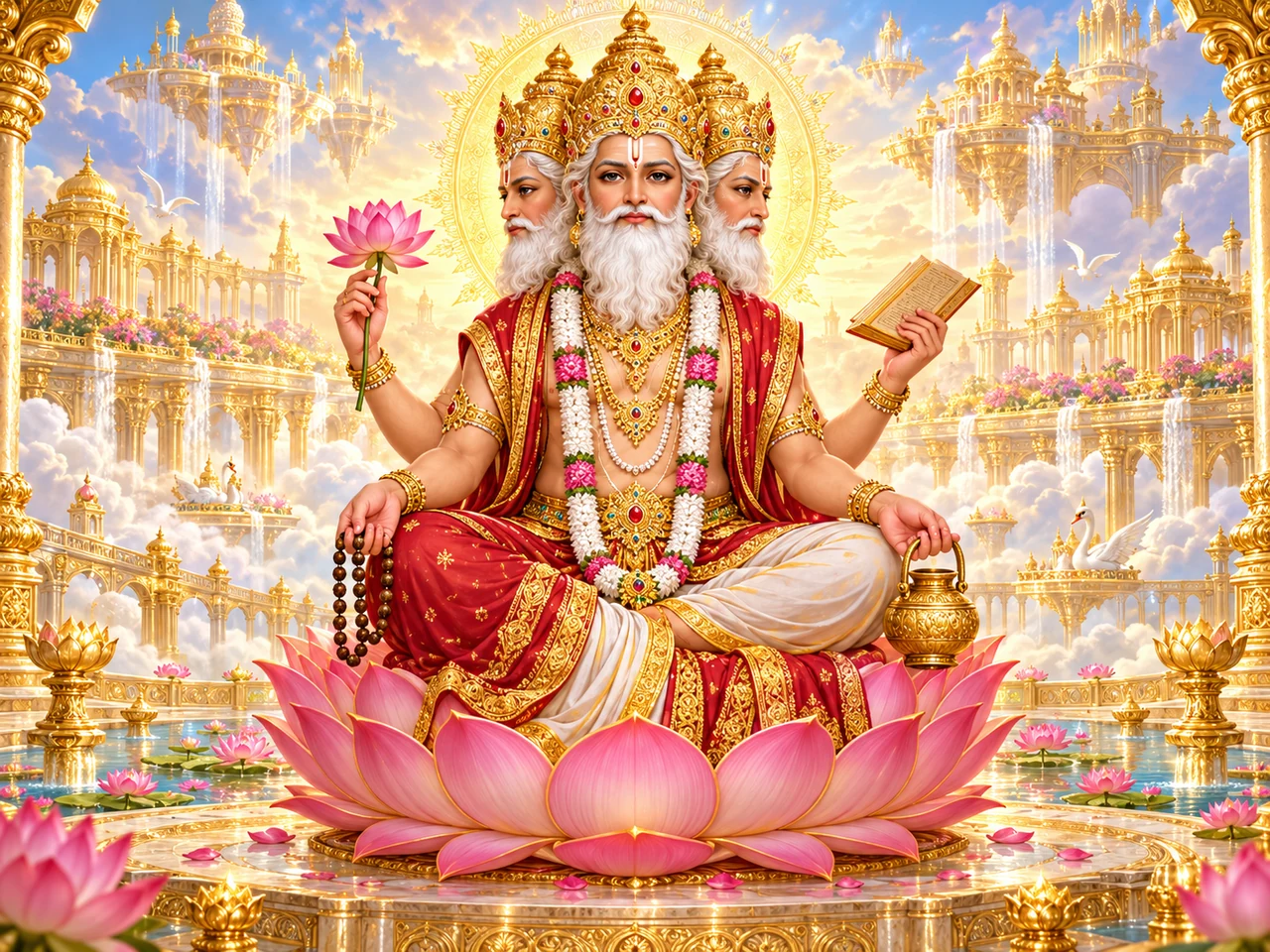
When Hindu stories imagine the world at the beginning of an age, they sometimes turn to a remarkable figure seated upon a lotus: BrahmaBrahmā, often pictured with four faces looking in four directions. He is associated with bringing living beings, sages and ordered worlds into manifestation. Yet he is not simply the Hindu equivalent of a sole, all-powerful creator outside the universe. The source of his creative power, his relationship with Vishnu and Shiva, and even the sequence of creation differ from text to text. 2 3 4
Brahma's story becomes more interesting once we stop asking, “Who created everything, in one sentence?” and begin asking, “How have different Hindu traditions described the movement from possibility into life?” This article explores his myths, symbols, temples and ideas without mistaking a devotional narrative for an independently verifiable event.
Names and identities: Brahma, Brahman and Brahmin
In careful transliteration, the creator is BrahmaBrahmā (ब्रह्मा), with a long final vowel. Brahman (ब्रह्म) is a philosophical term for ultimate reality in many Hindu traditions. Brāhmaṇa or Brahmin (ब्राह्मण) identifies a priestly/social category and also occurs in names of a genre of Vedic prose texts. The words have historical linguistic connections, but they are not interchangeable definitions. Saying that a verse discusses Brahman does not automatically mean it discusses the four-faced Brahma. 15
Common names and descriptions include Prajāpati (lord of creatures), Pitāmaha (grandsire), Svayambhū (self-born), Caturmukha or Chaturmukha (four-faced), Padmayoni or Abjaja (lotus-born), and Hiraṇyagarbha (golden embryo or golden germ). Their use is not perfectly uniform: Prajāpati and Hiraṇyagarbha have their own older textual histories and should not be equated with the later image of Brahma in every ancient context. In particular, the Rigveda's hymn to Hiraṇyagarbha is evidence for Vedic reflection on origins, not a securely dated portrait of the later four-faced deity. have their own older textual histories and should not be equated with the later image of Brahma in every ancient context. In particular, the Ṛgveda's hymn to Hiraṇyagarbha is evidence for Vedic reflection on origins, not a securely dated portrait of the later four-faced deity. 1 15
For search and reading, the spellings Brahma, Brahma, Brahma Dev, Brahmadev, Brahma Ji, Chaturmukh Brahma,Brahma, Brahmā, Brahma Dev, Brahmadev, Brahma Ji, Chaturmukh Brahma, and Pitamaha Brahma usually concern the creator deity. The unaccented English spelling Brahma can also cause confusion with Brahman; context matters.
From Vedic questions to Puranic creation
The Vedic hymns do not offer one mandatory account of creation. Rigveda 10.121Ṛgveda 10.121 celebrates Hiraṇyagarbha, a mysterious primordial principle or being, and asks to whom an offering should be made. Its later reception connects such language with Prajāpati and Brahma, but the relationship is a history of interpretation, not a simple statement that a later Puranic icon already existed unchanged. 1
By the time of many epic and Puranic accounts, Brahma appears as a personified creator. The Vishnu PurāṇaViṣṇu Purāṇa, Book I, describes creation within recurring cosmic cycles, with Vishnu as the highest organizing divine reality in that text. Its second chapter explicitly understands Brahma, Vishnu and Rudra as functions or manifestations of the one supreme Vishnu. Its fifth chapter then describes Brahma bringing forth successive orders of beings. These are Vaishnava theological claims of that work, not neutral descriptions accepted in identical form by every Shaiva or Shakta lineage. 2 3
A creation account tells us more than what happens first. It also asks whether time has one beginning, whether beings return in cycles, what knowledge is needed to create wisely, and how a powerful being recognizes limits. Reading Brahma in this way opens a thoughtful route into Hindu cosmological imagination without confusing it with the experimental science of the physical universe.
1. A lotus from Vishnu's navel
Imagine a vast expanse of waters and Vishnu resting in cosmic repose. From him grows a lotus; on the flower appears Brahma. The Bhāgavata Purāṇa, Canto 3, chapter 8, pictures Brahma looking around, unable at first to comprehend either his surroundings or his own origin. In verse 16 he acquires four faces as he turns toward the directions. His first experience is not omniscience but uncertainty. 5
The episode matters because it places the creator within a larger order. In this Vaishnava telling, he is not the ultimate source of the lotus and the waters. A beginner might assume “creator” necessarily means “the highest god in all Hinduism”; this narrative instead presents creation as an entrusted activity dependent on Vishnu. Other traditions describe that dependence differently.
The flower is not a botanical claim about how galaxies formed. As a religious image it allows readers to contemplate life unfolding from hidden possibility. Its meaning should be attributed to interpreters and traditions rather than declared a single ancient explanation for every lotus in art.
2. Creation through thought—and the sages who choose another path
The Vishnu PurāṇaViṣṇu Purāṇa, Book I, chapters 5 and 7, does not describe creation as one effortless gesture. Brahma meditates, brings forth different forms of life, and encounters forms of creation that do not fulfil his aim. Chapter 7 names mind-born progenitors, among them Bhṛgu, Pulastya, Pulaha, Kratu, Aṅgiras, Marīci, Dakṣa, Atri and Vasiṣṭha in Wilson's translated presentation. Lists of these ancestral sages vary across texts and contexts. 3 4
Some early mind-born sons, represented by Sanandana and others, are drawn toward knowledge and detachment rather than procreation. This creates a memorable tension: the divine plan to populate a world meets beings who prefer renunciation. The story joins two valued impulses in Hindu thought, engagement with the world and the search for freedom from attachment.
In that same Vaishnava textual setting, Rudra arises amid Brahma's frustration. Shaiva accounts may narrate their relationship differently. It would be misleading to tell readers that the Vishnu Purāṇa'sViṣṇu Purāṇa's sequence settles Shiva's ultimate theological status for everyone. 4
3. The fifth head and a lesson about pride
Why does Brahma usually have four heads when some stories speak of five? One influential Shaiva narrative concerns Brahma's pride and the appearance of Bhairava. In Shiva Purāṇa, Śatarudra-saṃhitā, chapter 8Śiva Purāṇa, Śatarudra-saṃhitā, chapter 8, the fierce form Bhairava cuts off Brahma's fifth head. The story links that act with accountability and with Bhairava's skull-bearing expiation. 7
But readers deserve an important qualification. Shiva Purāṇa, Vidyeśvara-saṃhitā, chapter 8Śiva Purāṇa, Vidyeśvara-saṃhitā, chapter 8 recounts a related situation in which Bhairava is about to strike, yet Shiva intervenes and Brahma is spared at that moment. The difference is material: we should not silently merge the two versions or claim that a single chapter proves the same sequence in every recension. 6 7
These narratives use vivid divine conflict to address false claims, arrogance and the responsibility that accompanies knowledge. Within their Shaiva settings, Shiva's transcendence is emphasized. Other Hindu traditions assign ultimate status differently. The story is not documentary evidence that an anatomically five-headed historical being was injured, nor should it be used to demean Brahma's worshippers.
4. Brahma's bewilderment before Krishna
A different, distinctly Vaishnava lesson appears in Bhāgavata Purāṇa 10.13. After seeing young Krishna with cowherd friends, Brahma removes the boys and calves to test what he cannot understand. Krishna manifests counterparts of the missing companions, and Brahma eventually realizes that his own creative power cannot measure the divine reality before him. He bows in humility. 8
The episode gives Brahma a different narrative role from his cosmic creation stories: he becomes a learner. It presents Krishna's supremacy within the Bhāgavata's theology. To turn the story into a universal ranking endorsed by all Hindus would erase other traditions; to ignore it would erase an important part of Brahma's religious literature.
How to recognize Brahma in art
Brahma's most familiar artistic markers are four faces, often four arms, a manuscript or book, prayer beads (akṣamālā), a water vessel (kamaṇḍalu), and sometimes kuśa grass or a ritual implement. He may sit on a lotus and is associated with a haṃsa—a goose or swan-like bird. Specific objects vary by region, century and sculptural setting; an individual illustration should never be treated as an authenticated checklist of the oldest texts. 9 10
The four directions suggest a creative gaze over the whole world. An illustrated manuscript at the Metropolitan Museum of Art identifies a water vessel, rosary, Vedic book and kuśa grass in a painting from Mankot, circa 1720. A four-faced Cambodian Brahma at the same museum, dated to the early tenth century, demonstrates how the deity appears in Southeast Asian art. Material objects, dates and museum provenance tell us that representations circulated; they do not prove the literal events of creation. 9 10
A sculptural representation in Cleveland is catalogued as Brahma–Shiva, highlighting that attribution and composite identities can be complex. Before using a picture as an example, note how its collecting institution identifies the work and whether the object is a standalone Brahma, a composite, or part of a larger shrine program. 11
Creation, time and philosophical significance
Brahma is particularly useful for learning the meaning of sṛṣṭi (manifestation or creation), kalpa (a great cosmic period) and pralaya (dissolution). The Vishnu PurāṇaViṣṇu Purāṇa, Book I, chapter 3, speaks of Brahma's day and night and a world that emerges again after cosmic rest. These are sacred frameworks for immense cyclical time, not confirmed astronomical ages. 12
The familiar Trimūrti places Brahma, Vishnu and Shiva beside one another as creator, preserver and dissolver. It is a useful educational shorthand, but not a complete map of Hindu theology. In the Vishnu PurāṇaViṣṇu Purāṇa, these functions are expressions of Vishnu; Shaiva philosophies can locate ultimate reality in Shiva, while Shakta traditions describe the Goddess or Shakti as the decisive power. Some worshippers focus instead on a chosen deity without organizing devotion around a fixed triad. A Kashmiri triad sculpture at the Met shows that the three figures could be joined artistically, but one artwork cannot establish universal doctrinal agreement. 2 13
Do not confuse Brahma's lifespan, expressed symbolically through immense cycles, with the philosophical idea of Brahman as ultimate reality. The former is associated with a personal cosmic office and succession of worlds; the latter is interpreted differently in Vedanta and other traditions. Even when a text closely connects them, a reader must attend to its vocabulary and school. 12 15
Relationships: Saraswati, Savitri, Gayatri, Vishnu and Shiva
Brahma is widely associated with Saraswati, goddess of learning, speech and the arts. In other narrative and ritual contexts Savitri and Gayatri are prominent. The names are not interchangeable in every source. At Pushkar, Rajasthan Tourism records a local account of Brahma's sacrifice, Gayatri's place in the temple, and Savitri's anger and associated hill shrine. This records local sacred tradition, not one universal family tree fixed across Hinduism. 14 16
In the religious literature, the relationship to Vishnu may be expressed through Brahma's lotus-birth or through Vishnu's own creative manifestation. The relationship to Shiva appears in accounts of conflict and reconciliation as well as in shared iconography and temple programs. These are not contradictions that can always be removed by choosing one narrative as “the real one.” The texts emerge from different theological conversations and often serve different devotional purposes. 2 5 7
Scriptures and literature: where to begin
A reader can trace Brahma through several distinct kinds of evidence:
- Rigveda 10.121:Ṛgveda 10.121: Vedic Hiraṇyagarbha hymn; important background to later creation vocabulary, not by itself a description of a four-faced statue. 1
- Vishnu Purāṇa 1.2, 1.3, 1.5 and 1.7:Viṣṇu Purāṇa 1.2, 1.3, 1.5 and 1.7: Vaishnava cosmic theology, recurring time, Brahma's creative activity and mind-born sages. 2 3 4 12
- Bhāgavata Purāṇa 3.8 and 10.13: Brahma's lotus-birth and the Krishna encounter. 5 8
- Shiva Purāṇa, Vidyeśvara-saṃhitā 8 and Śatarudra-saṃhitā 8:Śiva Purāṇa, Vidyeśvara-saṃhitā 8 and Śatarudra-saṃhitā 8: two distinct tellings around Brahma's fifth head and Bhairava. 6 7
These are pointers to identifiable editions and hosted presentations. The exact Sanskrit recensions and independent source rights still need editorial confirmation. Brahma's entry does not require duplicating the previously prepared ShivGoraksh Bhagavad Gita, Devi Mahatmyam (Durga Saptashati) or Ashtavakra Gita; none is presented here as its principal primary source.
Temples, devotion and living heritage
Pushkar, near Ajmer in Rajasthan, is among the best-known centres of Brahma devotion. The state tourism department describes the Jagatpita Brahma Mandir near Pushkar Lake, its four-faced image and hamsa motif, and the pilgrimage activity around Kartik Purnima and the Pushkar fair. Regional narratives link the lake to a fallen lotus and Brahma's sacrifice to Savitri and Gayatri. These accounts should be introduced as stories told about a holy place, while the physical temple and present worship are matters of observable heritage. 14 16
Is Pushkar the only Brahma temple in the world? No. Some travel descriptions use that attractive phrase, but it is too absolute. A Rajasthan government press record documents worship at the Asotra Brahma temple in Balotra district. Brahma's independent temples are comparatively uncommon, yet there are additional sanctuaries and images, and he appears in larger temple programs. 17 13
Why are Brahma temples less common than temples to Shiva, Vishnu or the Goddess? Devotional legends, including curses, offer one type of answer. Historical patterns of sectarian patronage and the relatively smaller role of Brahma as a central chosen deity offer another. Neither a single curse nor a claim that Brahma “has no power” should be asserted as an established universal explanation. 15 16
Public temple visits, darshan and community observances can be described as cultural and religious practices. Specific vows, mantras, ritual schedules and promises of guaranteed results differ by temple and lineage and are not prescribed here. The appropriate day for a festival should be checked against its local calendar, not generated from a generic annual date.
Is Brahma the same as Brahman?
No—not as a straightforward dictionary equivalence. Brahma is the named creator deity; Brahman is ultimate reality in many philosophical frameworks. Some texts and schools describe deep connections, but reading them properly requires keeping the terms distinct. 15
Did Brahma create the entire universe alone?
That is not the only Hindu account. In the Bhāgavata Purāṇa and Vishnu PurāṇaViṣṇu Purāṇa examples discussed here, Brahma creates within a broader reality associated with Vishnu. Other schools place their ultimate emphasis elsewhere. 2 5
Does Brahma have four or five heads?
Four are standard in much surviving iconography. Some Shaiva stories describe a fifth and disagree on the precise event involving Bhairava. Do not force a single storyline onto every image or scripture. 6 7 9
Is Saraswati always the only consort named with Brahma?
No. Saraswati is a widespread association, while the Pushkar traditions also feature Savitri and Gayatri. Their relationships differ by context. 15 16
Is Brahma worship forbidden?
No blanket prohibition can be inferred from the fact that his independent shrines are relatively few. There are functioning Brahma temples and established pilgrimage practices. 14 17
Are the Puranic creation cycles scientific measurements?
They are religious cosmologies—important to understanding sacred time and philosophical imagination—but not empirical measurements demonstrated by modern astronomy. 12
Glossary
- Brahma:Brahmā: Personified creator deity in numerous Hindu narratives.
- Brahman: Ultimate reality in many Hindu philosophical systems; not automatically Brahma.
- Prajāpati: “Lord of creatures”; title with a history wider than the later creator deity.
- Hiraṇyagarbha: “Golden embryo/germ”; Vedic creation concept, later interpreted in many ways.
- Trimūrti: Brahma, Vishnu and Shiva as a triad of cosmic functions in some presentations.
- Sṛṣṭi: Creation or manifestation.
- Kalpa: Vast period in traditional cosmological time.
- Pralaya: Dissolution or reabsorption of a world.
- Mānasa-putra: Mind-born son or progeny in a mythic creation narrative.
- Haṃsa: Swan/goose-like bird associated with Brahma in art.
- Yajña: Sacrificial worship or offering, used in several senses across texts.