



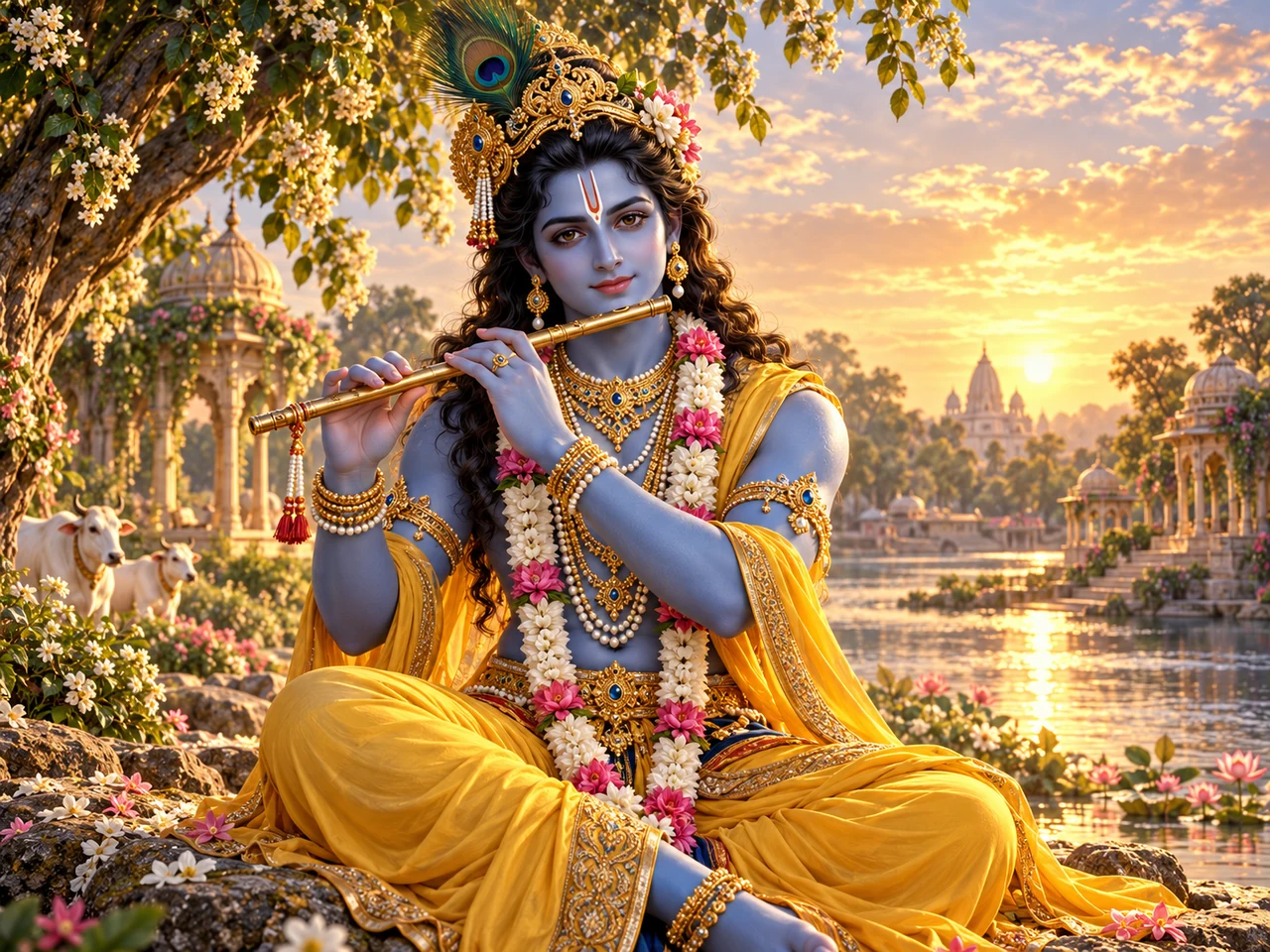
Editorial source notice: Five text units (opening refrain plus four descriptive stanzas) follow the selected Drik Panchang online witness 1. Repetition cues reflect this witness. This is an unpublished working transcription, not a critically verified or rights-cleared edition. Roman Hindi below preserves the original words, rather than translating them. Publication and Aadesh indexing are OFF.
What this Aarti is and why it matters
“Aarti Kunj Bihari Ki” is a Braj-influenced Hindi devotional song addressed to Krishna. Kunj denotes a grove; bihari is a dweller or wanderer there. Together, Kunj Bihari evokes Krishna in the wooded spaces of Vrindavan. The song is a sequence of living images rather than a chronological retelling of Krishna’s whole life. It offers a way for the reader to look, listen, remember and finally pray. 1
The first half makes Krishna visible through ornaments, music and Radha’s presence. The second moves through the peacock crown and a joyous cowherd gathering to the Ganga and the riverbank; in the last lines the speaker asks to be heard. This movement from beauty to vulnerability explains why its recurring Aarti line can feel both communal and deeply personal.
Historical and linguistic setting
The verses use Hindi with Braj-region diction: bajavai (plays), bilasai (shines), thadhe (standing), samarana (recollection), renu (fine dust) and benu (flute). The metre, pauses and repetition are adapted in different communities. Such variation does not by itself indicate that one group has altered a single pristine ancient Sanskrit original: this is a vernacular composition, not a Vedic Sanskrit hymn. The composer and date are not authenticated. A commercial recording lists the lyricist as “Traditional,” which is a catalogue description rather than an archival proof of authorship. The Gita Press anthology OCR has also been inspected; it uses five descriptive stanza divisions instead of four and contains some alternate readings. Its scanned page images have not yet been visually collated. Therefore we do not claim that this online reading is identical to an original authorial text. 2 7
Five layers of devotional meaning
1. Love and presence: Radha and the gopis embody remembered intimacy with Krishna; theological schools understand their relation through their own interpretive lenses. 2. Care and shelter: Giridhar recalls Krishna protecting the Vraja community under Govardhan. 3
3. Beauty as an aid to recollection: The flute, crown, forest garland, moonlight and cowherd landscape are contemplative imagery, not historical eyewitness details. 4. A bridge of imagery: The Ganga verse holds the Vaishnava symbol of Vishnu’s feet alongside the Shaiva image of Shiva’s matted locks, without erasing the theological differences between traditions. 5
5. Prayer rather than guarantee: The closing appeal to remove worldly bonds is an expression of faith. Reading the Aarti does not guarantee a material, medical or psychological outcome.
When is it sung? The Aarti is associated with Krishna devotion in homes and temples, including Janmashtami observances and ordinary worship. The song itself gives neither a compulsory time nor a fixed recitation count. Separate calendar logic is needed for any festival date, and individual temple and lineage customs may differ. This page is a reading and meaning guide, not a temple ritual manual.
Key words
| Word | Meaning in this Aarti |
|---|---|
| Kunj Bihari | Krishna among the groves of Vrindavan |
| Giridhar | Krishna as holder of Govardhan |
| Murari | Krishna, slayer of Mura |
| Baijanti | A traditional garland or floral ornament |
| Banamali | Forest-garlanded Krishna |
| Aali | Female friend or companion in poetic diction |
| Darasan | Sacred sight or devotional vision |
| Renu | Dust or fine riverbank sand |
| Benu | Flute |
| Bhav phand | Figurative bondage of worldly existence |
Additional passage commentary
Refrain — Refrain — Kunj Bihari, Giridhar, Murari
Meaning: We offer Aarti to Krishna, who delights in the green groves of Vraja, who bears the Govardhan hill, and who overcame the demon Mura. Explanation: Three names hold together three dimensions of devotion. Kunj Bihari pictures the intimate landscape of Vrindavan; Giridhar remembers Krishna protecting the cowherds under Govardhan 3; and Murari recalls the narrative of Mura in Bhagavata Purana 10.59 4. These are traditional theological epithets, not three separate deities. Aarti here is devotional praise, not a prescription of a fixed number of lamp movements.
Stanza 1 — Vanamali, Radha and the flute
Meaning: Krishna wears a vaijayanti garland, plays a sweet flute and has shining earrings. Nanda’s beloved child stands among the creepers, dark in complexion, with bee-like curls and a musk mark. Radha shines near him; the scene culminates in the beauty of Shyama. Explanation: This first long stanza is an image of darshan, the loving contemplation of a deity’s form. “Vanamali” means garlanded with forest flowers and links Krishna with the landscape; “aali” in Braj poetry can address a female companion. Dark lustre is an aesthetic attribute, not a claim about a measurable celestial colour. The stanza moves from ornaments and music to a relational image of Radha and Krishna; devotional communities interpret that relationship differently, and no single institutional explanation is universal.
Stanza 2 — Peacock crown, music and the cowherd community
Meaning: Krishna’s golden, peacock-adorned crown shines; even the gods yearn to behold him. Flowers seem to rain from above while instruments sound. The cowherd girls express incomparable affection and delight. Explanation: The imagery of floral showers and eager heavenly beings is familiar in devotional narrative and should be read as praise rather than a report of a dated event. “Murachang” is a vernacular instrument name whose identification and spelling should be checked against the printed witness; it is not silently replaced with a familiar modern instrument. “Rati” here denotes deep affection in the verse’s devotional-poetic register, not a uniform prescription for worshippers.
Stanza 3 — The Ganga and the holy feet
Meaning: The Aarti praises the Ganga as sacred water associated with the divine feet of Hari, imagined as cleansing the stains of the age. Shiva receives the river within his matted locks, while remembering the divine image is held to release the devotee from delusion. Explanation: A useful scriptural parallel is Bhagavata Purana 5.17, in which the heavenly Ganga is related to Vishnu’s foot 5. Shiva’s locks belong to a wider network of Ganga-descent narratives and also appear here as a link between Vaishnava and Shaiva imagery. “Banwari” is another epithet of Krishna as the forest wanderer. “Removing sin” expresses the Aarti’s religious assurance, not an experimentally verified outcome or a substitute for moral responsibility.
Stanza 4 — Yamuna-bank landscape and the humble appeal
Meaning: Fine bright sand shines on the riverbank, the flute sounds in Vrindavan, and cowherd women, men and cattle fill the scene. Under gentle moonlight, the worshipper turns from description to a plea: hear the call of a humble seeker and free the heart from worldly entanglement. Explanation: “Renu” is dust or sand; “benu” is a Braj/Hindi form of flute. “Bhav phand” evokes the knot or snare of repeated worldly involvement, a devotional metaphor. The phrase “deen bhikhari” is a humble self-description and does not mean that poverty establishes holiness. Another sung reading ends “deen dukhari”; the two readings should be recorded as variants rather than simultaneously presented as a single original line.