



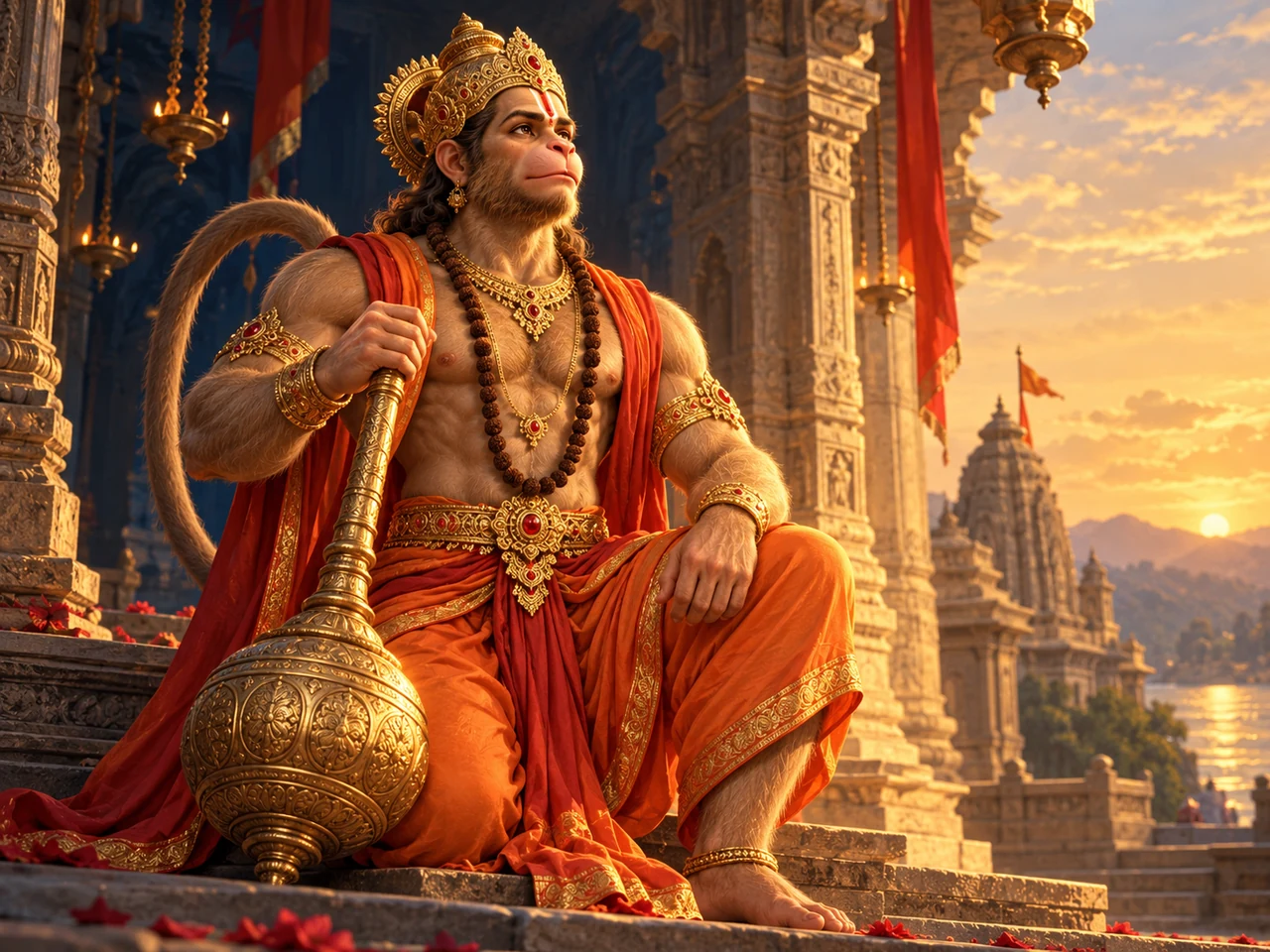
Who is Hanuman?
A messenger steps into a foreign city carrying neither a royal army nor a claim to its throne. His task is to find someone who has been taken from her home, offer her trustworthy news, and return with the truth. In the Rāmāyaṇa, that messenger is Hanuman. The story gives him extraordinary strength, but it is his judgment, restraint, and loyalty that make his strength meaningful. When he meets Sita, he first needs to earn her confidence. When the army faces a medical emergency, he finds an ingenious way to bring what is needed. And when praise comes to him, devotional traditions remember him turning it toward Rama. 4 · 6
Hanuman is a revered divine vānara—a member of the monkey-like heroic people of the epic—and a central companion of Rama. Across much of India and beyond, he is honoured as a model of bhakti (loving devotion), sevā (service), fortitude, and resourcefulness. These qualities have made him important in Vaishnava devotion to Rama, in traditions that associate him with Shiva, and in forms of worship that do not fit neatly into a single sectarian label. The Rāmāyaṇa character, the later independent deity, and living regional traditions belong to an interconnected but historically developing story. 11 · 12
Names, family, and identities
Hanuman is also commonly called Hanumat, Anjaneya or Anjaniputra (son of Anjana), Pavanputra, Vayuputra or Maruti (associated with the wind), Bajrangbali (often understood as one of adamantine strength), and Mahavir (great hero). Rama-duta, the messenger of Rama, is especially apt: it describes what he does, not merely how powerful he is. Pronunciation and spelling differ across languages—Hanuman in Sanskrit transliteration, Hanuman in common English, Hanuman-jī in respectful Hindi usage, and Añjanēyar in Tamil settings., the messenger of Rama, is especially apt: it describes what he does, not merely how powerful he is. Pronunciation and spelling differ across languages—Hanumān in Sanskrit transliteration, Hanuman in common English, Hanumān-jī in respectful Hindi usage, and Añjanēyar in Tamil settings.
Hanuman's mother is Anjana in influential traditions; Kesari is commonly named as his father, while Vayu, the wind deity, is closely involved in stories of his conception and power. In Kiṣkindhā-kāṇḍa 66, Jambavan recalls Hanuman's birth and wind-associated abilities to rouse him for the sea crossing. This is a traditional birth account, not a recoverable historical genealogy. Exact family details and explanations differ across retellings. 2
Hanuman is often described as a brahmachari, a figure of disciplined conduct. Yet readers should not assume that every regional story or lineage presents his personal status in precisely the same way. Another frequent identification calls him a manifestation or portion of Shiva or Rudra. Such connections are meaningful within particular devotional and Puranic traditions, but Hanuman's service to Rama must not be erased or described as exclusively Shaiva. A poetic comparison of his burning Lanka to Rudra's destruction of Tripura in Sundara-kāṇḍa 54 is a comparison, not by itself proof of a universal theological identity. 5
Where do the sources place him?
Hanuman's earliest central literary setting is the developing Sanskrit Rāmāyaṇa tradition. Its books narrate the partnership with Sugriva, the search for Sita, the journey to Lanka, and the war against Ravana. The precise historical dating and formation of the epic are complex scholarly questions, so a single firm date for 'the first Hanuman' would mislead readers. The Mahābhārata includes a memorable meeting between Hanuman and Bhima, both connected with Vayu. Much later, songs, plays, regional Rāmāyaṇas, devotional hymns, temple sculpture, and oral narratives broadened the way he was worshipped. 7 · 11
The distinction matters. An episode that appears in a late devotional song is not automatically part of the earliest extant Sanskrit epic; conversely, later religious creativity is not less meaningful to the communities that cherish it. ShivGoraksh therefore describes individual traditions by name rather than combining every popular Hanuman tale into an imaginary single ancient biography. Philip Lutgendorf's historical study is particularly helpful for understanding how the great epic helper became an independently beloved object of devotion. Its accessible abstract supports this broad historical framing, not detailed claims about pages of a book that were not inspected. 12
1. The first meeting: wisdom before strength
Rama and Lakshmana search the forest for Sita. Sugriva sees two armed strangers and wonders who they are. Hanuman approaches them, traditionally in the guise of an ascetic, and speaks with care. Rama notices the quality of his words, his knowledge, and his poise. Hanuman then discloses that he has come on Sugriva's behalf. The encounter begins the friendship and alliance that move the search forward. Kiṣkindhā-kāṇḍa 3 is a valuable counterweight to the popular picture of Hanuman as a warrior alone: here, the hero's foremost skill is communication. 1
One lesson a modern reader may draw—an interpretation, not a line quoted from the epic—is that courage includes asking questions before making assumptions. Hanuman does not intimidate the strangers to obtain information. His alertness and courtesy make trust possible. In an epic full of powerful kings and miraculous weapons, this quiet introduction has enormous consequences.
2. The sea crossing and Sita's ring
When the searchers reach the seashore, despair threatens their mission. Jambavan reminds Hanuman of his abilities and origin. Hanuman gathers himself and leaps across the ocean toward Lanka. The Sundara-kāṇḍa presents the crossing not simply as a display of speed but as a succession of challenges demanding steadiness and discrimination. 2 · 3
The most moving part of the mission is not the leap. It is the meeting with Sita in captivity. A stranger suddenly claims to carry news of Rama; why should she believe him? Hanuman presents Rama's signet ring as a token of trust and offers reassurance without dismissing her pain. Sundara-kāṇḍa 36 connects his courage to empathy, discretion, and the proper use of evidence. He succeeds as a messenger because the message is recognizably Rama's, not because he demands that Sita admire him. 4
3. The burning of Lanka: force and its limits
After finding Sita, Hanuman comes into conflict with Ravana's forces. In the epic's account, a fire is set upon his tail; he turns the situation around and sets parts of Lanka ablaze. The scene is dramatic and disturbing. Sundara-kāṇḍa 54 does not describe fire as a harmless spectacle: it speaks of buildings, frightened inhabitants, and destruction. The narrative belongs to the epic's world of war and must not be turned into a general instruction to celebrate violence. 5
Devotional storytelling often emphasizes the defeat of pride and oppression; a literary reading can also notice the terrible effects of conflict. These interpretations are not mutually exclusive. They help explain how one character can represent both great power and the moral need to direct power responsibly. Hanuman's larger mission remains the recovery of Sita and the defeat of her abductor, not destruction for its own sake.
4. The medicinal mountain: resourcefulness in a crisis
During the war, Lakshmana is gravely injured. Sushena identifies healing herbs on a distant mountain and asks Hanuman to bring them. On arrival, Hanuman cannot reliably distinguish the required plants. Instead of returning empty-handed or guessing, he carries the whole mountain peak. Sushena extracts the remedies and treats Lakshmana. In one widely available Sanskrit-text presentation this occurs in Yuddha-kāṇḍa 101; chapter numbering differs among digital editions, so readers should follow both the named episode and the edition-specific locator. 6
The mountain story works on several levels. It is a miraculous act in the traditional narrative, an enduring image of urgent service, and a story about admitting uncertainty. Hanuman does not pretend to know which herb is correct. He chooses a bold solution that preserves the chance of help. The story is not evidence that a particular ancient plant can clinically revive people today, and no medical promise is implied.
Hanuman and Bhima: an episode from another epic
In the Mahābhārata's Vana-parvan, Bhima encounters an old monkey blocking his path. Irritated, he asks the animal to move; the monkey suggests that Bhima move its tail instead. Bhima, famed for his strength, cannot lift it. The stranger reveals himself as Hanuman, another son of the wind deity, and Bhima receives a lesson in humility. This account belongs to the Mahābhārata, not the core sequence of Hanuman's Lanka mission. In K. M. Ganguli's historical English translation it is found around Vana-parvan section CXLVI; Sanskrit critical-edition numbering requires separate confirmation. 7
The tale turns a simple gesture into an ethical question: what good is immense power if it cannot recognize wisdom standing quietly before it? Later popular art and retellings connect Hanuman with Arjuna's banner as well, but those details need separate textual checking before precise verse references are assigned.
How is Hanuman represented in art?
Hanuman's recognizable monkey face and tail coexist with humanlike posture and richly varied regional forms. He may kneel before Rama, stand with folded hands, carry a mace (gadā), hold a mountain, or appear as an alert guardian. None of these attributes should be treated as compulsory in every era. The Metropolitan Museum of Art's eleventh-century Chola bronze, for example, shows a poised Hanuman respectfully engaging Rama; its monkey identity is conveyed especially through the face and tail. This evidence does not mean that the later, muscular mace-bearing image is inaccurate—it demonstrates that devotional art has never had only one visual formula. 8
A Rajasthan painting of around 1800 presents Hanuman carrying the medicinal peak. It is evidence for how an episode was pictured at that time, not an eyewitness illustration of an event in epic history. A Mewar painting of about 1700 shows Hanuman in the company of Rama and Sita. Together, these works show how central relationship is to Hanuman iconography: his bodily power and his orientation toward Rama often appear in the same composition. 9 · 10
Popular images in which Hanuman reveals Rama and Sita within his heart express an especially vivid devotional idea: the beloved lives at the centre of the devotee's being. Some depictions show him holding an open chest; this is a religious image of wholehearted commitment, not anatomical evidence. The orange or red sindoor of some images and shrines likewise belongs to living regional practice and should not be universalized from one photograph.
Why is Hanuman a model of bhakti?
Bhakti does not mean passive admiration. Hanuman listens, acts, thinks, and assumes responsibility for another's welfare. His devotion is directed primarily toward Rama, and his service also protects and reassures Sita. Strength, knowledge, humility and self-discipline are complementary rather than competing virtues in the picture devotees draw of him. 11
Readers may encounter three devotional names—dāsya-bhāva (the attitude of a loving servant), śaraṇāgati (taking refuge or surrender), and seva (service). They describe interpretive approaches, not one universally binding doctrine. In the encounter with Sita, service takes the form of reliable speech; on the battlefield it becomes initiative; with Bhima it becomes a gentle correction to pride. A strong person who refuses to learn would miss the point of these stories.
Hanuman also crosses sectarian boundaries. In Rama-focused Vaishnava life, he is the exemplary devotee of the divine Rama. Some Shaiva teachings identify him with Shiva or Rudra; other traditions emphasize his wind-born nature or independent divine protection. An encyclopedic profile should respect these connections while naming their sources and not inventing a single unanimous theological position. 12
Hanuman in literature and worship
The Vālmīki Rāmāyaṇa is the central reference for the episodes described above. The Mahābhārata offers another narrative setting. Across India, retellings of Rama's story—especially vernacular traditions—make Hanuman accessible through local speech, song and performance. The Hindi-region Rāmcaritmānas, associated with Tulsidas, occupies an important place in this devotional world, but it is a distinct composition, not simply another title for the Sanskrit Rāmāyaṇa. 13
The Hanuman Chalisa
The Hanuman Chalisa is a celebrated hymn of forty chaupais, traditionally attributed to Tulsidas and commonly transmitted in Awadhi, alongside opening and closing dohas. Its verses praise Hanuman's devotion, strength, wisdom and protective presence. Many worshippers recite it regularly, especially on Tuesdays or Saturdays in some North Indian traditions. It is important to say traditionally attributed: literary scholars have also questioned the certainty of the Tulsidas attribution. The accessible scholarly discussion supports acknowledging this disagreement; it does not justify claiming an independently verified autograph manuscript. 13
This article does not reproduce the hymn or a modern translation. Anyone wishing to study individual verses should use an identified edition, distinguish an original Awadhi reading from commentary, and check reproduction rights. The name Chalisa should not be mistaken for a separate ancient Vedic hymn.
Public practices and festivals
Hanuman is honoured through temple visits, offerings, recitation, listening to Rāmāyaṇa stories, songs, charitable service, and personal prayer. Many devotees associate Tuesday and Saturday with him; these are customary devotional associations, not universal requirements. Hanuman Jayanti/Janmotsav celebrates his birth, but its calendrical observance varies with region and tradition. A website should not present one date as applicable to every community without consulting its calendar authority.
Other worship-related stories describe particular vows, offerings, mantras or practices. Those subjects need tradition-specific sourcing, particularly when claims of protection, healing or guaranteed results are made. ShivGoraksh can explain such beliefs respectfully without promising outcomes, supplying restricted instructions, or replacing medical or mental-health care.
Frequently asked questions
Is Hanuman a god or a devotee? Both terms occur in living Hindu practice: he is worshipped as a divine presence and remembered as Rama's unsurpassed servant. These are not necessarily contradictory descriptions.
Is Hanuman the same as Shiva? Some traditions associate him with Shiva or Rudra, but that identification is not the only account. Hanuman's relationship with Rama is central to the Rāmāyaṇa and to many communities that revere him.
Did Hanuman really bring the entire mountain? This is a celebrated episode of the Rāmāyaṇa's sacred narrative. An interpretation of its ethical and devotional significance should not be misrepresented as historical or medical verification.
Why is Hanuman called Pavanputra? The name points to his traditional connection with Vayu, the wind deity; it does not claim a modern biological explanation.
Is the Hanuman Chalisa part of the Vālmīki Rāmāyaṇa? No. It is a later devotional hymn traditionally attributed to Tulsidas, with its own literary history and questions of attribution.
Are all Hanuman images shown with a mace? No. Historic images include kneeling, speaking, praying and mountain-bearing forms, among others.
Glossary
| Term | Meaning in this article |
|---|---|
| Vānara | A monkey-like heroic being or people in the epic tradition; not an asserted zoological classification |
| Bhakti | Loving devotion to the divine |
| Sevā | Service performed for another's welfare or in devotion |
| Rama-duta | Messenger of Rama |
| Pavanputra / Vayuputra | Son of the wind, a traditional name |
| Gadā | Mace, a common but not universal attribute in Hanuman images |
| Sundara-kāṇḍa | The Rāmāyaṇa book centred on Hanuman's search in Lanka |
| Chalisa | A forty-chaupai devotional hymn in this context |
| Doha / chaupai | Verse forms used in North Indian devotional poetry |
| Dāsya-bhāva | Devotional posture of loving service |