



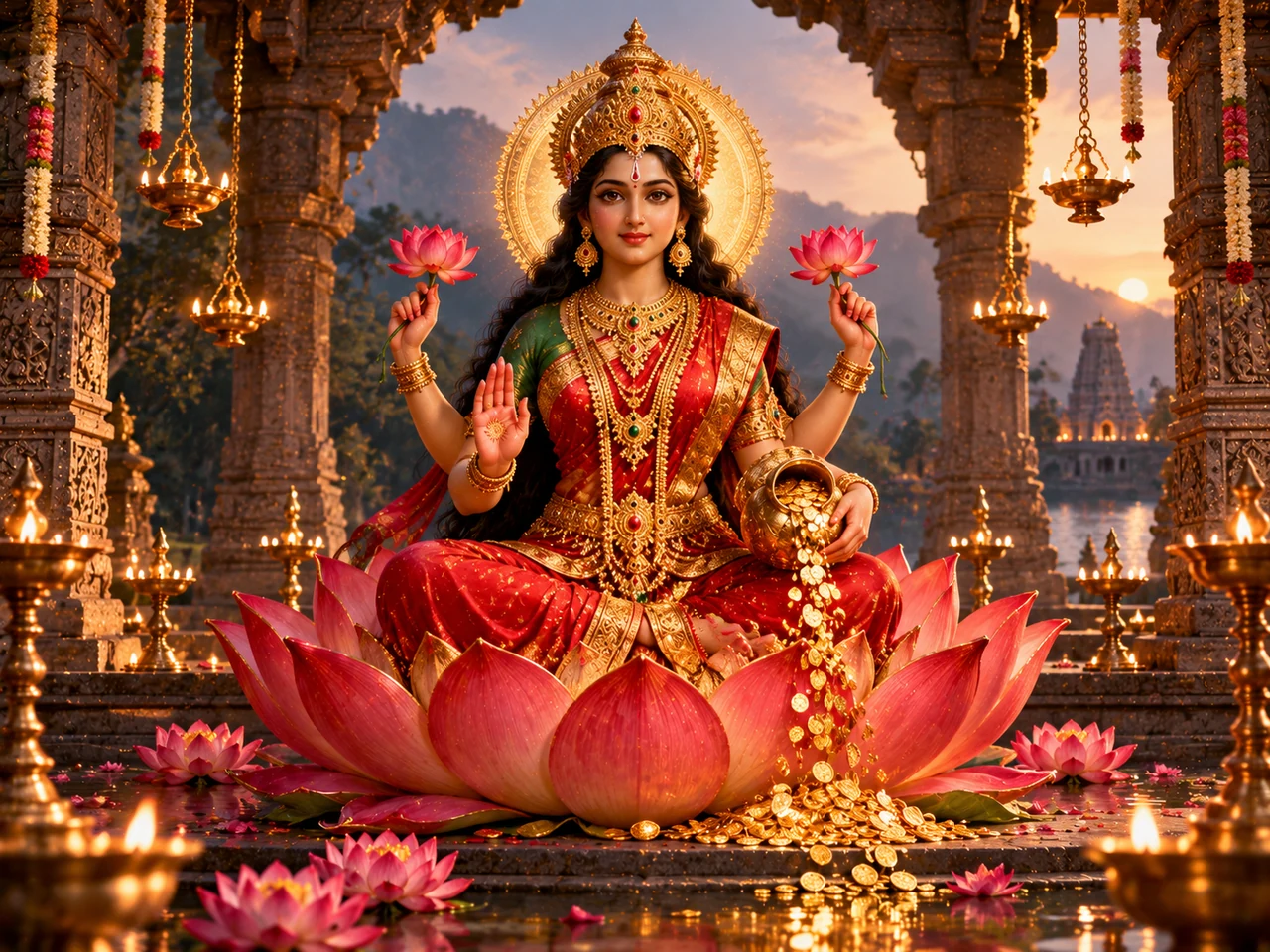
A lotus opens above dark water. An image of a radiant goddess sits within its petals, her hands offering both reassurance and abundance. Sometimes two elephants stand beside her, pouring water in a royal welcome; sometimes she rests beside Vishnu. In Indian homes, she is welcomed with lamps and a wish that the household may prosper. This is Lakshmi (Lakshmi, लक्ष्मी)Lakshmi (Lakṣmī, लक्ष्मी)—also called Shri (Shri)Sri (Śrī)—whose presence signifies much more than a pile of coins.
Lakshmi is closely associated with wealth, good fortune, beauty, nourishment, auspiciousness and well-being. For many worshippers she represents the conditions in which life can flourish: food to share, a secure home, honest livelihood, affection, generosity and dignity. In Vaishnava traditions she is inseparable from Vishnu or Narayana; in other devotional settings she is approached directly as a compassionate divine mother. The stories and pictures described below belong to particular textual and living traditions. They are not historical accounts that can be verified in the same way as an inscription or a dated sculpture. 1 2 5
Names, meanings and identities
LakshmiLakṣmī can convey a mark of good fortune or auspicious distinction; ShriŚrī evokes splendour, excellence, dignity and flourishing. The overlapping names developed rich religious meanings over time. Mahalakshmi emphasizes her greatness; Padma, Kamala and Padmalaya connect her with the lotus; RamaRamā is a familiar name in Vaishnava texts; Jaladhijā or Samudratanayā recalls the ocean-birth narrative. Varalakshmi is the boon-granting form specially honoured in several southern household traditions.
Names do not always mark different, independent goddesses. Sometimes they indicate an epithet, sometimes a particular iconographic type, and sometimes a locally distinctive form of devotion. Nor does every image of a lotus-bearing female figure permit certain identification without its archaeological setting. Lakshmi's history links textual language, household devotion, temple theology and visual art that did not all develop simultaneously. 1 3 4 5
In a Shaiva–Shakta learning library, Lakshmi belongs fully within the wider Hindu religious landscape. Her close relationship with Vishnu must be presented faithfully, not assimilated into a purely Shaiva account. Some Shakta interpretations place different goddesses within a comprehensive vision of Devi, but this does not cancel Vaishnava interpretations of Lakshmi as Shri-Narayana's eternal companion.In a Shaiva–Shakta learning library, Lakshmi belongs fully within the wider Hindu religious landscape. Her close relationship with Vishnu must be presented faithfully, not assimilated into a purely Shaiva account. Some Shakta interpretations place different goddesses within a comprehensive vision of Devi, but this does not cancel Vaishnava interpretations of Lakshmi as Sri-Narayana's eternal companion.
Early sources: Shri before the familiar pictureEarly sources: Sri before the familiar picture
When someone says that Lakshmi is “in the Vedas,” a useful question follows: which text and which layer? The celebrated Shri SūktaŚrī Sūkta invokes Shri-Lakshmi through imagery of brightness, gold, lotus, cattle, horses and auspicious prosperity. It is transmitted among invokes Sri-Lakshmi through imagery of brightness, gold, lotus, cattle, horses and auspicious prosperity. It is transmitted among khila or supplementary hymns associated with the Rigvedic tradition; it should not be presented without qualification as one of the standard hymns of the core Śākala Rigveda Saṃhitā. Recensions, verse totals and textual histories require care. An institutional catalogue records Usha R. Bhise's study of these khila hymns, while an online presentation of an older Shri Sukta commentary explains their supplementary status. or supplementary hymns associated with the Rigvedic tradition; it should not be presented without qualification as one of the standard hymns of the core Śākala Ṛgveda Saṃhitā. Recensions, verse totals and textual histories require care. An institutional catalogue records Usha R. Bhise's study of these khila hymns, while an online presentation of an older Sri Sukta commentary explains their supplementary status. 3 4
The point is not to make the goddess seem less ancient or important. It is to see how language of auspiciousness gradually became connected with an increasingly recognizable divine personality. Material evidence gives another kind of testimony: the Los Angeles County Museum of Art catalogues a first-century-BCE relief of Shri-Lakshmi being attended by elephants, while the Metropolitan Museum documents a sixth-century sculpture of Gaja Lakshmi. These objects show that major elements of her visual identity have long histories, even though a sculpture cannot prove that all later stories were known when it was made. The point is not to make the goddess seem less ancient or important. It is to see how language of auspiciousness gradually became connected with an increasingly recognizable divine personality. Material evidence gives another kind of testimony: the Los Angeles County Museum of Art catalogues a first-century-BCE relief of Sri-Lakshmi being attended by elephants, while the Metropolitan Museum documents a sixth-century sculpture of Gaja Lakshmi. These objects show that major elements of her visual identity have long histories, even though a sculpture cannot prove that all later stories were known when it was made. 5 6
1. When prosperity leaves the gods
In Vishnu PurāṇaViṣṇu Purāṇa, Book I, chapter 9, the sage Durvasa gives Indra a heavenly garland. Indra's careless treatment of it provokes a curse; the gods lose their strength and face defeat. They turn to Vishnu, who directs them toward the great churning of the milk ocean. The narrative connects loss of prosperity with a failure of respect and with the instability of worldly power. This is an interpretation of the story's moral texture, not a promise that prosperity will automatically vanish after a particular mistake. 1
This account is especially instructive because Lakshmi is not merely a treasure to be acquired. The crisis concerns the order that makes the worlds thrive. Read devotionally, the story asks whether power without humility can remain secure.
2. The ocean is churned; Shri appears2. The ocean is churned; Sri appears
Gods and asuras use Mount Mandara and the serpent Vasuki to churn the ocean of milk in search of amrita. Vishnu supports the mountain in his tortoise form, according to the Puranic narrative. Many extraordinary beings and treasures emerge. Finally Shri-Lakshmi rises, radiant and adorned, and is welcomed in a ceremonial bathing. The Gods and asuras use Mount Mandara and the serpent Vasuki to churn the ocean of milk in search of amrita. Vishnu supports the mountain in his tortoise form, according to the Puranic narrative. Many extraordinary beings and treasures emerge. Finally Sri-Lakshmi rises, radiant and adorned, and is welcomed in a ceremonial bathing. The Bhāgavata Purāṇa 8.8 describes her appearance, the attendants and elephants, and the lotus garland she carries. 1 2
The beautiful scene also has narrative weight: abundance arrives within a larger struggle, after cooperation, rivalry and exhausting effort. Yet different Puranas order or explain the ocean's treasures differently. The present article follows the cited Vishnu PurāṇaViṣṇu Purāṇa and Bhāgavata Purāṇa presentations where specified; it does not claim a single harmonized version is the only ancient account.
3. Lakshmi chooses Vishnu
The Bhāgavata Purāṇa 8.8.19–25 depicts Lakshmi considering prospective companions and choosing Mukunda (Vishnu), whom the narrative praises for unfailing qualities. She offers him a lotus garland and is welcomed at his chest. That image became central to the affectionate pair Lakshmi–Narayana. 2
For many Vaishnava worshippers, the story teaches that prosperity finds its proper home alongside sustaining order, goodness and spiritual steadiness. It is also worth noticing that the goddess is a discerning actor in the story: she considers and chooses. Devotional texts may present the divine couple as eternally united even while narrating an apparent meeting during the ocean's churning; these are theological, rather than biographical, ways of speaking.
4. One goddess, different appearances
Vishnu Purāṇa I.9Viṣṇu Purāṇa I.9 also says Shri was first born to also says Sri was first born to Bhrigu and Khyati, and later emerged from the ocean. The text further associates her with Sita when Vishnu appears as Rama and Rukmini when he appears as Krishna. Rather than forcing these statements into a single modern genealogy, it is better to understand them in the Puranic language of repeated divine manifestation. 1
This is a particularly useful safeguard against a common oversimplification: saying that the ocean-churning episode is Lakshmi's only origin leaves out an explicit alternative within the same work. Different traditions emphasize different divine appearances and relationships.
Lotus, elephants, coins: how to read the image
The lotus is Lakshmi's most persistent visual companion. It rises from water, opens into beauty and offers a place of dignity. Artists place lotuses in her hands or below her feet, and devotional explanations often read them as signs of purity and flourishing amid life's uncertainty. Such symbolic readings are contextual interpretations, not scientific descriptions of a flower. 5 6 7
In Gaja Lakshmi, elephants surround or bathe the goddess. The Metropolitan Museum's sixth-century Kashmir sculpture shows elephants pouring water; a first-century-BCE LACMA relief already uses the elephant-and-lotus composition. The British Museum connects the elephants' water with life-giving rain. Depending on setting, this imagery can suggest fecundity, royal authority, abundance and welcome. 5 6 8
Four-armed images often carry lotuses and show abhaya (reassurance or fearlessness) and varada (giving or blessing) hand gestures. Gold ornaments and falling coins are common in popular modern devotional prints, but not every ancient sculpture displays coins. Red, pink and gold garments likewise vary with artistic medium and locality. An owl may accompany Lakshmi in some regional imagery, particularly in Bengali contexts; it is misleading to treat the owl as an indispensable vehicle in every tradition. Image details should be identified against a particular source, not manufactured from a generic picture. 5 7 9
The eight Lakshmis: abundance has several meanings
Ashta Lakshmi means “eight Lakshmis,” a devotional grouping of aspects of prosperity. A widely used list names Adi (primordial well-being), Dhana (material resources), Dhanya (grain and food), Gaja (royal or auspicious plenty), Santana (family continuity), Veera/Dhairya (courage or patience), Vijaya (victory) and Vidya (learning). Other circulating lists use Aishwarya in place of Vidya, or differ elsewhere. A tradition-oriented calendar reference explicitly acknowledges these variants; therefore no one list is presented here as universally fixed from Vedic antiquity. 10
This grouping challenges the idea that “wealth” means currency alone. Food security, the courage to act well, knowledge, relationships and the capacity to overcome hardship can also be understood as kinds of abundance. The names are devotional categories, not separate measurable supernatural forces. Nor should a modern popular hymn automatically be assumed to be ancient without a verified textual history.
Lakshmi, Vishnu and wider Hindu thought
In many Vaishnava traditions Shri and Vishnu are worshipped together as a divine pair. Vishnu sustains cosmic order; Lakshmi embodies the blessing, compassion and flourishing that accompany it. In many Vaishnava traditions Sri and Vishnu are worshipped together as a divine pair. Vishnu sustains cosmic order; Lakshmi embodies the blessing, compassion and flourishing that accompany it. Shri VaishnavaSri Vaishnava theological traditions give Shri a particularly important place, often describing her compassionate approach to devotees. The precise doctrines of mediation, divine nature and grace differ among theologians and require specialist review before detailed attribution. A British Museum publication documents a Nepalese image that represents Vishnu and Lakshmi in a single combined body—a striking artistic statement of inseparability. theological traditions give Sri a particularly important place, often describing her compassionate approach to devotees. The precise doctrines of mediation, divine nature and grace differ among theologians and require specialist review before detailed attribution. A British Museum publication documents a Nepalese image that represents Vishnu and Lakshmi in a single combined body—a striking artistic statement of inseparability. 9
The wider Shakta frame may honour abundance as an aspect of the one Goddess. The Devi Mahatmyam (Durga Saptashati), chapter 5, includes a litany saluting the Goddess in various forms present among living beings, including Lakshmi. This does not mean that all Vaishnava and Shakta texts offer the same ontology or that Lakshmi must always be reduced to Durga. ShivGoraksh's separately prepared Devi Mahatmyam (Durga Saptashati) is not assumed published; the reference here is textual, not a live site link. A definitive Sanskrit-verse alignment is pending comparison with the project's selected edition. 11
Lakshmi is also significant outside exclusively Hindu settings. The British Museum notes that forms of her are revered in some Jain and Buddhist contexts, though meaning and identification depend upon the community. Across cultures, recognizable symbols can travel without proving identical theology. 8
A goddess in literature and art
The Shri SūktaŚrī Sūkta gives the goddess a vivid world of light, agricultural wealth and desired well-being. The Vishnu PurāṇaViṣṇu Purāṇa narrates her birth and links her appearances with Vishnu's descents. The Bhāgavata Purāṇa provides a carefully developed scene of her choosing Vishnu. The Devi Mahatmyam (Durga Saptashati) offers a wider goddess framework. These texts should be read as identifiable works, not collapsed into one supposed “scripture of Lakshmi.” 1 2 3 11
Sculpture offers independent evidence for changing representations. The LACMA early relief and Metropolitan Museum stone sculpture suggest continuity in the Gaja Lakshmi motif over centuries; the National Museum in New Delhi catalogues a later bronze from probably Gujarat. In the modern era, printed devotional images have spread a familiar seated, four-armed, coin-giving Lakshmi far beyond one regional art school. Dating an individual artwork is possible; dating a complete religious belief from its image alone is not. 5 6 7
Worship, festivals and household life
For many households, honouring Lakshmi involves cleaning and welcoming the home, lighting lamps, arranging flowers, making rangoli or alpana, and sharing food. The ethical meanings people draw may include hospitality, care for elders, fair dealing and gratitude for what supports life. These are descriptions of public customs, not mandatory rituals or guarantees of financial gain.
Diwali is particularly associated with Lakshmi worship across many communities. The British Museum describes lamps and offerings to welcome good fortune, and a British Library archive records village Diwali imagery and practices in Gurgaon, Haryana. Yet Diwali is not everywhere exclusively Lakshmi's festival: different regions also foreground Rama, Krishna, Kali, the new year, ancestors or other observances. 9 12
Varalakshmi Vrata is prominent in a number of Tamil, Telugu and Kannada households, especially as a women's family-oriented vow during the Shravana season. Its observed form, who participates and its calendrical convention vary between communities; a locally followed panchanga is needed for actual dates. The name emphasizes Lakshmi as one who grants boons, but the religious promise belongs to belief, not an established predictive fact. 13
Kojagari Lakshmi Puja, linked with the Ashvina/Sharad full moon in Bengali and certain other eastern and western Indian traditions, carries themes of household prosperity, harvest and a night of wakefulness. Maharashtra Tourism provides one public cultural description; communities differ in details. 14 In some Bengali homes an owl appears beside Lakshmi and rice or new grain helps express the harvest connection. Such regional markers enrich the story rather than contradicting a single canonical template.
A temple visitor may encounter Lakshmi–Narayana, Mahalakshmi, Gaja Lakshmi, Shri DeviSri Devi accompanying Vishnu, or distinctive local forms. “Sri Devi” and “Bhu Devi” are often depicted in relation to Vishnu in South Indian temple iconography, but their roles should not be flattened into a single generic “two wives” formula. Festival worship and specialized mantra or tantric practice likewise should not be confused: this profile records accessible public traditions and does not give initiation-dependent instructions.
What Lakshmi invites us to consider
A picture of Lakshmi may first remind someone of money. The older language of Shri, the imagery of food and water, and the stories of pride and discernment broaden the question: A picture of Lakshmi may first remind someone of money. The older language of Sri, the imagery of food and water, and the stories of pride and discernment broaden the question: what makes a life truly prosperous? Financial security matters. So do nourishment, generosity, honesty, resilience and freedom from needless fear. Interpreting Lakshmi through these values is a thoughtful modern explanation rooted in her traditional associations, not a claim that any single scripture gives a universal economic philosophy.
The tradition can encourage gratitude without blaming people for poverty. Illness, exclusion and economic hardship do not prove that someone has been abandoned by a goddess. Equally, conspicuous luxury is not a measure of spiritual worth. A respectful reading separates devotional hope from simplistic rules about who deserves good fortune.
Common questions and careful answers
Is Lakshmi only the goddess of money? No. Shri-Lakshmi embraces auspiciousness, nourishment, abundance and good fortune; money is one expression, not the whole subject. No. Sri-Lakshmi embraces auspiciousness, nourishment, abundance and good fortune; money is one expression, not the whole subject.
Is she Vishnu's wife or an independent goddess? Both presentations occur in different contexts. Vaishnava texts emphasize her lasting unity with Vishnu; historical sculpture and household traditions also honour her directly. These positions need not be misrepresented as identical. 1 5
Was she born only from the ocean? No. Vishnu Purāṇa I.9 narrates both a birth from Bhrigu and Khyati and a later ocean emergence. No. Viṣṇu Purāṇa I.9 narrates both a birth from Bhrigu and Khyati and a later ocean emergence. 1
Are all eight Ashta Lakshmi lists identical? No. Devotional enumerations vary, particularly around Veera/Dhairya, Vidya and Aishwarya. 10
Must every Lakshmi image contain an owl and falling gold coins? No. Look at the ancient elephant-and-lotus imagery; iconographic conventions differ by place and period. 5 6
Does worship guarantee riches? Some traditions express hopes for blessing, but no verifiable guarantee or substitute for responsible economic decisions follows from that belief.
Brief glossary
- Shri (Shri):Śrī (Sri): auspicious splendour, dignity, flourishing; a key name of the goddess.
- Lakshmi:Lakṣmī: goddess of prosperity and good fortune, with related meanings of auspicious distinction.
- Mahalakshmi: “Great Lakshmi,” an honorific used in multiple settings.
- Padma / Kamala: lotus-associated names.
- Samudra Manthana: the mythic churning of the ocean.
- Gaja Lakshmi: Lakshmi flanked or bathed by elephants.
- Aṣṭa Lakshmi:Aṣṭa Lakṣmī: a devotional grouping of eight aspects of Lakshmi.
- Abhaya / Varada mudra: gestures of reassurance and of giving or blessing.
- Vrata: a religious vow or chosen observance, differing by tradition.
- Alpana / Rangoli: decorative floor designs associated with festivals and homes.
- Khila: a supplementary Vedic hymn or textual addition, not automatically part of the core recension.