



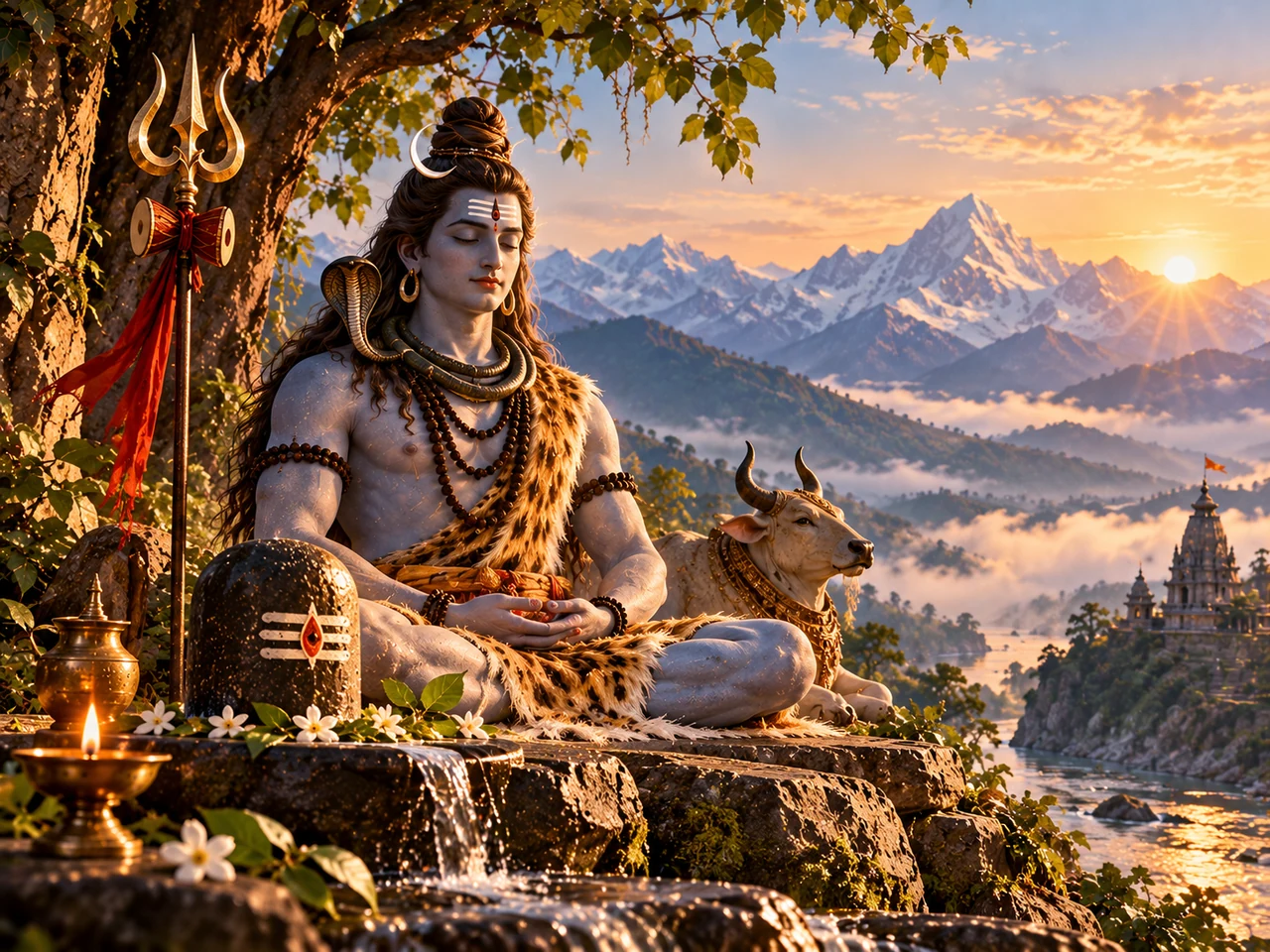
A figure sits in silence beneath the vast sky, his hair bound in matted locks. The same figure appears elsewhere surrounded by fire, dancing with a lifted foot. He can be a solitary ascetic and a father, a fearsome power and a compassionate refuge. These are not competing portraits to be tidied into one. Their tension is part of why Shiva has inspired storytellers, philosophers, artists and devotees across centuries.
Within Shaivism, Shiva is worshipped as supreme reality and lord. Other Hindu traditions place him within differently understood divine relationships. The familiar label “destroyer” captures only one dimension: Shiva's dissolution may signify the ending of a cosmic cycle, the fading of ignorance, or the transformation without which renewal cannot occur. This is a guide to major traditions and their evidence—not a claim that every community gives every image the same meaning. 2, 3
Names, meanings and identities
ShivaŚiva commonly carries the sense “auspicious” or “beneficent.” MahadevaMahādeva means “great god”; Maheśvara, “great lord”; ShankaraŚaṅkara suggests one who brings auspiciousness; Śambhu evokes well-being. Rudra, prominent in Vedic material, is associated with formidable power as well as healing and protection. The relation between Vedic Rudra and the later many-sided Shiva is an important history of religious continuity and change, not proof that all later stories already existed in their classical form in the earliest hymns. The Rigveda addresses Rudra with praise and petitions for safety and well-being (2.33). , prominent in Vedic material, is associated with formidable power as well as healing and protection. The relation between Vedic Rudra and the later many-sided Shiva is an important history of religious continuity and change, not proof that all later stories already existed in their classical form in the earliest hymns. The Ṛgveda addresses Rudra with praise and petitions for safety and well-being (2.33). 1, 2
Other names draw attention to specific images: Nīlakaṇṭha is the blue-throated one; Tryambaka is often understood as three-eyed; Paśupati is lord of creatures; Naṭarāja is lord of dance; Dakṣiṇāmūrti signifies Shiva as a teacher in a respected Shaiva iconographic tradition. Names are signposts into distinct bodies of devotion rather than a definitive checklist of identical attributes in all regions.
It helps to distinguish three ways people speak about Shiva. A devotee may address a present, responsive lord; a philosophical treatise may discuss ultimate consciousness or divine agency; a historian may trace texts, institutions and surviving images. None of these questions cancels the others, but each calls for different evidence.
Origins: from Rudra to diverse Shaiva traditions
The Vedic Rudra is powerful and potentially unsettling; petitioners seek his benevolence. In later religious literature, Shiva becomes central to elaborate myths, temple traditions, personal devotion and philosophical speculation. These developments unfolded across long periods and many communities. There is no single securely documented date when a fully formed “modern Shiva” emerged. 1, 2
Shaivism is not a single doctrine. Important strands include Shaiva SiddhantaŚaiva Siddhānta, traditions of Kashmir Shaiva thought, devotional communities in Tamil-speaking regions, ascetic orders and the Nath streams associated with yogic practice. These have different scriptures, approaches to liberation, social histories and accounts of the divine. The blanket statement that “all Shaivas believe X” is usually too strong. 2
Art adds another kind of evidence. Sculptures of Shiva as Nataraja flourished in South India; the mature Chola-period bronze format made cosmic motion visible in remarkably balanced form. A seventh-century Kashmir-region stone linga and a ninth-century Shahi-period linga show how Shiva's non-human-form emblem could take distinctive regional artistic forms. A dated sculpture establishes the presence of a form in that period; it does not date the first telling of every associated story. 3, 4, 5
The poison and the blue throat
In the celebrated churning of the ocean narrative, a deadly poison emerges before the sought-after treasures. Beings fear its spread. Shiva takes the poison to protect life; the episode explains the devotional epithet Nīlakaṇṭha. The Bhāgavata Purāṇa, book 8, chapter 7, explicitly describes Shiva taking the poison out of compassion and the dark mark it leaves on his throat. Versions across tellings differ in their details and emphasis. 6
For many readers, the story asks a practical moral question: what does power mean if it does not protect the vulnerable? The answer is symbolically vivid, not a recommendation to imitate consuming harmful substances. The miracle belongs to a sacred narrative, not to ordinary human physiology.
Sati, Daksha and the cost of arrogance
A widespread Puranic narrative cycle tells of Sati, her father Daksha's sacrificial event, and a grievous rupture surrounding Shiva's exclusion or dishonour. The narrative has several textual recensions and retellings, with significant differences in sequence and detail. It is often read through themes of respect, anger, loss and the danger of ritual pride without compassion. Exact passages and differences between recensions require a separate text-by-text check before any verse-level citation is published. 7
In the broader devotional cycle, Parvati undertakes sustained resolve in seeking union with Shiva. Their relationship is portrayed variously as the meeting of ascetic stillness and active power, or as a divine household with Ganesha and Skanda. These are religious literary accounts; they are not biographies with historically datable events.
The endless pillar of light
In the Liṅgodbhava narrative, Brahma and Vishnu seek the limits of a blazing, apparently endless pillar; neither can find its beginning or end. Shiva is revealed within it. This tale dramatizes divine immensity and the limits of competitive claims to supremacy. The Metropolitan Museum identifies the motif in Puranic and Agamic traditions and documents a Chola-period stone rendering of the scene. The narrative expresses a Shaiva theological perspective; it should not be recast as an objective ranking accepted by every Hindu school. 8
The dancer who moves without losing balance
Shiva's Naṭarāja form gathers apparently opposed actions into a single image: the rhythm of emergence, the fire of ending, a hand that reassures, and a lifted foot suggesting refuge. In influential South Indian interpretations, the figure beneath the dancing foot is Apasmāra, associated with ignorance or obscuration. The famous flame-encircled bronze iconography matured under the Cholas, while dance images have their own longer history. 3, 9
The dance can be read as a cosmic event, a devotional encounter or an image of awareness remaining steady amid change. These are interpretive levels; not every sculptural feature has only one fixed meaning everywhere.
Reading Shiva's images carefully
A common image shows matted hair (jata)matted hair (jaṭā), a crescent moon, Ganga associated with the locks, an eye on the forehead, a trident (triśūla), a small drum (ḍamaru), a serpent, ash and Nandi the bull. Worshippers often connect these with disciplined attention, time, sound, potency, transience and guardianship. Such readings should be introduced as traditional or interpretive meanings rather than proven original intentions of every artist. The museum records make it especially clear that particular art objects have identifiable attributes while individual configurations vary. 3, 10
The third eye is frequently interpreted as insight surpassing ordinary perception; stories also relate it to fiery power. Ash can recall impermanence and an ascetic's distance from social display. The moon can suggest a relationship with cyclical time. Nandi is both Shiva's mount and a figure honoured in temple settings. The symbolism is layered: a trident is not merely a diagram, and a serpent cannot be assigned one universal allegorical meaning.
What is a Shiva linga?
The lingaliṅga is a central sacred emblem of Shiva. Sanskrit lingaliṅga can mean “mark” or “sign,” though that lexical explanation alone does not exhaust its religious meanings. Some art-historical descriptions explicitly recognise a phallic and generative dimension; devotional practice may foreground divine presence, the formless approached through a form, or the limitless reality of the Liṅgodbhava story. It is misleading either to deny all generative symbolism or to reduce every devotee's worship to a purely anatomical reading. 4, 5, 8
A linga can be plain, face-bearing or installed in varied temple contexts. The object is not an interchangeable decorative stone: for worshippers, a consecrated shrine has a particular religious identity and practice.
Shiva and Shakti in one form
Ardhanārīśvara unites Shiva and Parvati/Shakti in a single composite figure, a powerful way to imagine inseparable complementary dimensions. A British Museum painting from Rajasthan, dated around 1790–1810, depicts the two halves with differing attributes. Interpretations of gender, divine power and non-duality differ across schools; the image does not by itself settle contemporary debates about those topics. 10
The questions Shaiva philosophies ask
What is the self? Why do conscious beings experience limitation? What frees them? Shaiva systems answer these questions differently. Some describe Shiva as the supreme lord, souls as genuinely distinct and liberation as dependent on divine grace. Some non-dual Kashmir Shaiva philosophies focus on recognition of consciousness as fundamental reality. Other lineages combine devotional practice, discipline and embodied yoga in different balances. These descriptions are orientation points, not claims that one simplified formula stands for every authoritative Shaiva text. 2
An especially useful distinction is between renunciation and indifference. Shiva's ascetic aspect does not prevent his household narratives; his association with cremation grounds does not mean devotees celebrate suffering. Sacred images place the boundary between life and death, attachment and release, in view rather than hiding it. Some devotees understand Shiva's grace not as a promise that hardship disappears, but as a resource for facing change without losing compassion.
The paired words Shiva and Shakti often describe stillness and dynamic capacity, but schools differ in whether these are considered distinguishable aspects, inseparable realities or theologically ranked powers. It is important not to use one modern slogan as a substitute for an entire philosophical tradition.
Shiva among Hindu traditions
For many Shaivas, Shiva is ultimate lord. For many Shaktas, the Goddess is ultimate power and Shiva's role is explained through her. Vaishnava narratives may honor Shiva profoundly while explaining his relation to Vishnu within their own theology. Other worshippers comfortably honor multiple forms without arranging them into a strict hierarchy. Such plurality belongs to the subject itself, not to an editorial problem to be erased. 2, 6
Shiva's family has become a shared visual language: Parvati, Ganesha, Kartikeya/Skanda, and Nandi are often pictured together, while stories and regional prominence differ. Bhairava is a significant fierce Shaiva manifestation, with distinct religious and temple contexts. Dakṣiṇāmūrti evokes the teacher; Naṭarāja the dancer; Paśupati the lord of creatures. These forms overlap without collapsing into one uniform cult.
Tamil devotional hymns and temple arts, Kashmiri philosophy, Himalayan pilgrimage and Nath yogic lineages reveal different ways Shiva becomes culturally present. Historical reconstruction must follow particular works, places and lineages rather than claim every local custom is timeless or identical.
Scripture and literature: where to begin
- Rigveda 2.33Ṛgveda 2.33 addresses Rudra; its portrayal is an early textual starting point, not a complete manual to later Shaivism. 1
- Bhāgavata Purāṇa 8.7, especially the poison episode, supplies a clear example of Shiva's compassionate action in a Purana revered beyond specifically Shaiva communities. 6
- Purana and Agama narrative traditions preserve the Liṅgodbhava motif; these include theological literature with multiple versions and historically layered transmission. The museum record is evidence for the motif, not a substitute for verifying the Sanskrit line of a particular edition. 8
- Shiva PurāṇaŚiva Purāṇa is an important Shaiva textual corpus, but its textual history and editions should be checked before quoting a chapter number from memory. The Sati–Daksha cycle here is therefore narrated without an invented verse citation. 7
ShivGoraksh has separately prepared the Bhagavad Gita, Devi Mahatmyam (Durga Saptashati) and Ashtavakra Gita. Their future publication does not make them direct substitutes for primary Shaiva texts. Links should be made only after specific passages and the website's approved scripture identifiers have been checked; no verse-level internal link is asserted here.
Devotion, festivals and lived practice
Mahāśivarātri is widely associated with special worship, night vigils, prayer and reflection on Shiva; local calendars, observances and explanations vary. ShravanaŚrāvaṇa (Sawan) carries special devotional importance in many regions, and PradoshaPradoṣa observance is associated with Shiva worship in numerous communities. There is no universal civil-calendar date attached here: lunar reckoning, locality and observance traditions matter.
People may visit a Shiva temple, listen to narratives, sing hymns, offer flowers or water, or repeat publicly familiar devotional names such as “Om Namah Shivaya.” The existence of widely known public practices does not authorize improvised initiation instructions. Specific mantra disciplines, nyāsa, tantric worship, restricted diagrams and lineage-bound vows should be learned within appropriate communities and are outside this introductory guide. Nor is there a promise of guaranteed health, wealth or supernatural results.
In many temples the linga is the focus of worship, while elsewhere a Nataraja image, a family image, a local guardian form or an aniconic natural site may be central. Describing these differences respectfully allows a beginner to see a living tradition rather than one supposedly universal checklist.
Is Shiva only the destroyer?
No. Destruction is one familiar theological role, often paired with creation and preservation or with the wider five activities articulated in some Shaiva readings of Nataraja. The label alone misses grace, insight, guardianship and devotion. 3, 9
Are Rudra and Shiva exactly the same in every ancient text?
Later traditions strongly connect them. Historical study nevertheless distinguishes the Vedic Rudra hymns from later extensive Shiva myths and institutional traditions. 1, 2
Does the linga have only one meaning?
No. Generative symbolism, sacred presence, emblematic form and cosmic imagery coexist in different sources and contexts. Dismissing any one dimension universally would distort the evidence. 4, 8
Is Nataraja a depiction of a literal astronomical event?
It is a religious and artistic image of cosmic activity; interpreting it as a verified scientific model would be an unsupported claim. 3
Is there one correct Shaiva philosophy?
Shaiva schools have substantial differences. This library describes their self-understandings without pronouncing one historically or spiritually superior. 2
Glossary
- Agama — A category of religious textual traditions important to several Shaiva ritual and theological lineages.
- Apasmara — Figure associated with ignorance/obscuration in well-known Nataraja imagery.
- Ardhanarishvara — Composite Shiva–Parvati form.
- Damaru — Small drum associated with Shiva.
- Linga — Sacred emblem/sign associated with Shiva, understood in multiple ways.
- Nandi — Bull associated with Shiva as mount and honored figure.
- Shaivism — Diverse traditions centered on Shiva.
- Shakti — Divine power, often personified as Goddess; interpreted differently across schools.
- Tandava — Term associated with vigorous or cosmic forms of Shiva's dance.
- Trishula — Trident carried by Shiva in many images.