



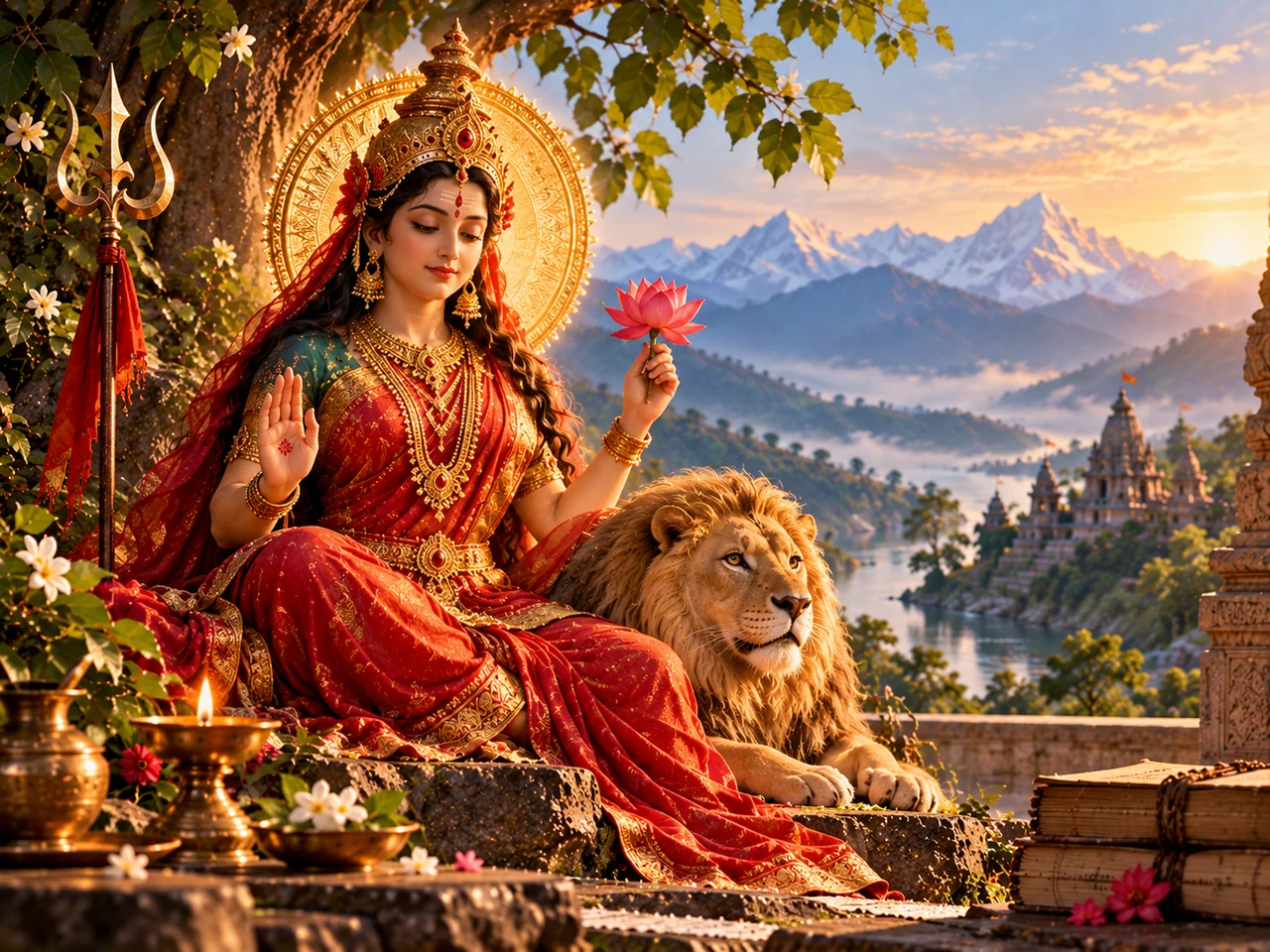
Who is Shakti?
A lamp can be beautifully made, but without light it cannot illuminate a room. In many Hindu traditions, Shakti names the power through which divine reality becomes active, perceptible and creative. The Sanskrit word shaktiśakti may mean power, capacity or potency. It can describe the power of a deity, the dynamism of the cosmos, and the Goddess (Devi) whom devotees address as Mother. These meanings overlap, but they are not interchangeable in every text or community. 5
For some Shaiva thinkers, Shiva and Shakti are inseparable aspects of a single divine reality. For many Shakta worshippers, Shakti is not merely someone else's energy: she is the ultimate divine reality, worshipped as Durga, Kali, Lalita, a local Mother Goddess or another beloved form. Still other Hindu traditions place goddesses within different theological relationships. This page offers a map of those perspectives rather than an attempt to force them into one answer. 5 7
The central question is not simply, “Which goddess is Shakti?” It is also, “How have Hindu communities understood divine power, protection, knowledge, change and the intimate presence of the sacred?”
Names, meanings and identities
Shakti (Shakti; शक्ति) is a Sanskrit noun meaning power or capacity; (Śakti; शक्ति) is a Sanskrit noun meaning power or capacity; Adi Shakti (Ādiśakti) commonly means primordial power in later devotional language. Devi means goddess, and Mahadevi can mean the Great Goddess. Jagadamba and Jagadjanani express the affectionate image of the Mother of the World. Ambika, Bhagavati, Chandika, Durga, Kali, Uma and Parvati are overlapping but not mechanically equivalent names, with histories and emphases of their own. 5 6
Three distinctions keep the subject clear:
- Shakti as a quality or agency: the power to create, know, act, sustain or transform. A source may speak of a god's shakti without presenting an independent goddess as its supreme deity.
- Shakti as the worshipped Goddess: a devotee may meet that same sacred power personally, as a Mother who hears prayer, a warrior who confronts injustice, or wisdom that dispels confusion.
- Shakti as a theological principle: Shakta and certain Shaiva philosophies develop sophisticated accounts of the relationship between consciousness, manifestation and divine freedom. Their technical terms should not be flattened into modern physics. 5 13
The familiar names Parvati and Uma often foreground the relationship with Shiva; Durga frequently evokes protection and battle; Kali can evoke time, mortality and fierce compassion; Lalita Tripurasundari is central to Shri Vidya traditions. These are helpful entry points, not a universal hierarchy of forms. is central to Sri Vidya traditions. These are helpful entry points, not a universal hierarchy of forms. 8 11 12
From Vedic voices to the Great Goddess
The history of Goddess traditions is longer and more varied than any single origin story. The Rigveda's hymn 10.125Ṛgveda's hymn 10.125, often called the Devi Sukta or Vak Sukta, speaks in the first person through a powerful feminine sacred voice associated with Vak. This voice describes an encompassing agency among divine powers and throughout the world. Later Goddess-centred interpretation reads the hymn as an important witness to the universality of Devi. Yet a Vedic hymn is not, by itself, proof that every later image of Durga or Lalita already existed in its later form. The surviving Sanskrit hymn and an identified nineteenth-century translation were consulted for this distinction. 1 2
A different and memorable image occurs in the Kena Upanishad. After a mysterious encounter humbles the gods, Indra meets Uma Haimavati. She identifies the mysterious presence as Brahman, the ultimate reality whose victory the gods had mistakenly claimed as their own. The scene gives the feminine figure a role as revealer of true knowledge; it should not be expanded into a complete later Shakta theology that the Upanishad itself does not set out. 3
In subsequent centuries, goddess devotion found many forms in regional cults, temple art, Purana narratives and Tantric traditions. The Devi Mahatmyam (Durga Saptashati), embedded in the Markandeya Purana, is an especially influential Sanskrit work: in three large narrative movements it presents a Goddess who rescues cosmic order and whose presence reaches through ordinary life. Scholars regard this as a major articulation of the Great Goddess; the dating of individual layers and any direct line from a Vedic hymn to a later sect remains a more complicated historical question. 4 6
Because festivals, images and oral narratives were not all preserved in writing at the same moment, first surviving attestation should not be mistaken for the birthday of a living tradition. Historical description traces evidence; devotional accounts express sacred significance. Both matter, but they answer different questions.
1. The wisdom of Uma in the Kena Upanishad
The gods have won a victory and become proud. An extraordinary presence appears, but even Agni and Vayu cannot demonstrate the powers they boast of before it. Indra approaches; the presence disappears, and he encounters a radiant woman, Uma Haimavati. She explains that the glory belonged to Brahman. 3
The power of this story lies in its reversal. Knowledge arrives not through a louder claim to power, but through humility and instruction. Uma here is a teacher who can name what the gods have failed to recognize. It is a textually attested teaching episode, not a claim that the Upanishad narrates Parvati's whole later biography.
2. The sleeping Vishnu and Mahamaya
At the opening of the Devi Mahatmyam (Durga Saptashati), a cosmic crisis unfolds while Vishnu sleeps. Brahma addresses the great Goddess associated with Yoganidra, the divine sleep enveloping Vishnu, and invokes her so that the threat of Madhu and Kaitabha can be met. The episode treats the Goddess as more than an ornament beside a male deity: her presence shapes the conditions in which action becomes possible. 4
Readers may notice a paradox. Sleep can mean obstruction, but it can also suggest a world held within a deeper power. The text's devotional language makes that power worthy of praise. This is interpretation of the narrative, not a scientific account of sleep or creation.
3. The many powers of the gods and Mahishasura
When Mahishasura and his forces overwhelm the gods, the Devi Mahatmyam (Durga Saptashati) tells how their radiance or powers come together in a magnificent Goddess. The deities furnish weapons and emblems; she confronts an opponent who changes forms and ultimately defeats him. The narrative spans the middle movement of the work, notably chapters 2–4. 4
One way devotees understand the story is as the triumph of protective strength over destructive arrogance. But the text also grants the Goddess decisive agency: she is not simply a passive vessel for weapons borrowed from others. Historical sculptures of the buffalo-demon battle confirm that communities visualized the story in distinctive artistic forms across regions. The art provides evidence for representations, not eyewitness evidence of the narrated combat. 9
4. A Mother present in minds, lives and aspirations
The Devi Mahatmyam (Durga Saptashati) does not restrict the Goddess to a battlefield. Its fifth chapter repeatedly praises her presence in beings as intelligence, hunger, peace, memory, compassion, motherhood and shakti. In chapter 10, as her manifestations return to her, the Goddess declares her oneness before Shumbha. At the close, King Suratha seeks restored worldly sovereignty while the merchant Samadhi asks for knowledge freeing him from possessive attachment. The Goddess grants different boons. 4
Together these passages suggest an expansive devotional imagination: the sacred can be recognized in struggle and tenderness, in ordinary human faculties, and in differing human needs. The story's promises are part of its religious world; they should not be advertised as guaranteed results of reading a website.
Images and symbols: no single portrait of Shakti
There is no one obligatory appearance for a principle expressed through so many goddesses. Rather than reading all symbolism into a chosen illustration, it helps to recognize particular iconographic traditions.
Ardhanarishvara, the half-female, half-male form joining Shiva and Parvati, makes unity visible without erasing distinction. Sculptures and paintings may place identifiable attributes on either side. A thirteenth-century Kerala bronze held by the Metropolitan Museum of Art is one historical example of the combined form; it establishes the existence of that representation, not a single fixed interpretation accepted by every school. 10
A Gauri or Parvati image may appear poised, crowned and ornamented, sometimes with a lotus or other auspicious attributes. A tenth-century central Indian Gauri sculpture also illustrates why iconography requires care: surviving hands, local vehicles and formal features cannot be generalized to every image of Shakti. 8
Durga is often represented with multiple arms, weapons and a lion or tiger, especially as Mahishasuramardini. These features point toward her protective and martial narrative. Even here, the exact number and selection of arms or weapons depend on the work, period and region. 9
Kali may carry imagery associated with death, time or fierce transformation; such imagery is not permission to reduce her to cruelty. In devotional contexts she can also be approached as a compassionate Mother. A particular Kali picture cannot stand for every Kali tradition. 11
Other traditions picture Shakti through Shri ChakraSri Chakra, a sacred geometric form particularly important in Shri Vidya. Its visual identity belongs to a specific practice and philosophical setting. A diagram copied casually online is not a substitute for understanding its transmission or initiation norms. this edition contains no ritual diagram or operative instructions. , a sacred geometric form particularly important in Sri Vidya. Its visual identity belongs to a specific practice and philosophical setting. A diagram copied casually online is not a substitute for understanding its transmission or initiation norms. this edition contains no ritual diagram or operative instructions. 12
Shiva and Shakti: inseparability without sameness of schools
A common image pairs Shiva as consciousness or stillness with Shakti as manifestation or dynamic capacity. It can be a helpful introduction, provided it is not mistaken for the entire philosophy of all Hindus or even all Shaivas. Some nondual Shaiva thinkers describe ultimate consciousness as inherently self-aware and dynamically expressive; their accounts are subtler than a division in which a passive man owns an active woman. 13
Within many Shakta systems, the Goddess does not need to be defined by a husband. She is the origin, presence and goal of the religious world. A Goddess-centred hymn may call her Mother of everything, while a Shaiva temple image may describe Parvati in intimate union with Shiva. These are not errors to be tidied away; they are different devotional and philosophical orientations. 5 7
For beginners, Ardhanarishvara offers a useful question rather than a final proof: what becomes possible when apparent opposites—silence and expression, consciousness and action, masculine and feminine—are seen in relationship? The icon can invite thought about interdependence, but it should not be treated as a literal rule about human sex roles or a complete social theory.
Philosophical paths: power, knowledge and liberation
Shakta texts may speak of prakriti (nature or the matrix of manifestation), maya (a context-dependent term for divine power of appearance or delusion), and shakti (agency or potency). These words are related but not synonyms. Nor does “energy” here necessarily mean energy as measured in a physics laboratory. A conceptual bridge can help a reader understand a tradition; it should not turn theology into an empirical scientific finding. 5 6
Bhakti, the path of loving devotion, finds room for trust, gratitude, questioning, fear and tenderness toward the Mother. Devotees may speak as children addressing an intimate presence, while others approach the Goddess as sovereign beyond comparison. In daily life, the philosophical question can become personal: what would it mean to combine courage with compassion, or activity with self-knowledge? Those are reflective applications, not specific promises made by every scripture. 7
Shri VidyaSri Vidya places Lalita Tripurasundari at the centre of a distinctive Shakta Tantric tradition and elaborates meanings of the goddess, sacred diagrams and mantras. Academic studies show a historical body of literature with variations, commentaries and initiation practices. Public description of its history does not authorize publication of restricted mantras, procedures or an invented self-initiation program. 12 14
Several routes of practice appear across Goddess traditions: temple worship, hymn recitation, village festivals, service, contemplation and teacher-guided discipline. These should not be arranged as a ranking that everyone shares. The goal of moksha, liberation, also receives different explanations across schools.
The Goddess across Hindu communities
In Bengal, Durga Puja unites sacred narrative with artistry, public gatherings and the affectionate theme of the Goddess visiting her natal home. Kali devotion is also particularly visible. In Gujarat, many Navratri gatherings bring devotion into collective dance such as garba. In parts of southern India, households and temples commemorate the Goddess through their own arrangements, images, songs and regional names. There is no single pan-Indian script for observing every festival. 11 15 16
A worshipper of Lakshmi may emphasize well-being and auspiciousness; a devotee of Saraswati may honour learning and expression; devotees of Durga, Kali, Parvati or Lalita may approach other dimensions of divine femininity. Some theological systems unite such forms within Mahadevi; others honour their distinct relationships, such as Lakshmi's association with Vishnu. Respecting Shakti's breadth means not silently absorbing every goddess into a single sectarian account. 5 7
Local grama-devis (village goddesses) and sacred places also belong to the wider landscape. They may carry histories and rituals not fully documented by the major Sanskrit works. A serious library should make room for local testimony while stating clearly when the source is regional or the origin uncertain.
Where to read about Shakti in scripture
| Text or passage | Why it matters | Reading caution |
|---|---|---|
| Rigveda 10.125Ṛgveda 10.125 (Vak / Devi Sukta) | An expansive sacred feminine first-person voice. 1 | Later Shakta reception is not proof of identical original Vedic theology. |
| Kena Upanishad 3.12–4.1 | Uma Haimavati explains the truth of Brahman to Indra. 3 | A concise episode, not a complete later Parvati biography. |
| Devi Mahatmyam (Durga Saptashati) 1 | Mahamaya/Yoganidra in the cosmic narrative. 4 | Distinguish base text from attached liturgical supplements in compilations. |
| Devi Mahatmyam (Durga Saptashati) 2–4 | The Goddess and Mahishasura. 4 | Artistic retellings vary in detail. |
| Devi Mahatmyam (Durga Saptashati) 5; 10; 11; 13 | Presence in beings, unity of forms, praise and differing boons. 4 | Verse divisions and liturgical numbering require edition checking before quotation. |
The Devi Mahatmyam (Durga Saptashati) is already a separately prepared ShivGoraksh scripture project. Its publication and link availability are not assumed here; any future internal link must be attached only after its edition-level verification and release. The Bhagavad Gita and Ashtavakra Gita also exist as separate preparation projects, but this article does not borrow unverified verses from them or pretend they already have public routes.
Devotion and festivals: what visitors may encounter
Public expressions of devotion include namaskara (a respectful bow), visiting a temple, listening to stories, singing accessible hymns and joining a community celebration. In many homes a simple expression of gratitude to the Divine Mother is enough to give daily devotion a personal meaning. These are descriptions, not claims that one rite is compulsory, medically effective or certain to produce miracles. 7
Navratri, the “nine nights,” is observed in more than one season and in varied regional ways. Durga Puja is particularly prominent in eastern India; garba is an important part of many Gujarati celebrations. Other communities honour forms such as Gauri, Amba, Kali or Lalita on locally meaningful occasions. Calendars are lunar and region-dependent, so this evergreen page gives no fixed annual Gregorian date. 15 16
Certain Tantric, mantra, nyasa, chakra or lineage-dependent practices fall outside an introductory public article. Where a community requires initiation (diksha), neither a web explanation nor a downloadable picture substitutes for qualified guidance. Shakti devotion is not confined to those disciplines, however: song, prayer, learning and service also matter across communities. 12 14
Is Shakti a goddess or an energy?
Both usages exist, but context decides the meaning. Sometimes shakti means power or capacity; in Shakta devotion the Goddess herself may be supreme reality. “Energy” is a convenient English analogy, not a scientific equivalence. 5
Is Shakti simply another name for Parvati?
Parvati is a central manifestation or relationship in many Shaiva accounts, but “Shakti” has a wider theological range. Durga, Kali and Lalita have their own literary and living traditions; the exact relationship among forms varies by school. 5 12
Does Shakti have to be subordinate to Shiva?
No single answer describes all traditions. Some Shaiva formulations emphasize inseparability; Shakta traditions may understand the Goddess as the highest reality. One perspective should not be advertised as binding on the others. 5 13
Are fierce goddesses opposed to maternal compassion?
Not necessarily. Protection, the ending of threats, tenderness and time's unsettling power can coexist within a tradition's portrait of the Goddess. Individual texts and worshipping communities need to be heard in context. 7 11
Does every Shakti practice require secret initiation?
No. Many public prayers and festivals are openly shared. Specific Tantric disciplines may be initiation-dependent, and the boundaries differ among lineages. 12 14
Glossary
| Term | Plain-language meaning |
|---|---|
| Shakti (Shakti)Shakti (Śakti) | Power, capacity or divine potency; also the worshipped Goddess in context. |
| Devi / Mahadevi | Goddess / Great Goddess. |
| Shakta (Shakta)Shakta (Śākta) | Devotee or school devoted centrally to the Goddess. |
| Shaiva (Shaiva)Shaiva (Śaiva) | Devotee or school focused on Shiva. |
| Prakriti (Prakṛti) | Nature or basis of manifestation, interpreted differently across schools. |
| Maya (Māyā) | Power of appearance or concealment; interpretation is school-dependent. |
| Ardhanarishvara | Composite Shiva–Parvati form expressing a unity of difference. |
| Shri Vidya (Shrividya)Sri Vidya (Śrīvidyā) | Goddess-centred Tantric tradition principally associated with Lalita Tripurasundari. |
| Diksha (Diksha)Diksha (Dīkṣā) | Initiation transmitted according to a lineage's rules. |
| Bhakti | Loving devotion or religious participation through a personal relationship. |