



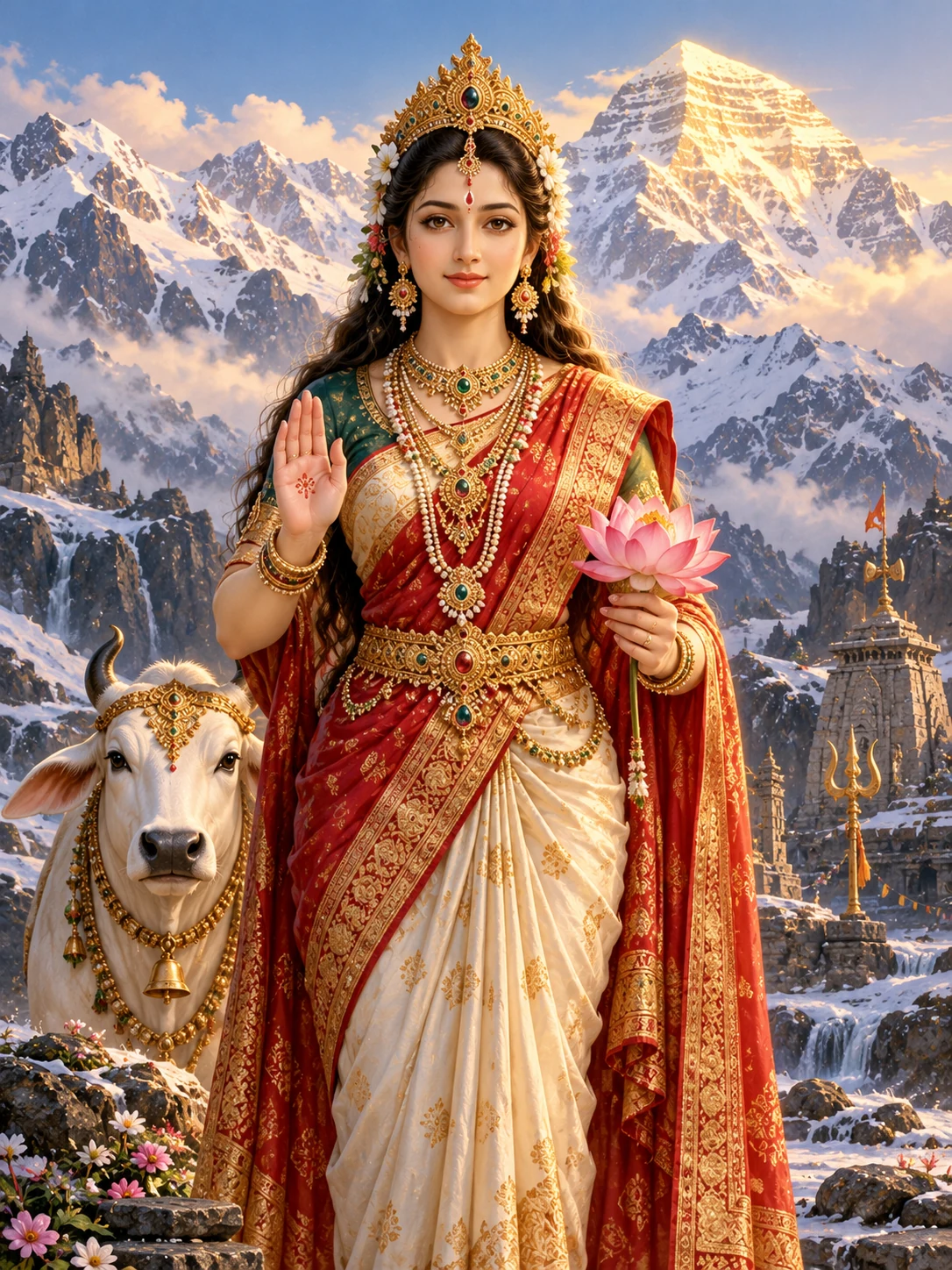
Who is Parvati? In one familiar image, she sits beside Shiva on a mountain, a quiet companion to the great ascetic. In another story, she leaves royal comfort and undertakes an extraordinary discipline of her own choosing. In yet another, she protects a child she has created and challenges even Shiva's attendants. These are not competing pictures of a passive wife. Together they reveal a divine figure associated with steadfast purpose, affectionate family life, insight and Shakti—the power through which sacred reality becomes active.
Parvati is widely revered as the wife of Shiva and as the mother of Ganesha and, in many tellings, Skanda or Kartikeya. She is also known as Uma, Gauri, Haimavati, Girija and Shailaja. Shakta traditions may understand the Goddess as supreme in her own right, not simply as an adjunct to a male deity. The names and identities meet in living worship, but the way they meet is not identical in every scripture, region or theological school. 1 8
A helpful way to begin: Parvati is not merely a character in Shiva's story. Stories about her decision, penance, family and divine manifestations ask what strength looks like when it takes the forms of patience, knowledge, tenderness and protection.
Names and identities: why is she called Uma or Gauri?
Parvati means daughter of the mountain, recalling her father Himavat or Himachala, the personified Himalaya. Girija and Shailaja express a related idea of mountain-born daughter. Haimavati connects her with Himavat; Uma is an important ancient name whose precise derivation should not be reduced to a single folk explanation. The Shiva Purana, for example, explains Uma through Mena's attempt to dissuade her daughter from severe penance. That is a story-world etymology, not proof that every earlier use of the name had the same origin. 3
Gauri commonly evokes a bright or radiant aspect of the Goddess, often understood in connection with marital auspiciousness. Ambika means a motherly goddess in many contexts. Aparna is explained in the Shiva Purana as a name earned when Parvati refused even leaves as food during her legendary austerity. These overlapping names are not evidence that one uniform biography applies to every ancient hymn or local goddess cult. 3 8
For searching and reading, Parvati Mata, Maa Parvati, Uma Maheshwari, Gauri Mata, Girija, Haimavati, Aparna, Shivani and Shailputri are useful related terms. Shailputri also names the first of the nine Navadurga in a separate festival classification. That Navadurga list should not be mistaken for a complete list of Parvati's names across all traditions. Similarly, Shankar is widely a name of Shiva; it does not automatically mean Parvati is married to someone other than Shiva.
From early references to Puranic narratives
The Kena Upanishad, in its third and fourth sections, presents Uma Haimavati as a luminous figure who tells Indra that the mysterious divine presence was Brahman. This is especially important because she appears as a revealer of knowledge. It would be a mistake, however, to claim that this Upanishadic scene already supplies the entire later Puranic account of the daughter of Mena marrying Shiva, or to assign it a precise date from this passage alone. 6
Much later literary and religious works tell extended stories about the mountain princess. The Shiva Purana's Rudra-samhita, Parvati-khanda narrates her birth, encounters with Shiva, tapas (disciplined austerity) and marriage. Kalidasa's Kumarasambhava develops this union as classical Sanskrit poetry, with beauty and longing intertwined with spiritual concentration and the need for a divine child. These are related literary worlds, not interchangeable textual editions. 1 14
The historical evidence looks different again. Sculptures of Uma–Maheshvara, Parvati with Ganesha and Skanda, and Ardhanarishvara survive from several places and centuries. Museums can identify the date, region and attributes of particular artworks; they cannot establish when a divine marriage 'really happened'. Material evidence records how people represented and honored the Goddess in identifiable communities. 9 12
1. Sati returns as the daughter of Himavat
A recurring Shaiva narrative begins before Parvati's birth. Sati, daughter of Daksha and wife of Shiva, abandons her body after the conflict surrounding her father's sacrifice. The Shiva Purana connects her subsequent appearance as the daughter of Himavat and Mena with the renewal of her bond with Shiva. Its Parvati-khanda names this reincarnation directly and later depicts the joyful arrival of the divine child in the mountain household. 1 2
The appeal of the story lies partly in its contrasting settings: the ancient grief of separation and the tenderness of parents welcoming a daughter. For devotees, continuity across Sati and Parvati speaks of a divine relationship that survives loss. For a historian, this is a Puranic theological narrative, not proof of a datable human reincarnation. Other Goddess traditions arrange their genealogies differently.
2. Tapas, disagreement and a freely pursued goal
Shiva appears as an uncompromising ascetic, absorbed in meditation rather than palace life. Parvati's resolve to join him is tested. In Parvati-khanda chapter 22, she tells her parents of her wish to undertake tapas; her mother Mena fears the hardship and asks her not to go. Parvati persists, eventually receives permission and enters the mountain landscape to practise austerity. The text explains the names Uma and Aparna within this episode. 3
This is more than a tale of 'winning a husband'. Within the narrative, Parvati has an intention that does not vanish when relatives disapprove. Her discipline shifts attention from inherited privilege or outward adornment toward self-direction. At the same time, the extreme fasting and exposure described by the Purana are literary and religious motifs, not safe health advice or universal instructions. No reader should attempt to copy such practices.
The Shiva Purana also portrays Shiva testing her commitment through disguise and difficult conversation before revealing himself. In the marriage chapters, even the family wonders how the unclassifiable ascetic fits ordinary social expectations. That tension is deliberate: the apparently homeless yogi becomes part of a home without becoming less mysterious. 1
3. A wedding between two ways of life
The wedding account is unusually vivid. Himavat and Mena prepare for the marriage; the guests include celestial beings; Shiva's procession unsettles familiar expectations about a desirable bridegroom. Chapter 48 of the Parvati-khanda culminates in the joining of Shiva and Parvati's hands, while a dialogue about Shiva's lineage reminds the assembly that he cannot be reduced to a conventional human pedigree. 4
Many families encounter the couple as Uma–Maheshvara: Shiva and Parvati seated together, often with signs of affection rather than cosmic battle. A Nepalese copper-alloy sculpture from the eleventh century, described by the Metropolitan Museum, preserves this intimate conception. Such images let devotion imagine divine power as companionship, yet they do not imply that every school teaches the same theory of marriage, gender or cosmic authority. 9
4. The child at the doorway: Parvati and Ganesha
In Shiva Purana, Rudra-samhita, Kumara-khanda chapter 13, Parvati desires an attendant who will follow her instructions, and she creates a boy whom she calls her son. She appoints him to guard her privacy. Shiva arrives, does not recognize the boy and is stopped at the entrance. Conflict follows; subsequent chapters recount the loss of the child's head, restoration and recognition as Ganesha, chief of the ganas. The chapter itself acknowledges other accounts of Ganesha's birth. 5
Read from Parvati's perspective, the episode concerns agency, boundaries and maternal protection. She is not simply watching a disagreement between male figures; the child was created on her initiative. It is also important not to export this one telling as the only pan-Hindu version. Several narratives and regional traditions differ about Ganesha's origins.
A fifth connection: Parvati and the emergence of Kaushiki
The Devi Mahatmyam (Durga Saptashati), chapter 5, introduces Parvati coming to the Ganga while the gods praise the Goddess. An auspicious form, Ambika or Kaushiki, emerges from Parvati's bodily sheath; the narrative then describes Parvati taking a dark appearance and being called Kalika. This is an important specific textual relationship among Parvati, Ambika, Kaushiki and Kalika, not a licence to announce that every form called Kali or Durga has exactly the same biography in every tradition. 7
Readers exploring the already prepared ShivGoraksh Devi Mahatmyam (Durga Saptashati) project can compare this scene with its wider Shumbha–Nishumbha story when the scripture is independently reviewed and published. That scripture project is not assumed to be live, and this page does not reproduce its chapter material.
What does Parvati look like in sacred art?
There is no single exclusive Parvati portrait. In Uma–Maheshvara works she may sit on Shiva's knee or beside him; in a family composition she may appear with Ganesha and Kartikeya. A tenth-century Gauri sculpture in the Metropolitan Museum has multiple arms and ornaments, and its surviving lotus supports a seated Ganesha. The museum notes that textual iconographic prescriptions allow variation in her attributes. Her appearance cannot be deduced reliably from a generic website thumbnail. 8
A British Museum relief from Odisha portrays Hara–Parvati, attended by a lion and Nandi, alongside musicians and ritual objects. Elsewhere Parvati is two-armed, holding a lotus or a mirror, while another work presents her as a many-armed goddess. The animal near a sculpture is meaningful only after checking that object's specific historical identification: a lion next to Parvati does not automatically turn the whole relief into a depiction of Durga defeating Mahishasura. 13 18
Ardhanarishvara: two halves, one form
In Ardhanarishvara, Shiva and the Goddess appear as the two halves of one body. The imagery can express the inseparability of Shiva and Shakti, or the completeness of a sacred reality that includes contrasted principles. A Kerala bronze in the Met and an eleventh-century sculpture documented by LACMA demonstrate distinctive iconographic solutions; theological interpretations vary. This is not a claim that Shiva and Parvati are absent as individually worshipped forms. It is another way traditions think about their relation. 10 11
Shakti, knowledge and family: philosophical significance
Shakti can mean power or capacity. In many Shaiva and Shakta settings, the Shiva–Parvati relation becomes a way of reflecting on stillness and expression, consciousness and manifest energy, or complementary dimensions of a single reality. These are interpretive frameworks, not one formula accepted unchanged by all Hindu communities. For some Shakta devotees, the Goddess herself is supreme; Parvati is not defined only by her husband. 11
Parvati also invites thinking about knowledge. Uma Haimavati in the Kena Upanishad makes divine reality intelligible to Indra. In the Puranic tapas story, knowledge is approached through commitment rather than display. In household imagery, even an ascetic can be present in the world of children and relationships. The texts do not offer a simple instruction to abandon family life or to make marriage a compulsory spiritual achievement. 6 3
A family image can be particularly welcoming to beginners: Shiva, Parvati, Ganesha and Skanda make complex religious ideas visible through care, disagreement, responsibility and belonging. It is better to say 'in many traditions' when describing such a divine family, because narratives of Skanda's birth and Ganesha's parentage differ by text and region. A fourteenth-century Javanese sculpture shows Parvati flanked by both sons, demonstrating how this idea traveled beyond the Indian subcontinent. 12
How do Parvati, Durga and Kali relate?
An easy answer—'they are completely separate'—would misrepresent many Shakta traditions. The opposite easy answer—'they are absolutely identical in every story and ritual'—would also flatten real diversity. Parvati/Gauri/Uma frequently foregrounds the mountain daughter, bride or mother. Durga may foreground the protective, martial Goddess; Kali may foreground fierce liberation, transformation and motherly refuge. Yet texts, images and devotional songs repeatedly bring these identities together, sometimes explicitly. 7 17
In Bengal, Agamani traditions imagine Uma or Durga returning to her parents' home. A British Museum painting preserves the emotional welcome of Himavat's household. This belongs to a particular literary and cultural understanding of the Goddess: the same festival may honor her as a visiting daughter and a victorious protector. Those meanings coexist without demanding that every regional icon have exactly the same attributes. 17
Festivals and public devotion
Gangaur, particularly associated with Rajasthan, venerates Gauri and Shiva through processions, household observances and regional arts. Official Rajasthan tourism materials describe its meanings in relation to the marital pair and springtime celebration. They document a living practice, not a command that every devotee must seek marriage or perform the same household rites. 15
Hartalika Teej in parts of India and Nepal often recalls Parvati's persistence and union with Shiva. Nepal's tourism board describes family visits, song and dance, and fasting traditions, while the Pashupati Area Development Trust links the festival to the devotional narrative. Fasting customs are culture-specific and voluntary, may carry health risks, and should never be presented as universal requirements or guarantees of longevity. 16 19
Gauri worship appears in other regional festivals, and many Shaiva devotees honor Parvati together with Shiva during religious observances. Navratri may involve her through particular regional identifications of the Goddess, but the nine Navadurga and the thirteen chapters of the Devi Mahatmyam (Durga Saptashati) are different frameworks. Festival dates move with local calendars; this timeless article does not supply unverified civil dates.
Public devotion may include listening to narratives, visiting a temple, singing, offering flowers or reflecting on the Goddess's qualities. Tantric initiation, restricted mantras and lineage-specific procedures are outside this public reference article. No effectiveness or medical outcome is promised.
Is Parvati the same as Shakti?
Shakti often names divine power itself, while Parvati names a widely worshipped Goddess with particular stories and identities. Many traditions see her as an embodiment of Shakti; some Shakta readings accord the Goddess ultimate status. The words overlap but are not always interchangeable categories.
Are Uma and Gauri two different wives of Shiva?
Common Shaiva usage treats them as names or forms associated with Parvati, not two unrelated wives. A source referring to Uma or Gauri must nevertheless be read in its own literary context. 8
Is the Upanishadic Uma certainly the same as every later Parvati portrait?
The Kena Upanishad names Uma Haimavati and portrays her explaining Brahman; later Hindu tradition strongly connects her with Parvati. The verse alone does not give the complete later iconography, marriage plot or children's names. 6
Is Parvati only gentle, while Durga and Kali are separate fierce goddesses?
No universal separation holds. Their relationships vary by scripture, sect, iconography and locality. The Devi Mahatmyam (Durga Saptashati) itself explicitly links Parvati, Kaushiki and Kalika, while regional devotion connects Uma with Durga. 7
Does Parvati's tapas mean people should practise extreme fasting?
No. It is a traditional religious narrative about extraordinary resolve, not a health recommendation or a replicable spiritual prescription. Daily self-discipline need not involve bodily deprivation.
Are Shiva and Shankar two husbands or two gods in Parvati's stories?
In much Hindu worship, Shankar is a name or epithet of Shiva. ShivGoraksh maintains separate educational pages to address different reader questions, not to invent a separate spouse or deity.
A short glossary
- Parvati (पार्वती):Pārvatī (पार्वती): Goddess, commonly understood as daughter of the mountain.
- Umā (उमा): An important name of the Goddess; the Kena Upanishad describes Uma Haimavati.
- Gaurī (गौरी): Name associated with a radiant, auspicious form of the Goddess.
- Himavat / Himācala (हिमवत् / हिमाचल): Personified Himalaya, Parvati's father in many narratives.
- Menā / Menakā (मेना / मेनका): Parvati's mother in prominent Puranic tellings.
- Tapas (तपस्): Religious discipline or austerity; not automatically extreme fasting.
- Shakti (शक्ति):Śakti (शक्ति): Divine power or energy; understood differently in different schools.
- Uma–Maheśvara (उमा-महेश्वर): Image or name of Shiva and Parvati together.
- Ardhanārīśvara (अर्धनारीश्वर): Composite half-male, half-female form of Shiva and Shakti.
- Kauśikī (कौशिकी): Goddess emerging from Parvati in the Devi Mahatmyam (Durga Saptashati) episode.
- Āgamanī (आगमनी): Bengali songs and traditions imagining Uma's arrival at her parents' home.