



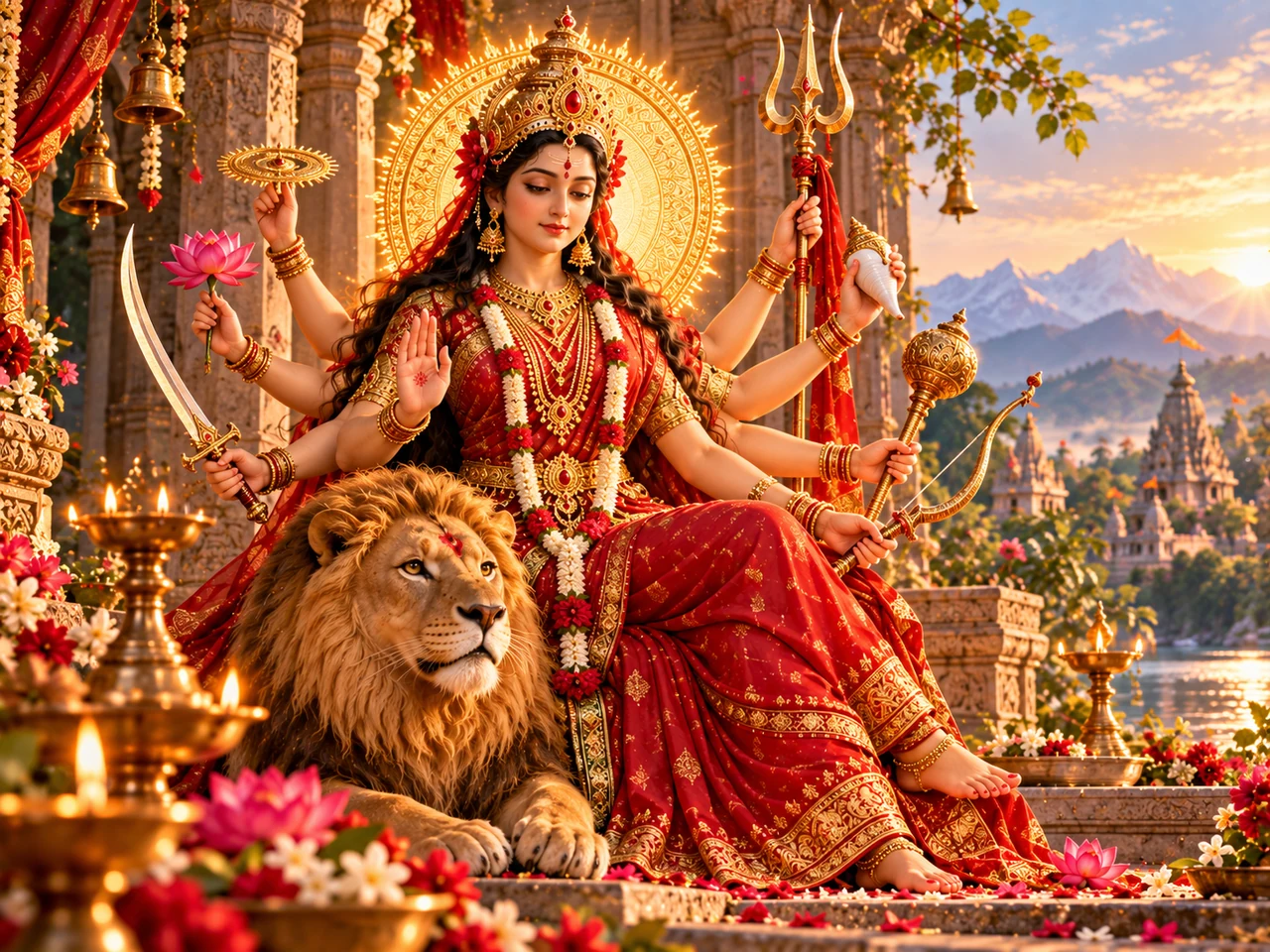
Editorial edition notice: Complete selected Roman-script rendition of the forty numbered couplets plus one separately printed closing invocation, aligned to the fixed Wikisource revision 1. The words remain Hindi in Roman script; they are not English translated lyrics. Public release is blocked pending specialist and licence review.
What is this devotional work? The Durga Chalisa is a North Indian devotional hymn in Hindi with regional poetic forms. Its verses approach Durga not only as the heroic vanquisher of threatening beings but also as the Mother who feeds, enlightens and listens to an ordinary devotee’s troubles. The movement from cosmic radiance to a small personal appeal makes the text easy to enter emotionally: first we meet the Goddess of the three worlds, and finally we hear a person asking for refuge. 1
A chalisa traditionally denotes a forty-unit devotional composition. Here the named witness numbers forty couplets and then prints one final, unnumbered invocation. That final couplet is displayed rather than hidden or reclassified as a doha without proof. The selected Roman spelling is meant to be readable by non-Devanagari readers; its approximations do not create a new original poem.
How to read its images and divine names
Jyoti and nirankar: The Goddess’s light points to a presence not confined to one bodily image. Yet moon, fierce eyes, lion and weapons make that presence accessible through form. These two modes—beyond form and encountered through form—can coexist in devotional poetry. Shakti denotes power or dynamic potency and is much more than physical force. 1
Annapurna, Lakshmi, Saraswati and Gauri: The hymn names nourishment, prosperity, learning and family-connected tenderness together with fiercer manifestations. This expresses a Shakta theological identification, in which one ultimate Goddess may be worshipped in many names. It should not erase the distinct histories or philosophical differences of Vaishnava, Shaiva and other Devi traditions. Weapons, lion, sword and skull-bowl: These are traditional religious images of courage, protection and the defeat of forces that threaten order. The sword and trident are not instructions for violence against real persons. Historical Durga sculptures also present the lion, trident and buffalo-demon episode in recognizable forms. 5
Stories and historical boundaries
The victory over Mahishasura and the later conflicts with Raktabija, Shumbha and Nishumbha echo episodes narrated in the Sanskrit Devi Mahatmyam (Durga Saptashati) (the Durga Saptashati). The Chalisa is not a chapter or verbatim extract of that scripture: it is a separate vernacular retelling that compresses multiple episodes into short couplets. See the chapter map for the Mahishasura conflict (chapters 2–3), Raktabija (chapter 8), Nishumbha (chapter 9), and Shumbha (chapter 10). 4
One couplet says the Mother took Narasimha’s form and protected Prahlada. In familiar Vaishnava storytelling Narasimha is Vishnu’s avatar; this is a Shakta framing of the divine power behind the event. The selected line then reads Hiranyaksha. The better-known Prahlada narrative concerns his father Hiranyakashipu. Neither the line nor the narrative should be silently rewritten to agree with the other. 1 2
Another cluster tells a story about Shankar Acharya not recognizing Shakti and later obtaining her grace. This is best treated as a devotional teaching-story, not as a verified incident in the historical life of Adi Shankaracharya. It emphasizes that spiritual understanding and divine power cannot simply be separated within the hymn’s worldview. No historical date or named primary source for the anecdote has been independently established.
Places, forms and difficult readings
Hinglaj and Nagarkot are place-associated forms in Goddess devotion. The hymn invokes them as signs of her wide presence; it is not a travel guide and offers no festival or pilgrimage timing. Matangi, Dhumavati, Bhuvaneshwari, Bagalamukhi and Tara also point toward Mahavidya-associated vocabulary. This public reader explains names and imagery; it provides no initiation, bija-mantra, nyasa, yantra or specialized ritual procedure. The witness prints “श्री भैरव”, “छिन्न भाल” and “शंखन” in places where some explanations might expect different names or words. They remain as printed. Whether they are regional pronunciations, transcription errors or a different textual lineage requires collation of older editions. 1 2
The name Devidas appears in the last invocation. It is a signature voice, not sufficient documentation of an individual’s birthplace, era or other literary works. Do not confuse this unverified signature with an established biography. 1
Spiritual significance without guarantees
The hymn moves from praise and legends to personal prayer: difficulties surround the speaker, craving and pride become inner adversaries, and the Goddess is invoked as compassionate refuge. References to wealth, relief from suffering, liberation and siddhi belong to religious hope and metaphysical tradition, not guaranteed financial, medical or psychological outcomes. Ordinary reading of the hymn is distinguishable from restricted practices of specific lineages. For a thoughtful reading, notice the sequence: universal power (1–9), interwoven divine forms and local traditions (10–20), protective battle imagery (21–26), hope, self-mastery and spiritual instruction (27–34), then intimate prayer (35–41). The teaching can be approached as an exploration of courage, sustenance, humility and trust without treating narrative miracles as historically verified events.
Text source, variants and reuse acknowledgement
Selected text: the fixed Wikisource revision oldid 415580, containing forty numbered units and an unnumbered closing couplet. The page displays CC BY-SA 4.0. Credit: Wikisource contributors, “दुर्गा चालीसा”, fixed revision at the source page, licence. Changes for this draft: newly prepared Roman-script reading and independently written explanations; the source’s numbered Devanagari wording and irregular punctuation are retained. No third-party English translation is reproduced. Downstream attribution, ShareAlike scope and underlying-text reuse rights require final legal review. 1 6
Variants not merged: the first stanza’s second invocation (Durge versus Ambe), the Prahlada adversary name, some Mahavidya-related readings, wording about desire/pride, and the unnumbered ending. Sanskrit Documents includes an alternate plain-text layer with additional spelling differences. That difference is recorded rather than patched into the chosen edition. 2 3
Key words
Chalisa: a roughly forty-unit devotional poem; Amba/Jagadamba: the Mother, Mother of the world; Shakti: divine energy/power; Annapurna: nourishing Mother; darshan: devotional seeing or encounter; bhakti: loving devotion; Mahamaya: a related but not directly named philosophical concept; parampad: the highest spiritual state in devotional language; riddhi/siddhi: flourishing and attainment terms with tradition-specific meanings.
Additional passage commentary
Chaupai 1 {#chaupai-01}
Namo namo Durge sukh karni. Namo namo Durge dukh harni.
Meaning: The devotee bows repeatedly to Durga, revered as giver of happiness and remover of sorrow. Explanation: This is a prayerful address, not a literal guarantee that no hardship will occur.
Chaupai 2 {#chaupai-02}
Nirankar hai jyoti tumhari. Tihun lok phaili ujiyari.
Meaning: The Goddess's unconfined radiance is imagined as lighting all three worlds. Explanation: The language joins luminous form with a reality not confined to any single image; 'nirankar' is preserved from this witness.
Chaupai 3 {#chaupai-03}
Shashi lalaat mukh mahavishala. Netra laal bhrikuti vikarala.
Meaning: Her moonlike forehead, majestic face, red eyes and fierce brows are praised. Explanation: Fierce facial features signify protective strength in devotional imagery, not a psychological description.
Chaupai 4 {#chaupai-04}
Roop Maatu ko adhik suhaave. Darash karat jan ati sukh paave.
Meaning: Her beautiful appearance fills the worshipper with joy upon seeing her. Explanation: Darshan denotes a devotional encounter of seeing and being present before the deity.
Chaupai 5 {#chaupai-05}
Tum sansaar shakti lai keena. Paalan hetu ann dhan deena.
Meaning: The Goddess is praised as cosmic power, sustaining life with food and wealth. Explanation: Material nourishment appears alongside cosmic power; the verse does not promise personal riches for chanting.
Chaupai 6 {#chaupai-06}
Annapoorna hui jag paala. Tum hi aadi sundari baala.
Meaning: As Annapurna, the Mother feeds the world; she is also hailed as primordial beauty. Explanation: Annapurna is an aspect of nourishment; 'Bala' can also carry a youthful-goddess resonance.
Chaupai 7 {#chaupai-07}
Pralaykaal sab naashan haari. Tum Gauri Shivshankar pyaari.
Meaning: She dissolves all at cosmic ending and is also beloved Gauri of Shiva. Explanation: Creation, sustenance and dissolution appear as connected expressions of Shakti.
Chaupai 8 {#chaupai-08}
Shiv yogi tumhare gun gaaven. Brahma Vishnu tumhen nit dhyaaven.
Meaning: Shiva, yogis, Brahma and Vishnu are portrayed praising and meditating upon her. Explanation: The devotional poem presents a Shakta theological viewpoint, not a universal ranking accepted by every Hindu school.
Chaupai 9 {#chaupai-09}
Roop Saraswati ko tum dhaara. De subuddhi rishi munin ubaara.
Meaning: Taking Saraswati's form, she offers wisdom and supports sages. Explanation: This is a devotional linking of Durga and Saraswati, retaining each goddess's distinct traditions.
Chaupai 10 {#chaupai-10}
Dharayo roop Narasinh ko Amba. Paragat bhai phaadkar khamba.
Meaning: The poem says the Mother manifested in Narasimha's form, emerging through a pillar. Explanation: In familiar Vaishnava narration Narasimha is Vishnu's avatar; this verse voices Shakti's encompassing power.
Chaupai 11 {#chaupai-11}
Raksha kari Prahlaad bachaayo. Hiranyaksh ko swarg pathaayo.
Meaning: Prahlada is rescued, while the witness names Hiranyaksha as the vanquished foe. Explanation: Variant warning: the well-known Prahlada–Narasimha story concerns Hiranyakashipu, not Hiranyaksha; do not silently correct the witness.
Chaupai 12 {#chaupai-12}
Lakshmi roop dharo jag maahin. Shri Narayan ang samaahin.
Meaning: In Lakshmi's form, the Mother accompanies Narayana in the world. Explanation: The hymn brings Vaishnava imagery inside an encompassing Goddess theology.
Chaupai 13 {#chaupai-13}
Ksheer-sindhu mein karat vilaasa. Daya-sindhu deejai man aasa.
Meaning: At the Ocean of Milk, the compassionate Mother is asked to hear the heart's hope. Explanation: Kshirasagara belongs to sacred cosmological storytelling; it is not a geographical location.
Chaupai 14 {#chaupai-14}
Hinglaaj mein tumhin Bhavani. Mahima amit na jaat bakhaani.
Meaning: The Mother is identified with Hinglaj Bhavani; her greatness cannot be fully described. Explanation: Hinglaj is a distinct place-centred Shakti tradition; no pilgrimage directions or safety claims are implied.
Chaupai 15 {#chaupai-15}
Matangi aru Dhoomavati Mata. Bhuvaneshwari Bagala sukh daata.
Meaning: Matangi, Dhumavati, Bhuvaneshwari and Bagalamukhi are praised as forms of the Goddess. Explanation: These names feature in Dashamahavidya traditions, whose ritual disciplines differ from public hymn-reading.
Chaupai 16 {#chaupai-16}
Shri Bhairav Tara jag taarini. Chhinn bhaal bhav dukh nivaarini.
Meaning: The hymn invokes a Bhairav/Bhairavi-associated form, Tara and a severing goddess as removers of worldly sorrow. Explanation: The selected witness actually reads 'श्री भैरव' and 'छिन्न भाल'; don't automatically replace them with 'Bhairavi' or 'Chhinnamasta'.
Chaupai 17 {#chaupai-17}
Kehari vaahan soh Bhavani. Laangur veer chalat agvaani.
Meaning: Bhavani appears seated on a lion, accompanied by a heroic forerunner. Explanation: The 'Langur veer' identity varies across local devotional tellings; an identification with Hanuman needs sourcing.
Chaupai 18 {#chaupai-18}
Kar mein khappar khadg viraajai. Jaako dekh kaal dar bhaajai.
Meaning: Her sword and skull-bowl are depicted as so formidable that even Time/Death trembles. Explanation: A skull-bowl can signal fierce-goddess iconography; the effect is poetic and theological.
Chaupai 19 {#chaupai-19}
Sohai astra aur trishoola. Jaate uthat shatru hiy shoola.
Meaning: Weapons and trident announce a force before which enemies are shaken. Explanation: The line expresses victory over threatening forces; it is not a prescription for harming people.
Chaupai 20 {#chaupai-20}
Nagarkot mein tumhin viraajat. Tihun lok mein danka baajat.
Meaning: At Nagarkot the Goddess dwells, her fame resounding through the three worlds. Explanation: Nagarkot is traditionally associated with the Kangra-area goddess shrine; historical identification merits independent review.
Chaupai 21 {#chaupai-21}
Shumbh Nishumbh daanav tum maare. Raktabeej shankhan sanhaare.
Meaning: The Mother defeats Shumbha, Nishumbha and Raktabija, as the poem tells it. Explanation: These are narrative figures in Devi Mahatmyam (Durga Saptashati), particularly the later battle chapters; 'shankhan' remains a difficult witness reading.
Chaupai 22 {#chaupai-22}
Mahishasur nrip ati abhimaani. Jehi agh bhaar mahi akulaani.
Meaning: Proud Mahishasura burdens the earth with oppressive wrongdoing. Explanation: Mahishasura is a central adversary in Devi Mahatmyam (Durga Saptashati) chapters 2–3; the Chalisa retells the episode, not quotes it verbatim.
Chaupai 23 {#chaupai-23}
Roop karaal Kaalika dhaara. Sen sahit tum tihi sanhaara.
Meaning: Taking terrifying Kali-like form, the Mother destroys him and his forces. Explanation: Distinct Devi traditions may arrange these manifestations differently; the poem compresses several tales.
Chaupai 24 {#chaupai-24}
Pari gaadh santan par jab jab. Bhai sahaay Maatu tum tab tab.
Meaning: Whenever the saints suffer grave distress, the Mother comes to their aid. Explanation: This expresses trust in divine support rather than a documented claim of guaranteed rescue.
Chaupai 25 {#chaupai-25}
Amarpuri aru Baasav loka. Tab mahima sab rahen ashoka.
Meaning: Her glory fills the divine worlds with freedom from grief. Explanation: Amarapuri and Basava's realm are mythic sacred vocabulary rather than dated places.
Chaupai 26 {#chaupai-26}
Jwaala mein hai jyoti tumhaari. Tumhen sada poojen nar-naari.
Meaning: The flame is imagined as the Goddess's luminous presence, worshipped by women and men. Explanation: The image may evoke Jwala/Jwalamukhi traditions without proving one exact shrine identification.
Chaupai 27 {#chaupai-27}
Prem bhakti se jo yash gaaven. Dukh daaridra nikat nahin aaven.
Meaning: The hymn says loving praise keeps poverty and suffering away. Explanation: Devotional confidence should not become financial guarantees or replace practical help.
Chaupai 28 {#chaupai-28}
Dhyaave tumhen jo nar man laai. Janam-maran taako chhuti jaai.
Meaning: Attentive contemplation of the Goddess is associated with freedom from rebirth. Explanation: This is a religious account of liberation, not an empirically measurable outcome.
Chaupai 29 {#chaupai-29}
Jogi sur muni kahat pukaari. Yog na ho bin shakti tumhaari.
Meaning: Yogis, gods and sages proclaim that yoga depends upon her power. Explanation: The claim expresses Shakta theology about Shakti as the enabling power of discipline and awareness.
Chaupai 30 {#chaupai-30}
Shankar aacharaj tap keeno. Kaam aru krodh jeeti sab leeno.
Meaning: The poem recalls Shankar Acharya's austerities and conquest of desire and anger. Explanation: An episode associated with Shankaracharya appears in devotional legend; its historical details are unconfirmed.
Chaupai 31 {#chaupai-31}
Nishidin dhyaan dharo Shankar ko. Kaahu kaal nahin sumiro tumko.
Meaning: It says he contemplated Shankara day and night but did not remember the Goddess. Explanation: Read this as an instructional Shakta tale; do not present as a verified biography or denigrate another tradition.
Chaupai 32 {#chaupai-32}
Shakti roop ka maram na paayo. Shakti gai tab man pachhitaayo.
Meaning: Failing to discern the nature of Shakti, he regrets her withdrawal. Explanation: The story teaches the inseparability of divine power from realization within this text's viewpoint.
Chaupai 33 {#chaupai-33}
Sharanaagat hui keerti bakhaani. Jai jai jai Jagadamb Bhavani.
Meaning: Taking refuge, the devotee sings the glory of Mother Bhavani. Explanation: The narrative turns from an exemplary tale to explicit surrender and praise.
Chaupai 34 {#chaupai-34}
Bhai prasann aadi Jagadamba. Dai shakti nahin keen vilamba.
Meaning: The primordial Mother is said to bestow Shakti immediately and graciously. Explanation: The narrative resolves in grace; it does not establish a universal schedule for mystical experiences.
Chaupai 35 {#chaupai-35}
Moko Maatu kasht ati ghero. Tum bin kaun harai dukh mero.
Meaning: Surrounded by distress, the devotee asks the Mother who else can remove it. Explanation: A personal prayer of vulnerability comes after the heroic accounts; this shift makes the work relatable.
Chaupai 36 {#chaupai-36}
Aasha trishna nipat sataaven. Moh madaadik sab binshaaven.
Meaning: Hope, craving, delusion and pride cause distress; the Mother is invoked against them. Explanation: The couplet turns attention from external demons to inner habits and suffering.
Chaupai 37 {#chaupai-37}
Shatru naash keejai Maharaani. Sumiraun ikchit tumhen Bhavani.
Meaning: The devotee prays for enemies to be overcome and remembers Bhavani with one-pointed mind. Explanation: For public interpretation, frame the enemy language as a historical poetic plea for safety, not interpersonal violence.
Chaupai 38 {#chaupai-38}
Karo kripa he Maatu dayaala. Riddhi-siddhi dai karahu nihaala.
Meaning: The compassionate Mother is asked to grant flourishing and spiritual accomplishments. Explanation: Riddhi and siddhi have devotional and yogic resonances; the hymn does not authorize advanced techniques.
Chaupai 39 {#chaupai-39}
Jab lagi jiyun daya phal paaun. Tumharo yash main sada sunaaun.
Meaning: For as long as life lasts, the devotee seeks grace and vows to praise her glory. Explanation: The emphasis is sustained remembrance and gratitude, not a fixed-number ritual contract.
Chaupai 40 {#chaupai-40}
Shri Durga Chalisa jo koi gaavai. Sab sukh bhog parampad paavai.
Meaning: The poet celebrates the Chalisa and voices hope for happiness and ultimate liberation. Explanation: The 'parampad' line speaks in religious soteriological language; it does not promise quantifiable results.
Closing invocation {#closing-invocation}
Devidas sharan nij jaani. Karahu kripa Jagadamb Bhavani.
Meaning: The closing speaker, named Devidas, begs Jagadamba Bhavani to accept him as one who has taken refuge. Explanation: The signature identifies a voice in the poem; without independent documentation it cannot establish the poet's biography or dates.