



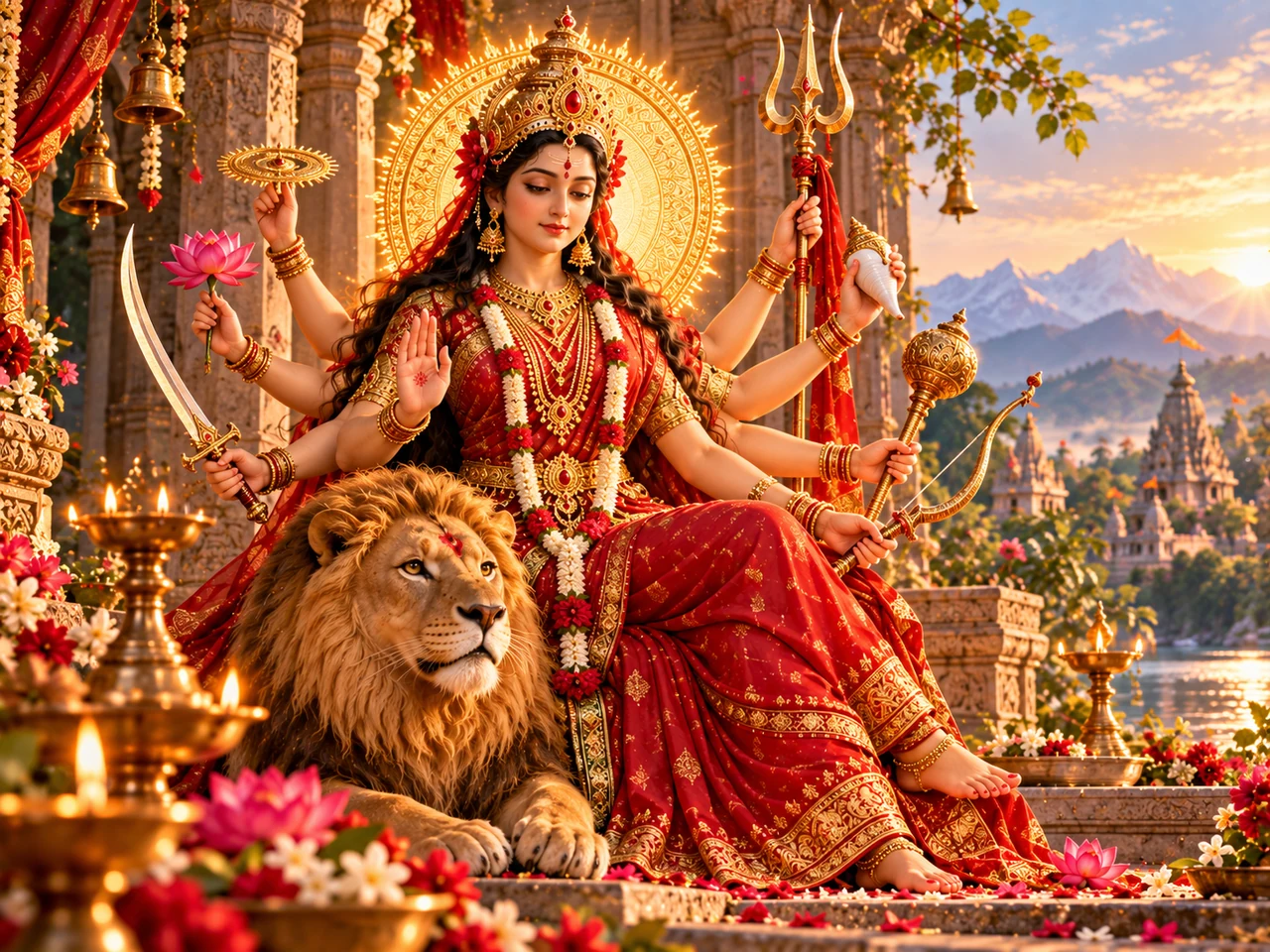
Edition notice: The Roman Hindi is the latest user-supplied ShivGoraksh-edited wording. This is a draft, not a verified reproduction of a historical recording or a licence for publication. [SRC-USER-065-V3]
Introduction and reading context
The seven sections comprise four full refrains and three intervening stanzas. The prayer moves from praise to a plea for protection, then to the mother–child bond and finally to a preference for the Mother’s affection over wealth. The repeated line at the end of each eight-line stanza is intentional, not an omitted chorus.
1. Opening invocation and chorus
Original Roman Hindi:
```text
ambe tu hai jagdambe kali jai durge khappar wali । tere hi gun gaaye bharati o maiya hum sab utarey teri aarti ॥
```
Overall meaning: The singers honor Ambe as Mother of the world, invoke her protective strength, praise her qualities and offer their collective aarti. Detailed explanation: “Ambe” names the Mother intimately; “Jagadambe” broadens her care to the world. “Kali” speaks of the fierce dimension of divine protection. The word “Bharati” can also denote the goddess of speech and learning, but its precise reference in this version requires textual review. The submitted “durge” clarifies the old V2 “dug” spelling. Line-by-line reading
1. ambe tu hai jagdambe kali — Ambe, you are Jagadambe, the Mother of the world, and Kali. Three divine names in one invocation; they describe theological facets, not three proven independent authorships. 2. jai durge khappar wali । — Hail Durga, portrayed as holding a skull-bowl. The khappar is part of fierce iconography; no ritual use of a skull vessel is prescribed. 3. tere hi gun gaaye bharati — Bharati sings your virtues.
“Bharati” may evoke Saraswati, speech or praise; the referent needs verification. 4. o maiya hum sab utarey teri aarti ॥ — O Mother, together we offer you aarti.
“utarey” is rendered as उतारें as a phonetic/editorial interpretation, not an externally verified reading.
[SRC-USER-065-V3]
2. Appeal for protection
Original Roman Hindi:
```text
tere jagat ke bhakt janan par Mata bhid padi hai bhari। daanav dal par toot pado maa karke singh sawari । so-so singho se tu balshali asth bhujao wali dushton ko pal mein sangharti । o maiya hum sab utarey teri aarti ॥
```
Overall meaning: The devotees describe a heavy difficulty facing the Goddess’s followers and ask her to confront destructive forces. Her lion and many arms express courage and divine guardianship. Detailed explanation: The lion and the multi-armed Goddess are familiar features of Durga iconography; a metaphorical reading emphasizes courage against cruelty, not violence against people. “so-so” is rendered as “सौ-सौ” provisionally; “asth” is kept as “अस्थ” rather than silently normalized to “अष्ट”. “sangharti” has an uncertain verbal form. No promise of supernatural protection is inferred. The lion and the multi-armed Goddess are familiar features of Durgā iconography; a metaphorical reading emphasizes courage against cruelty, not violence against people. “so-so” is rendered as “सौ-सौ” provisionally; “asth” is kept as “अस्थ” rather than silently normalized to “अष्ट”. “sangharti” has an uncertain verbal form. No promise of supernatural protection is inferred. Line-by-line reading
1. tere jagat ke bhakt janan par — A heavy trial has come upon your devotees in this world.
“jagat ke” and “janan” are retained in the Roman; the Hindi meaning is contextual. 2. Mata bhid padi hai bhari। — Mother, a grave difficulty has arisen.
“bhid” has an uncertain vowel/word identity; Devanagari भीड़ is provisional. 3. daanav dal par toot pado — Confront the host of demons. Within the devotional narrative this addresses demonic forces, not a call for violence against people. 4. maa karke singh sawari । — O Mother, mounted on the lion. The lion vehicle belongs to Durga iconography; the phrasing is from the supplied Roman. 5. so-so singho se tu balshali — You are mighty beyond a hundred lions.
“so-so” is interpreted provisionally as सौ-सौ rather than left as an English “so-so”. 6. asth bhujao wali — You, the one with many arms.
“asth” is preserved in the Roman and as अस्थ in Devanagari; the likely intended अष्ट must be approved before correction. 7. dushton ko pal mein sangharti । — You quickly overcome the wicked.
“sangharti” is not a confirmed spelling of a Sanskrit/Hindi verb. The rendering is contextual. 8. o maiya hum sab utarey teri aarti ॥ — O Mother, together we offer you aarti.
“utarey” is rendered as उतारें as a phonetic/editorial interpretation, not an externally verified reading.
[SRC-USER-065-V3]
3. Chorus after the appeal
Original Roman Hindi:
```text
ambe tu hai jagdambe kali jai durge khappar wali । tere hi gun gaaye bharati o maiya hum sab utarey teri aarti ॥
```
Overall meaning: The refrain turns the urgent appeal into shared praise and reverence for the Mother. Detailed explanation: The four lines are fully repeated, not abbreviated as “repeat chorus”. Even the same words acquire a more supplicatory tone after a stanza of distress. Line-by-line reading
1. ambe tu hai jagdambe kali — Ambe, you are Jagadambe, the Mother of the world, and Kali. Three divine names in one invocation; they describe theological facets, not three proven independent authorships. 2. jai durge khappar wali । — Hail Durga, portrayed as holding a skull-bowl. The khappar is part of fierce iconography; no ritual use of a skull vessel is prescribed. 3. tere hi gun gaaye bharati — Bharati sings your virtues.
“Bharati” may evoke Saraswati, speech or praise; the referent needs verification. 4. o maiya hum sab utarey teri aarti ॥ — O Mother, together we offer you aarti.
“utarey” is rendered as उतारें as a phonetic/editorial interpretation, not an externally verified reading.
[SRC-USER-065-V3]
4. Compassion and mother–child relationship
Original Roman Hindi:
```text
maa bete ka hai ish jag mein bada hi nirmal nata । poot kaput sune hai par na mata suni kumata ॥ sab par karuna darshaney wali amrut barsaney wali dukhiyon ke dukhdae nivarti । o maiya hum sab utarey teri aarti ॥
```
Overall meaning: A child may be imperfect, yet the singer seeks compassion from the Mother. Her kindness is imagined as nectar and solace for those who suffer. Detailed explanation: “Pūt–kapūt” contrasts a good child and a child who errs; the verse asks for a compassionate mother without justifying wrongdoing. “Nirmal nata” now clearly means a pure bond. “dukhdae” is uncertain and rendered phonetically, so the closing line is given a contextual meaning, not falsely claimed as an exact verified reading. Nectar is poetic imagery, not a medical claim. Line-by-line reading
1. maa bete ka hai ish jag mein — In this world there is a bond between mother and child. The submitted “ish” is understood as “इस”, but not altered in the authoritative Roman. 2. bada hi nirmal nata । — It is a deeply pure bond. The user-supplied “nirmal” resolves the earlier V2 “namal”. 3. poot kaput sune hai par na — We have heard of worthy and unworthy children, but not …
The idea is completed by the following line; keep their relationship intact. 4. mata suni kumata ॥ — … of a mother called a bad mother. This is a devotional ideal of maternal compassion, not a sociological generalization about every real parent. 5. sab par karuna darshaney wali — You show compassion to everyone.
“darshaney” is rendered provisionally as दर्शाने; avoid claims of visionary practice. 6. amrut barsaney wali — You shower nectar. Nectar is imagery for grace, relief and renewal; not a health promise. 7. dukhiyon ke dukhdae nivarti । — You help remove the troubles of the suffering.
“dukhdae” is retained verbatim in Roman and phonetically rendered; precise morphology unresolved. 8. o maiya hum sab utarey teri aarti ॥ — O Mother, together we offer you aarti.
“utarey” is rendered as उतारें as a phonetic/editorial interpretation, not an externally verified reading.
[SRC-USER-065-V3]
5. Chorus after maternal compassion
Original Roman Hindi:
```text
ambe tu hai jagdambe kali jai durge khappar wali । tere hi gun gaaye bharati o maiya hum sab utarey teri aarti ॥
```
Overall meaning: The familiar words return after the appeal for mercy, making maternal affection part of the shared offering. Detailed explanation: The third full chorus is retained to respect the supplied performance order. Its recurrence underlines that devotion embraces both strength and tenderness. Line-by-line reading
1. ambe tu hai jagdambe kali — Ambe, you are Jagadambe, the Mother of the world, and Kali. Three divine names in one invocation; they describe theological facets, not three proven independent authorships. 2. jai durge khappar wali । — Hail Durga, portrayed as holding a skull-bowl. The khappar is part of fierce iconography; no ritual use of a skull vessel is prescribed. 3. tere hi gun gaaye bharati — Bharati sings your virtues.
“Bharati” may evoke Saraswati, speech or praise; the referent needs verification. 4. o maiya hum sab utarey teri aarti ॥ — O Mother, together we offer you aarti.
“utarey” is rendered as उतारें as a phonetic/editorial interpretation, not an externally verified reading.
[SRC-USER-065-V3]
6. Devotion valued above wealth
Original Roman Hindi:
```text
nahi maangtey dhan aur daulat na chaandi na sona maa । hum to maangey maa tere man mein ek chota sa kona ॥ sabki bigdi banane wali laaj bachane wali satiyo ke sat ko sanvarti । o maiya hum sab utarey teri aarti ॥
```
Overall meaning: The devotees say they seek neither money nor precious metals, only a modest place in the Mother’s affection. They praise her as a guardian of dignity and hope. Detailed explanation: “A small corner” in the Mother’s mind conveys longing for relationship rather than material reward. The final “satiyo ke sat” phrase is preserved and should not be expanded into a doctrinal statement about anyone’s moral standing without review. Prayer is framed as hope, not a guarantee that hardship will end. Line-by-line reading
1. nahi maangtey dhan aur daulat — We do not ask for money or riches. The sentiment places affection above material gain; it does not reject the duties of earning and care. 2. na chaandi na sona maa । — Neither silver nor gold, O Mother. Parallel with the preceding line, this makes the material contrast explicit. 3. hum to maangey maa tere man mein — Mother, what we ask is a place in your heart.
“man mein” is figurative language for remembrance and affection. 4. ek chota sa kona ॥ — Just one small corner. Humility and closeness, not a physical location, are emphasized. 5. sabki bigdi banane wali — You set troubled affairs right. A devotional expression of hope, not a verified prediction of events. 6. laaj bachane wali — You protect dignity.
“laaj” evokes honor and dignity, not a prescribed social code. 7. satiyo ke sat ko sanvarti । — You preserve what the singer calls “satiyo ke sat”. Interpretive scope of “satiyo ke sat” is unresolved; do not infer a single legal, historical or ethical doctrine. 8. o maiya hum sab utarey teri aarti ॥ — O Mother, together we offer you aarti.
“utarey” is rendered as उतारें as a phonetic/editorial interpretation, not an externally verified reading.
[SRC-USER-065-V3]
7. Closing chorus
Original Roman Hindi:
```text
ambe tu hai jagdambe kali jai durge khappar wali । tere hi gun gaaye bharati o maiya hum sab utarey teri aarti ॥
```
Overall meaning: The final chorus closes the aarti in communal gratitude to Ambe, just as it began. Detailed explanation: The fourth complete chorus closes the seven-section witness. Every occurrence is retained as supplied and carries the same stable structural identity as in V2. Line-by-line reading
1. ambe tu hai jagdambe kali — Ambe, you are Jagadambe, the Mother of the world, and Kali. Three divine names in one invocation; they describe theological facets, not three proven independent authorships. 2. jai durge khappar wali । — Hail Durga, portrayed as holding a skull-bowl. The khappar is part of fierce iconography; no ritual use of a skull vessel is prescribed. 3. tere hi gun gaaye bharati — Bharati sings your virtues.
“Bharati” may evoke Saraswati, speech or praise; the referent needs verification. 4. o maiya hum sab utarey teri aarti ॥ — O Mother, together we offer you aarti.
“utarey” is rendered as उतारें as a phonetic/editorial interpretation, not an externally verified reading.
[SRC-USER-065-V3]
Theological, historical and linguistic notes
Devi and devotion. Ambe, Jagadambe, Durga and Kali are related forms or names in Shakta worship. The song joins protective iconography (lion, many arms and khappar) with the tenderness of the Mother, without requiring all these images to be interpreted literally. Nirmal relationship. The mother–child comparison portrays compassion as the ideal of devotion. It neither guarantees miracles nor excuses harmful conduct. The desire for a small corner in the Mother’s affection expresses inward belonging rather than material bargaining. Textual uncertainty. This is a Roman Hindi performance-oriented witness. “asth”, “bhid”, “sangharti”, “dukhdae”, “satiyo ke sat”, “janan” and “utarey” have no separately verified source reading here. The derived Devanagari is a best-effort transcription, not an authorized correction to the submitted Roman. Recording and credit. Saregama identifies the song with the film Navratri and credits Bharat Vyas as lyricist, Chitragupta as music director and Mohammed Rafi and Asha Bhosle as singers. A distinct authorship claim appeared in 2025 reporting. Neither finding establishes which words match the user-supplied V3 text. 3 5
Rights and release. This is internal editorial preparation of lyrics directly supplied in chat. Modern song lyrics may still be copyrighted; an edited label does not grant republication or translation rights. The official Indian copyright law distinguishes literary copyright term from sound-recording term. No public release clearance is claimed. [SRC-LAW-INDIA-065-V3]
Frequently asked questions
Is this the original 1955 film recording transcript? No. It is the latest Roman Hindi submitted by the user, with source comparison pending. Why is “asth” not changed to “asht”? The source Roman reads “asth”; editorial inference is logged rather than silently accepted. Why repeat the opening refrain four times? Those full appearances are part of the submitted order; three additional response lines close the intervening stanzas. Can this be published or used by Aadesh now? No. Both are disabled until textual, rights and human editorial reviews are complete.