



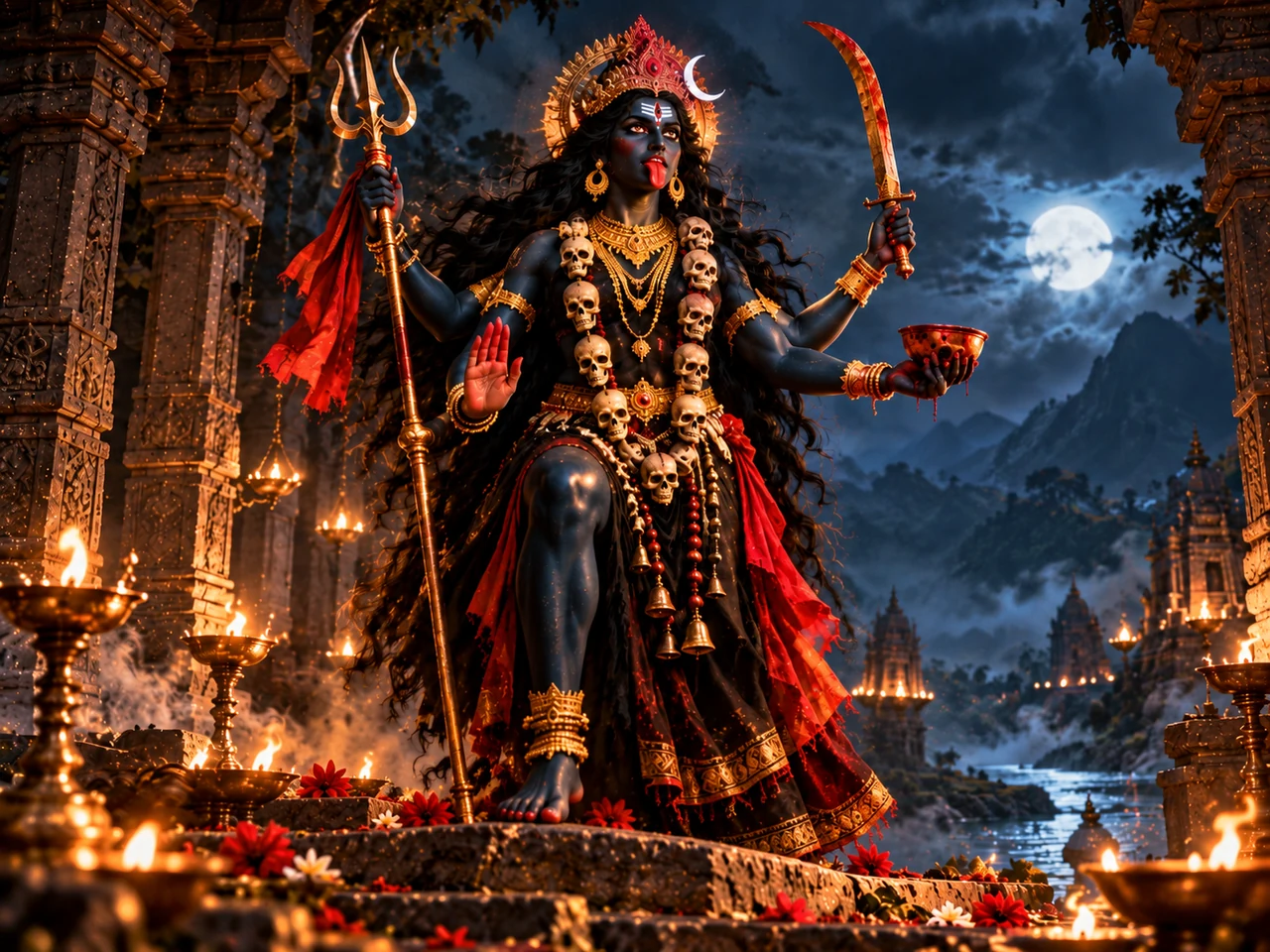
A goddess steps into a scene of overwhelming danger. Her hair is loose, her eyes blaze, and her appearance unsettles even the viewer who knows the story will end in protection. This is Kali (KaliKālī, काली). Her image refuses to hide death, conflict or change. Yet in homes, songs and temples she is also addressed with the intimacy of Ma—Mother. How can the same figure be so fierce and so deeply loved?
The question is a doorway into her meaning. In the Devi Mahatmyam (Durga Saptashati), Kali appears when the Goddess confronts enemies whose destructive power threatens the world. In later Shakta theology, she may be revered as supreme reality itself. In Bengali devotional poetry, she is the mother to whom someone can speak about loneliness, bewilderment, hope and trust. These are related but different settings; no single picture or explanation exhausts them. 1 5 10
For a first-time reader, it helps to set aside the assumption that an alarming image must represent evil. Kali's fierce actions are directed against forces portrayed as destructive. Her devotees may experience her as refuge, liberating insight, or the courage to confront impermanence. Those devotional claims are matters of religious meaning, not measurable guarantees. This guide distinguishes the older narrative, later art, living practice and interpretations developed within particular communities.
Names, meanings and identities
The usual Sanskrit form of her name is KaliKālī, with long vowel sounds; it is often understood as “the dark one.” Religious interpretation also connects her with kāla, time and the end to which all changing things are subject. The linguistic senses of dark colour and time should not be flattened into one universal etymology. In spiritual writing they meet in the idea that nothing conditioned can escape change. Kālikā is a related devotional name. Mahākālī emphasizes cosmic scope in traditions that use it; Śyāmā evokes her dark, beautiful appearance in Bengali worship; and Bhavatāriṇī, “she who carries beings across worldly existence,” names the form worshipped at Dakshineswar. 5 8 13
Chamunda (ChamundaCāmuṇḍā) is especially important. Devi Mahatmyam (Durga Saptashati) chapter 7 relates precisely why Kali receives that name after defeating Chanda and Munda. In other worship and art, Chamunda may have a distinct identity and image. Bhadrakali is another name with strong regional histories, and must not be treated as proof that every image labelled Bhadrakali is identical to the Bengali Kali-on-Shiva form. A Kerala bronze catalogued by the British Museum, for example, has eight arms and a markedly different posture. 1 12
Kali is connected to Shakti, the divine power central to Shakta religion, and to Durga, Parvati and Shiva in overlapping but not interchangeable ways. Some devotees see her as a manifestation of Parvati or Durga; in Kali-centred traditions she is the ultimate Goddess, not merely another deity's attendant. These explanations belong to different theological settings and deserve to be heard in their own terms. 5 11
One useful clarification: *Kali the goddess is not the same figure as Kali of the term Kālī the goddess is not the same figure as Kali of the term Kali Yuga. English spellings can conceal differences in Sanskrit words and religious identities. 15
From sacred literature to a recognisable goddess
Kali's history does not begin neatly with a single date, author or temple. Indian goddess worship has many old, interacting strands, but the first appearance of a word resembling her name does not establish the full identity of the later, familiar goddess. The Devi Mahatmyam (Durga Saptashati), within the Markandeya Purana, gives one of the earliest highly influential and clearly identifiable narrative portraits of Kali. Its precise composition history is studied by scholars rather than fixed by a universally accepted date. 1 5
The text also belongs to a larger story: different forms of the Goddess battle threats to the cosmic and moral order. Kali is not introduced simply as a separate warrior arriving from elsewhere. She emerges from Ambika's brow in a moment of concentrated anger. That narrative connection matters. It joins gentleness and wrath without declaring them opposite moral beings. The fierce Goddess is an expression of the protecting Goddess's own power. 1
Over time, Shakta and tantric traditions developed broader accounts in which Kali has cosmic and liberating significance. Her appearance in devotional painting, temple icons and Bengali songs also developed across different periods. The widely familiar figure stepping on Shiva is especially prominent in later eastern Indian art; it should not be projected backwards as the visual scene described in chapter 7. The Metropolitan Museum's research explicitly distinguishes the Devi Mahatmyam (Durga Saptashati) battlefield image from later depictions showing Kali on Shiva. 5 7
1. The appearance from Ambika's brow
In Devi Mahatmyam (Durga Saptashati) chapter 7, hostile armies approach Ambika as she sits on a mountain with her lion. Her expression changes; out of her furrowed brow springs Kali. The description is deliberately startling: a terrifying face, sword and noose, wild tongue, hollowed eyes, and a garland of human heads. She does not pause to explain herself. She enters the battle against the forces advancing on the Goddess. 1
The account offers more than a dramatic origin scene. Ambika's initial composure and Kali's terrifying arrival belong to one sequence. A reader may interpret this as a reminder that compassion is not the same as passivity: protection sometimes requires forceful resistance. That is an interpretation of the story, not a translation of any particular Sanskrit verse.
2. Why Kali is called Chamunda
Two commanders, Chanda and Munda, attack. Kali defeats them and presents their heads to Chandika. The Goddess then names her Chamunda, connecting the title to the defeated enemies. This is the narrative of chapter 7, notably its closing passage; some later summaries shift the episode to the Mahishasura battle, but that is not the sequence of the chapter being cited here. 1
Why does the text dwell on the names? Naming marks Kali's contribution to the larger victory. The chapter presents her not as uncontrolled violence for its own sake, but as part of the Goddess's response to an existential threat. Different temples and traditions may nevertheless honour Chamunda separately, and their iconography cannot automatically be inferred from this one scene.
3. Raktabija: a danger that multiplies
Chapter 8 turns to Raktabija, whose spilled blood produces more enemies like him. Every blow risks creating another army. The problem is not simply that he is strong: the obvious way to fight him makes the danger worse. Chandika asks Kali—addressing her as Chamunda—to catch the blood and consume the new forms before they multiply. Only then can the enemy be defeated. 2
Readers often find the story memorable because it portrays a self-reproducing crisis. Some teachers interpret Raktabija as habit, anger or fear that grows when handled without insight. Such psychological readings can illuminate a modern reader's experience, but they are not a substitute for the text's narrative claim about a supernatural demon. Kali's blood-drinking here has a specific function within the battle; it is not an invitation to imitate the event in religious practice.
4. Kali and Shiva: the pause after the dance
One of the best-known later images shows Kali standing on the motionless body of Shiva. A popular devotional telling says that her battlefield dance became so intense that Shiva lay in her path. On recognising him beneath her foot, she paused; versions differ about whether her extended tongue conveys embarrassment, astonishment or another meaning. Museum collections document this narrative and the prominence of the pairing in Bengal's later visual culture. 5 7
This is not a scene to attribute casually to Devi Mahatmyam (Durga Saptashati) chapter 7 or 8. It belongs to a different and elaborated narrative setting. One Shakta interpretation understands Shiva as still consciousness and Kali as its dynamic energy; another emphasizes how her action is checked by recognition. Neither explains every community's image or every devotee's understanding. The representation need not be read as a claim that one deity humiliates another. 6 7
Recognising Kali in images and sacred art
A common Kali image includes a dark or blue-black complexion, loose hair, four arms, a blade, a severed head, a necklace of heads, a girdle of arms, a projecting tongue and an open landscape associated with the cremation ground. Some hands may instead express reassurance or the giving of blessings. These details differ across regions, periods, media and forms. The Devi Mahatmyam (Durga Saptashati)'s Kali is gaunt and armed with a sword and noose; the household print of a beautiful, four-armed figure standing upon Shiva belongs to a much later visual idiom. 1 5 6
The blade can be read devotionally as cutting delusion; the head as mortality or severed ego; the garland as an uncompromising reminder of death; the darkness as the mystery beyond familiar forms; and the extended tongue as fury, awe, or recognition depending on the story. These are interpretive possibilities, not one universal, ancient dictionary of symbols. It is more accurate to ask who made this image, where, when, and for which community? 5 8
The cremation ground, or śmaśāna, points toward the frailty of the body and the boundaries society normally avoids. Some tantric communities understand such settings within a specialized religious discipline. General readers can appreciate their philosophical symbolism without treating esoteric rites as everyday instructions. Nor should a modern painting be offered as archaeological proof for an event in sacred literature.
Look, for example, at the British Museum's late nineteenth-century Bengal clay image: Kali strides across recumbent Shiva, with a distinctively Bengali crown. Contrast it with the institution's seventeenth-century Kerala Bhadrakali bronze. The differences are part of the tradition's history, not errors needing to be harmonized. 7 12
Philosophy: time, consciousness and freedom
Kali draws attention to a truth people often evade: everything living changes. Youth passes; possessions are insecure; familiar worlds end. When the Goddess is interpreted in relation to time, her frightening appearance becomes a question: what remains meaningful when nothing can be permanently possessed? In this context “destruction” need not mean delight in suffering. It may point to the transformation that makes new life possible and to freedom from clinging. That is a philosophical reading, not a promised personal result. 5 11
In some Shakta theological systems the Divine Mother is the power from which the whole universe appears and into which it is withdrawn. In a related Shaiva-Shakta interpretation, Shiva represents still or witnessing consciousness and Shakti/Kali the capacity through which experience and activity unfold. This is a teaching within certain traditions, not a claim that every Shaiva, Shakta or Smarta thinker holds an identical metaphysics. The famous image of Kali standing on Shiva can visually express the relationship, while its narrative explanation remains a separate question. 6 8
The wider Devi Mahatmyam (Durga Saptashati) gives an illuminating perspective on divine plurality. In chapter 10 the Goddess gathers her manifestations back into herself and declares her unity. In the story's own theology, forms such as Kali participate in the power of the one Goddess. That statement helps explain the text's relationships among its divine figures; it should not erase the distinct identities they acquire in later practice. 3
Kali is also associated with the Mahavidyas, a group of ten goddesses prominent in certain tantric and Shakta frameworks. These traditions explore fierce and benevolent forms of knowledge, but there is no reason to invent a universal set of visual details or a beginner's manual for initiatory worship. Kali is not reduced to an anger management allegory; she is a living object of religious devotion, philosophy and art. 14
The Divine Mother in households, songs and communities
In Bengali devotional poetry, fierce appearance does not prevent tender address. The devotee can ask Mother why life is confusing, complain about suffering, or seek her protection. Ramprasad Sen is a prominent name in this world of Shyama-sangeet (songs devoted to the dark Mother). Scholar Rachel Fell McDermott's study of Bengali lyrics shows a long, varied tradition in which cosmic Goddess, playful Mother and compassionate refuge coexist. This is evidence for a literary and devotional history, not permission to copy copyrighted modern translations of poems. 10
The temple of Dakshineswar near Kolkata offers a concrete example. Its Kali is worshipped as Bhavatarini, and its history is associated with the patron Rani Rashmoni and the nineteenth-century spiritual teacher Ramakrishna. The temple's own account places its establishment in 1855 and describes a complex that also includes Shiva shrines and a Radha-Krishna temple. Its dream account concerning the founder is a valued traditional narrative; the temple's construction is a historical claim of a different kind. 13
The Kalighat tradition in Kolkata likewise carries strong devotional significance, with its connection to Goddess worship described in museum research and regional traditions. In communities far from Bengal, the Goddess can be understood or pictured differently. An important contemporary example is a Kali image commissioned for the British Museum in collaboration with Bengali Hindu community members, representing a form known as Maa Bhavatarini. It records how a devotional icon can be interpreted through the voices of living worshippers rather than only through an outsider's reaction to fearsome symbols. 5 8
Not all histories of Kali are purely temple histories. Printed images and public representation mattered in colonial Bengal. British Museum research discusses how her images became entangled with political expression. That history should be neither sensationalized nor treated as if every devotee's religious life had a political agenda. 9
Worship, festivals and careful boundaries
For many households, Kali devotion is straightforwardly affectionate: a clean place for prayer, a picture or icon, flowers, a lamp, music, remembrance, and reflection on how one treats others. Public practices vary. A visitor should follow local guidance and avoid assuming that one family's observance is a rule for all followers. Some traditions give a special place to red hibiscus, but flower choices and offerings depend on place and lineage. 5 8
Kali Puja, particularly important in Bengal, is associated with the autumn new-moon period and often coincides with the time when Diwali is celebrated in many parts of India. It is not equivalent to every Diwali observance, nor should a fixed Gregorian date be presented as timeless. Kali is also honoured at other times in the year, in community festivals and in the rhythms of ordinary devotion. Some followers use the name Shyama Puja. 7 9 13
Tantric and lineage-specific religious disciplines form another part of Kali's history. Their significance can be explained publicly, but mantras requiring initiation, restricted ritual methods, consecrations, cremation-ground rites and esoteric diagrams are not reproduced here as instructions. Claims of guaranteed protection, medical cures or supernatural outcomes must not be presented as verified facts. Religious practice also must not be used to justify harm. These boundaries protect both the reader and the integrity of distinct communities.
Kali within Hindu traditions
Within Shaktism, Kali may be the great Mother and ultimate ground of existence. In many Shaiva settings she is approached through the relationship of Shiva and Shakti. In the Devi Mahatmyam (Durga Saptashati) she stands within the Goddess's battle against destructive powers; in regional traditions, names such as Chamunda and Bhadrakali can support their own cults, stories and forms. A Bengali Kali image, a Kerala Bhadrakali image and a literary description need not match point for point. 1 5 12
The most helpful approach is not to force a hierarchy in which all local traditions become imperfect versions of one correct template. Instead, notice their shared questions: How does divine protection respond to terror? How can the sacred contain both stillness and movement? Why is the Goddess a mother even when her image is fierce? In this variety lies much of Kali's enduring importance.
Presence in scripture and literature
Three source groups are especially useful for continued reading:
- The Devi Mahatmyam (Durga Saptashati), chapter 7: Kali's emergence from Ambika; Chanda and Munda; the name Chamunda. The textual events are directly located, though final Sanskrit-edition collation is pending. 1 4
- The Devi Mahatmyam (Durga Saptashati), chapter 8: the Raktabija episode and Kali's part in stopping the multiplication of opponents. 2 4
- The Devi Mahatmyam (Durga Saptashati), chapter 10: the Goddess's statement about her many manifestations and their unity. This clarifies the scripture's worldview, not a claim about the identity of every later sect. 3 4
Alongside these, Bengali songs and the scholarly study of their history reveal the tender voice of Kali devotion.
Questions readers often ask
Is Kali an evil or demonic goddess? No. Her fearsome image belongs to traditions that worship her as a protective, often compassionate form of the Divine Mother. The enemies of her best-known scriptural battles threaten the world; fearsome appearance is not proof of moral evil. 1 5
Is Kali the same as Durga or Parvati? Some traditions identify them as expressions of one divine power; others give Kali a distinct supreme status or specific myths. “Always identical in every text” is too simple. 3 5
Why does she stand on Shiva? Several later explanations describe Shiva lying in her path to halt her dance, or interpret the pair as consciousness and power. The familiar image is not the event narrated in Devi Mahatmyam (Durga Saptashati) chapter 7. 5 7
Does her tongue always mean shame? No. Explanations range from a startling battlefield expression to recognition or embarrassment in a later tale. Image context matters. 5
Why are death and cremation grounds present in her art? They bring impermanence into view and have special meaning in some Shakta and tantric traditions. That does not make every depiction an instruction for restricted practices. 5 11
Must devotees perform tantric rites? No. Public household devotion and elaborate lineage-governed traditions are distinct. The latter require guidance within their own communities, not instructions from a general reference page. 8
Short glossary
| Term | Meaning in this article |
|---|---|
| KaliKālī | The goddess often named “the dark one”; also interpreted in relation to time and transformation |
| Devī | Goddess; a theological title whose context matters |
| ShaktiŚakti | Divine power; also a name for the Goddess in many Shakta contexts |
| ChamundaCāmuṇḍā | Name given to Kali after the defeat of Chanda and Munda in Devi Mahatmyam (Durga Saptashati) 7 |
| Raktabīja | Demon whose blood generates further opponents in Devi Mahatmyam (Durga Saptashati) 8 |
| Śmaśāna | Cremation ground, important to some iconographies and religious settings |
| Śyāmā | Affectionate Bengali devotional name associated with the dark Mother |
| Bhavatāriṇī | “She who carries beings across”; Kali's name at Dakshineswar |
| MahavidyaMahāvidyā | A “great knowledge” goddess within particular ten-goddess Shakta-tantric groupings |
| DikshaDīkṣā | Initiation, required for certain lineage-specific practices |