



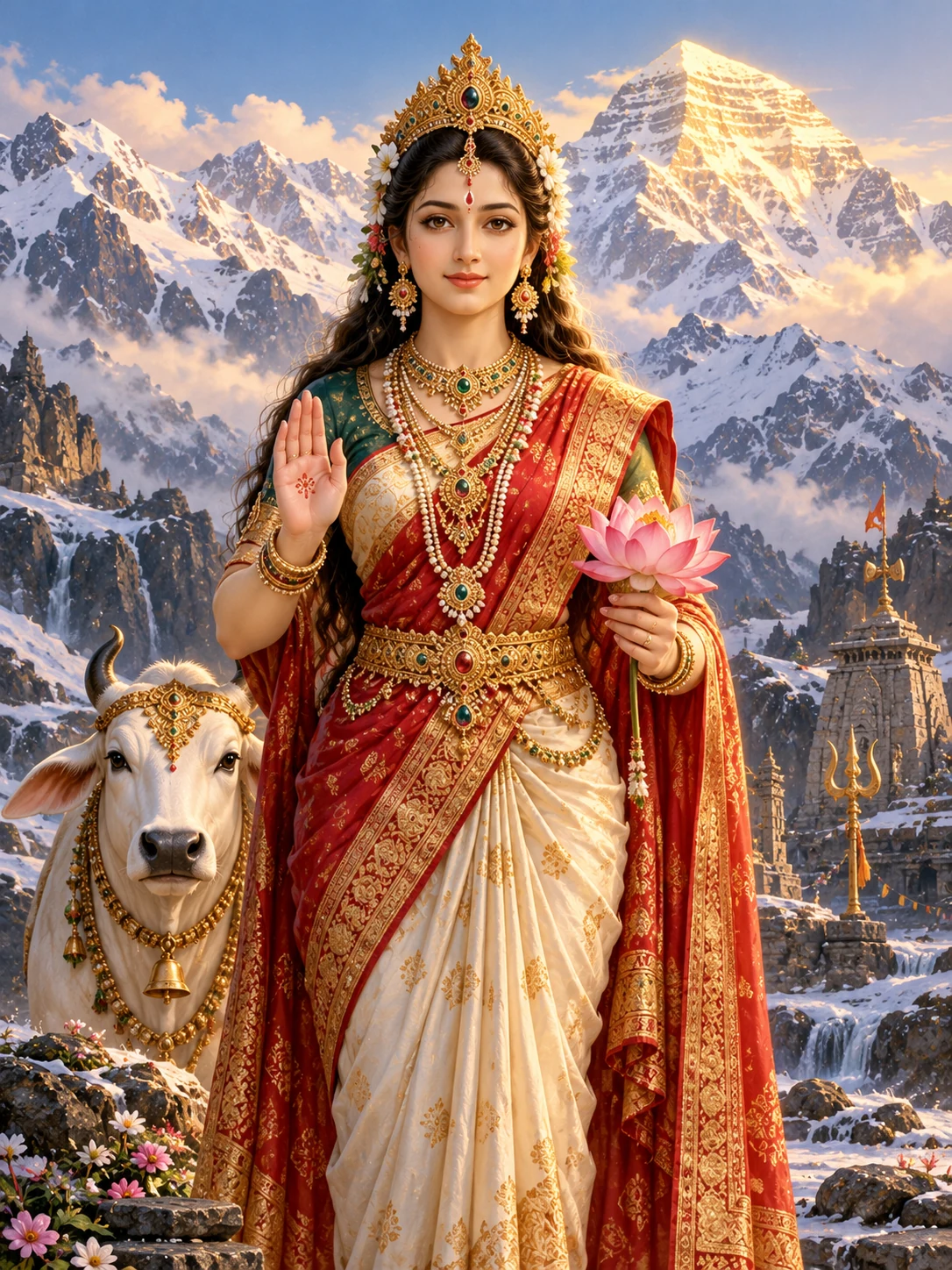
Reader edition: Bṛhatstotraratnākara, 1912, item 83, printed pp. 160–161, Commons DjVu leaves 188–189. The 1912 scan has an opening Ganesha invocation, Bṛhatstotraratnākara, 1912, item 83, printed pp. 160–161, Commons DjVu leaves 188–189. The 1912 scan has an opening Gaṇeśa invocation, ten main verses, two closing prayers and a separate colophon, all represented below. The repeated request bhikṣāṃ dehi is abbreviated by the printer in verses 2–10 and fully expanded here using verse 1. The older print, not a combined internet text, controls the wording. Three additional verses found in some later recensions are not part of this printed witness 13. educational edition, not cleared for publication or Aadesh.
Understanding Annapūrṇā and the central prayer
The name Annapūrṇā combines anna (food, grain or nourishment) and pūrṇā (full or complete). The hymn praises her not as a detached symbol of abstract plenty, but as the Mother from whom the speaker has the courage to ask for help. Repetition matters: after each great cosmic title, the same human-scale plea returns—bhikṣāṃ dehi. The image of a well-fed divine mother and a dependent seeker makes receiving food dignified rather than shameful. The setting is Kāśī/Varanasi. In the living temple tradition Annapūrṇā is treated as a form of Parvati and is closely associated with Śiva/Viśveśvara; the official local administration lists her temple near Kāśī Viśvanātha . In the living temple tradition Annapūrṇā is treated as a form of Pārvatī and is closely associated with Śiva/Viśveśvara; the official local administration lists her temple near Kāśī Viśvanātha 56. A popular account portrays Shiva discovering the indispensability of material nourishment when he approaches Parvati as Annapūrṇā for food. That is a traditional story, . A popular account portrays Śiva discovering the indispensability of material nourishment when he approaches Pārvatī as Annapūrṇā for food. That is a traditional story, not a verbatim narrative in these twelve verses. The last two verses bring the hymn’s ethics into focus: knowledge and detachment, followed by an expanded notion of family and home. Detachment in this context should not mean disregard for feeding people; rather, freedom from possessiveness can coexist with concrete care for bodies and communities. Food donations and the practice of sharing meals are relevant contemporary resonances, not ritual requirements issued by the hymn.
Form, historical witness and attribution
The selected anthology entry is labelled Annapūrṇāstotram. Its final line calls it an Annapūrṇāṣṭaka-stotra, but twelve numbered verses are visible: ten longer praise verses with the recurring petition and two short concluding prayers. This discrepancy is preserved as found; no verses are deleted to manufacture an eight-verse text. Scan leaves 188–189 are printed pages 160–161, not printed 188–189 1. The print credits Śaṅkarācārya in its colophon. The hymn is traditionally attributed to Ādi ShankaraĀdi Śaṅkara, but that printed credit does not by itself establish the historical composition date or author. The present article labels the claim as traditional/print attribution, not a scholarly certainty. The named printed collection is a historical source witness; it is not a critical edition. 13
Textual choices and variant readings
The following differences have practical consequences for reading. Verse 5 keeps dṛśyādṛśya-prabhūta-vāhana-karī, unlike the vibhūti found in some electronic texts. Verse 6 and verse 8 keep daśā-śubha-karī, rather than widely circulating sadā-śubha-karī. Verse 7 preserves the difficult older kāśmīrā tri-jaleśvarī tri-laharī sequence, not the alternative tripureśvarī trinayanī. Verse 9 retains kuntala-dharī (hair), where another recension says kuṇḍala-dharī (earrings). Verse 10 preserves viśveśvara-shri-dharīviśveśvara-śrī-dharī. Verse 12 begins mātā ca, not mātā me. All are recorded with exact tokens in the source list/the edition notes 134. The three extra verses beginning with a supplication against worldly affliction and hunger found after verse 10 in some digital printings are excluded from this selected 1912 recension. Some digital sources treat them as an insertion drawn from a different Annadā-kalpa material 3; that provenance itself requires later textual verification. The phonetic Roman IAST in this draft was mapped from the selected Devanagari and still needs a Sanskrit language reviewer.
Questions readers often ask
Is this Annapurna Ashtakam or Annapurna Stotram? Both labels are used. In this print the heading says Stotram while the colophon says Aṣṭaka; the witness includes ten praise and two closing verses. The names alone do not settle a universal verse count. Why does every main verse ask for bhiksha? Bhikṣā is literally an offered portion of food or alms. Read devotionally, it can imply sustenance and compassion; verse 11 explicitly requests knowledge and non-attachment. Is Ādi Shankara certainly the author?Is Ādi Śaṅkara certainly the author? This printed colophon attributes the work to Śaṅkarācārya, but historical authorship has not been independently proved from it. Does the stotra guarantee food, wealth, cure or salvation? No empirical guarantee follows from devotional praise. Language about health, fearlessness and liberation belongs to the religious voice of the poem. Are special timings or an initiation required? This article presents a publicly readable hymn. It does not establish compulsory timings, an initiation procedure, ritual benefits or personalized practice.
Additional passage commentary
Opening invocation
Meaning: Salutation to Shri Ganesha, the printed preface before this hymn. Salutation to Śrī Gaṇeśa, the printed preface before this hymn. Explanation: An opening invocation of the anthology/item, not one of the twelve numbered Annapūrṇā verses; it is displayed to preserve the witness boundary.
Verse 1
Meaning: Giver of enduring joy, blessings and fearlessness, a treasury of beauty, purifier of dread and suffering, the manifest power of Maheśvara; purifier of the Himalayan line and sovereign of Kāśī: Mother Annapūrṇeśvarī, grant me alms, for your compassion is my support. Explanation: The first verse names a fullness that is more than a full granary. Varābhaya joins generosity with a promise of fearlessness in devotional imagery; prāleyācala means the snow-mountain range, linking Annapūrṇā to Parvati. The noun means the snow-mountain range, linking Annapūrṇā to Pārvatī. The noun bhikṣā ordinarily evokes food or an offering received in humility. The closing appeal can also be heard as a request for the capacity to live without hoarding or indifference to another person’s hunger. The hymn addresses the Goddess as sovereign of Kāśī, not as an abstract distributor of guaranteed rewards.
Verse 2
Meaning: Adorned with ornaments of varied gems and resplendent golden garments, with a pearl garland falling across her breast, scented with saffron and fragrant agaru wood, radiant sovereign of Kāśī: Mother, graciously grant me alms. Explanation: Jewels, gold and perfume build an image of royal splendour, but the poet uses it to praise the one whose gift is as basic as daily food. Kāśmīra here may denote saffron and aguru fragrant aloeswood; neither is a geographical claim that the Goddess literally resides in Kashmir. The imagery of the nourishing mother is bodily and intimate, not simply an inventory of ornaments. Even a richly dressed divine figure is approached with the simple request for sustenance.
Verse 3
Meaning: You bestow the joy of disciplined union, overcome adversaries and establish steadfastness in dharma and rightful prosperity. Your radiance gleams like moon, sun and fire; you guard the three worlds and are praised as giver of wished-for good. Sovereign of Kāśī, Mother, grant me alms. Explanation: The verse combines inward discipline (yogānanda) with moral and material life (dharma–artha). Food makes concentration and ethical action possible; the poem refuses a division in which spirituality matters and material wellbeing does not. Ripu, an enemy, can be understood at the level of hostile beings in praise poetry, while later readers may meditate on anger or selfishness as inner adversaries. The cosmic lights are praise imagery, not a physical description or an instruction for ritual practice.
Verse 4
Meaning: Dwelling in the caverns of Mount Kailāsa, you are Gaurī, Umā, Śaṅkarī and Kaumārī; you make the significance of sacred revelation approachable and are associated with the seed-syllable Oṃ. You open the closed gates of liberation. Sovereign of Kāśī, grant me alms. Explanation: Annapūrṇā is recognised here as Parvati through several names. Annapūrṇā is recognised here as Pārvatī through several names. Nigama refers to Vedic revelation; oṅkāra-bījākṣarī evokes the sacred syllable Oṃ as a theological symbol. The striking phrase moksha-dvāra-kapāṭa-pāṭanamokṣa-dvāra-kapāṭa-pāṭana describes the opening of a locked gate: liberation becomes imaginable as access, not as an object bought by ritual. Because a seed syllable is mentioned, the hymn should not be taken as a manual for mantra initiation or secret practice.
Verse 5
Meaning: Bearer of abundance visible and invisible, whose vastness contains the cosmic vessel; one who cuts through the strings of the world’s play and sparks the lamp of discriminating knowledge, who brings delight to Viśveśa, Lord of the universe: Mother of Kāśī, grant me alms. Explanation: Brahmāṇḍa-bhāṇḍa-udarī pictures the universe as a vessel within the Mother’s immeasurable body. Vijñāna-dīpa is the lamp of insight; unlike an ordinary material lamp it points to discernment. The complex compound about the threads of the līlā-nāṭaka is interpretively difficult: it may suggest discerning or interrupting the bindings of the divine drama. It should not be presented as a straightforward physical or cosmological claim. This witness prints prabhūta-vāhana, whereas modern digital recensions often read vibhūti-vāhana.
Verse 6
Meaning: You are earth itself, the sovereign of all people, blessed Mother Annapūrṇeśvarī, with dark flowing locks, ruler of daily food-giving; you bring joy to all and turn difficult circumstances toward the good. Sovereign of Kāśī, grant me alms. Explanation: Urvī can mean earth; the verse makes the Mother both a cosmic presence and the daily sustainer. The phrase nityānna-dāna explicitly honours daily food-giving. This invites a practical ethical reading: preserving the dignity of people who receive food is part of taking nourishment seriously. Our chosen print has daśā-śubha-karī, a difficult expression about making one’s condition auspicious; the widespread sadā-śubha-karī is recorded as a variant, not inserted silently.
Verse 7
Meaning: You embody the whole series of letters from a to kṣa and the threefold modes associated with Śambhu; praised as Kāśmīrā, sovereign of three waters, triple-wave, ever-sprouting and Śarvarī. You awaken longing and raise people up. Sovereign of Kāśī, grant me alms. Explanation: This is the densest and least secure cluster of epithets in the poem. Ādi-kṣānta commonly refers to the whole Sanskrit letter-series from a to kṣa, but the scan’s ādikṣānti form and the compounds tri-jaleśvarī / tri-laharī need specialist philological review. The older page differs substantially from a widely circulated tripureśvarī / trinayanī sequence. Our explanation stays close to the visible words and refrains from claiming a single tantric doctrine as their certain meaning.
Verse 8
Meaning: Goddess adorned with many extraordinary jewels, beautiful Dākṣāyaṇī; the text evokes her left side and nourishing breast, together with the auspiciousness of Maheśvarī. You are praised for cherishing devotees and improving their condition. Sovereign of Kāśī, grant me alms. Explanation: Dākṣāyaṇī is an established name for Satī, daughter of Dakṣa, and connects the Goddess to a larger Shiva–Shakti narrative. The witness’s is an established name for Satī, daughter of Dakṣa, and connects the Goddess to a larger Śiva–Śakti narrative. The witness’s vāmaṃ svādu-payodhara-priyakārī construction is grammatically compressed; the most direct devotional sense involves motherly nurture and her relation to Shiva’s left side, but exact syntax is not secure. Retaining the awkward construction is grammatically compressed; the most direct devotional sense involves motherly nurture and her relation to Śiva’s left side, but exact syntax is not secure. Retaining the awkward vāmaṃ is deliberate. A more smoothly worded modern vāmā or vāme text should be represented as a variant, not passed off as the old print.
Verse 9
Meaning: Radiant as countless moons, suns and fires, with luminous and bimba-fruit-like lips, described through moon-, sun- and fire-like splendour, holding a rosary, book, noose and goad: sovereign of Kāśī, Mother, grant me alms. Explanation: The ornaments change to tools of knowledge and direction: mālā can evoke devotion, pustaka learning, pāśa restraint or binding, and aṅkuśa discipline or redirection. These are interpretive associations, not a required iconographic inventory for every Annapūrṇā image. The older witness reads kuntala-dharī (tresses) in one line; a better-known modern rendition reads kuṇḍala-dharī (earrings). That one-letter shift changes the picture materially, so it belongs in the variants ledger.
Verse 10
Meaning: Protector, giver of great fearlessness, compassionate Mother, praised as a direct giver of release and of the good associated with Shiva, bearer of Viśveśvara’s splendour; she is linked to the lament of Dakṣa and to wellbeing. Sovereign of Kāśī, grant me alms. Protector, giver of great fearlessness, compassionate Mother, praised as a direct giver of release and of the good associated with Śiva, bearer of Viśveśvara’s splendour; she is linked to the lament of Dakṣa and to wellbeing. Sovereign of Kāśī, grant me alms. Explanation: The closing main stanza gathers protection, liberation and healing language. Dakṣākranda-karī evokes Dakṣa’s grief in the Satī–Shiva cycle, but this hymn does not narrate that full story. evokes Dakṣa’s grief in the Satī–Śiva cycle, but this hymn does not narrate that full story. Nirāmaya-karī belongs to a devotional vocabulary of wellbeing: it must not be translated into a clinical cure promise. Viśveśvara-shri-dharīViśveśvara-śrī-dharī, printed in the older edition, differs from the common viśveśvarī śrīdharī reading and is intentionally preserved here. The request for alms remains the refrain even after the grandest names.
Verse 11
Meaning: O Annapūrṇā, eternally full and dearer than life to Shankara: grant me alms, O Parvati, so that knowledge and freedom from grasping may mature. O Annapūrṇā, eternally full and dearer than life to Śaṅkara: grant me alms, O Pārvatī, so that knowledge and freedom from grasping may mature. Explanation: The short prayer makes explicit what the ten longer stanzas leave implicit. JnanaJñāna is liberating understanding; vairāgya is non-clinging, not a command to despise the world or ignore hunger. The supplicant asks not for endless possessions but for insight and steadiness. In this 1912 printed sequence this is verse 11, a closing prayer, not proof that all traditions regard the composition as exactly an eight-verse aṣṭaka.
Verse 12
Meaning: The goddess Parvati is my mother, the god Maheśvara my father; devotees of Shiva are my kin and all three worlds my homeland. The goddess Pārvatī is my mother, the god Maheśvara my father; devotees of Śiva are my kin and all three worlds my homeland. Explanation: The final verse expands the household into a spiritual family. Bhuvanatraya, the three worlds, is a traditional cosmological idiom and here communicates radical breadth of belonging. It need not erase particular families or exclude people of other paths. Read as a devotional affirmation that nourishment and kinship ought not stop at one household or birthplace. This printed witness begins mātā ca, not the mātā me found in some digital versions.
Colophon
Meaning: The printed colophon declares the Annapūrṇāṣṭaka-stotra, traditionally ascribed to Śaṅkarācārya, complete. This is a textual credit, not independent proof of authorship. Explanation: The label aṣṭaka appears in the colophon even though the scanned printed item numbers ten main praise verses and two appended closing prayers; the verse count here follows the witness and does not discard words to force an eight-verse title.