



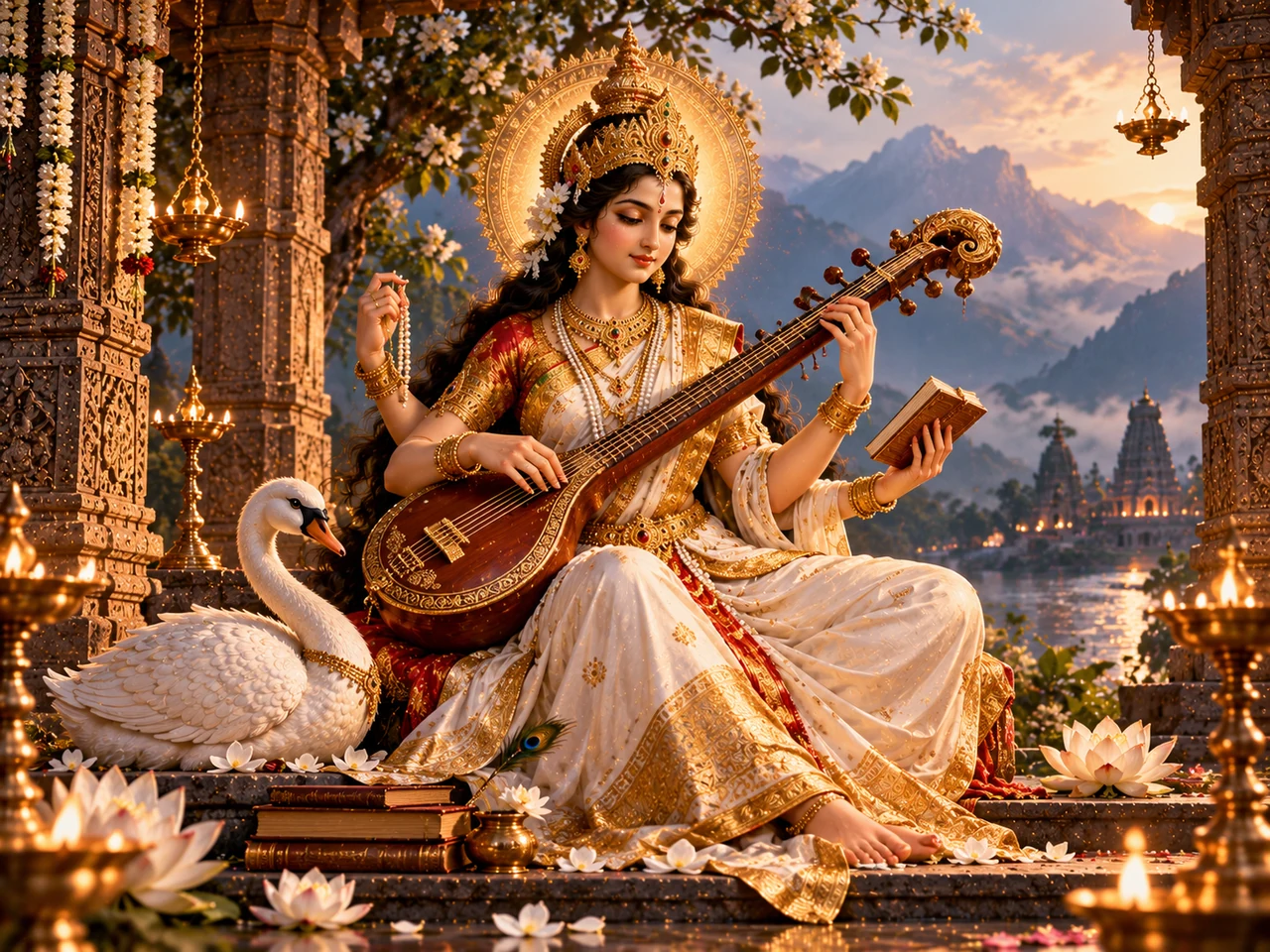
A book rests in her hand. Across her lap stretches a veena, a stringed instrument capable of disciplined melody. Beside her is often a graceful hamsa, usually represented as a swan or goose. This is the familiar Saraswati: a goddess approached when a child begins to write, a musician begins to practise, or a reader hopes to understand rather than merely remember. But her story begins much earlier than this well-known portrait. In the oldest Vedic hymns, Saraswati is also a mighty river and a divine presence worthy of praise. Over many centuries, images of flowing water, speech, intelligence and the arts became intertwined. 3 · 4 · 5
To understand Saraswati is therefore to follow more than one current. There is the Saraswati of Vedic poetry; the personification of inspired and truthful speech; the goddess of learning familiar in homes and schools; and the figure represented differently in Hindu, Jain and Buddhist art. None of these layers needs to erase the others. Together they explain why a seemingly quiet image of a seated musician occupies such an enduring place in religious and cultural life.
Names, meanings and identities
Saraswati (Sanskrit SaraswatiSarasvatī; सरस्वती) is commonly linked with saras, a lake or pool, and with watery abundance. Etymology alone cannot reconstruct a precise original cult, but the association is fitting for the river praised in Vedic poetry. Vāgdevī means goddess of speech; Vāṇī evokes utterance or voice; Bhāratī is a Vedic name associated with sacred expression, though it should not automatically be treated as a perfectly interchangeable name in every ancient passage. Śāradā is especially cherished in several learning and temple traditions. Vīṇāpāṇi or Vīṇāvādinī describes the goddess bearing or playing the veena. 1 · 4
In ordinary devotional language, she is Maa Saraswati, motherly giver of knowledge. In many Hindu traditions she is associated with Brahma, the creator, as his consort or creative power. Some other traditions tell different origin accounts or give her a more independent identity. In eastern Indian Durga Puja imagery she may also appear among Durga's family, a relationship that should not be projected onto every part of India or every scriptural account. 12 · 18
A useful distinction is that Saraswati the goddess and Saraswati the river can be separate referents in a modern discussion yet remain closely connected in the history of literature and devotion. Likewise, Vāc (speech) is an important Vedic concept and divine figure; saying that Saraswati came to be associated with Vāc does not mean every early occurrence of Vāc already depicts the familiar veena-bearing goddess. 4
The river that was addressed as divine
Several hymns of the RigvedaṚgveda address Saraswati. Hymn 6.61 praises her force and protection; hymns 7.95–96 describe a noble and nourishing river whose waters inspire reverence. The hymns belong to ancient ritual poetry, not to a modern geographical survey. They tell us how their composers praised Saraswati, but they do not, by themselves, settle every present-day debate about the course or identity of an ancient river. 2 · 3
In Rigveda 2.41.16 she receives an exceptional threefold address: foremost among mothers, rivers and goddesses. The compact verse shows why she cannot be reduced to a merely physical watercourse in the Vedic religious imagination. At the same time, it would be misleading to insist that the same verse already contains all the attributes of later Saraswati worship. The historical journey from river and praise to the goddess of refined knowledge involved further textual and cultural development. In Ṛgveda 2.41.16 she receives an exceptional threefold address: foremost among mothers, rivers and goddesses. The compact verse shows why she cannot be reduced to a merely physical watercourse in the Vedic religious imagination. At the same time, it would be misleading to insist that the same verse already contains all the attributes of later Saraswati worship. The historical journey from river and praise to the goddess of refined knowledge involved further textual and cultural development. 1 · 4
The visual image of the river offers a helpful interpretive bridge. Water can be heard, received and shared; words also move from speaker to listener. Such comparisons illuminate later symbolism, but they are interpretations, not statements that one particular ancient verse commands every modern reader to make. In scholarly study, the precise emergence and relationship of Saraswati, Vāc and knowledge remain topics of literary history. 4
How the familiar goddess developed
The Saraswati known from later images carries manuscripts, plays music and presides over education. That visual and devotional world grew through centuries of literary, ritual and artistic transmission. It is a mistake to imagine an unbroken photographic portrait running directly from the earliest Ṛgvedic verse to today's calendar image. The Metropolitan Museum of Art, for instance, documents nineteenth-century prints in which a white-clad Saraswati holds a veena and books, while another regional print gives her unusual attributes associated with Vishnu. The art itself is evidence for historical diversity. 5 · 7
1. The powerful current of the Vedic hymns
Imagine a poet who knows that a river can sustain a settlement, nourish animals and also inspire fear when its waters surge. The hymn is not a report of one dramatic battle; its drama lies in praise. Saraswati is invoked as an energetic force, a protector and a source of abundance. Later readers have heard in this current an image of knowledge itself: something that gives life when cared for and may overwhelm when approached without understanding. The first part is an ancient textual witness; the second is a modern explanatory analogy. Keeping them distinct respects both the poem and the reader. 2 · 3
This Vedic scene matters because it prevents the modern goddess from being flattened into an examination-time good-luck symbol. A river belongs to a wider world of ecology, community, movement and ritual memory. Saraswati's early presence in poetic worship is more expansive than the narrow request to score well on a test.
2. The river that vanishes and returns in the epic landscape
The Mahābhārata remembers Saraswati as a sacred river marked by pilgrimage places. In the Vana Parva pilgrimage narrative, the travellers encounter Vinaśana, described as a place where Saraswati disappears, and hear of places where she becomes visible again. This is an epic-sacred account, not an archaeological demonstration that a particular contemporary river has been conclusively identified. The text places movement, landscape, faith and memory into a story that pilgrims could retell. 10 · 11
The disappearance can be interpreted spiritually as a reminder that what sustains us is not always visible. Yet the epic itself tells a specific sacred-geographical story; readers should not be told that a later metaphor is the one and only meaning of its passage. Ancient place names, modern river science, and theological beliefs call for different forms of evidence.
3. Speech beside creation: Saraswati and Brahma
A later, widely familiar devotional picture sets Saraswati beside Brahma. In this relationship, creation is not simply the production of forms; it also needs names, expression and intelligibility. The goddess is understood in many traditions as Brahma's consort or creative counterpart. Specific Purāṇic origin stories, however, vary considerably, and some are difficult to reconcile when read as one literal family biography. A careful introductory account can convey the theological idea without asserting that one contested narrative is mandatory for every worshipper. 18 · 4
Some traditions address Saraswati primarily as an independent goddess of knowledge. Others place her in wider arrangements of divine energies alongside Lakshmi and Parvati. These should be understood as different theological and artistic languages, not as entries in a single universal genealogical chart.
How to read Saraswati's iconography
The veena immediately links Saraswati with music. A string must be tuned: too loose and the sound is weak, too tight and it may break. This makes the instrument a compelling image for disciplined learning and sensitive artistry. That particular balance metaphor is an accessible interpretation, not a claim that every old image-maker intended it. Historically documented artworks show veena-bearing Saraswati figures across different regions and centuries. 8 · 9
The manuscript or book suggests learning and the preservation of knowledge. A palm-leaf book is not equivalent to a modern school textbook, but it reminds us that Saraswati's realm includes poetry, recitation, philosophical study and the patient labour of scholars. The rosary, when shown, may evoke repetition, attention or devotional discipline; its precise meaning should be read according to the object and tradition. 5 · 8
White garments, a pale lotus and a hamsa are common elements of her widely recognized visual language. White often evokes clarity and composure in devotional interpretation. The bird is conventionally called a swan in English but may be rendered as a goose in museum records; neither zoological label should obscure its role as a sacred vāhana (vehicle). Some images replace the bird with a peacock, as a famous Ravi Varma-associated print illustrates. An unfamiliar vehicle does not automatically mean the figure has been misidentified. 5 · 6
Artists may portray two or four arms, seated or standing figures, and different instruments, flowers or companions. A regional devotional print can even show attributes normally associated with Vishnu. Reading iconography is therefore a matter of identifying an individual artwork and its context, not enforcing one timeless checklist. 7
Speech, wisdom and the responsibility of learning
Saraswati is frequently called the goddess of knowledge, but the word knowledge covers several activities. Students work to remember and understand. Musicians learn rhythm, listening and improvisation. Teachers communicate difficult ideas fairly. Writers search for words that illuminate rather than confuse. The goddess offers a cultural way of treating these tasks as meaningful, disciplined and potentially sacred.
The distinction between information and wisdom is useful here. Information is something one may possess; wisdom involves judging when and how to use it. A worshipper might express the wish that intelligence be joined to patience and truthful speech. This is a modern explanatory reflection compatible with broad devotional themes, not an exact doctrinal formula borrowed from a verified Sanskrit verse.
Vāc means speech, but speech is more than noise. It gives form to instruction and promises; it can console or injure. Saraswati's association with speech invites questions of ethics: Are words accurate? Do they respect the listener? Do they leave room for correction? Her iconography is gentle, yet the responsibility she represents is demanding. Neither devotional belief nor ritual participation guarantees learning without study, practice, and support.
Saraswati within wider religious traditions
Within Hinduism, Saraswati is connected with the creative power of Brahma in many accounts. Her connection to Shakti can also be understood within goddess-centred traditions, although the distinctions among Saraswati, Mahasaraswati, Durga and other forms of the Goddess depend on the text and school. The Devi Mahatmyam (Durga Saptashati), separately prepared as a ShivGoraksh scripture project, should not be used as a convenient source of made-up Saraswati verses or treated as an already published internal route. A later devotional identification is not necessarily a statement made verbatim in its thirteen chapters.
There are especially interesting relationships in Bengal. Images of Durga's household commonly include Saraswati and Lakshmi, but the British Museum notes that this arrangement is distinctively Bengali and not a universal genealogy across Hindu regions. It demonstrates how regional devotion develops family-like visual worlds around celebrated deities. 12
Saraswati also has important lives outside Hindu worship. The Walters Art Museum describes her adoption in Hindu, Jain and Buddhist settings; museum collections preserve Jain Saraswati sculptures, sometimes styled very differently from popular Hindu prints. In Buddhist traditions she may be a protectress of knowledge, poetry and eloquence. Japanese Benzaiten reflects a further history of transmission and adaptation: a British Museum painting portrays her playing a lute. These traditions are related through history, but their beliefs and ritual settings should not be collapsed into one religion. 9 · 17 · 19
Saraswati in scriptures, literature and visual history
For a reader wishing to trace the evidence, begin with three kinds of source. First, look at Ṛgvedic passages 2.41.16, 6.61 and 7.95–96 for Saraswati as a praised divine presence and river. Second, read the Mahābhārata pilgrimage accounts to see Saraswati become part of a remembered sacred landscape. Third, examine dated material objects: medieval sculpture, nineteenth-century prints and local ritual images show how later communities pictured the goddess. These sources illuminate different periods; they are not interchangeable proof of one another. 1 · 2 · 3 · 10 · 8
The Ṛgvedic Saraswati cannot be described accurately by citing a modern festival brochure as though it were an ancient manuscript. Conversely, a Vedic verse cannot tell us precisely how a modern school in Kolkata celebrates Saraswati Puja. For the latter, local cultural and governmental records are more relevant. A robust library uses the right kind of source for each question.
Saraswati's association with learning helps explain her appearances in the lives of poets and musicians. However, legends that a particular poet became a genius overnight through her intervention should be labelled as devotional storytelling unless their textual provenance has actually been established. They should not be offered as historical biography or as a promise of supernatural exam results.
Vasant Panchami and Saraswati Puja
Vasant Panchami (also spelled Basant Panchami) is a major occasion of Saraswati worship, especially in parts of northern and eastern India. In West Bengal, schools, households and communities honour the goddess, often bringing books and musical instruments into the setting of worship. Odisha also observes Saraswati Puja during the spring season. Clothing colours, school customs, offerings and artistic forms vary, so an introductory guide should not declare one household procedure compulsory everywhere. 13 · 14
One touching feature is the beginning of literacy. In Bengali practice, haate-khori or hate-khori may mark a child's first letters, while other regions use related names and customs. The meaning is larger than the moment: education begins through the hands and voices of teachers, parents and children, not through an automatic spiritual shortcut. 13
Navratri and Vidyarambham in the southNavaratri and Vidyarambham in the south
In Kerala, Saraswati worship is prominent in the final days of NavratriNavaratri. Books and instruments may be set aside respectfully, and Vidyarambham, the ceremony of beginning education, is widely observed on Vijayadashami. Kerala Tourism specifically documents this practice at Panachikkadu Saraswati Temple in Kottayam. These are documented regional traditions, not proof that Vasant Panchami and Vijayadashami are identical festivals. 15 · 16
Public explanations of such practices are appropriate for a learning library. Detailed family observances differ; no initiate-only mantra, guaranteed effect, universal muhurta or invented ritual prescription is supplied here. The date of a festival changes from year to year in the civil calendar and should be handled by a separately reviewed calendar resource.
Everyday expressions of devotion
Many people begin a new book, class, composition or performance with an invocation to Saraswati. Others express reverence by looking after books, thanking teachers, practising an instrument or making educational opportunities available to children. These practices show the relationship between devotion and effort. Religious traditions describe her blessing; the practical work of learning remains the student's and teacher's responsibility.
Common questions and misconceptions
Was Saraswati always the veena-playing goddess? No. Her early textual evidence includes the divine river and sacred praise. The familiar musician-and-manuscript iconography belongs to later, historically documented artistic development. 4 · 5
Is she Brahma's wife or an independent goddess? Many Hindu accounts call her Brahma's consort. Other accounts emphasize different origins or her independent role. One formulation should not be imposed upon every Purana, school or community. 18
Does her bird have to be a swan? The hamsa is often called a swan or goose; some notable images instead show a peacock. Regional artworks must be read on their own terms. 6 · 8
Is Saraswati only worshipped by students? No. Musicians, artists, writers and teachers honour her, and her religious importance extends far beyond examinations. Jain and Buddhist forms also attest a much wider cultural history. 9
Is the physical Saraswati river definitely identified? No single Ṛgvedic hymn independently resolves all modern historical, hydrological and geographical debates. Keep textual sacred geography and scientific reconstruction distinct. 3 · 4
Does Saraswati Puja automatically make someone successful? A devotional family may pray for wisdom, but neither a festival nor a mantra should be represented as a guaranteed examination or career outcome. Learning still requires effort, guidance and opportunity.
Brief glossary
- Saraswati (सरस्वती):Sarasvatī (सरस्वती): Goddess associated with a Vedic river, speech, learning, music and knowledge across different historical settings.
- Vāc (वाच्): Speech; also a divine figure in Vedic religious language.
- Vāgdevī (वाग्देवी): Goddess of speech.
- Vīṇā (वीणा): Indian stringed instrument represented with Saraswati.
- Haṃsa (हंस): Bird, conventionally called a swan or goose, associated with her as a vehicle.
- Vāhana (वाहन): An animal or other vehicle associated with a deity in religious iconography.
- Vasant Panchami (वसंत पंचमी): Spring observance particularly linked with Saraswati worship in many regions.
- Vidyarambham (विद्यारम्भम्): Ceremony marking the beginning of learning, prominent in Kerala on Vijayadashami.
- Tīrtha (तीर्थ): Sacred place or crossing, frequently associated with pilgrimage and water.