



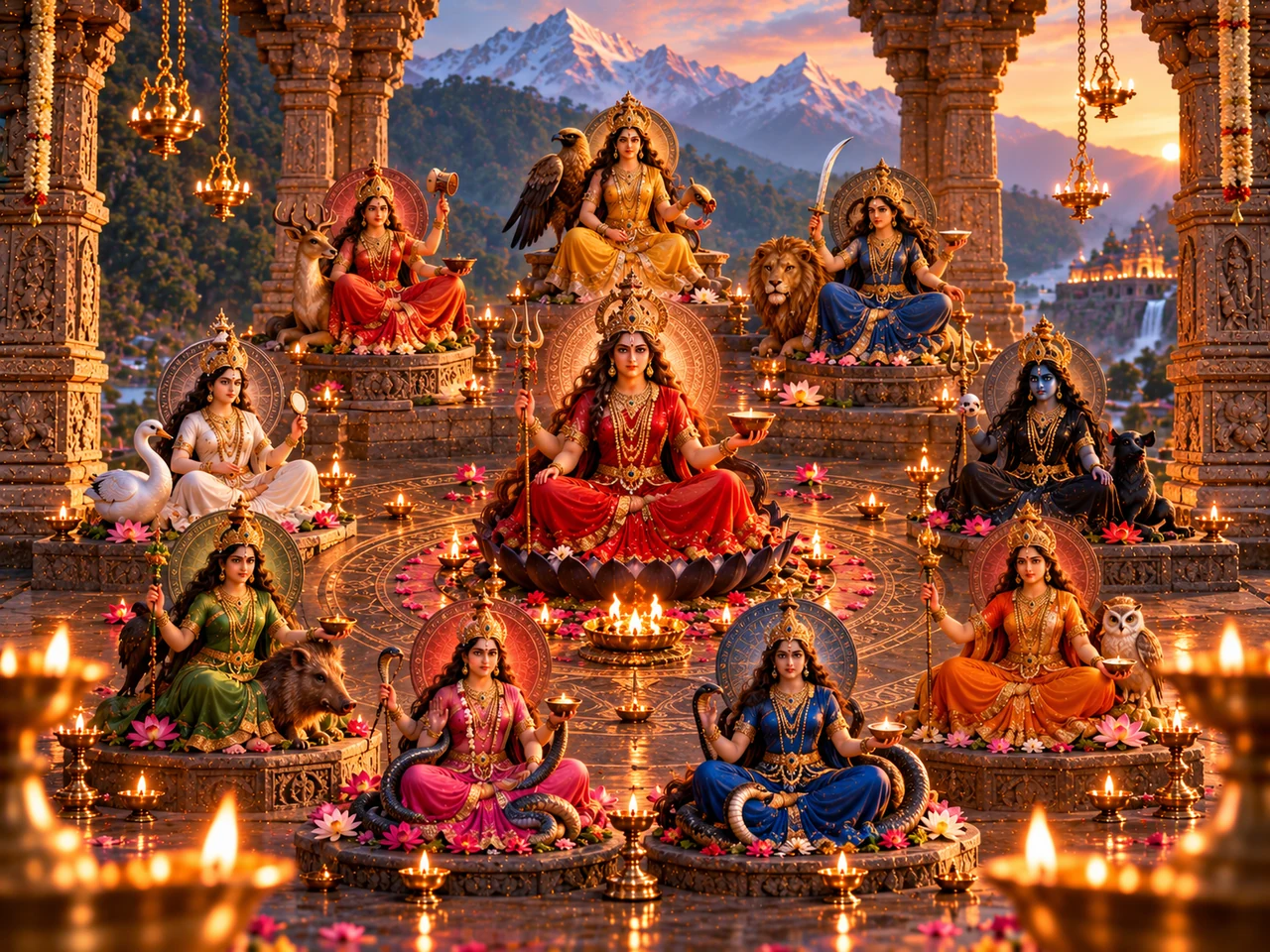
A stone circle stands open to the sky. Around its interior, many goddesses occupy individual niches: one may resemble a familiar mother deity; another bears an animal head; a third holds an object from ordinary household life beside a startling sign of power. No single statue tells the whole story. To understand the Yoginis, we have to look at the group—and at the very different communities that imagined, worshipped and sculpted them.
In historical Hindu traditions, Yoginis are powerful female divine beings especially associated with forms of Shakta and Shaiva tantra. The word yoginī is also the feminine form of yogin, and can designate a woman who practices yoga. It is important not to collapse those two usages: a living woman called a yogini is not automatically a goddess from a medieval temple circle. Academic discussions also recognize Buddhist tantric contexts in which related terminology occurs. 1 2
The frequently heard phrase Chausath Yogini means “sixty-four Yoginis.” Yet forty-two and eighty-one also appear in the surviving record. Even lists containing sixty-four figures disagree about who belongs to the group. Rather than supply an artificial master list, this guide explains the historical evidence, the sacred ideas and the living heritage that make the Yoginis worth studying. 1 3
Names, meanings and different identities
Yogini is conventionally written yoginī in scholarly transliteration, with the long final vowel. In Hindi, योगिनी is singular and योगिनियाँ or योगिनियों are common plural forms. Chausath, Chaunsath and Odia Chausathi are regional spellings of “sixty-four.” Names such as Yogini-chakra or Yoginī-chakraYoginī-cakra refer to a circle or ordered group of Yoginis; they do not identify one standardized set of images or one obligatory ritual diagram.
The term has at least three distinguishable uses. A divine Yogini is a goddess or potent female being found in sacred images and tantric literary traditions. A human yogini may be a female practitioner, ascetic or teacher, depending on context. And in certain traditions a Yogini may be described through a relationship between human practice and divine presence. These meanings overlap in some sources, but they should never be assumed interchangeable. 1 2
The collective is best understood as a tradition of many female divinities, not one person with sixty-four interchangeable nicknames. Some lists incorporate well-known names of the Goddess or Mothers; others place less familiar, locally rooted or fierce beings at the center. Comparisons with dakini figures require equal care: there are intersections with Buddhist tantric vocabulary, but neither word is a blanket synonym for the other. 1 3
Origins: where the evidence begins
The Yoginis did not enter Indian religious life through a single universally accepted origin story. Scholars trace their prominence in tantric contexts to roughly the early medieval period; Shaman Hatley’s academic overview points to developments beginning around the seventh century CE. Monumental temple evidence becomes particularly visible in subsequent centuries, although identifying the date of every site, image and textual layer remains a specialist task. 2 3
Several streams of religious life converge in the record: venerations of mother goddesses, regional divine protectors, the development of Shaiva and Shakta tantric systems, and the patronage that made substantial shrines possible. This is an account of historical interaction, not a claim that all Yoginis originated in exactly one source. Texts, sculptures, place names and living worship do not always speak in the same voice.
The Matrikas—Mother goddesses often worshipped as a sevenfold or eightfold set—are closely related to several Yogini traditions. One arrangement imagines eight families of eight, yielding sixty-four. But that attractive arithmetic is not a key to every temple or manuscript. Some attest groups of forty-two or eighty-one; other configurations include or exclude the Matrikas themselves. Vidya Dehejia’s foundational study compares divergent lists rather than declaring one final sequence. 1 3 4
Four ways the traditions tell their story
There is no reliable basis for presenting a single four-part pan-Indian mythology of the Yoginis. The following narrative threads instead introduce four historically identifiable modes of imagining their collective power.
1. Many powers within the presence of Devi
In some traditions, the Yoginis are understood as extensions, companions or manifestations of Devi, the Great Goddess. Imagine one radiating center surrounded by many distinct presences: protection, fierce transformation, knowledge, local guardianship and other powers are represented not as abstract headings but as goddesses with names and faces. This is an interpretive way to explain a theological pattern found in several lists; it is not a literal story universally recited at all Yogini temples. Dehejia documents traditions that connect Yoginis with manifestations of Devi, while individual lists vary. 1 4
The significance is both unity and difference. A devotee may see one divine power expressed in many forms without denying that the forms possess their own character. That resembles wider Shakta approaches to divine plurality but does not make every Yogini group identical to Durga’s nine forms or to the ten Mahavidyas.
2. The Mothers, their circles and the question of number
Another strand relates Yoginis to the Matrikas. The Mothers themselves belong to important strands of Hindu visual and devotional culture. In some textual arrangements, additional Yoginis are placed around them in sets or families. The result may be a powerful vision of coordinated female divinity, expressed through a chakra—a circle with an ordered structure. 1 3
Why sixty-four? Eight multiplied by eight provides a meaningful structure in some contexts. But the temple at Bhedaghat is famously associated with eighty-one, and scholars also identify forty-two-member configurations. The evidence therefore teaches a useful lesson: a sacred number is meaningful inside a particular tradition; it is not permission to erase other traditions. 3 5
3. Yoginis in Shaiva and Bhairava settings
Yogini systems also appear within tantric Shaivism, including traditions connected with Bhairava, a fierce form of Shiva. In such settings, discussions of divine power, recognition, protection and ritual authority are woven together. Historical shrines sometimes place a Shiva-related figure at the center of a field of female divinities. That arrangement illustrates a relationship; it does not prove that every Yogini is merely Shiva’s attendant or that all Shaiva schools practice the same rites. 2 5
The details of initiatory rites belong to their own lineages and source-critical research. A public educational introduction should explain their existence without inventing mantras, access qualifications or promised results.
4. The temple circle becomes a place
At Hirapur in Odisha, a small open-air shrine invites visitors to look inward at a ring of sculpted female divinities. At Ranipur-Jharial, a related sacred landscape contains a Yogini shrine among other historical religious buildings. At Khajuraho, the Yogini shrine takes an unusually rectangular, rather than circular, form. The stone remains show how a concept of many goddesses could become an architectural experience. 6 7 8
These places should not be romanticized as unchanged windows into a secret past. Buildings have been repaired, images have disappeared, religious practices have shifted and scholarly interpretations continue to develop. Yet surviving niches, sculptures and inscriptions offer firmer evidence than modern legends unsupported by records.
Architecture and historical temple sites
A number of Yogini sanctuaries are hypaethral, meaning open to the sky. The usual image is an inward-facing sequence of small shrines framing a courtyard, sometimes with a central structure. The circle makes every image part of a shared visual field. Still, not all Yogini temples are circular, and neither a roofless plan nor a numerical label establishes precisely what rituals took place there. 3 5
Hirapur, Odisha
The Chausathi Yogini temple at Hirapur, near Bhubaneswar, is among the clearest surviving examples of a roofless, circular Yogini shrine. Odisha’s Hindu Religious Endowment authorities describe the site and associate it with a ninth-century horizon; an attribution to Queen Hiradevi appears in that account but should be treated as an attribution requiring independent epigraphic confirmation. Sculptures stand in the niches around the enclosure, conveying the collective’s individuality and unity. 6
Look at the differences between the figures before attempting to assign a fixed name to each. Their objects, animals and postures matter. They also remind us how much context is lost when a single photograph separates an image from its temple setting.
Ranipur-Jharial, Odisha
Ranipur-Jharial, in Balangir district, contains a notable open-air Yogini enclosure in a larger historical religious landscape. Official Odisha tourism and district sources record associations with Shaiva worship and other traditions at this site. The nearby temples are evidence of a complex sacred environment, not proof that the Yogini circle possessed only one doctrinal identity. 7 9
Khajuraho, Madhya Pradesh
Khajuraho’s Chausath Yogini temple is a valuable corrective to a common stereotype. Its surviving shrine cells frame a rectangular courtyard. The UNESCO World Heritage Centre’s tentative-list submission discusses this exception and the site’s early medieval context. A tentative-list submission is not the same as inscription of the Yogini temples as an independent UNESCO World Heritage property. 5
The structure’s empty or damaged cells also pose a conservation question: which original figures can still be securely identified, and which reconstructions depend on scholarly inference? The temple should be read as evidence with gaps, not as a complete illustrated list ready to copy.
Bhedaghat, Madhya Pradesh
The Bhedaghat/Bheraghat site near Jabalpur is especially important because it is discussed in connection with eighty-one Yoginis. Scholarly reports relate its program to different textual and spatial schemes from the popular sixty-four. The association demonstrates why “Chausath Yogini” can operate as a broad name without describing every historical count literally. 3 5
Mitawali, Madhya Pradesh
At Mitawali (Mitaoli) in Morena district, an impressive circular structure is identified with the Yoginis and also known as Ekattarso Mahadeva. A central shrine and surrounding cells survive, while original Yogini images are not preserved in the manner seen at Hirapur. Government descriptions are not fully consistent about dating: a district page associates an inscription dated 1323 CE with a king whose stated reign belongs to the eleventh century. The chronology and attribution must therefore be rechecked against epigraphy before being treated as settled historical fact. 10 11
Sometimes the building’s resemblance to the historic Indian Parliament is described as proof of architectural inspiration. Resemblance alone cannot demonstrate the architects’ source; that popular claim should remain an unverified hypothesis, not a site fact.
Appearance, animals and symbolic meaning
An individual Yogini can be serene, imposing, human-faced or animal-headed. Some figures hold a blade, shield, skull-cup or other striking object; others hold a broom, basket or symbols connected with ordinary work. The contrast is not a mistake. Museum records show that Yogini sculpture can combine the everyday, auspicious and formidable in a single deity. 12 13 14
A Smithsonian National Museum of Asian Art sculpture is described with a winnowing basket, broom and skull-cup, along with a bird at the base. The institution reads those details as part of her multiple identity; its object-specific interpretation should not be projected onto every Yogini representation. Similarly, a tenth-century work in the Musée Guimet collection is related to fierce goddess and Matrika iconography without implying that all sites used the same features. 12 13
Vehicles or animal companions may connect a figure to a local environment or to a wider iconographic family. Circular arrangements may suggest coordinated divine presence. Fierce faces and unsettling attributes can be understood in a religious context of protection and transformative power. These are context-sensitive interpretations, not translations automatically guaranteed by an object’s appearance. The exact identification of many individual figures remains uncertain.
Ideas: power, plurality and the limits of interpretation
The Yoginis invite readers to think about Shakti as not only one feminine form but a multiplicity of powerful presences. In some traditions, power is distributed through a circle; in others, a supreme goddess encompasses many differentiated manifestations. The communal arrangement invites reflection on relation, complementarity and the sacredness of diverse capacities. Such reflections can help a general reader engage with the material, but they should be identified as interpretive, not as universal doctrinal statements. 1 2
Tantric traditions are not a single belief system and should not be reduced to sensational stories about magic or sexual rites. Texts and ritual systems differ by lineage, time and region. Some sources discuss special attainments (siddhis), but historical documentation that people sought them is not scientific evidence that supernatural effects occur. We can learn how communities understood power without promising extraordinary outcomes.
The presence of female deities also does not, by itself, establish how much authority actual women held in each historical community. The history of women practitioners requires separate documentary work. Nor can one infer a complete ritual from a statue’s jewelry, animal head or place in a wall.
Connections with wider Hindu and Buddhist traditions
The Devi Mahatmyam (Durga Saptashati) celebrates the power of the Goddess and includes narratives of divine feminine collectivity. It is an illuminating comparison for Shakta thought, yet it does not provide a universal catalogue of sixty-four Yoginis. ShivGoraksh’s separately prepared Devi Mahatmyam (Durga Saptashati) project should be linked only after its specific passages and publication routes are approved. 1
The Matrikas form one major connection; Durga, Kali and Shakti are broader theological points of reference. Shiva and Bhairava connect the Yoginis to Shaiva tantric settings. Buddhist tantric writings also have powerful female figures, including Yoginis and Dakinis, whose exact relationships must be determined text by text. Hatley’s Oxford reference work is useful for locating these intersections without homogenizing them. 2
Calling the Yoginis “just forms of the Navadurga,” “all wives of Shiva,” or “identical to Buddhist Dakinis” would distort the diversity of the evidence. Connections are not identities.
Scriptures, literature and historical evidence
Unlike a single deity whose best-known story might be anchored in one celebrated Purana passage, the Yoginis are a multi-source research subject. Relevant evidence includes tantric texts, Purana-related lists, later compilations, temple sculpture and epigraphy. The Brahmayamala and other Shaiva tantric materials enter modern scholarly discussion of these cults, but a responsible beginner article should avoid assigning exact chapter-and-verse claims from manuscripts that were not directly compared. 1 2
Vidya Dehejia’s Yogini, Cult and Temples: A Tantric Tradition (1986) provides an influential comparative treatment of textual lists and monuments. Her book’s bibliographic identity is independently confirmed by the National Museum; the present draft has not treated a freely circulating scan as cleared for reuse. Shaman Hatley’s Yoginīs (2020) is another important academic point of entry, but only the accessible abstract was examined directly for this edition. 1 2 4
The surviving temple record and museum object catalogues are especially helpful because they let readers check that Yogini images really exist in identifiable places and collections. They cannot, however, answer every question about the oral teachings and ceremonies associated with those figures.
Devotion, heritage and respectful engagement
Historical Yogini practice belongs in discussions of temple worship, Goddess devotion and tantric lineages. Some shrines remain meaningful to local worshippers; others are principally conserved or studied as heritage places. Contemporary practice should not be described as a single unbroken ceremony performed identically since the ninth century. 6 7
For a general visitor, appropriate public engagement may mean learning a shrine’s history, respecting worshippers, following site rules, and looking closely at the surviving sculpture. The existence of public temples does not make lineage-restricted mantra, initiation or secret ritual instruction publicly transferable. This article therefore provides no ritual recipe, diagram for practice, initiation sequence, or promised spiritual result.
If images are reproduced on ShivGoraksh, image rights and accurate captions must be checked independently. A sculpture held by a museum is not automatically free to republish, and a modern devotional illustration is not historical proof.
Are there exactly sixty-four Yoginis?
No. Sixty-four is a major and influential grouping, but sets of forty-two and eighty-one also occur, and the names within sixty-four-member lists vary. 1 3
Is a Yogini the same as a woman who practices yoga?
Not necessarily. The word can refer to a human female practitioner or a divine female being, among other lineage-specific senses. Context determines the meaning. 2
Is every Yogini temple circular?
No. Khajuraho’s shrine has a rectangular plan. 5
Are the Yoginis simply the Navadurga or the Mahavidyas?
No. Traditions intersect through wider Goddess theology, but these are distinct groupings with their own histories and variable classifications.
Do their fierce appearances mean they are evil?
No automatic conclusion follows from a fierce face or skull-cup. Such images operate in specific sacred and protective contexts; object identification and interpretation must be grounded locally. 12 13
Can a modern list online be treated as the authentic sixty-four names?
Only if it identifies which text, manuscript, shrine or lineage the list represents. A list without provenance should not be described as the single authentic version. 1
Glossary
- Yogini / Yoginī: Female practitioner or divine female figure, depending on the source and setting.
- Chausath / Chausathi: Sixty-four; a common label for particular Yogini groups or shrines.
- Shakti: Divine power; in Shakta traditions, centrally associated with the Goddess.
- Matrikas: A group of Mother goddesses, frequently related to certain Yogini configurations.
- Chakra / Chakra:Chakra / Cakra: Circle, wheel or organized arrangement; its meaning is context-dependent.
- Bhairava: A fierce form of Shiva, important in some Shaiva tantric settings.
- Tantra: A broad family of religious texts, disciplines and traditions, not one uniform doctrine.
- Hypaethral: Open to the sky, as used of certain temple courtyards.
- Siddhi: Special accomplishment or power described in yogic/tantric traditions; not proof of a scientifically demonstrated effect.
- Dakini: Female figure in certain tantric settings, notably Buddhist ones; not simply interchangeable with every Hindu Yogini.