



Who is Bhairava?
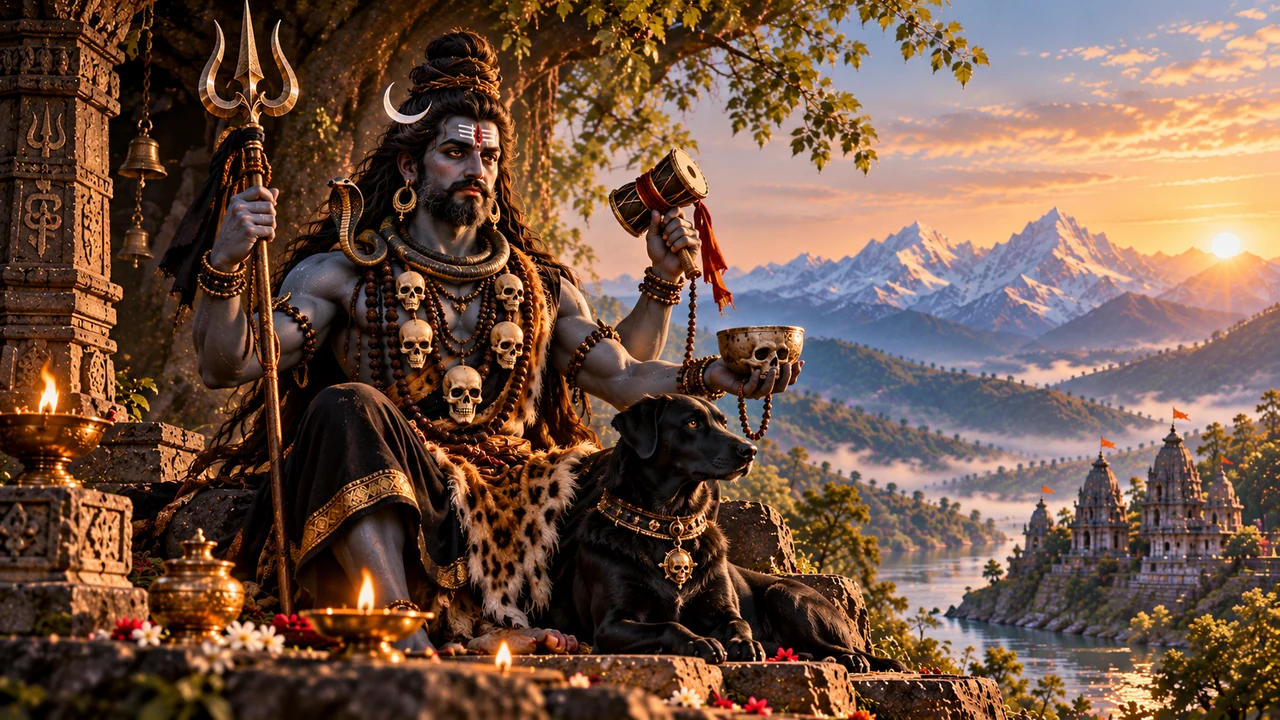
A figure with wild hair, a trident, a skull bowl and a dog at his side may seem startling in a temple courtyard. Yet devotees approach Bhairava (भैरव) not simply as an image of terror, but as a guardian: an aspect of Shiva who confronts pride, protects sacred boundaries and invites human beings to face what they would rather avoid. Kalabhairava, especially revered in Kashi (Varanasi), is one of the most familiar identities. The city knows him affectionately as its kotwal, or divine guardian. 3 7
It is easy to misunderstand this fierce appearance. A skull is not an invitation to violence; a frightening face does not imply that followers must be frightened all the time. Sacred art and narrative can use unsettling images to ask serious questions about ego, responsibility, mortality and protection. Those are interpretive possibilities, not a universal explanation accepted by every lineage. Bhairava also has a more expansive meaning in some nondual Shaiva texts, where the name indicates ultimate consciousness rather than merely a wrathful figure. 10
Names, identities and the meaning of “fierce”
Bhairava is commonly associated with the formidable, fearsome or awe-inspiring. Kala Bhairava or Kalabhairava is linked in devotional interpretation with kala (time), death and their transcendence. The Shiva Purana itself explains the name through his frightening appearance and power, and calls him the guardian of Kashi; this is a text-specific explanation, not proof of a single universally accepted etymology. 1
Other names and groupings encountered in particular settings include Kshetrapala (guardian of a place or sacred precinct), Batuka/Vatuka Bhairava (a youthful form in some traditions), Ashtabhairava (eight Bhairavas), and many locally named protectors. Mahakala sometimes overlaps in imagery and religious history with Bhairava; the names are not automatically interchangeable in every temple, school or Buddhist setting. A museum's Pala-period Mahakala, for example, belongs to an esoteric Buddhist context even while drawing on Shaiva visual forms. 12
The simplest orientation is this: in much Shaiva worship Bhairava is Shiva's formidable manifestation; in certain tantric and philosophical traditions Bhairava also names an all-encompassing divine reality. These usages should be read together with attention to their contexts, not flattened into one formula.
Origins: what literature and images establish
There is no responsibly demonstrable single historical date when Bhairava “first appeared.” Puranic accounts describe his divine origin within a sacred narrative; they do not supply an externally verifiable date. Temple sculpture, ritual literature and regional worship demonstrate that Bhairava acquired varied identities and artistic forms over a long period. The Institute of French Studies in Pondicherry (Institut Français de Pondichéry) documents numerous South Indian images across Shaiva and other temple settings, noting considerable regional differences. 6
A British Museum bronze attributed to approximately the tenth century in Karnataka depicts a fearsome Bhairava with a dog, skull, drum and trident. A Chola-period stone figure held by Singapore's Asian Civilisations Museum shows another form closely associated with Bhikshatana, Shiva as a wandering mendicant. Such pieces demonstrate historical representation, not that every iconographic detail belonged to an original or universal belief. The boundaries between Bhairava and related forms of Shiva are sometimes fluid in curatorial descriptions and religious practice. 3 5
1. The fifth head of Brahma: pride confronted
One celebrated cycle begins with a dispute over supremacy. Brahma and Vishnu, within a Shaiva Puranic telling, become caught in competing claims. Shiva appears, and Bhairava is brought forth to confront Brahma's arrogance. In the Shiva Purana's Shatarudra-samhita, chapter 8, Bhairava cuts off Brahma's fifth head. The chapter then connects the episode with atonement and Bhairava's authority over Kashi. It presents a religious drama about pride and cosmic order, not an event that historians can date. 1
There is an important difference within the same Purana. In Vidyeshvara-samhita, chapter 8, Bhairava is created from Shiva's brow and moves to punish Brahma, but Vishnu pleads for forgiveness and Shiva stops him before the head is cut off. In the Shatarudra-samhita account, the severing actually happens. It would be misleading to claim that every Shiva Purana passage gives an identical episode. 2 1
The moral reflection often drawn by a reader is not “power excuses every act”; rather, even exalted beings in the narrative are confronted with the limits of arrogance. That reflection is our explanation of the story, not a quotation from its verses.
2. The skull-bearing wanderer: responsibility after power
In the Shatarudra-samhita version, the story does not end with the beheading. Shiva instructs Bhairava to carry Brahma's skull and undertake a form of penance for the grave religious transgression named brahmahatya. The personified consequence follows him until the story reaches Varanasi. This episode helps explain why the skull (kapala) appears in Bhairava's imagery and why certain traditions remember him as a wandering, skull-bearing ascetic. 1
It is a demanding story: an agent of divine justice must also confront consequence. Readers may see in it a warning against the illusion that righteousness removes the need for self-examination. Scholars, however, must distinguish this specific Puranic telling from other traditions of Kapalika asceticism, from related Bhikshatana iconography, and from later local retellings. Similar objects in art do not establish identical rituals or origins. 5 3
3. The kotwal of Kashi: a city under sacred guardianship
Kashi's devotion gives the fearsome figure a surprisingly intimate role. The Varanasi district administration and Kashi's official portal describe Kalabhairava as the kotwal of the city, a guardian whose blessing pilgrims traditionally seek. The city's theology links sacred geography, moral accountability and protection. A visitor does not have to accept every local belief as historical fact to appreciate its importance to worshippers. 7 8
The guardian identity also appears in the Shatarudra-samhita, which grants Kala Bhairava authority over Kashi in its own narrative. “Guardian” should not be mistaken for a municipal office held by an objectively verified supernatural official. It is the community's religious way of describing a city felt to be under divine care. Pilgrimage routes and personal observances differ; not all Shiva devotees must visit one shrine in a prescribed sequence. 1
4. Bhairava as awareness: the question of the Vijnanabhairava
A different encounter unfolds in the Vijnanabhairava Tantra, an important text studied within the Kashmir Shaiva world. Its opening takes the form of a dialogue between Devi and Bhairava. Unlike a conventional story of an armed guardian, this literature invites philosophical reflection on awareness and recognition of the sacred. Vladimir Ivanov's published study of Ksemaraja's commentary explains how the Devi–Shiva dialogue is interpreted within a nondual Shaiva tradition and how the role of the Goddess matters to the very transmission of the teaching. 10
This does not mean every reader should try techniques copied from a tantric text. Some practices have contextual, teacher-guided or initiation-dependent dimensions, and the present profile provides no mantra transmission, esoteric visualizations or ritual recipes. The educational point is that the name Bhairava can lead from exterior forms to questions about consciousness, freedom and the relation of Shiva and Shakti.
What do the images mean?
Several features recur in representations, but not all are obligatory. South Indian survey material and museum catalogues are particularly useful because they describe actual objects rather than assuming a single timeless model. 6 3
- Dog: Frequently accompanies or serves as Bhairava's vahana (vehicle). Some interpretations connect this animal with liminal spaces, loyalty or the overturning of purity hierarchies. Those meanings should be attributed to their contexts rather than declared the sole intention of every artist.
- Skull bowl or severed head: Calls to mind the Brahma episode, the wandering ascetic and the nearness of mortality. A museum description may identify an object as a kapala without endorsing any one theological reading.
- Trident, drum, sword or other implements: Indicate relations with Shiva, formidable authority, rhythm and power. The instruments and number of arms vary by sculpture and region.
- Matted hair, snakes, flame, fangs and skull ornaments: Make his form unmistakably extraordinary and sometimes confrontational. A Nepalese mask-like head can differ radically from a freestanding South Indian bronze.
- Naked or ascetic appearance: Occurs in particular representations. It should not be treated as a dress rule for worshippers or a requirement of every image.
The British Museum records a Rajasthan painting of Shiva as Bhairava accompanied by two dogs, while the Smithsonian holds a Nepalese Bhairava with three faces, six arms and even a lotus. Such details are a helpful antidote to the claim that Bhairava always has one fixed count of faces, hands or objects. 4 11
Eight Bhairavas and the danger of a single list
Devotional explanations often discuss Ashtabhairava, eight forms associated in some systems with directions and guardianship. One widely circulated list includes Asitanga, Ruru, Chanda, Krodha, Unmatta, Kapala, Bhishana and Samhara. However, classifications, spellings, attributes, presiding directions and subordinate groupings change across textual and local systems. A tradition-oriented compilation offers one such mapping; it must not be promoted as a universal, critically verified list. 14
The Ujjain district administration confirms the importance of an eight-Bhairava context in that city's Shaiva devotion. This makes the grouping a living religious fact, but it does not automatically validate every internet chart linking eight Bhairavas with planets, colors, secret mantras or precise ritual outcomes. Those require separate evidence. 9
Bhairava across regions and wider traditions
Varanasi: Kalabhairava's guardianship belongs to the devotional landscape of Kashi. Temple visits, prayers and local stories give an ancient city its distinctive religious memory. 7
Ujjain: The city's official district site describes the Kal Bhairava shrine, its connection in tradition to the Skanda Purana's Avanti-khanda, and distinctive local offerings. Practices involving liquor at this shrine are a reported local ritual, not general guidance for home worship or proof that all Bhairava temples follow it. 9
South India: Bhairava often appears as a guardian near Shaiva temple environments. The Institut Français de Pondichéry documents variation in postures, attributes and number of arms across Tamil Nadu, Karnataka and Andhra regions. Some sculptures sit at the intersection of Bhairava and Bhikshatana imagery. 6 5
Nepal: Newar art developed striking Bhairava images. The Metropolitan Museum of Art holds a sixteenth-century Bhairava head connected with Indra Jatra celebration; Nepal Tourism Board describes the public display of Akash Bhairab during that festival. These are specific Nepalese cultural settings, not a miniature version of the Kashi cult. The Smithsonian notes shared Hindu and Buddhist devotion to Bhairava in Nepal; Buddhist Mahakala material illustrates a related but distinct theological frame. 13 15 11 12
Philosophy: fear, limits, time and protection
There is no single “Bhairava philosophy.” Three helpful threads can nevertheless be distinguished. First, the guardian marks a boundary: a sacred space is more than ordinary property and devotees bring obligations as well as requests. Second, the skull-bearer confronts mortality and accountability. Third, the nondual Bhairava of some tantric Shaiva reflection points beyond fear and separateness to awareness itself. These threads can enrich one another, but they emerge from different kinds of sources. 7 1 10
Readers sometimes interpret Kala as the force of time that nothing in ordinary life can halt. That makes the protector's image more subtle: courage need not pretend that death and change do not exist. This is a contemporary explanatory reading, not a verified translation of an ancient mantra or a guarantee of safety. Other schools place emphasis elsewhere; Shaiva, Shakta, local, Nath and Buddhist contexts must not be treated as interchangeable.
Scriptures and literature: a responsible reading map
The Shiva Purana offers two directly comparable versions of the Brahma episode: Vidyeshvara-samhita 8 and Shatarudra-samhita 8. Their disagreement is a valuable lesson in how living scriptural traditions preserve different accounts. 2 1
The Vijnanabhairava Tantra belongs to a different genre and intellectual context. Its dialogue is not a retelling of the same Puranic drama. The specialist paper cited here supports a broad introduction, not a line-by-line translation or attribution of unexamined Sanskrit verses. 10
Local religious sources also associate Kashi and Ujjain Bhairava shrines with sections of the Skanda Purana. Since the exact Sanskrit editions and chapter locators of those passages have not been checked for this edition, this article reports those connections as temple tradition rather than quoting or inventing chapter-and-verse references. 8 9
ShivGoraksh's prepared Bhagavad Gita, Devi Mahatmyam (Durga Saptashati) and Ashtavakra Gita are separate projects. None is presented here as a direct Bhairava source merely to manufacture an internal scripture link. They remain unpublished until independently released.
Devotion, observances and cultural life
Public Bhairava devotion can include visiting a shrine, offering respectful prayers, listening to stories, and participating in community festivals. Kashi's Kalabhairava temple is prominent in pilgrimage practice; Ujjain has its own established shrine culture; Nepal's Indra Jatra includes a conspicuous Bhairava presence. Each has its own customs. 8 9 15
Kalashtami denotes an observance associated with the dark-half eighth lunar day; an especially important annual observance is often called Kalabhairava Jayanti or Bhairava Ashtami. Month names may differ between north- and south-Indian lunar month conventions while the relevant observance may fall on the same civil day. No fixed Gregorian date or universal ritual timetable is supplied here. 16
Mantras, tantric rites, cremation-ground symbolism, specific offerings and initiation-based practices are tradition-dependent. Some material may require diksha (formal initiation) or appropriate guidance. The public article does not instruct readers to perform restricted practices, use intoxicants, seek supernatural results or attempt unsafe acts. Family customs, temple regulations and individual beliefs vary. Respectful observation and learning are valid ways to encounter this tradition.
Common questions and misunderstandings
Is Bhairava a separate god from Shiva? Many Shaiva traditions regard Bhairava as a form of Shiva. Other theological contexts emphasize the name differently. “A form of Shiva” is a useful introduction, not a complete account of every community. 1 10
Why is the dog present? It is a repeatedly documented associated animal or vehicle. Interpretations differ; it cannot prove one secret historical origin. 3
Did Bhairava definitely sever Brahma's head in every version? No. The two cited chapters of the Shiva Purana differ precisely here. 1 2
Does everyone worship eight Bhairavas with identical names and directions? No. Eightfold schemes are important, but specific mappings vary and must be sourced to the tradition using them. 14
Does a fierce icon justify harmful behavior? No. Iconography does not grant a license to harm people or animals. Claims of guaranteed miracles or magical protection are devotional beliefs, not established evidence.
Is Bhairava only about violence or fear? No. Guardianship, accountability, time, mortality and profound awareness all appear across different sources and settings. 7 10
Small glossary
| Term | Meaning in this article |
|---|---|
| Bhairava | A formidable manifestation of Shiva; in some texts, a name for supreme awareness |
| Kalabhairava | Bhairava especially associated with time, fearlessness and guardianship in some traditions |
| Kshetrapala | Protector or guardian of a sacred place |
| Kapala | Skull or skull bowl represented in ritual and iconography |
| Vahana | Animal vehicle or companion in sacred imagery |
| Ashtabhairava | Grouping of eight Bhairava forms; precise schemes vary |
| Brahmahatya | Grave religious transgression of killing a Brahmin in the Puranic narrative |
| Diksha | Initiation conferred within a religious lineage |
| Kotwal | Local term for an official or guardian; devotional epithet of Kalabhairava in Kashi |
| Vijnanabhairava | Shaiva tantric work presented as a dialogue between Devi and Bhairava |