



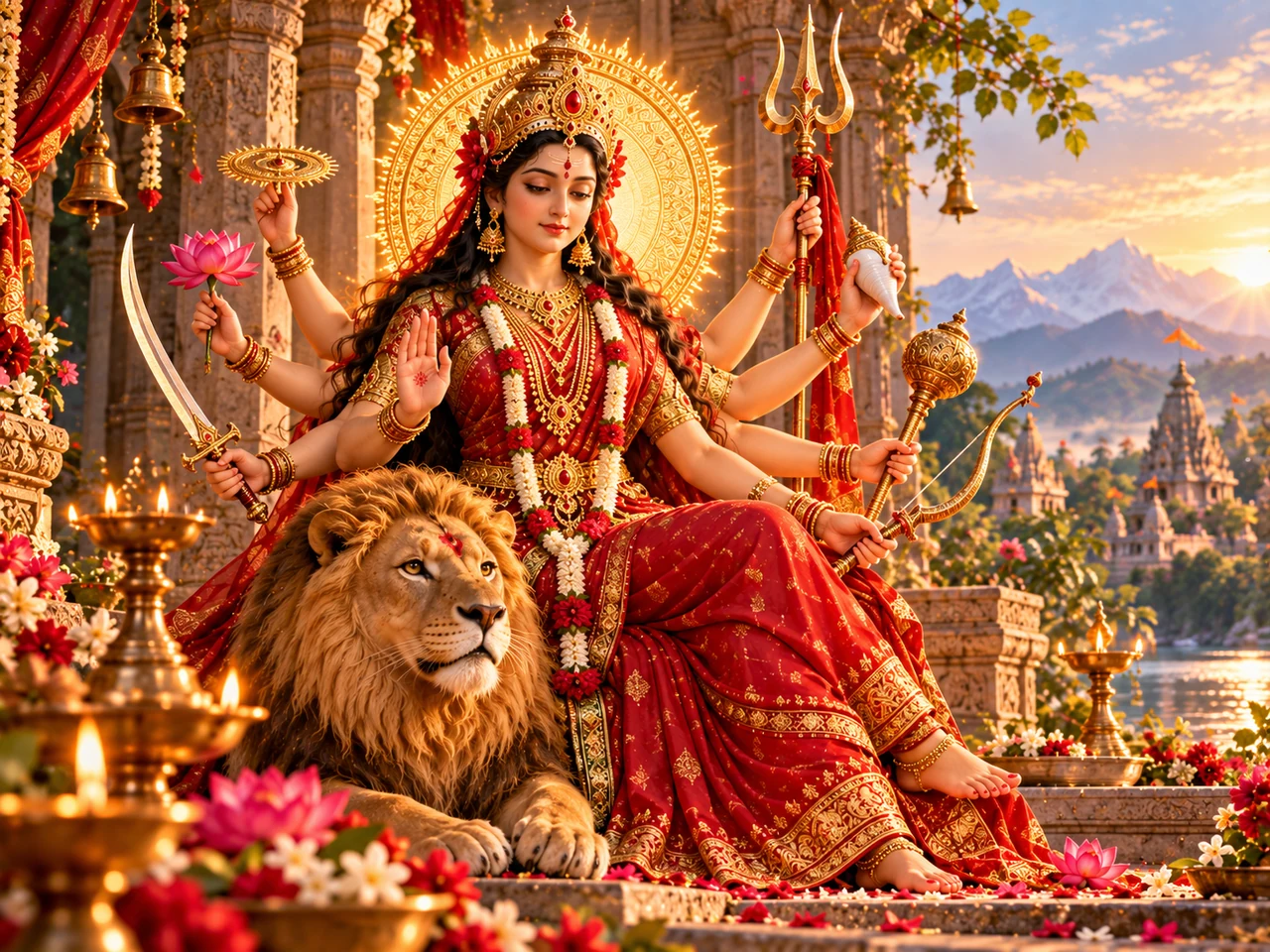
Imagine a figure standing calmly amid a battle: a lion at her side, many hands holding different weapons, and a face that conveys resolve rather than fear. This is one of the most recognizable images of Durga (Durga, दुर्गा). For generations of devotees, she has embodied a profound promise: when ordinary sources of protection fail, the divine can still confront injustice, fear and disorder. But the goddess is more than an image of victory. Her stories ask why power should be used, whom it ought to protect, and how fierce action can coexist with a mother's compassion. (Durgā, दुर्गा). For generations of devotees, she has embodied a profound promise: when ordinary sources of protection fail, the divine can still confront injustice, fear and disorder. But the goddess is more than an image of victory. Her stories ask why power should be used, whom it ought to protect, and how fierce action can coexist with a mother's compassion.
Durga is worshipped across Hindu traditions as a protective and powerful form of the Goddess (Devi). Many Shakta traditions regard her not merely as a helper of other deities but as supreme divinity itself. Other traditions understand her in relation to Parvati, Shiva, or the larger family of divine feminine manifestations. Such approaches overlap, yet they need not be identical. The Devi Mahatmyam (Durga Saptashati), a celebrated narrative within the Markandeya Purana, is the central literary doorway into her world; its thirteen chapters also circulate independently as the Durga Saptashati or Chandi. The separate ShivGoraksh scripture project is prepared, not assumed published here. 1 2
Names, identity and the meaning of Durga
The Sanskrit name DurgaDurgā is often interpreted devotionally as one who is difficult to overcome, or one who enables the crossing of difficulty. These are traditional explanations, not a claim that one English phrase exhausts the word's linguistic history. Mahishasuramardini names her as the slayer of Mahishasura; Chandika emphasizes her formidable power; Ambika evokes the Mother; Bhagavati is an honorific for the revered Goddess. Names such as Jagadamba, the Mother of the World, arise naturally in worship. The names may highlight a common goddess, but their meanings and textual histories are not interchangeable in every context. 1 3
A helpful distinction is between Durga, a recognizable deity and constellation of traditions, and Shakti, a term meaning divine power that can also designate the Goddess as supreme. Within Shakta worship, Durga may embody that ultimate power. In a Shaiva household, a devotee might speak of her close relationship with Parvati and Shiva; in Bengal, an affectionate family image brings her together with Ganesha, Kartikeya, Lakshmi and Saraswati. The artistic family grouping reflects a living regional convention, not necessarily the cast arrangement of the Devi Mahatmyam (Durga Saptashati). 3 10
Where the stories come from
The most influential early comprehensive account of Durga's martial protection appears in the Devi Mahatmyam (Durga Saptashati), conventionally the thirteen chapters numbered 81–93 of the Markandeya Purana (a numbering scheme that differs from some other presentations). Modern scholarship discusses its composition within a broad late-antique period; an exact author and precise year cannot responsibly be assigned. The text brings together older strands of goddess devotion while presenting a remarkable theological picture: the Goddess both transcends the world and works within it. 1 2
Textual history is not the same as devotional time. A story can describe events in a cosmic age without supplying the historical date at which a manuscript, sculpture or festival was created. Research on Durga's cult points to changing forms of royal, regional and temple patronage over centuries. Surviving sculptures from different places show how widely her imagery traveled; a ninth-century Javanese Durga in a museum collection, for example, cannot be treated as evidence that every local ritual was identical to an Indian practice. 3 4 8
1. A king and a merchant ask why the mind clings
The Devi Mahatmyam (Durga Saptashati) does not begin with a battle. It opens with two disappointed people. King Suratha has lost his position, while the merchant Samadhi has been rejected by relatives interested in his wealth. Yet both continue to worry about the very people and possessions associated with their distress. They ask the sage Medhas why understanding a problem does not automatically free someone from attachment.
Medhas answers by speaking of Mahamaya, the power through which living beings experience the world and its bonds. The Goddess can bind through fascination, yet she also makes insight and release possible. The frame matters: the reader encounters Durga's battles as part of an inquiry into attention, suffering and the limits of ordinary control. It is a story told as sacred teaching, not an experiment proving a psychological theory. 5
2. Mahishasura: many strengths gather around one protector
The asura Mahishasura has displaced the gods from their positions. In the Devi Mahatmyam (Durga Saptashati)'s middle episode, the gods' radiant powers unite in the form of a magnificent Goddess. They offer their weapons; Himavat gives her a lion. The assembled gifts are not a sign that she can act only with borrowed authority. The episode instead dramatizes scattered powers becoming concentrated in a decisive protective presence. 6
Mahisha is no passive opponent. In the battle he changes forms, and the buffalo is his most famous appearance. After fierce combat Durga defeats him. The episode has become Mahishasuramardini iconography: the goddess with weapons, a lion and a buffalo-shaped adversary. Some sculptures show the demon emerging in human form from the buffalo; others arrange the combat differently. We should read these images as historically situated works of art, not assume that every depicted detail is mandated by a single verse. 7 8
One meaningful reading of this victory is the restoration of order when domination has replaced legitimate responsibility. Another is intensely personal: human beings recognize the struggle against fear, arrogance or habits that seem stronger than their judgment. These interpretations illuminate the story; they do not replace the narrative's own account of a cosmic conflict.
3. Shumbha, Nishumbha and the many expressions of one Goddess
In the final narrative cycle, Shumbha and Nishumbha seek to possess the beautiful Goddess through demand and force. The story's tension is not romantic courtship: it concerns a refusal to be treated as something another person can simply claim. The Goddess insists on her own terms. Messengers and warriors are defeated, and powerful feminine manifestations appear during the struggle. 9
In one episode Chanda and Munda are defeated by the fierce form associated with Kali and Chamunda. 17 In another, Raktabija has the alarming ability to multiply as blood touches the ground; a coordinated strategy involving Kali counters that threat. Later, the Goddess brings her manifestations back into herself as she confronts Shumbha. 18 Shakta interpreters see here an especially vivid vision of unity expressed through many forms. Importantly, Kali is not just another spelling of Durga: particular narratives and devotional communities give each form distinctive character. 9 11
4. The Goddess answers two different prayers
After the teaching and the battles, Suratha and Samadhi turn to worship. In the concluding chapter, Durga grants different boons: the king receives the worldly future he seeks, while the merchant seeks and receives knowledge that frees him from attachment. The ending resists a simplistic account of devotion as one uniform bargain. It acknowledges both worldly responsibility and the desire for liberation, without promising that every worshipper will obtain a chosen result. 12
How to read her image: lion, weapons and multiple arms
The lion (simha) is Durga's best-known vehicle, although the precise visual relationship between lion, goddess and buffalo varies among artworks. Her multiple arms create a visual language for extraordinary ability. A trident, discus, conch, sword, bow, arrow, bell or shield can recall the weapons and gifts described in the narrative. A hand's object can carry additional meanings in later commentaries, but an attractive modern explanation is not automatically a scriptural statement. 6 7
A striking feature of Durga imagery is the coexistence of composure and force. Her expression may remain poised even as the surrounding scene becomes chaotic. Readers sometimes interpret this as disciplined strength: she confronts violence without becoming merely a mirror of it. That is a reflective interpretation, not a universal prescription for artists. Museum records identify real differences between eight-armed and ten-armed versions, between painted and sculpted representations, and between Indian and Southeast Asian settings. 7 8 10
The buffalo is an asura form in the narrative, not a statement that actual animals are morally evil. Equally, the battle's fierce imagery is a mythic and devotional language; it should not be used to justify violence against people. In a calm domestic shrine Durga may appear gracious and welcoming, while in a festival tableau she may stand at the moment of victory. Both can be meaningful representations.
Philosophy: protection, freedom and the paradox of power
The Devi Mahatmyam (Durga Saptashati) repeatedly resists an easy division between a gentle goddess and a fierce one. The same reality offers shelter, confronts danger, generates the world's experiences and can release beings from confusion. Mahamaya is therefore not merely a synonym for deception. Within the text's theology she is a world-forming power, and her gift of knowledge matters as much as her skill in battle. 5 2
Dharma, often simplified as righteousness, can also involve the sustaining order and responsibilities that keep life from collapsing into arbitrary might. Durga's protective action is meaningful because it responds to oppression. Her weapons are not valuable simply because they are weapons; their narrative purpose is to restore a damaged world. This is an interpretive reading, offered as a way to understand the themes rather than as a verse-by-verse doctrinal formula.
For some Shakta theologians the Goddess is the highest reality from which other divine powers appear. Other practitioners see Durga within a wider system including Shiva, Vishnu and regional divinities. Hindu traditions need not be forced into a single hierarchy. Nor should the Goddess's strength be reduced to a modern slogan that erases the complex devotional lives of her worshippers. 2 3
Durga among other divine forms and traditions
In many communities Durga and Parvati are closely connected. Yet 'Durga is always exactly Parvati in every text' is too sweeping. Sacred literature can present her as a manifestation arising for the gods' protection, as the supreme Mother, or through relationships developed in other Puranic and regional narratives. Similarly, Kali is sometimes a fierce manifestation within Durga's story and sometimes a central goddess with an independent devotional world. Lakshmi and Saraswati may be viewed as distinct goddesses, related expressions of Devi, or members of Durga's Bengali festival family. Context determines which explanation fits. 3 10 11
Regional traditions introduce further depth. Katyayani, Vindhyavasini, Chamundeshwari and other locally beloved forms are not interchangeable labels for one identical temple practice. Their stories, place-based customs and images deserve specific research. Historical studies describe royal and regional connections to the worship of the powerful Goddess, while museum objects document the changing visual vocabulary of her presence. These findings reveal development and diversity; they neither prove nor disprove devotional assertions about divine eternity. 4 8
Where Durga appears in scripture and literature
The most important gateway for this profile is the Devi Mahatmyam (Durga Saptashati), which may be read as three broad narrative movements:
- Chapter 1: Mahamaya, Vishnu and the Madhu–Kaitabha story, within the questions of Suratha and Samadhi.
- Chapters 2–4: The arising of the Goddess, the struggle against Mahishasura and the gods' praise.
- Chapters 5–13: The confrontations with Shumbha and Nishumbha, the Goddess's many manifestations, hymns, promises and the concluding boons.
The chapters also include reflective praise. The Narayani Stuti in chapter 11 celebrates the divine presence in manifold forms; chapter 12 discusses the merit of hearing and honoring the story within its devotional framework. 13 19 These are religious claims made by the text, not experimentally demonstrated guarantees. Some recitation traditions attach ancillary material, such as kavacha, argala or kilaka, to a Saptashati book or worship sequence. These should not automatically be counted as additional chapters of the thirteen-chapter Devi Mahatmyam (Durga Saptashati). 1 13
When reading historic editions, keep chapter conventions in view: Devi Mahatmyam (Durga Saptashati) chapter 1 corresponds to Markandeya Purana chapter 81 in the Pargiter presentation used for this source ledger. The independently prepared ShivGoraksh scripture is not yet linked as a live page. No exact Sanskrit quotation appears here because the chosen Sanskrit edition has not yet been checked line by line against this educational reading.
Navadurga: nine names, nine devotional emphases
During Navratri, a widely followed North Indian pattern honors Navadurga, nine forms of Durga. The conventional sequence is Shailaputri, Brahmacharini, Chandraghanta, Kushmanda, Skandamata, Katyayani, Kalaratri, Mahagauri and Siddhidatri. Its daily observance and associations can vary by region. This sequence should not be confused with the Devi Mahatmyam (Durga Saptashati)'s three main narrative movements or treated as a complete list of every goddess form everywhere. 14
The names create an accessible devotional journey. Shailaputri points toward the mountain-born daughter; Brahmacharini evokes disciplined spiritual effort; Chandraghanta and Katyayani are celebrated as active protectors; Kushmanda is associated in popular explanations with creative vitality; Skandamata presents maternal care; Kalaratri and Mahagauri juxtapose formidable and serene imagery; Siddhidatri is associated with accomplishment or spiritual perfections. Such short descriptions are interpretive summaries of current devotional presentations, not verified one-line quotations from an ancient source. 14
A person may honor these forms during nine nights without believing that every community uses the identical roster, sequence, clothing color or ritual system. In fact, a color-of-the-day chart circulating on social media often reflects a contemporary convention rather than universal scriptural law.
Worship, festivals and the living community
Navratri and Durga Puja are among the most visible occasions for devotion to Durga, but they take different forms in different places. Families may offer flowers, sing hymns, listen to stories and attend aarti. Some undertake fasting according to their own health, circumstances and family customs. Public participation in aarti, visits to shrines or learning the narratives is not the same as receiving initiation into a specialized tantric practice; the latter belongs to particular teachers and lineages. This profile does not prescribe restricted mantras or initiation rites. 14 15
In West Bengal, Durga Puja has become a meeting point of devotional life, clay sculpture, neighborhood collaboration, music and inventive temporary pavilions (pandals). The festival is often imagined as the Mother's return to her family home. UNESCO inscribed “Durga Puja in Kolkata” on its Representative List of the Intangible Cultural Heritage of Humanity in 2021. This recognition concerns a living cultural practice and its community, not official verification of a miraculous claim. 15 16
In Gujarat, the wider Navratri season is famously associated with garba and dandiya, while other regions emphasize temple processions, home shrines, dramatic performances or arrangements of dolls. The festival calendar follows lunar reckoning, and dates shift between civil years and local calendars; no fixed annual date is asserted here. Visitors should follow the customs of the individual temple or host community. 14
Is Durga the same as Shakti?
Durga is a form of the Goddess; Shakti also means divine power and can refer to supreme divinity. In many Shakta accounts they are intimately identified, but the terms are not identical in every religious or philosophical context.
Is Durga the wife of Shiva?
Some traditions link Durga with Parvati and therefore with Shiva. The Devi Mahatmyam (Durga Saptashati) also presents the Goddess as an independent and overarching cosmic power. Both approaches exist; a single relation should not overwrite the text's theology. 2
Why does Durga have so many arms?
Her multiple arms make the many weapons and capacities of divine protection visible. The number differs across images and traditions. It is not necessary to assume that every artwork copies one fixed description. 7
Are Navadurga and the ten Mahavidyas the same group?
No. Navadurga is a nine-form devotional grouping prominent during Navratri; the Dasha Mahavidya are a different tenfold framework within Shakta traditions. Individual names and theological associations sometimes intersect, but their lists and contexts should not be merged.
Does the Devi Mahatmyam (Durga Saptashati) promise guaranteed outcomes if recited?
The work praises hearing, recitation and worship as spiritually fruitful. Such passages express devotional belief. 19 ShivGoraksh does not present them as medical treatment, measurable prediction or guaranteed worldly results. 13
Mini glossary
- Devi (देवी): goddess; also the Great Goddess in many traditions.
- Shakti (शक्ति): power or capacity; divine feminine power in many theological settings.
- Asura (असुर): a class of beings in Hindu mythic narratives, not a shorthand for real-world people.
- Mahishasuramardini (महिषासुरमर्दिनी): the goddess as vanquisher of Mahishasura.
- Mahamaya (महामाया): a divine cosmic power associated with manifestation, binding and release.
- Navadurga (नवदुर्गा): a devotional grouping of nine forms of Durga.
- Vahana (वाहन): a deity's associated vehicle or mount.
- Stuti (स्तुति): a hymn of praise.
- Pandal (पंडाल): a temporary festive structure, especially prominent at public Durga Puja.
- Diksha (दीक्षा): formal initiation; rules depend on a particular tradition and teacher.