



Who is Kartikeya?
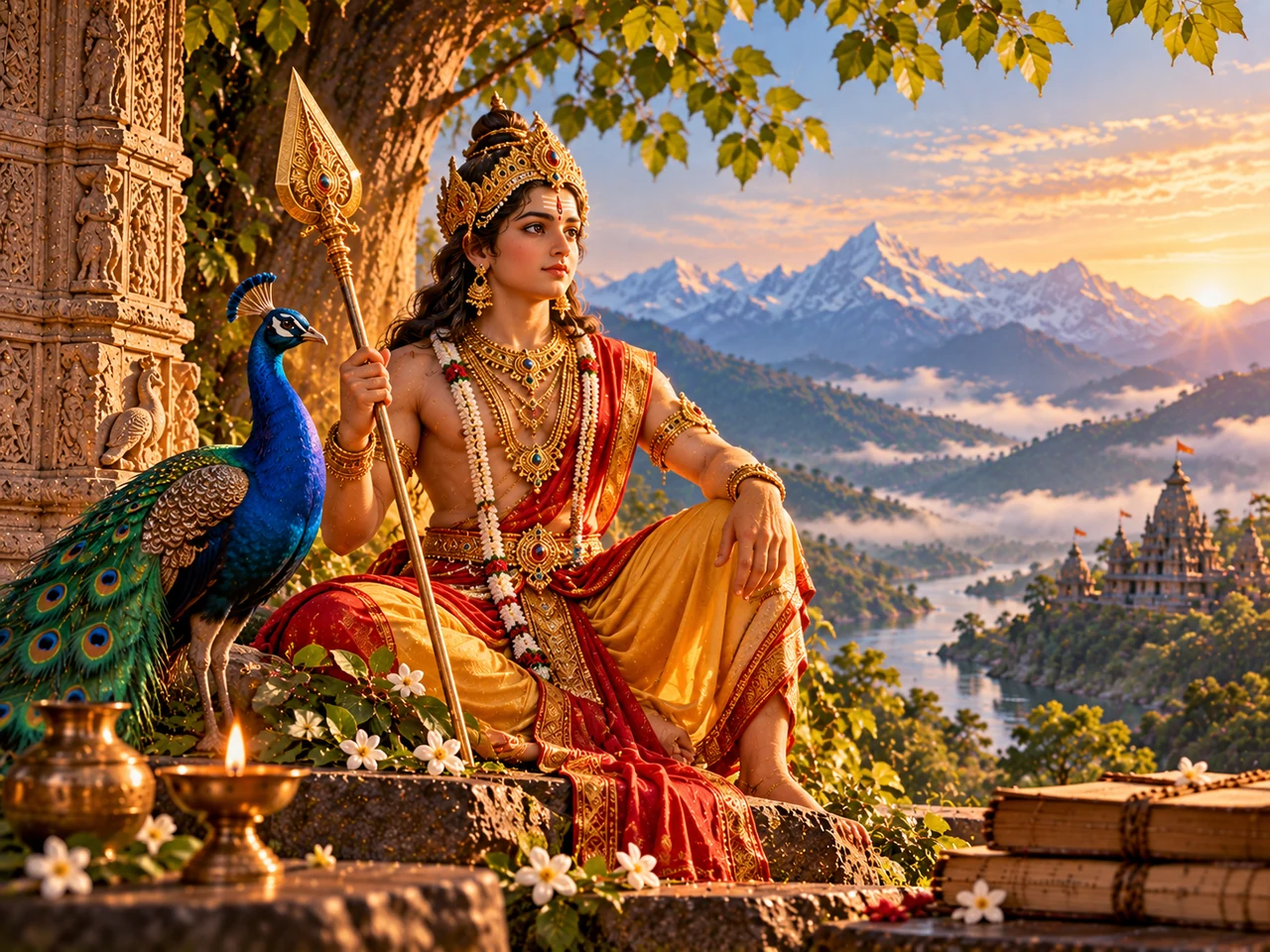
Picture a youthful deity carrying a slender spear, with a peacock standing beside him. In one temple he is a courageous commander; in another, a serene teacher; elsewhere, a beloved child to whom families bring their hopes. These may all be images of Kartikeya, also called Skanda, Kumara, Subrahmanya, and, especially in Tamil-speaking communities, Murugan. He is widely understood in Shaiva traditions as the son of Shiva and Parvati and the brother of Ganesha. Yet his Tamil devotional identity has its own deep literary history and cannot be reduced to a supporting role in another deity's story. 8 10
Kartikeya's martial character is unmistakable, but “god of war” is not his whole meaning. Courage, spiritual insight, youthful energy, protection, and the difficult task of directing strength responsibly appear in stories, songs, and sacred art. The contrast is part of his appeal: the spear can defeat a frightening adversary, while the child holding it can express tenderness and self-mastery. This article explains what different traditions say, what historical evidence can establish, and where the two should not be confused.
Names, meanings and overlapping identities
Skanda is a well-established Sanskrit name; Kumara conveys youth; Kartikeya recalls the Krittikas, the nurturing figures associated with his birth. Mahasena means “great army” or its commander, while Guha suggests one who is hidden or inwardly mysterious. Shanmukha or Shadanana refers to the six-faced form; Subrahmanya is another familiar name, especially in South Indian worship. Murugan, often connected in Tamil usage with beauty or youthfulness, is central to a distinctive body of Tamil poetry and temple devotion. Spellings such as Karthikeya, Kārttikeya, Murukaṉ and Murugan reflect different transliteration habits, not necessarily different gods. 2 4 8
These names do not erase meaningful differences. A Sanskrit Purana may emphasize Shiva's son who leads the gods against Taraka. A Tamil hymn may praise Murugan as the intimate lord of particular hills and shrines. Some devotees see the identities as entirely united; a historian instead asks when and how their literary, visual, and ritual traditions became connected. Both questions are legitimate, but they ask for different kinds of answers.
Origins: literature and historical evidence
The origins of a living deity's worship are not a single datable event. Epic and Puranic narratives present Skanda as a divine being within sacred history; they do not function as modern birth certificates. Early Tamil materials offer another important horizon, associating Murugan with the kurinji, the mountainous landscape in classical Tamil thought. The National Library Board of Singapore discusses references in Tolkappiyam, Paripadal, and Tirumurukarruppatai, while also describing the later interaction between Murugan and Sanskritic Skanda traditions. The precise dating of individual Tamil texts and the evolution of their cults require specialist judgment. 4 9
Material objects make the picture more tangible. The Metropolitan Museum of Art identifies a Gangetic-region terracotta as Karttikeya-Skanda, dated approximately to the first century BCE; that dating concerns the museum object, not a provable beginning of his worship. Gandharan sculptures centuries later show peacocks, javelins, and roosters, while a Kashmiri image from the eighth century displays a rosary and an unusual disk standard. Art thus documents long-lived, regionally diverse representations, rather than one timeless uniform costume. 5 6 7
1. A remarkable birth and the care of the Krittikas
In the Shiva Purana, the gods need extraordinary help against the threatening asura Taraka. The narrative links the emergence of Shiva's son with divine energy, its conveyance, and a birth beyond ordinary human processes. The Krittikas then nurture the child. Later episodes take the boy toward Shiva and Parvati and toward his role among the gods. The text offers sacred narrative, not a physiological explanation, and different tellings vary in their sequence and in the roles of Agni, Ganga, or the reeds. 1 2
A moving detail is easy to overlook: those who raised the boy fear losing him. The Krittikas' love matters alongside the cosmic drama. In this telling, belonging does not mean only biological parentage; nurture and affection deserve recognition. Readers encountering six-faced iconography may also hear traditions that associate the child's six aspects with six nurturing mothers, although the detailed explanation changes across retellings. We should not force every version into a single genealogy.
2. Kartikeya and Tarakasura: courage at the right moment
The Shiva Purana's Rudra-samhita, Kumara-khanda, recounts Kartikeya's appointment and the struggle against Tarakasura (Taraka). Gods who have failed to overcome the adversary turn toward the young commander. The battle is intense; Taraka initially resists him. Ultimately Kartikeya kills the asura with his spear and order is restored within the narrative. Chapters 7–10 provide a traceable sequence, with the climactic defeat in chapter 10. 3
The straightforward devotional reading celebrates protection from oppression. A reflective reader may additionally see a question about the responsible use of strength: power matters not simply because it can win, but because of what it protects. That second reading is an interpretation, not a literal verse quoted from the Purana. Nor should an account of gods and asuras be treated as proof of a datable military campaign.
3. Murugan and Surapadman: victory and transformation
In a major Tamil devotional cycle, Murugan confronts Surapadman (also written Suran or Sura). The tradition tells of a terrifying opponent who finally takes the form of a tree. Murugan splits it with the vel, his lance, and the resulting imagery is associated with the peacock and rooster: the mount and emblem that remain beside him. The National Library Board traces elements of this story to Tamil literary materials and distinguishes its festivals; the Metropolitan Museum describes the same peacock-and-rooster symbolism in a South Indian art-historical context. 4 11
Some tellings emphasize the enemy's defeat; others highlight his transformation into forms incorporated into Murugan's own iconography. This can inspire a devotional reflection: victory does not always mean merely throwing something away; what once threatened may be brought under wiser direction. The Kanda Puranam, a major Tamil narrative associated with Kachiyappa Sivachariyar, develops the Murugan cycle at length. It must not be casually described as identical in wording or structure to every recension of the Sanskrit Skanda Purana. 12
4. Love, kinship and the paths of Valli and Devasena
Murugan's stories are not confined to battle. In many South Indian traditions he appears with two consorts, Devasena (Tamil Deivanai/Teyvayanai) and Valli. The narratives around them differ in setting, characterization, and devotional emphasis; Valli is especially connected with a world of hills, pursuit, affection and local landscape, while Devasena is commonly associated with the heavenly court. The Metropolitan Museum records both beside a six-faced Subrahmanya in a historical popular print. 10 12
Some interpreters understand the paired stories as complementary kinds of devotion, but such readings belong to particular teachers or communities rather than to a universal doctrine. Likewise, stories about a divine fruit and Murugan's retreat to Palani explain the devotional image of Dandapani, the youthful staff-bearing ascetic. The National Library Board presents this as local tradition, not an archaeological account establishing how the place-name first arose. 4
How to read his image: six faces, vel and peacock
The vel is the lance or spear most readily associated with Murugan. In living Tamil devotion it is often understood as a gift of the Mother's power and as the sharpness that cuts through confusion. That is a devotional symbolism, not a claim that every pictured spear had precisely that meaning in every century. The peacock is his familiar vahana, or vehicle; the rooster can appear as an emblem or on a banner. A sixth- to seventh-century Gandharan figure at the Met actually holds a javelin and a rooster, an especially useful reminder that iconography changes. 4 6 13
Six faces give rise to names such as Shanmukha and Arumugam. Devotees variously relate them to encompassing sight, multiple powers, the nurturing Krittikas, or spiritual insight. These are interpretations preserved in different settings, not a universally agreed six-part dictionary. Four or more arms, a crown, a youthful face, and ornaments likewise vary according to artistic region and period. The Met's Kashmiri Skanda with a rosary and disk standard demonstrates how risky it would be to label anything without a vel “not Kartikeya.” 7 10
A child Skanda gently holding a peacock can convey affection rather than martial ferocity. A warrior statue may emphasize vigilance. A Murugan temple image may foreground a simple staff. No modern commissioned illustration should be treated as historical proof of what a particular text prescribed. For ShivGoraksh, the selected artwork will be mapped later as a visual aid; its details cannot independently settle textual questions.
Ideas: valor, knowledge, self-discipline and grace
Why does a warrior also appear as a teacher? Hindu devotional traditions regularly treat courage and insight as partners. In some southern contexts Murugan is a source of jnana, spiritual knowledge, while the vel represents discernment as well as protective force. In other depictions, the youthful deity holds a rosary; some narratives place him in the posture of one who teaches rather than conquers. These are theological and artistic languages, not laboratory claims about a weapon conferring wisdom. 7 13
The Palani form of Dandapani adds another contrast: a figure famous for heroic strength may be shown as a renouncer carrying a staff. This invites the reader to distinguish control over others from mastery of one's impulses. Equally, love for Valli and Devasena reminds worshippers that the same deity can be encountered through kinship, compassion and grace. No single interpretation is mandatory across Shaiva, Kaumara and Tamil regional communities.
Some traditions praise Murugan as supreme, while other Shaiva settings place him within Shiva's family. Such accounts are theological viewpoints held in meaningful contexts. Describing the variety respectfully does not require choosing one school as the objective winner.
Within Hindu traditions and across regions
In the familiar Shaiva family grouping, Shiva and Parvati are his parents and Ganesha his brother. The relative age of the brothers can differ by text, artistic convention and local telling; even modern museum labels choose particular genealogical assumptions. A family portrait should therefore not be mistaken for a single uncontested narrative chronology. 10 14
In parts of North India Kartikeya is frequently encountered through mythology, temple sculpture, and family imagery; in Tamil Nadu Murugan worship stands at the center of major temple networks, poetry, vows, and celebrations. Tamil-speaking communities in Shri Lanka, Malaysia, Singapore and elsewhere carry diverse versions of those traditions across generations. The National Library Board's account of Thaipusam in Singapore is a particularly useful example of how a deity's worship acquires local institutional and social forms without losing its Tamil connections. . Tamil-speaking communities in Sri Lanka, Malaysia, Singapore and elsewhere carry diverse versions of those traditions across generations. The National Library Board's account of Thaipusam in Singapore is a particularly useful example of how a deity's worship acquires local institutional and social forms without losing its Tamil connections. 4
This is not a simple story of a “northern god imported into the south” or its opposite. The evidence points to historically interacting streams of Tamil Murugan and Sanskrit Skanda traditions. Scholars investigate texts, archaeology, patronage and temple history to reconstruct connections; a living devotee may describe their relationship using a different vocabulary of divine unity. 4 8
Scriptures, poetry and the problem of one definitive text
For a Sanskrit-source entry point, see the Shiva Purana, Rudra-samhita, Kumara-khanda: chapters 2–5 cover the son's emergence and recognition; chapters 7–10 move toward the encounter with Taraka. The numbers apply to the identified online presentation of a particular recension, not every manuscript bearing the name Shiva Purana. Our account paraphrases episodes in fresh prose and reproduces no extended published translation. 1 2 3
For the Tamil heritage, readers may begin with Tirumurukarruppatai and Paripadal, then explore the later Kanda Puranam and devotional song traditions. These works are not interchangeable. Poetry tied to a sacred landscape can reveal the experience of devotion in a way quite different from an epic battle narrative. The precise philological dating, readings and translations of Tamil passages need edition-specific review before ShivGoraksh quotes lines in Tamil or Hindi. 4 9 12
Kartikeya is not the central subject of the three independently prepared ShivGoraksh scriptures—Bhagavad Gita, Devi Mahatmyam (Durga Saptashati) and Ashtavakra Gita. A superficial connection should not be used to manufacture a citation or an active internal link. Those projects remain separate until accurate references and publication status are confirmed.
The six abodes: sacred geography and careful history
Murugan's celebrated Arupadai Veedu, or six sacred abodes, are commonly identified today as Tirupparankunram, Tiruchendur, Palani, Swamimalai (Tiruverakam), Tiruttani and Pazhamudircholai. Each has stories, landscape, temple traditions and pilgrimage practices of its own. Heidelberg University's research explicitly studies how the present network of these six distinguished locations took shape historically. That is more precise than asserting that every modern identification was unchallenged from the earliest poem onward. 8
They form a striking range of settings: coastal Tiruchendur, hill sites, and temples connected with marriage, victory, knowledge or renunciation in local lore. A visitor encounters something different in each place, not six identical copies of a single shrine. This list is descriptive of current conventional recognition, not a promise that every historical name in Tirumurukarruppatai has an undisputed archaeological match. 8 9
Devotion, festivals and public culture
Skanda Sashti or Kanda Sashti commemorates Murugan's conflict with Surapadman in many Tamil contexts; dramatic retellings of victory may form part of the season. Thaipusam is particularly associated with the Mother's gift of the vel and is an important observance among Tamil communities beyond India, including Singapore and Malaysia. These festivals are not identical, and local calendars, processions and emphases vary. 4
Offerings, songs, processions and temple visits are public features of many communities. Some forms of vows and embodied devotion are strenuous and deeply situated in family, temple or lineage customs. This educational article does not provide an initiation procedure, instructions for piercing or severe austerities, or promised spiritual outcomes. Anyone seeking to participate should consult the relevant temple, local community and, where physical demands are involved, appropriate professional safety advice. The label for these descriptions is PUBLIC for general information; particular personal vows remain tradition-specific.
In devotional homes, Murugan may be remembered through a simple image, a song, or a story told to a child. That everyday continuity is as important to understanding the tradition as the drama of a festival procession. Faith, scholarship and personal participation can coexist without pretending to be the same kind of evidence.
Are Kartikeya, Skanda and Murugan the same?
They are commonly identified as the same deity in contemporary Hindu worship, but their Sanskrit and Tamil traditions have distinct histories. Recognizing unity in devotion need not erase those histories. 4 8
Why six faces?
Six-faced Shanmukha iconography has multiple devotional explanations, including associations with the Krittikas. It is not honest to claim that one modern symbolic explanation is the sole original interpretation. 2 10
Is the vel only a weapon?
It is visibly a lance, and it is also understood in many devotional settings as a symbol of power, protection and insight. Symbolic interpretation and a physical description should be kept distinct. 4 13
Does every tradition say he is unmarried?
No. Traditions featuring Valli and Devasena are important in South India, while other regions and forms emphasize a youthful ascetic or bachelor. Do not universalize either one. 10 4
Are the six abodes unquestioned ancient historical sites?
The six are established sacred pilgrimage places today. Historical questions about the identification and development of their network are subjects of continuing research, not settled by devotional familiarity alone. 8
Glossary: key terms
| Term | Meaning in this article |
|---|---|
| Vel | The lance or spear closely associated with Murugan; also devotionally interpreted as divine power. |
| Vahana | An associated mount or vehicle; Kartikeya's is typically a peacock. |
| Krittikas | Nurturing figures linked with the name Kartikeya in traditional birth narratives. |
| Shanmukha / Arumugam | The six-faced manifestation. |
| Kumara | Youthful divine form; a widely used epithet. |
| Deivanai / Devasena | One of Murugan's consorts in many southern traditions. |
| Valli | Another consort, associated with a distinctive Tamil story world. |
| Arupadai Veedu | The conventional network of six important Murugan pilgrimage temples. |
| Kaumara | A designation for traditions centered on Kumara/Skanda. |