Text, Meaning & Explanation
जय गणपति सदगुण सदन, कविवर बदन कृपाल । विघ्न हरण मंगल करण, जय जय गिरिजालाल ॥
Roman HindiJai Ganpati sadgun sadan, kavivar badan kripaal. Vighn haran mangal karan, jai jai Girija-laal.Jai Ganpati sadgun sadan, kavivar badan kripaal. Vighn haran mangal karan, jai jai Girija-laal.
Meaning
The poet salutes Ganapati, a gracious home of virtues, remover of impediments and beloved son of Girija.
Explanation
The opening invokes moral goodness and hopeful beginnings; the devotional praise is not a promise that life's difficulties disappear automatically.
जय जय जय गणपति गणराजू । मंगल भरण करण शुभः काजू ॥1॥
Roman HindiJai jai jai Ganpati Ganraaju. Mangal bharan karan shubh kaaju.Jai jai jai Ganpati Ganraaju. Mangal bharan karan shubh kaaju.
Meaning
Victory to Ganapati, king of the divine attendants, who fills endeavours with auspiciousness.
Explanation
The repeated praise establishes a celebratory tone. Ganaraja is an honorific, not a claim about a dated earthly kingdom.
जै गजबदन सदन सुखदाता । विश्व विनायका बुद्धि विधाता ॥2॥
Roman HindiJai Gajbadan sadan sukhdaata. Vishva Vinaayaka buddhi vidhaata.Jai Gajbadan sadan sukhdaata. Vishva Vinaayaka buddhi vidhaata.
Meaning
Praise to the elephant-faced Vinayaka, giver of joy and guide of understanding.
Explanation
The elephant face points to recognizable Ganesha iconography. Wisdom here includes discernment and responsible action.
वक्र तुण्ड शुची शुण्ड सुहावना । तिलक त्रिपुण्ड भाल मन भावन ॥3॥
Roman HindiVakra tund shuchi shund suhaavana. Tilak tripund bhaal man bhaavan.Vakra tund shuchi shund suhaavana. Tilak tripund bhaal man bhaavan.
Meaning
The curved trunk and forehead markings make the deity's appearance delightful to the devotee.
Explanation
The forehead marking reflects an iconographic devotional description. It is not evidence of a single compulsory marking across all regions.
राजत मणि मुक्तन उर माला । स्वर्ण मुकुट शिर नयन विशाला ॥4॥
Roman HindiRaajat mani muktan ur maala. Swarn mukut shir nayan vishaala.Raajat mani muktan ur maala. Swarn mukut shir nayan vishaala.
Meaning
A gem-and-pearl garland shines on the chest; a golden crown and broad eyes adorn Ganesha.
Explanation
Ornaments evoke majesty and affection in worship; the hymn is describing a visualized devotional form.
पुस्तक पाणि कुठार त्रिशूलं । मोदक भोग सुगन्धित फूलं ॥5॥
Roman HindiPustak paani kuthaar trishoolam. Modak bhog sugandhit phoolam.Pustak paani kuthaar trishoolam. Modak bhog sugandhit phoolam.
Meaning
A book, axe and trident are named among the attributes; modaks and fragrant flowers are offered.
Explanation
The book evokes learning while gifts express hospitality and devotion. Iconographic attributes differ across Ganesha forms.
सुन्दर पीताम्बर तन साजित । चरण पादुका मुनि मन राजित ॥6॥
Roman HindiSundar peetaambar tan saajit. Charan paaduka muni man raajit.Sundar peetaambar tan saajit. Charan paaduka muni man raajit.
Meaning
Yellow garments adorn Ganesha; even sages rejoice at his revered feet and sandals.
Explanation
The sandals and feet are poetic signs of reverence. The verse asks readers to notice humility alongside grandeur.
धनि शिव सुवन षडानन भ्राता । गौरी ललन विश्व-विख्याता ॥7॥
Roman HindiDhani Shiv suvan Shadaanan bhraata. Gauri lalan vishva-vikhyaata.Dhani Shiv suvan Shadaanan bhraata. Gauri lalan vishva-vikhyaata.
Meaning
Blessed son of Shiva, brother of six-faced Skanda, beloved child of Gauri, known widely.
Explanation
Family relationships situate Ganesha within Shiva-Parvati traditions, although Puranic family narratives vary.
ऋद्धि-सिद्धि तव चंवर सुधारे । मूषक वाहन सोहत द्वारे ॥8॥
Roman HindiRiddhi Siddhi tav chanvar sudhaare. Mooshak vaahan sohat dvaare.Riddhi Siddhi tav chanvar sudhaare. Mooshak vaahan sohat dvaare.
Meaning
Riddhi and Siddhi attend him with a ceremonial fan, and the mouse vehicle stands at the doorway.
Explanation
Riddhi and Siddhi may be understood as personified prosperity and accomplishment; the mouse is a distinctive iconographic companion.
कहौ जन्म शुभ कथा तुम्हारी । अति शुची पावन मंगलकारी ॥9॥
Roman HindiKahau janm shubh katha tumhaari. Ati shuchi paavan mangalkaari.Kahau janm shubh katha tumhaari. Ati shuchi paavan mangalkaari.
Meaning
The speaker turns to Ganesha's auspicious birth story.
Explanation
This is a narrative transition: the ensuing story is one devotional telling, not the sole version in all Puranas.
एक समय गिरिराज कुमारी । पुत्र हेतु तप कीन्हा भारी ॥10॥
Roman HindiEk samay Giriraaj kumaari. Putra hetu tap keenha bhaari.Ek samay Giriraaj kumaari. Putra hetu tap keenha bhaari.
Meaning
Parvati, daughter of the mountain king, undertook severe austerity wishing for a son.
Explanation
The story portrays perseverance and longing; it should not be converted into a prescribed fertility practice.
भयो यज्ञ जब पूर्ण अनूपा । तब पहुंच्यो तुम धरी द्विज रूपा ॥11॥
Roman HindiBhayo yagya jab poorn anoopa. Tab pahunchyo tum dhari dvij roopa.Bhayo yagya jab poorn anoopa. Tab pahunchyo tum dhari dvij roopa.
Meaning
When the splendid sacrifice was completed, Ganesha appeared in the form of a Brahmin guest.
Explanation
The miraculous visitor motif underlines the dignity of welcoming a guest in the poem's narrative.
अतिथि जानी के गौरी सुखारी । बहुविधि सेवा करी तुम्हारी ॥12॥
Roman HindiAtithi jaani ke Gauri sukhaari. Bahuvidhi seva kari tumhaari.Atithi jaani ke Gauri sukhaari. Bahuvidhi seva kari tumhaari.
Meaning
Gauri joyfully received the visitor and cared for him generously.
Explanation
The mother's generosity precedes recognition of the visitor's identity; the moral emphasis is hospitality without calculation.
अति प्रसन्न हवै तुम वर दीन्हा । मातु पुत्र हित जो तप कीन्हा ॥13॥
Roman HindiAti prasann havai tum var deenha. Maatu putra hit jo tap keenha.Ati prasann havai tum var deenha. Maatu putra hit jo tap keenha.
Meaning
Pleased, the divine guest offers a boon concerning Parvati's prayer for a child.
Explanation
The boon belongs to sacred narrative and expresses grace; it should not be marketed as a guaranteed physical outcome.
मिलहि पुत्र तुहि, बुद्धि विशाला । बिना गर्भ धारण यहि काला ॥14॥
Roman HindiMilahi putra tuhi, buddhi vishaala. Bina garbh dhaaran yahi kaala.Milahi putra tuhi, buddhi vishaala. Bina garbh dhaaran yahi kaala.
Meaning
A wise son is promised, in this narrative, without an ordinary pregnancy.
Explanation
Such divine-birth language is mythic and theological; it does not establish a biological claim.
गणनायक गुण ज्ञान निधाना । पूजित प्रथम रूप भगवाना ॥15॥
Roman HindiGannaayak gun gyaan nidhaana. Poojit pratham roop Bhagvaana.Gannaayak gun gyaan nidhaana. Poojit pratham roop Bhagvaana.
Meaning
Ganesha is hailed as leader of the ganas, treasure of good qualities and wisdom, first to be honoured.
Explanation
The first-worshipped title is a widespread Hindu practice emphasis, though custom differs by community and ceremony.
अस कही अन्तर्धान रूप हवै । पालना पर बालक स्वरूप हवै ॥16॥
Roman HindiAs kahi antardhaan roop havai. Paalna par baalak swaroop havai.As kahi antardhaan roop havai. Paalna par baalak swaroop havai.
Meaning
After speaking, the visitor vanishes and appears as a baby in the cradle.
Explanation
The narrative links divine promise and manifestation through a sudden transformation.
बनि शिशु रुदन जबहिं तुम ठाना । लखि मुख सुख नहिं गौरी समाना ॥17॥
Roman HindiBani shishu rudan jabahin tum thaana. Lakhi mukh sukh nahin Gauri samaana.Bani shishu rudan jabahin tum thaana. Lakhi mukh sukh nahin Gauri samaana.
Meaning
The baby cries, and Gauri feels overflowing joy on seeing his face.
Explanation
The tenderness of an ordinary mother-child encounter balances the divine grandeur of the story.
सकल मगन, सुखमंगल गावहिं । नाभ ते सुरन, सुमन वर्षावहिं ॥18॥
Roman HindiSakal magan, sukhmangal gaavahin. Naabh te suran, suman varshaavahin.Sakal magan, sukhmangal gaavahin. Naabh te suran, suman varshaavahin.
Meaning
Everyone celebrates, and divine beings shower flowers according to the selected wording.
Explanation
The witness unusually reads “नाभ ते”; another text reads “नभ ते” (from the sky). The base reading is preserved, not corrected silently.
शम्भु, उमा, बहुदान लुटावहिं । सुर मुनिजन, सुत देखन आवहिं ॥19॥
Roman HindiShambhu Uma bahudaan lutaavahin. Sur munijan sut dekhan aavahin.Shambhu Uma bahudaan lutaavahin. Sur munijan sut dekhan aavahin.
Meaning
Shiva and Uma make generous gifts while gods and sages come to see the child.
Explanation
Public generosity and collective joy signal that the birth is meaningful beyond the household.
लखि अति आनन्द मंगल साजा । देखन भी आये शनि राजा ॥20॥
Roman HindiLakhi ati aanand mangal saaja. Dekhan bhi aaye Shani raaja.Lakhi ati aanand mangal saaja. Dekhan bhi aaye Shani raaja.
Meaning
Seeing the celebration, Shani arrives to visit the baby.
Explanation
Shani's appearance begins this particular narrative of how Ganesha acquires an elephant head.
निज अवगुण गुनि शनि मन माहीं । बालक, देखन चाहत नाहीं ॥21॥
Roman HindiNij avgun guni Shani man maahin. Baalak dekhan chaahat naahin.Nij avgun guni Shani man maahin. Baalak dekhan chaahat naahin.
Meaning
Mindful of the danger attributed to his gaze, Shani hesitates to look at the child.
Explanation
The hesitation conveys a tradition-specific fear, not an astronomical fact about Saturn or anyone born under it.
गिरिजा कछु मन भेद बढायो । उत्सव मोर, न शनि तुही भायो ॥22॥
Roman HindiGirija kachhu man bhed badhaayo. Utsav mor, na Shani tuhi bhaayo.Girija kachhu man bhed badhaayo. Utsav mor, na Shani tuhi bhaayo.
Meaning
Girija takes Shani's reluctance as possible displeasure with her celebration.
Explanation
The misunderstanding creates the dramatic tension that drives the following exchange.
कहन लगे शनि, मन सकुचाई । का करिहौ, शिशु मोहि दिखाई ॥23॥
Roman HindiKahan lage Shani, man sakuchaai. Ka karihau, shishu mohi dikhaai.Kahan lage Shani, man sakuchaai. Ka karihau, shishu mohi dikhaai.
Meaning
Shani timidly asks what would happen if the child were shown to him.
Explanation
His cautious words prepare listeners for the mythic consequence in this version.
नहिं विश्वास, उमा उर भयऊ । शनि सों बालक देखन कहयऊ ॥24॥
Roman HindiNahin vishvaas, Uma ur bhayau. Shani son baalak dekhan kahyau.Nahin vishvaas, Uma ur bhayau. Shani son baalak dekhan kahyau.
Meaning
Uma does not accept the warning and asks Shani to see the baby.
Explanation
The poem depicts a tragic collision of insistence and apprehension.
पदतहिं शनि दृग कोण प्रकाशा । बालक सिर उड़ि गयो अकाशा ॥25॥
Roman HindiPadat-hin Shani drig kon prakaasha. Baalak sir udi gayo aakaasha.Padat-hin Shani drig kon prakaasha. Baalak sir udi gayo aakaasha.
Meaning
At Shani's sidelong glance, the child's head disappears into the sky in the poem.
Explanation
This is a supernatural birth story in a specific textual tradition; do not confuse it with a universally shared account.
गिरिजा गिरी विकल ह्वै धरणी । सो दुःख दशा गयो नहीं वरणी ॥26॥
Roman HindiGirija giri vikal hvai dharani. So dukh dasha gayo nahin varani.Girija giri vikal hvai dharani. So dukh dasha gayo nahin varani.
Meaning
Overwhelmed by grief, Girija collapses; the poet says her anguish is beyond words.
Explanation
Maternal grief occupies the centre of this moment, avoiding a purely triumphant treatment of the story.
हाहाकार मच्यौ कैलाशा । शनि कीन्हों लखि सुत को नाशा ॥27॥
Roman HindiHaahaakaar machyau Kailaasha. Shani keenhon lakhi sut ko naasha.Haahaakaar machyau Kailaasha. Shani keenhon lakhi sut ko naasha.
Meaning
An outcry arises on Kailasa when the child is thought lost because of Shani's glance.
Explanation
The narration represents what participants believe within the myth; it is not advice for judging people associated with the planet.
तुरत गरुड़ चढ़ि विष्णु सिधाये । काटी चक्र सो गज सिर लाये ॥28॥
Roman HindiTurat Garud chadhi Vishnu sidhaaye. Kaati chakra so gaj sir laaye.Turat Garud chadhi Vishnu sidhaaye. Kaati chakra so gaj sir laaye.
Meaning
Vishnu goes swiftly on Garuda and brings an elephant's head using his discus.
Explanation
In this telling Vishnu's intervention replaces the Shiva-beheading motif of another well-known tradition.
बालक के धड़ ऊपर धारयो । प्राण मन्त्र पढ़ि शंकर डारयो ॥29॥
Roman HindiBaalak ke dhad oopar dhaarayo. Praan mantra padhi Shankar daarayo.Baalak ke dhad oopar dhaarayo. Praan mantra padhi Shankar daarayo.
Meaning
The elephant head is placed on the child's body, and Shiva invokes renewed life.
Explanation
The text depicts a sacred miracle; it is not a medical or operative technique and provides no reproducible mantra procedure.
नाम गणेश शम्भु तब कीन्हे । प्रथम पूज्य बुद्धि निधि, वर दीन्हे ॥30॥
Roman HindiNaam Ganesh Shambhu tab keenhe. Pratham poojya buddhi nidhi var deenhe.Naam Ganesh Shambhu tab keenhe. Pratham poojya buddhi nidhi var deenhe.
Meaning
Shiva gives the name Ganesha and grants him the honoured status of being worshipped first.
Explanation
The name and boon connect the birth narrative with living customs of beginning religious observances with Ganesha.
बुद्धि परीक्षा जब शिव कीन्हा । पृथ्वी कर प्रदक्षिणा लीन्हा ॥31॥
Roman HindiBuddhi pareeksha jab Shiv keenha. Prithvi kar pradakshina leenha.Buddhi pareeksha jab Shiv keenha. Prithvi kar pradakshina leenha.
Meaning
Shiva sets a test involving circumambulation of the earth.
Explanation
The storyline moves from physical power to judgment and insight.
चले षडानन, भरमि भुलाई । रचे बैठी तुम बुद्धि उपाई ॥32॥
Roman HindiChale Shadaanan, bharami bhulaai. Rache baithi tum buddhi upaai.Chale Shadaanan, bharami bhulaai. Rache baithi tum buddhi upaai.
Meaning
Six-faced Skanda sets out, while Ganesha conceives a different solution.
Explanation
The brothers model different approaches; the poem values imaginative understanding over mere speed.
चरण मातु-पितु के धर लीन्हें । तिनके सात प्रदक्षिण कीन्हें ॥33॥
Roman HindiCharan maatu-pitu ke dhar leenhen. Tinke saat pradakshin keenhen.Charan maatu-pitu ke dhar leenhen. Tinke saat pradakshin keenhen.
Meaning
Ganesha bows to his parents and circles them seven times.
Explanation
For this narrative, regarding parents as one's world expresses reverence; it is not a binding rule for every family situation.
धनि गणेश कही शिव हिये हरषे । नभ ते सुरन सुमन बहु बरसे ॥34॥
Roman HindiDhani Ganesh kahi Shiv hiye harshe. Nabh te suran suman bahu barse.Dhani Ganesh kahi Shiv hiye harshe. Nabh te suran suman bahu barse.
Meaning
Shiva rejoices in Ganesha's insight, and the gods shower flowers.
Explanation
The climax celebrates intelligence guided by relationship and humility.
तुम्हरी महिमा बुद्धि बड़ाई । शेष सहस मुख सके न गाई ॥35॥
Roman HindiTumhari mahima buddhi badaai. Shesh sahas mukh sake na gaai.Tumhari mahima buddhi badaai. Shesh sahas mukh sake na gaai.
Meaning
Even thousand-mouthed Shesha could not exhaustively praise Ganesha's wisdom and greatness.
Explanation
Hyperbole conveys reverence, not a measurable comparison among divine beings.
मैं मतिहीन मलीन दुखारी । करहुँ कौन विधि विनय तुम्हारी ॥36॥
Roman HindiMain matiheen maleen dukhaari. Karahun kaun vidhi vinay tumhaari.Main matiheen maleen dukhaari. Karahun kaun vidhi vinay tumhaari.
Meaning
The speaker humbly admits limited understanding and asks how to offer a worthy prayer.
Explanation
The first-person voice turns a grand story into personal devotion and self-examination.
भजत 'रामसुन्दर' प्रभुदासा । जग प्रयाग, ककरा, दुर्वासा ॥37॥
Roman HindiBhajat Ramsundar Prabhudaasa. Jag Prayaag Kakra Durvaasa.Bhajat Ramsundar Prabhudaasa. Jag Prayaag Kakra Durvaasa.
Meaning
The stanza names Ramsundar in a devotional signature and includes the obscure place/name sequence Prayag, Kakra and Durvasa.
Explanation
A name in the verse suggests a poet's signature, but does not establish an independently documented author or date; the remaining words need philological checking.
अब प्रभु दया दीन पर कीजै । अपनी शक्ति भक्ति कुछ दीजै ॥38॥
Roman HindiAb Prabhu daya deen par keejai. Apni shakti bhakti kuchh deejai.Ab Prabhu daya deen par keejai. Apni shakti bhakti kuchh deejai.
Meaning
The humble devotee prays for compassion, strength and devotion.
Explanation
The requested strength can be understood as courage for responsible action, not a promise of supernatural power.
श्री गणेश यह चालीसा, पाठ करै कर ध्यान । नित नव मंगल गृह बसै, लहे जगत सन्मान ॥
Roman HindiShri Ganesh yah Chalisa, paath karai kar dhyaan. Nit nav mangal grih basai, lahe jagat sanmaan.Shri Ganesh yah Chalisa, paath karai kar dhyaan. Nit nav mangal grih basai, lahe jagat sanmaan.
Meaning
The closing verse praises attentive recitation as a source of auspiciousness and esteem.
Explanation
These are statements of traditional devotional hope, not experimentally validated rewards or mandatory recitation instructions.
सम्बन्ध अपने सहस्र दश, ऋषि पंचमी दिनेश । पूरण चालीसा भयो, मंगल मूर्ती गणेश ॥
Roman HindiSambandh apne sahasra dash, Rishi Panchami dinesh. Pooran Chalisa bhayo, mangal moorti Ganesh.Sambandh apne sahasra dash, Rishi Panchami dinesh. Pooran Chalisa bhayo, mangal moorti Ganesh.
Meaning
The final colophon says the Chalisa was completed in connection with Rishi Panchami; the opening date phrase is uncertain.
Explanation
Do not calculate a calendar year or identify an author from this unstable textual line. Other witnesses give a different opening.
Context & Usage
What is the Ganesh Chalisa? The Ganesh Chalisa is a North Indian vernacular hymn honouring Ganesha as a source of auspicious beginnings, understanding and courage. It opens with praise and visual descriptions of the deity, turns into a narrated birth story, celebrates the insight shown in the circumambulation of his parents, and closes with a humble personal appeal. Readers can appreciate the movement from praise → story → discernment → prayer, rather than reducing it to a formula for obtaining a result. 1
The wording is Hindi with strong Braj/Awadhi-inflected forms, not a Sanskrit scripture in the metrical shloka format. Terms such as Gajbadan (elephant-faced), Shadanan (six-faced Skanda), Mushak (mouse), Shambhu (Shiva) and Girija (Parvati) help readers follow the relationships. Older vernacular forms such as havai, bhayo and kahyau are part of the source and should not be silently turned into modern standard Hindi.
Why does this “Chalisa” have 38 chaupais? A chalisa ordinarily evokes a hymn of forty units, but the specific chosen Wikisource revision numbers its chaupais from 1 to 38, following an opening doha and preceding two closing dohas. This produces 41 total reading units when the three dohas are counted separately. A heading is not licence to manufacture two missing verses or import lines from a distinct Ganesha hymn. Other sites sometimes say “forty” while displaying this same shorter numbered sequence. The discrepancy is a finding, not a defect to hide. 124
Ganesha’s appearance: more than decorative imagery
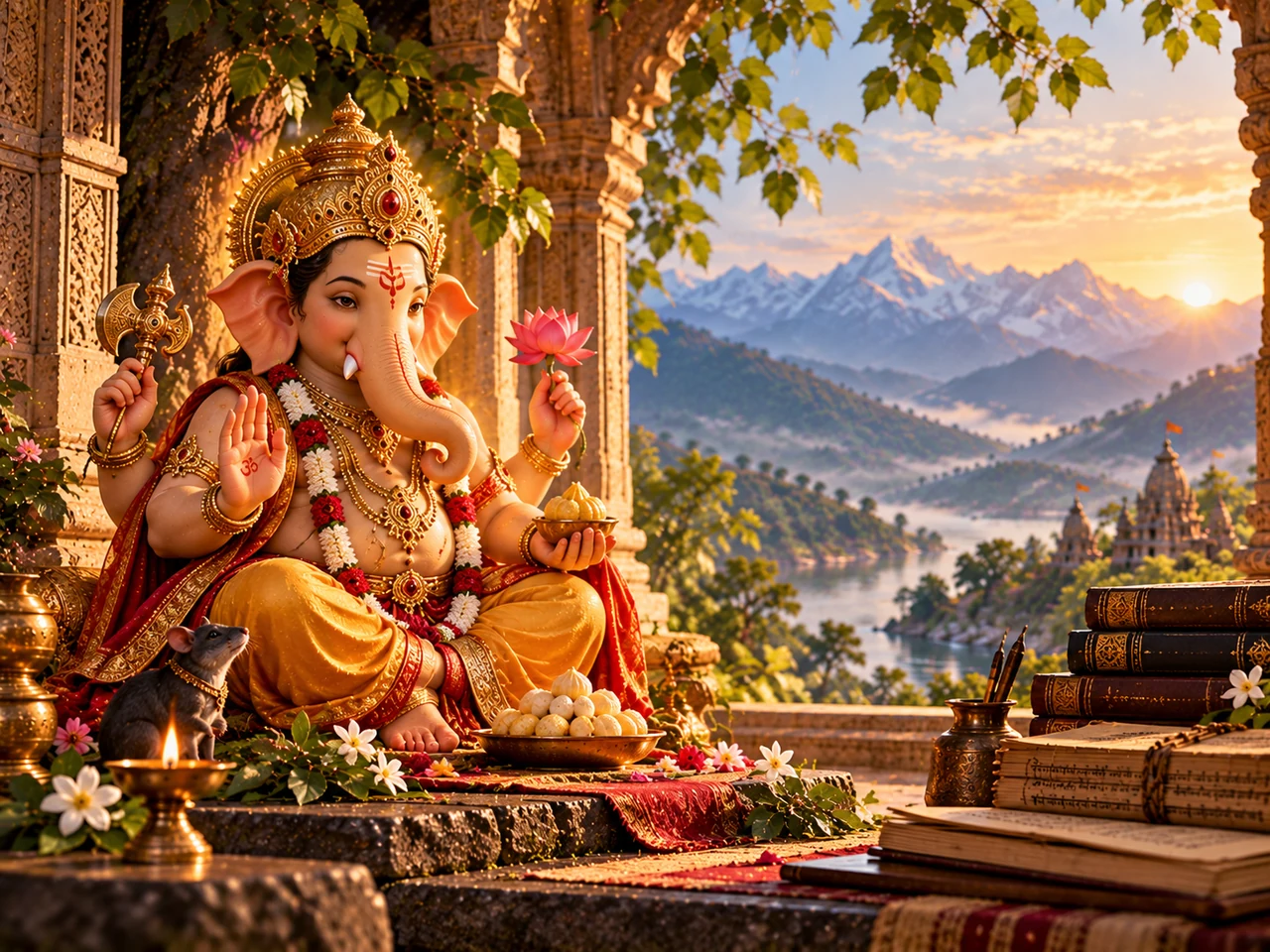
The early stanzas invoke the curved trunk, broad eyes, forehead markings, crown, pearl ornaments, book, weapons, yellow garment, modaks and mouse mount. A book easily evokes learning; offerings represent welcome and devotion, and the mouse links the grandeur of the god to a small ordinary creature. Nevertheless, symbolic explanations should be offered as interpretations rather than universal ancient definitions for every object. Ganesha images across centuries and regions differ in how many arms they show and what each hand carries. Museum records confirm the elephant-headed figure and mouse association while documenting other iconographic variations. 56
The hymn situates him in the Shiva–Parvati family as sibling of Skanda. Riddhi and Siddhi may be understood as personified prosperity and accomplishment, within the poem’s devotional setting. These family and iconographic descriptions belong to a broad living religious culture and should not be presented as independent proof that all traditions narrate the same details.
The Shani-glance birth story, and why versions differ
In units 20–30, Shani is reluctant to look at the infant, misfortune is narrated, Vishnu brings an elephant head, and Shiva restores life and honours Ganesha. This is not identical to the well-known story in which Parvati fashions a guardian and Shiva beheads the child during a dispute at her door. The British Museum’s overview notes the latter narrative. Both are transmitted as sacred stories; their details should not be forcibly harmonised into a single event or described as verifiable history. 15
The Shani motif is not evidence that astronomical Saturn causes injury or that anyone has a dangerous personal “gaze.” Respect for a tradition is compatible with rejecting fear-based astrology, scapegoating, medical claims, or discrimination based on birth details.
The lesson of circling one’s parents
In stanzas 31–34 Shiva sets a test of circling the earth. Skanda travels while Ganesha honours his parents by circumambulating them instead. The episode values perception, relational gratitude and ingenuity above raw speed. Readers need not derive a coercive rule requiring unquestioning obedience to family members in unsafe circumstances; the point is the poem’s picture of discerning love and humility.
The “Ramsundar” signature and unsettled date
The thirty-seventh numbered stanza includes the name Ramsundar, plausibly a poet’s chhap or signature. That is not yet a verified historical biography. The final colophon mentions Rishi Panchami but reads “Sambandh apne sahasra dash” in the selected text, whereas Sanskrit Documents prints “Samvat apan sahasra dash.” These phrases are too uncertain to calculate a composition year. No unsupported exact century is assigned here. 12
Editorial variants: witness first, interpretation second
The selected witness is printed as read, including awkward “जै”, “विश्व विनायका”, “नाभ ते”, “रचे बैठी” and the disputed colophon. The comparison site reads differently, notably “जय”, “विश्व विनायक”, “नभ ते”, and a different date phrase. A modern editor might want to normalise these, but doing so without a documented edition would create an unacknowledged hybrid. All differences therefore remain in the structured variant ledger. 12
Devotional context and responsible practice
Ganesha is widely honoured at the beginning of worship and in Ganesh Chaturthi celebrations. Reading a public devotional work is distinct from initiatory mantra or ritual instruction: this edition does not prescribe number-based japa, secret syllables, homa, nyasa, promised wealth, fertility remedies or cures. Accounts of spiritual protection or removing obstacles express faith; they do not replace medical treatment, studying, planning or ethical choices.
Frequently asked questions
Is this the complete Ganesh Chalisa? Yes—the complete selected online witness: one opening doha, 38 numbered chaupais and two closing dohas. Historical-edition collation is pending.
Why are there 38 numbered chaupais in a Chalisa? That is the actual numbering of this fixed witness. Two extra stanzas have not been invented to make the title’s conventional count.
Who composed this Chalisa? The poem names Ramsundar in one stanza, but neither the poet’s identity nor an exact composition date has been independently established.
Does Ganesha lose his head because of Shiva or Shani? This selected poem uses Shani’s glance and Vishnu’s intervention; another widely told version centres on Shiva beheading Parvati’s guardian.
Is the English page an English translation of the original verse? No. The whole poem at the top remains Roman Hindi. Original English meanings appear only afterward, stanza by stanza.
Will reciting it guarantee exam success or remove every obstacle? No. Devotees may find encouragement, but there are no guaranteed practical or medical outcomes.
Why does one line say “naabh” rather than “nabh”? The selected page reads “नाभ”, while another witness reads “नभ”. It is transparently preserved for specialist source review.
Is this content already published in ShivGoraksh or used by Aadesh? No. All six files are draft-only; release, source-rights checks and Aadesh ingestion are blocked.




Additional passage commentary
Chaupai 1 {#chaupai-01}
Meaning: Victory to Ganapati, king of the divine attendants, who fills endeavours with auspiciousness. Explanation: The repeated praise establishes a celebratory tone. Ganaraja is an honorific, not a claim about a dated earthly kingdom. Stable reading ID: related reading · 1
Chaupai 2 {#chaupai-02}
Meaning: Praise to the elephant-faced Vinayaka, giver of joy and guide of understanding. Explanation: The elephant face points to recognizable Ganesha iconography. Wisdom here includes discernment and responsible action. Stable reading ID: related reading · 1
Chaupai 3 {#chaupai-03}
Meaning: The curved trunk and forehead markings make the deity's appearance delightful to the devotee. Explanation: The forehead marking reflects an iconographic devotional description. It is not evidence of a single compulsory marking across all regions. Stable reading ID: related reading · 1
Chaupai 4 {#chaupai-04}
Meaning: A gem-and-pearl garland shines on the chest; a golden crown and broad eyes adorn Ganesha. Explanation: Ornaments evoke majesty and affection in worship; the hymn is describing a visualized devotional form. Stable reading ID: related reading · 1
Chaupai 5 {#chaupai-05}
Meaning: A book, axe and trident are named among the attributes; modaks and fragrant flowers are offered. Explanation: The book evokes learning while gifts express hospitality and devotion. Iconographic attributes differ across Ganesha forms. Stable reading ID: related reading · 1
Chaupai 6 {#chaupai-06}
Meaning: Yellow garments adorn Ganesha; even sages rejoice at his revered feet and sandals. Explanation: The sandals and feet are poetic signs of reverence. The verse asks readers to notice humility alongside grandeur. Stable reading ID: related reading · 1
Chaupai 7 {#chaupai-07}
Meaning: Blessed son of Shiva, brother of six-faced Skanda, beloved child of Gauri, known widely. Explanation: Family relationships situate Ganesha within Shiva-Parvati traditions, although Puranic family narratives vary. Stable reading ID: related reading · 1
Chaupai 8 {#chaupai-08}
Meaning: Riddhi and Siddhi attend him with a ceremonial fan, and the mouse vehicle stands at the doorway. Explanation: Riddhi and Siddhi may be understood as personified prosperity and accomplishment; the mouse is a distinctive iconographic companion. Stable reading ID: related reading · 1
Chaupai 9 {#chaupai-09}
Meaning: The speaker turns to Ganesha's auspicious birth story. Explanation: This is a narrative transition: the ensuing story is one devotional telling, not the sole version in all Puranas. Stable reading ID: related reading · 1
Chaupai 10 {#chaupai-10}
Meaning: Parvati, daughter of the mountain king, undertook severe austerity wishing for a son. Explanation: The story portrays perseverance and longing; it should not be converted into a prescribed fertility practice. Stable reading ID: related reading · 1
Chaupai 11 {#chaupai-11}
Meaning: When the splendid sacrifice was completed, Ganesha appeared in the form of a Brahmin guest. Explanation: The miraculous visitor motif underlines the dignity of welcoming a guest in the poem's narrative. Stable reading ID: related reading · 1
Chaupai 12 {#chaupai-12}
Meaning: Gauri joyfully received the visitor and cared for him generously. Explanation: The mother's generosity precedes recognition of the visitor's identity; the moral emphasis is hospitality without calculation. Stable reading ID: related reading · 1
Chaupai 13 {#chaupai-13}
Meaning: Pleased, the divine guest offers a boon concerning Parvati's prayer for a child. Explanation: The boon belongs to sacred narrative and expresses grace; it should not be marketed as a guaranteed physical outcome. Stable reading ID: related reading · 1
Chaupai 14 {#chaupai-14}
Meaning: A wise son is promised, in this narrative, without an ordinary pregnancy. Explanation: Such divine-birth language is mythic and theological; it does not establish a biological claim. Stable reading ID: related reading · 1
Chaupai 15 {#chaupai-15}
Meaning: Ganesha is hailed as leader of the ganas, treasure of good qualities and wisdom, first to be honoured. Explanation: The first-worshipped title is a widespread Hindu practice emphasis, though custom differs by community and ceremony. Stable reading ID: related reading · 1
Chaupai 16 {#chaupai-16}
Meaning: After speaking, the visitor vanishes and appears as a baby in the cradle. Explanation: The narrative links divine promise and manifestation through a sudden transformation. Stable reading ID: related reading · 1
Chaupai 17 {#chaupai-17}
Meaning: The baby cries, and Gauri feels overflowing joy on seeing his face. Explanation: The tenderness of an ordinary mother-child encounter balances the divine grandeur of the story. Stable reading ID: related reading · 1
Chaupai 18 {#chaupai-18}
Meaning: Everyone celebrates, and divine beings shower flowers according to the selected wording. Explanation: The witness unusually reads “नाभ ते”; another text reads “नभ ते” (from the sky). The base reading is preserved, not corrected silently. Stable reading ID: related reading · 1
Chaupai 19 {#chaupai-19}
Meaning: Shiva and Uma make generous gifts while gods and sages come to see the child. Explanation: Public generosity and collective joy signal that the birth is meaningful beyond the household. Stable reading ID: related reading · 1
Chaupai 20 {#chaupai-20}
Meaning: Seeing the celebration, Shani arrives to visit the baby. Explanation: Shani's appearance begins this particular narrative of how Ganesha acquires an elephant head. Stable reading ID: related reading · 1
Chaupai 21 {#chaupai-21}
Meaning: Mindful of the danger attributed to his gaze, Shani hesitates to look at the child. Explanation: The hesitation conveys a tradition-specific fear, not an astronomical fact about Saturn or anyone born under it. Stable reading ID: related reading · 1
Chaupai 22 {#chaupai-22}
Meaning: Girija takes Shani's reluctance as possible displeasure with her celebration. Explanation: The misunderstanding creates the dramatic tension that drives the following exchange. Stable reading ID: related reading · 1
Chaupai 23 {#chaupai-23}
Meaning: Shani timidly asks what would happen if the child were shown to him. Explanation: His cautious words prepare listeners for the mythic consequence in this version. Stable reading ID: related reading · 1
Chaupai 24 {#chaupai-24}
Meaning: Uma does not accept the warning and asks Shani to see the baby. Explanation: The poem depicts a tragic collision of insistence and apprehension. Stable reading ID: related reading · 1
Chaupai 25 {#chaupai-25}
Meaning: At Shani's sidelong glance, the child's head disappears into the sky in the poem. Explanation: This is a supernatural birth story in a specific textual tradition; do not confuse it with a universally shared account. Stable reading ID: related reading · 1
Chaupai 26 {#chaupai-26}
Meaning: Overwhelmed by grief, Girija collapses; the poet says her anguish is beyond words. Explanation: Maternal grief occupies the centre of this moment, avoiding a purely triumphant treatment of the story. Stable reading ID: related reading · 1
Chaupai 27 {#chaupai-27}
Meaning: An outcry arises on Kailasa when the child is thought lost because of Shani's glance. Explanation: The narration represents what participants believe within the myth; it is not advice for judging people associated with the planet. Stable reading ID: related reading · 1
Chaupai 28 {#chaupai-28}
Meaning: Vishnu goes swiftly on Garuda and brings an elephant's head using his discus. Explanation: In this telling Vishnu's intervention replaces the Shiva-beheading motif of another well-known tradition. Stable reading ID: related reading · 1
Chaupai 29 {#chaupai-29}
Meaning: The elephant head is placed on the child's body, and Shiva invokes renewed life. Explanation: The text depicts a sacred miracle; it is not a medical or operative technique and provides no reproducible mantra procedure. Stable reading ID: related reading · 1
Chaupai 30 {#chaupai-30}
Meaning: Shiva gives the name Ganesha and grants him the honoured status of being worshipped first. Explanation: The name and boon connect the birth narrative with living customs of beginning religious observances with Ganesha. Stable reading ID: related reading · 1
Chaupai 31 {#chaupai-31}
Meaning: Shiva sets a test involving circumambulation of the earth. Explanation: The storyline moves from physical power to judgment and insight. Stable reading ID: related reading · 1
Chaupai 32 {#chaupai-32}
Meaning: Six-faced Skanda sets out, while Ganesha conceives a different solution. Explanation: The brothers model different approaches; the poem values imaginative understanding over mere speed. Stable reading ID: related reading · 1
Chaupai 33 {#chaupai-33}
Meaning: Ganesha bows to his parents and circles them seven times. Explanation: For this narrative, regarding parents as one's world expresses reverence; it is not a binding rule for every family situation. Stable reading ID: related reading · 1
Chaupai 34 {#chaupai-34}
Meaning: Shiva rejoices in Ganesha's insight, and the gods shower flowers. Explanation: The climax celebrates intelligence guided by relationship and humility. Stable reading ID: related reading · 1
Chaupai 35 {#chaupai-35}
Meaning: Even thousand-mouthed Shesha could not exhaustively praise Ganesha's wisdom and greatness. Explanation: Hyperbole conveys reverence, not a measurable comparison among divine beings. Stable reading ID: related reading · 1
Chaupai 36 {#chaupai-36}
Meaning: The speaker humbly admits limited understanding and asks how to offer a worthy prayer. Explanation: The first-person voice turns a grand story into personal devotion and self-examination. Stable reading ID: related reading · 1
Chaupai 37 {#chaupai-37}
Meaning: The stanza names Ramsundar in a devotional signature and includes the obscure place/name sequence Prayag, Kakra and Durvasa. Explanation: A name in the verse suggests a poet's signature, but does not establish an independently documented author or date; the remaining words need philological checking. Stable reading ID: related reading · 1
Chaupai 38 {#chaupai-38}
Meaning: The humble devotee prays for compassion, strength and devotion. Explanation: The requested strength can be understood as courage for responsible action, not a promise of supernatural power. Stable reading ID: related reading · 1