



Selected witness: Gujarati Wikisource, “ગણેશ આરતી”, revision 204056; complete five-couplet reading. Script-converted/romanized, not a conflation with longer recensions. 1
What this Aarti celebrates
“Jai Ganesh Deva” is a North Indian Hindi-language Aarti sung in praise of Ganesha. It addresses him affectionately as Parvati’s son and Shiva’s son, portrays his distinctive form, and brings together the offerings, hopes and gratitude of a devotional gathering. It is not a Vedic Sanskrit mantra and should not be conflated with the Marathi Aarti “Sukhkarta Dukhharta.” 1 2
The five-couplet version reproduced above comes from the fixed 2023 revision of the Gujarati Wikisource work “ગણેશ આરતી.” The page is written in Gujarati script but the underlying song is Hindi vernacular, as shown by words such as jaki, moose ki savaari and deenan. The Hindi text on this page is a careful Devanagari script conversion, not a claim that the Gujarati page originally displayed Devanagari. The English page uses reader-friendly Roman Hindi rather than translating the lyric into English. 1
The refrain and performance
The first couplet functions as an invocation. Singers may repeat it after other couplets, sometimes twice; that performance habit should not be confused with the number of distinct couplets in the selected printed-style witness. The source itself has five successive two-line units. The unit anchors below follow that order exactly and may be used to synchronize original, transliteration and explanation. 1 2
Themes worth noticing
A beloved member of the Shiva–Shakti family
This Aarti tells us whose son Ganesha is, using the intimate family names Parvati and Mahadeva. His own name remains the song’s refrain, and his praise stands on its own. The connection enriches ShivGoraksh’s Shiva–Shakti coverage without treating Ganesha as a mere footnote to another deity. Accounts of his birth and elephant head vary across religious literature; the hymn itself does not narrate any one birth story. 4 5
Elephant form, one tusk and the little mouse
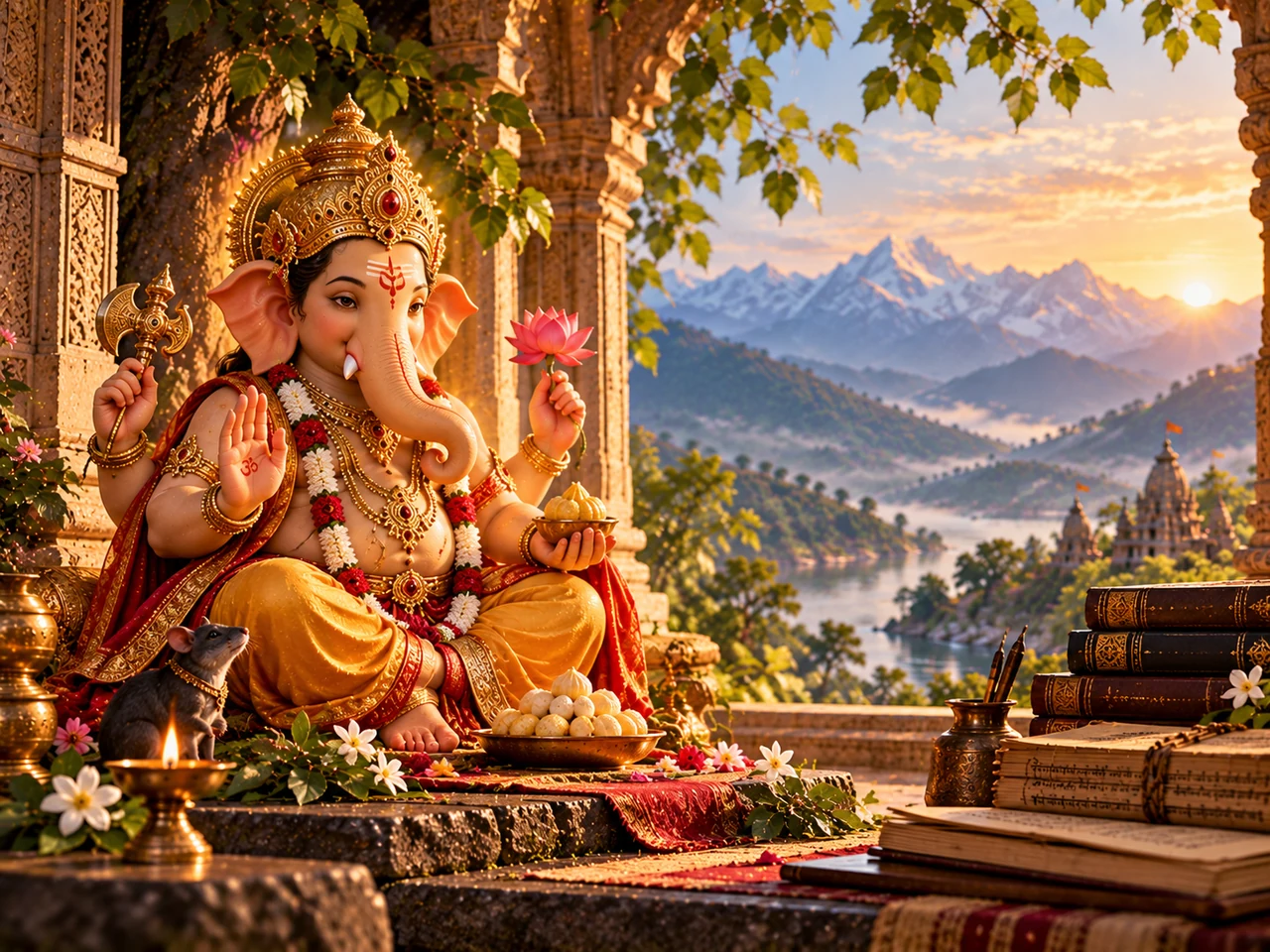
The contrast between a great elephant-headed deity and his small mouse mount gives the hymn a vivid visual memory. One tusk and four arms are specific iconic identifiers, though sculptures also show different arm counts and attributes. Museum records document older Ganesha imagery with sweets, tusks, goads and other emblems; the Aarti selects just a few recognizable features for easy singing. 4 5
Gifts are meaningful, but not a commercial exchange
Paan, flowers, dried fruit and laddus in the fourth couplet are expressions of hospitality, pleasure and love. The song does not say that purchasing more costly gifts earns more divine attention. The concluding appeal directs the listener back to compassion for those in difficulty and to devotion rather than accumulation.
Compassion without false promises
The third couplet belongs to an older literary world and includes terms that can stigmatize illness or infertility in contemporary speech. They are retained here because a source-faithful reading should not silently censor historical language. Their interpretation must be humane: the song voices a community’s need for health, children and material security, but it cannot serve as medical advice or promise of guaranteed results. People dealing with disability, disease, childlessness or poverty deserve dignity, care and practical support.
Language notes and selected textual variants
- Jaki (“whose”), deenan (“of those in distress”), chadhai (offered), laduan (laddus) and sohe (adorns / looks fitting) are expressions in Hindi devotional vernacular. They should not be “corrected” into Sanskrit inside the original.
- Mathe par tilak occurs in another popular witness where the selected text has mastak par sindoor. Neither is silently substituted in this edition. 2
- Paan / phool / meva may appear in other performances with haar or phal. These are contextual variants, not extra lines to attach indiscriminately. 2
- A separate line beginning “Sur Shyam” is included by another online witness, but this five-couplet text does not contain it. That phrase by itself does not authenticate authorship by the historical poet Surdas. 2 3
- The ending’s “Shambhu-sut vaari / jag balihaari” differs from variants using Shambhu sutkaari, jaaoon balihaari or manorath. The exact witness form is retained here. 1 2
What can be responsibly said about its history? This is an Aarti from vernacular devotional circulation, not a demonstrably ancient Upanishadic passage. The cited fixed Wikisource revision calls the author unknown; another lyric publisher supplies variants rather than a critical historical reconstruction. Without an identified first edition, securely dated manuscript, or convincing scholarly argument, no century or named poet should be given as fact. A familiar line is evidence of circulation, not proof of origin. 1 2
The text selected for the present reader is complete relative to one openly available five-couplet witness, but a critical collation with the underlying scan and representative printed collections is still pending. That is why overall source status remains partial, and why this is not an approved publication edition.
Devotional setting — not a ritual manual
Aarti commonly means honoring a deity with song and light. This short work may be read or sung as a prayer of praise and reassurance, whether alone or together. The educational content does not mandate fixed counts, auspicious timings, offerings or ceremonies, and it does not provide initiation-dependent procedures. Ritual performance follows family, temple and lineage custom; the practice classification remains subject to qualified tradition-specific review.
Additional passage commentary
Couplet 1
Meaning: All praise to Lord Ganesha! His mother is Parvati and his father is Mahadeva, Shiva. Explanation: The repeated “Jai” gives the verse its welcoming, communal rhythm. “Jaki” is a vernacular form meaning “whose”; it has not been replaced with modern Hindi in the original text. Naming Parvati and Mahadeva places the beloved deity within the Shiva–Shakti family, yet the Aarti is wholly focused on Ganesha. This opening couplet is the refrain many families sing again between subsequent verses; this particular five-couplet witness prints it only once.
Couplet 2
Meaning: Ganesha is single-tusked, compassionate and shown with four arms. Vermilion adorns his forehead or head, and a mouse is named as his mount. Explanation: “Ekadant” (one-tusked) is a standard Ganesha epithet; not every image or narrative explains the missing tusk in the same way. Four arms describe this verse’s iconographic form, not a claim that all historical sculptures have four. Sindoor suggests the auspicious devotional ornament of the image. The small mouse alongside the great elephant-headed figure is a memorable inversion of scale, often read devotionally as mastery over restlessness, though that symbolic reading is not asserted by the Aarti itself. Museum descriptions independently document the tusk, sweets and varied arms in Ganesha sculpture. 4 5
Couplet 3
Meaning: Devotees poetically ask the Lord who gives sight to the blind, wellbeing to those afflicted by disease, children to the childless, and resources to people in poverty. Explanation: This verse uses the intense language of petition, not a medical protocol or verifiable promise of cures, conception or wealth. “Kodhin” is an older, potentially stigmatizing word for people affected by leprosy; it is preserved as part of the textual witness, not endorsed as modern respectful usage. “Baanjhan” similarly belongs to an older social vocabulary that can hurt people facing infertility. The responsible reading places compassion, dignity and support above expectations of guaranteed physical outcomes. “Maaya” here is best read in its vernacular sense of material means or resources, rather than automatically imported as a technical Advaita term.
Couplet 4
Meaning: Betel leaves, flowers and dry fruits are presented as offerings; laddus are offered as food, and devotees offer their service. Explanation: The catalogue of ordinary offerings makes the Aarti intimate and recognisable. A sweet like a laddu recalls the enduring association of Ganesha with sweets; museum objects likewise depict a container of sweets in his hand. 4 There is no obligation stated here that every worshipper must procure every item. “Sant” and “seva” place attention not only on objects but on the disposition of those offering them. The archaic verb forms “chadhai” and “laage” are retained from the chosen witness; rewording them into contemporary prose would change the lyrics.
Couplet 5
Meaning: O son of Shambhu, uphold the dignity of people in distress. The singer asks that heartfelt wishes be fulfilled and expresses loving self-offering in praise. Explanation: The last couplet turns from description to direct appeal. “Laaj raakho” is a plea for protection of honour and dignity; it is not merely an appeal for money. “Shambhu-sut” refers to the son of Shiva, returning to the opening family image. “Balihaari” is the language of grateful devotion, not a command to make any harmful sacrifice. The line asks rather than promises: a prayer can express hope without implying that outcomes are mechanically guaranteed. The source writes “vaari” and “jag balihaari”; other printed and sung texts differ. 1 2