



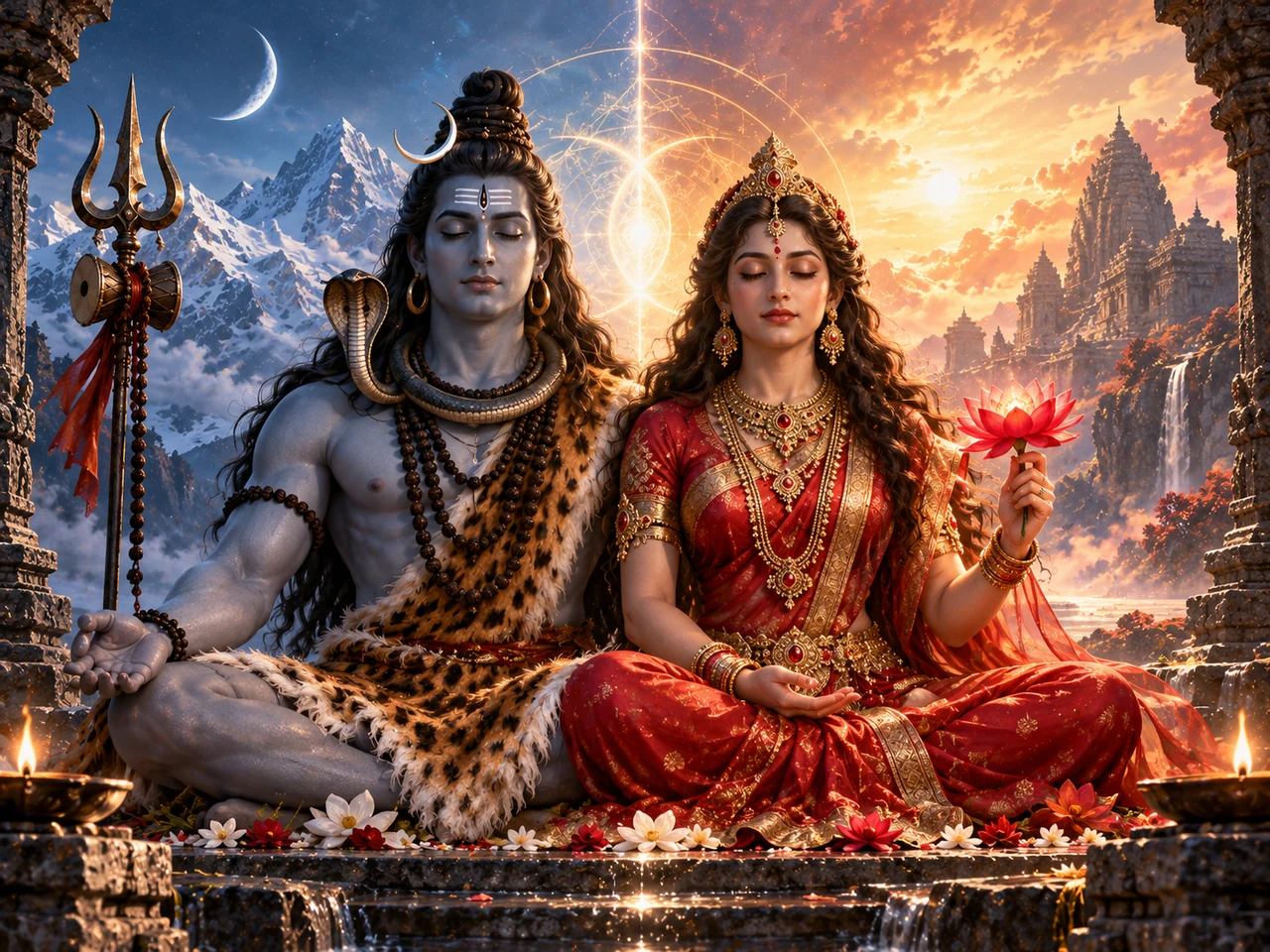
Consciousness and power, Lord and Goddess, two beloved deities and sometimes one indivisible reality: a guide to what these images mean—and where traditions disagree.
Imagine a shrine in which Shiva sits beside Parvati; now imagine a sculpture whose single body is half Shiva and half Parvati. The first image seems to show a relationship between two persons. The second asks whether what looks like two may express one reality. Both are familiar within Shiva-centred religion, yet neither settles every philosophical question about Shiva (Shiva, शिव)Shiva (Śiva, शिव) and Shakti (Shakti, शक्ति)Shakti (Śakti, शक्ति). Their relationship changes meaning as we move between household devotion, temple art, Shaiva philosophy and Goddess-centred theology. 4 5
This guide offers a way to read those differences respectfully. It does not ask readers to choose a belief, assume that all communities teach the same doctrine, or turn complex spiritual language into claims proved by physics. It explains what major sources and traditions actually say, why their answers matter and how the two names can be meaningful together without becoming interchangeable.
Key takeaways
- Shiva names a deity and, in several philosophies, supreme reality; Shakti can mean power or capacity, divine agency, a theological principle, or the Goddess herself. Context determines which meaning is intended. 1 9
- In influential nondual Kashmir Shaiva accounts, Shiva and Shakti are inseparable aspects of consciousness and its self-awareness or free agency—not two independently existing substances. 1
- Shaiva Siddhanta commonly starts from Lord, individual souls and bonds as genuinely differentiated categories; its understanding of divine power should not be silently recast as Kashmir Shaiva nondualism. 2
- In Shakta theological settings, the Goddess may be supreme in her own right, not simply a subordinate “energy” owned by a male deity. The Devi Mahatmyam (Durga Saptashati) praises the Goddess as power present in living beings. 3 10
- Ardhanarishvara visually unites Shiva and Parvati, while Somaskanda shows Shiva, Parvati and their child Skanda in a divine family. Each image invites a different reading. 4 5
- These are religious and philosophical interpretations. No artistic symbol or metaphor by itself proves a modern scientific theory or dictates a single social role for men and women.
1. What do the two names mean?
Shiva, in much Shaiva worship, is Mahadeva, the great Lord: ascetic, householder, teacher, dancer and giver of grace. His many identities are not an instruction to reduce the traditions that venerate him to one creed. The English word Shakti derives from Sanskrit shaktiśakti, a capacity, potency, ability or power. A simple sentence such as “the power of understanding” can use shakti in an ordinary sense; a Shaiva theologian may use it for God's intrinsic capacity; a Goddess devotee may address Shakti as Mother and ultimate divinity. These usages overlap, but they are not synonyms. 9 1 10
Parvati (Parvati, पार्वती) is a goddess with her own narratives, names and forms. Parvati (Pārvatī, पार्वती) is a goddess with her own narratives, names and forms. Parvati and Shakti must not be defined as permanently identical at every level of discourse: Parvati may embody or express Shakti in a particular tradition, while shaktiśakti can designate a general category of divine power, and Goddess traditions have numerous forms and independent theological priorities. Likewise, Shiva and the ShivGoraksh entity called Shankar are not thereby universally separate gods; Shankara is a widely used name of Shiva, though naming conventions vary. 9
A working glossary
| Term | A beginner's meaning | What to remember |
|---|---|---|
| Shiva (शिव)Śiva (शिव) | Shiva; in some schools the ultimate Lord or reality | Not every school defines Shiva identically |
| Shakti (शक्ति)Śakti (शक्ति) | Capacity, potency, divine power; also Goddess | Can be a philosophical term or personal divinity |
| Śaktimān (शक्तिमान्) | The one possessing power | Relationship may be understood as inseparable, not physical possession |
| Parāśakti (पराशक्ति) | Supreme power/Goddess in relevant traditions | Requires tradition-specific attribution |
| Ardhanārīśvara (अर्धनारीश्वर) | Lord whose form is half woman | An image of unity; readings vary |
| Prakāśa (प्रकाश) | Illumination or manifestation of awareness in Pratyabhijna thought | Not literally electric or solar light |
| Vimarśa (विमर्श) | Self-apprehension or reflexive awareness in that philosophy | Not merely everyday verbal reasoning |
| Svātantrya (स्वातन्त्र्य) | Freedom, self-determining agency | A theological description of supreme consciousness |
| Pati–paśu–pāśa (पति–पशु–पाश) | Lord, bound soul, bond in Siddhanta | A different conceptual architecture from strict nondual identity |
2. One image, several questions
There are three useful questions to keep distinct. Who is worshipped? A family may honour Shiva and Parvati as distinct, loving divine persons. What is ultimate reality? A philosopher may argue that consciousness and its ability to know and manifest cannot be divided. How does life change? A practitioner may understand devotion, grace or insight as a path of transformation. A tradition's answer to one question does not automatically determine its answer to the others.
For instance, the analogy of fire and its heat helps beginners understand why some nondual authors refuse to separate Shiva and Shakti. A fire without heat would no longer be the fire being described; its capacity is not an unrelated object. The Kashmir Shaiva philosopher Somānanda uses this kind of inseparability analogy. But any analogy has limits: metaphysical awareness is not a physical flame, and the analogy is not a scientific measurement of divine energy. 1
Another common comparison is a musician and music. It vividly suggests expression, yet can mislead: the musician can stop playing, whereas some nondual accounts do not permit a real separation between ultimate consciousness and its power. Use metaphors to begin an inquiry, not to finish it.
3. Historical setting: linked developments, not one founding moment
There is no single recoverable date when every Shiva–Shakti teaching began. Rudra–Shiva-centred religion developed in multiple communities and texts; early identifiable organized Shaiva lineages belong to a different historical evidentiary world from the Vedic hymns. Tantra, temple ritual and regionally rooted Goddess worship contributed further vocabularies for divine power. 7 9
A rough orientation—not a claim of linear evolution—is helpful:
- Earlier textual antecedents: Vedic material associated with Rudra and diverse goddess worship provides important background, but cannot be made to contain every later Tantric system in finished form. 7
- Early-medieval Shaiva and Shakta developments: Distinct ritual schools and philosophies flourished and interacted. Some Kashmir traditions integrated Shaiva and Goddess-centred materials, while Siddhanta developed its own Agamic teachings. 1 2
- Regional art and devotion: Surviving images testify to how traditions were expressed. A Kerala Ardhanarishvara bronze is dated by The Met to about the thirteenth century; a Chola-period Somaskanda is dated to the early eleventh century. These dates belong to the particular objects, not to the invention of their imagery. 4 5
- Continuing practices and interpretations: Devotional families, temple communities, theologians and yoga-related lineages continue to make different connections between Shiva, Devi and the world. The Nath Sampradaya, for example, cannot simply be assigned a single universal Shiva–Shakti metaphysics. 8
Traditional sacred narratives—such as Shiva and Parvati's marriage or the Goddess's cosmic deeds—convey religious values and identities. They should not be inserted into a modern chronology as securely dated eyewitness events. Equally, historical work on inscriptions and art cannot decide whether a believer's experience of grace is spiritually valid.
4. Nondual Kashmir Shaivism: awareness and its power
In the Pratyabhijna (“Recognition”) philosophy associated with Utpaladeva and Abhinavagupta, ultimate reality is understood as Shiva-consciousness: not merely an inert witness, but awareness with the intrinsic capacity for self-apprehension, freedom and manifestation. Shakti is integral to what that consciousness is. The philosophical pair prakāśa–vimarśa is often explained as awareness's luminosity and its reflexive self-recognition. It is misleading to translate these simply as “male silence and female motion.” 1
Consider seeing a tree. Recognition philosophers ask not only what appears, but how any appearance is intelligible to awareness, how “I know” is possible and how experience has continuity. Their response develops sophisticated arguments in dialogue with other Indian philosophical schools, especially Buddhist epistemology. The argument concerns consciousness and the status of the world; it is not a claim that modern neuroscience has demonstrated a metaphysical Shiva. 1
Some presentations speak of Shiva as consciousness and Shakti as its dynamic power. This introductory formula is useful if qualified: consciousness here is not meant to be passive and helpless until a separate agent arrives. The point in this tradition is inseparability. Shiva's svātantrya, freedom, is expressed through Shakti; manifestation is not supposed to create a second ultimate reality. Descriptions of spanda (“pulsation”) belong to related Kashmir Shaiva discussions of divine power and should not be equated with measurable mechanical vibration or a medical treatment. 1
Nor is “Kashmir Shaivism” one perfectly uniform doctrine. The historical landscape includes different scriptures, philosophical authors and other, non-nondual Shaiva communities. Kashmir Shaivism: An Accessible Introduction will offer a closer study of Recognition and its intellectual setting.
5. Shaiva Siddhanta: Lord, souls and grace
Shaiva Siddhanta requires a genuinely different starting point. In influential Sanskrit Siddhanta accounts, pati (the Lord, Shiva), paśu (bound individual souls) and pāśa (the bonds or conditions limiting them) are distinct real categories. Shiva is the liberating Lord, rather than merely a poetic label for a soul that is already fully identical with the Lord in every respect. God's knowledge, action and grace are significant, but readers should not automatically import Pratyabhijna's one-consciousness model into Siddhanta. 2
The tradition also has historical diversity. The early Sanskrit Agamic current and later Tamil Shaiva Siddhanta thinkers did not always express the relationship among Shiva, souls and liberation in precisely the same way. Tamil hymns, temples and subsequent doctrinal works shaped the tradition; neither “dualism” nor “Tamil Shaivism” alone captures its entire range. 2
What does Shakti mean here? In introductory terms, divine powers and grace can be discussed as belonging to Shiva's activity toward souls, but their exact taxonomy differs by textual stream and author. This guide therefore avoids inventing a canonical set of powers or pretending that all Siddhantins worship Parvati in one prescribed manner. The specialized comparison belongs in Shaiva Siddhanta: Philosophy and Tradition, where Agamic and Tamil sources must be checked separately.
6. Shakta traditions: the Goddess is not merely an accessory
In some Shiva-oriented accounts, a writer may emphasize Shiva as the śaktimān, the possessor of Shakti. A Shakta theologian may reverse that framing entirely: Devi is the ultimate, and other divine forms appear in relation to her sovereignty. A respectful comparison must let the Goddess-centred text speak in its own voice rather than translating it in advance into Shaiva terminology. 10 6
The Devi Mahatmyam (Durga Saptashati), a celebrated Goddess text within the Markandeya Purana, praises Devi as power present in beings. Its Chapter 5 includes the refrain yā devī sarvabhūteṣu śaktirūpeṇa saṃsthitā—an invocation of the Goddess abiding in all beings as power. The online edition used to locate this passage numbers it 5.32–34; editions and translations need collation before final publication. This is an instance of Shakta praise, not proof that every Shaiva school grants Shakti precisely the same metaphysical position. 3
Goddess traditions are themselves diverse. Durga, Kali, Parvati and other forms may be read as connected manifestations in a given worship community, but a local tradition can maintain its own stories, ritual priorities and relationships. Museum scholarship discussing Kali's imagery shows that those emphases shift across texts and historical settings. 6
A striking picture of Kali standing upon Shiva has received different devotional readings; it cannot be treated as the universal visual definition of Shakti's supremacy or as an instruction about household gender roles. Likewise the literary Goddess's victories express sacred meaning in a particular narrative world, not a laboratory account of physical forces.
7. Ardhanarishvara: one body, more than one interpretation
Ardhanarishvara combines Shiva and Parvati in a single form, conventionally articulated into masculine and feminine halves. It is among the clearest visual invitations to consider divine complementarity or inseparability. The Metropolitan Museum of Art records an Ardhanarishvara bronze from Kerala, approximately thirteenth century, and other examples in South and Southeast Asian contexts. The imagery is historically attested, while any single philosophical interpretation remains a matter of tradition and commentary. 4
The image can teach at least three different lessons without forcing them into one equation. A devotee may see a shared divine life; a philosopher may see power and its possessor as mutually implicated; an art historian may investigate workshops, regional styles, patrons, dates and iconographic conventions. It is possible to value all three without asking one to prove the others.
Important caution: Ardhanarishvara does not, by itself, establish that every person must embody one fixed set of “male” and “female” psychological traits. Devotional iconography belongs to a history of symbolic languages; modern readers can discuss its implications for gender, but should not substitute their interpretation for what every worshipping community believes.
8. Shiva and Parvati as a family: presence, devotion and difference
Where Ardhanarishvara joins two figures, Somaskanda depicts Shiva, Uma/Parvati and Skanda in a family grouping. The Met's early-eleventh-century Chola bronze demonstrates the importance of this iconographic form in South Indian worship and processional life. 5
For an everyday devotee, this depiction can express tenderness, relationship, parenthood and divine protection. It also reminds us that union does not always mean loss of personhood. Shiva and Parvati can be addressed individually in prayer while also being understood as inseparably connected at a different theological level. Not every devotee asks the technical question whether they are “two substances”; religious art may be encountered first through affection and ritual belonging.
Stories of Parvati's determination, Shiva's asceticism and their marriage communicate tensions between renunciation and domestic responsibility, stillness and involvement in the world. Their details vary considerably across literary and local retellings. Do not attach a specific Puranic verse to a generalized retelling unless the actual edition and passage have been checked.
9. Four viewpoints side by side
| Context | Shiva and Shakti emphasis | What would be misleading? |
|---|---|---|
| Nondual Pratyabhijna / related Kashmir traditions | Consciousness inseparable from self-awareness, freedom and manifestation 1 | Treating Shakti as a detachable material battery |
| Shaiva Siddhanta | Lord, real souls and bonds; divine power and liberation in a differentiated theology 2 | Claiming souls are simply identical to Shiva in the same sense as Kashmir nondualism |
| Shakta theological sources | Goddess as cosmic power and, in some streams, highest divinity 3 10 | Defining Devi only as Shiva's subordinate consort |
| Devotional/iconographic settings | Shiva–Parvati as partners, family, or composite form 4 5 | Treating a sculpture as a philosophical proof text |
These are orienting comparisons, not exclusive boxes. Historical communities have exchanged texts, deities and concepts, and individual teachers can draw selectively from several streams. Differences still matter. Philosophical respect does not require flattening all positions into “everything is exactly the same.”
10. Daily life, devotion and learning in context
Shiva–Shakti relationships can be encountered through family shrines, Parvati devotion, hymns, temple festivals, visual arts, pilgrimages and conversations about dharma. Mahashivratri emphasizes Shiva in many communities; Navratri celebrates forms of the Goddess; Shravana Mondays, Pradosha and other observances have their own histories and calendrical rules. Festival dates, ritual intervals and locally appropriate customs belong to the separately validated ShivGoraksh Calendar, not to an evergreen explanation here.
A reader need not perform an advanced rite to appreciate the philosophical question: Can awareness be meaningfully separated from the power to know and act? Another may ask what devotion to both Shiva and Parvati teaches about reverence, relationship or mutual responsibility. These are invitations for reflection, not guaranteed spiritual or psychological outcomes.
Some Shaiva and Shakta traditions preserve specialized mantras, initiations, diagrams, yogic disciplines and private ritual obligations. A publicly accessible educational article should describe their historical existence without supplying esoteric sequences or implying that curiosity constitutes initiation. Such material remains tradition-specific or initiation-dependent and subject to specialist review.
11. Frequent misconceptions
“Shiva is always passive; Shakti does everything.” This is an oversimplification, especially of nondual traditions in which Shiva's agency is inseparable from Shakti. Some poems use strong contrasts for devotional effect, but their rhetorical language is not every school's ontology. 1
“Shakti just means Parvati.” Parvati is central in numerous Shiva narratives, yet Shakti may mean divine potency, supreme Goddess or a different named Goddess according to source and tradition. 3 9
“Ardhanarishvara proves a universal teaching about male and female personalities.” Iconography has layered theological, historical and social receptions; it should not be reduced to a rule about individuals. 4
“Kashmir Shaivism and Shaiva Siddhanta teach the same nondualism.” They have overlapping vocabularies but important differences concerning God, souls and liberation, and each contains internal historical complexity. 1 2
“Shiva–Shakti is a modern scientific law of energy and matter.” These are terms in religious philosophy and devotion. Metaphors involving energy, magnetic fields or quantum physics are not experimental verifications of the theology.
“All Nath teachers explain Shiva and Shakti identically.” Nath texts and communities have varied across regions and centuries. Review a specific lineage and historically supportable text rather than manufacturing a uniform system. 8
1. Are Shiva and Shakti two gods or one reality?
Both kinds of expression occur, but they answer different questions. Devotees may address Shiva and Parvati as distinct persons; a nondual philosopher can understand Shakti as Shiva's inseparable power. Shakta theology may begin instead with the Goddess as supreme. Always ask, “According to which source or community?” 1 3
2. Is Shakti another name for Parvati?
Sometimes a community identifies Parvati with supreme Shakti. As a Sanskrit philosophical term, however, shaktiśakti also means power or capacity; Shakta traditions honour other goddess forms as well. Treat identification as a specified teaching, not a universal dictionary rule.
3. What is the significance of Ardhanarishvara?
The composite Shiva–Parvati form evokes a shared divine reality and multiple understandings of complementarity. Museum objects attest its historical artistic presence; interpretation varies with the tradition and the question being asked. 4
4. Does Kashmir Shaivism teach that Shakti is separate from consciousness?
The Pratyabhijna formulations discussed here argue the opposite: awareness includes its inherent reflexive self-apprehension and freedom, expressed as Shakti. “Shiva plus a second power” is therefore often a misleading beginner's picture. 1
5. How is Shaiva Siddhanta different?
Influential Siddhanta systems maintain differentiated realities of Lord, souls and bonds, and foreground grace and liberation; they do not simply share the identical metaphysics of Kashmir nondual Recognition. Later Tamil Siddhanta contains further internal developments. 2
6. Is Devi inferior to Shiva in every Hindu tradition?
No. Some Shaiva presentations emphasize Shiva as Lord with intrinsic power; Shakta sources praise Devi as the universal or supreme reality. A fair account does not make a Goddess text merely a footnote to Shaiva theology. 3 10
7. Can Shiva–Shakti ideas be explained through science?
An analogy can help someone picture dynamic expression, but neither shaktiśakti nor spanda maps straightforwardly onto the precisely defined energy or vibration of modern physics. Claims of scientific proof would require evidence not furnished by these religious texts.
8. Where should a beginner read next?
Start with Major Schools of Shaivism for the major Shaiva schools, Introduction to Shaktism: The Goddess, Divine Power and Living Traditions for Goddess-centred theology, and Understanding Shiva Linga Symbolism for Shiva symbolism. Explore Kashmir Shaivism: An Accessible Introduction and Shaiva Siddhanta: Philosophy and Tradition after these foundations.