



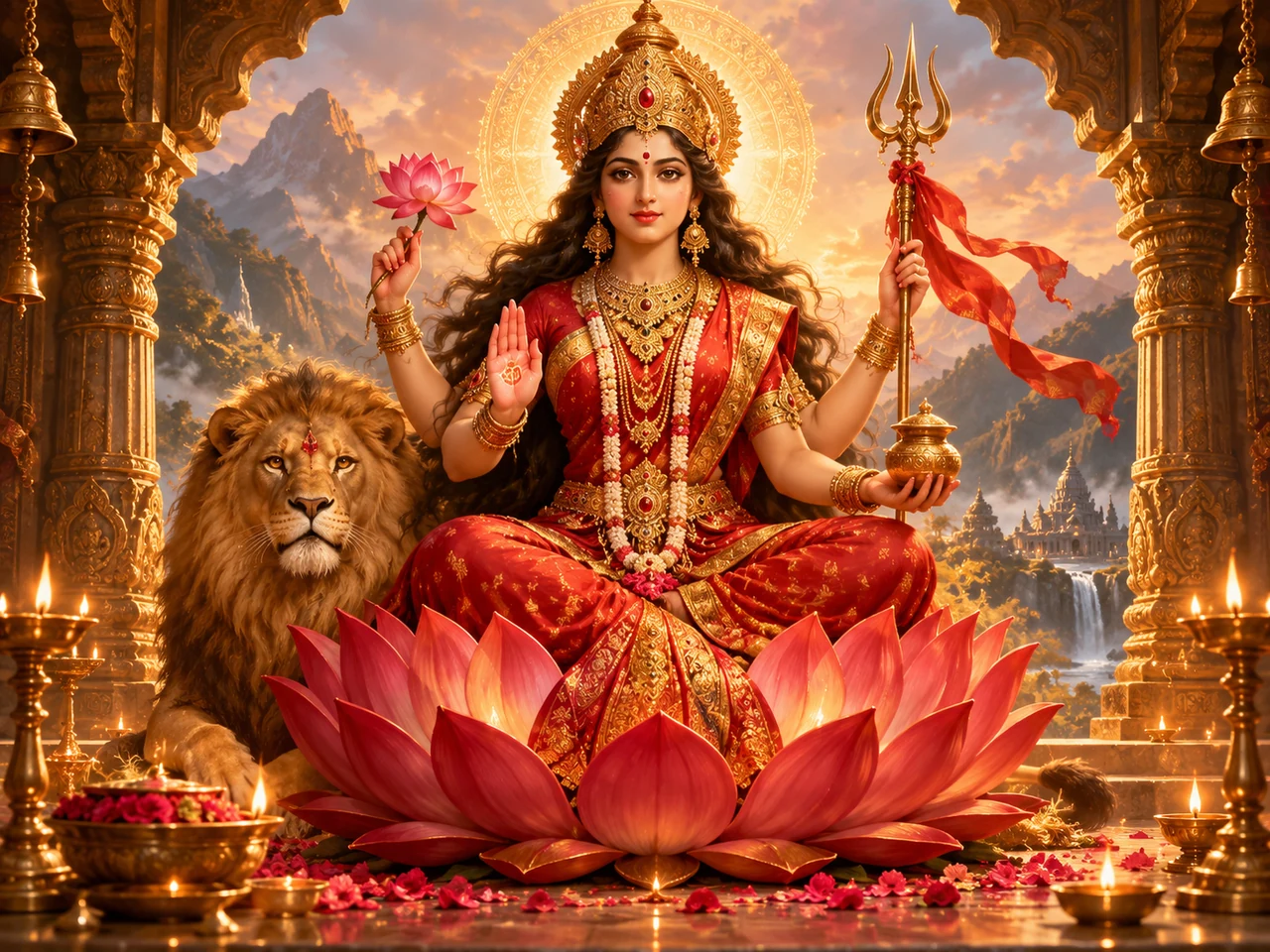
An accessible journey through Devī, the many meanings of Shakti, sacred stories, philosophical teachings and the communities that keep goddess traditions alive.An accessible journey through Devī, the many meanings of Śakti, sacred stories, philosophical teachings and the communities that keep goddess traditions alive.
A child may first encounter the Goddess through a mother singing a devotional song. Another visitor meets her in the fierce image of Kali, in the serene presence of Lalitā, or in an autumn procession celebrating Durga. Are these different goddesses, different faces of one Goddess, or different ways of approaching ultimate reality? Within A child may first encounter the Goddess through a mother singing a devotional song. Another visitor meets her in the fierce image of Kālī, in the serene presence of Lalitā, or in an autumn procession celebrating Durgā. Are these different goddesses, different faces of one Goddess, or different ways of approaching ultimate reality? Within Shaktism (Shaktism)Shaktism (Śāktism), the answer depends on which text, temple, lineage, family and philosophical tradition we are asking about.
Shaktism is a family of Hindu traditions in which the Goddess—Devī (देवी)—or divine power—Shakti (शक्ति)Śakti (शक्ति)—occupies a central place. Many Śāktas regard her as supreme reality, not merely as the spouse or assistant of a male deity; other goddess-oriented traditions preserve more complex relations among Shiva, Vishnu, their powers and particular goddesses. Scholar June McDaniel identifies substantial variation in how Shaktism understands and approaches divinity. 1 This guide introduces those differences without asking a beginner to choose one theology as the only authentic version.
Key takeaways
- Devī means “goddess”; shaktiśakti means power or capacity. Their theological relationship varies with context.
- Shaktism is not a single church, uniform creed or one fixed ritual system. Goddess-centred devotion, temple practice, philosophical study and Tantra can coexist without being identical. 1 9
- The Devi Mahatmyam (Durga Saptashati) presents a powerful Goddess who protects cosmic order and is praised as present throughout living existence. Its stories and hymns are religious texts, not laboratory claims. 2 4 6
- Early hymns such as RigvedaṚgveda 10.125 are important to later Shakta interpretation, but do not prove that every later Shakta school already existed in Vedic times. 10.125 are important to later Śākta interpretation, but do not prove that every later Śākta school already existed in Vedic times. 3
- Durga, Kali, Lalitā Tripurasundari and regional goddesses have Durgā, Kālī, Lalitā Tripurasundarī and regional goddesses have distinct histories and devotional personalities, even where worshippers recognize connections among them. 8 10
- Shakta religion thrives both in philosophical texts and in songs, festivals, local shrines, families, craft traditions and pilgrimage. 9 12 13
1. The essential vocabulary: Goddess, power and worshipper
Devī (देवी) is a general Sanskrit term for a goddess. Mahādevī (महादेवी), the Great Goddess, can designate the encompassing divine figure praised in some Shakta texts. , the Great Goddess, can designate the encompassing divine figure praised in some Śākta texts. ShaktiŚakti, from a word associated with capacity or power, may denote a divine principle, the agency of a deity, or the Goddess herself. Shakta (शाक्त)Śākta (शाक्त) means a devotee or participant in goddess-centred traditions; ShaktismŚāktism is the modern English umbrella term. 1
Imagine a lamp: its visible flame, light and capacity to illuminate are conceptually connected. It might help a beginner see why some philosophies distinguish consciousness from its expressive power, whereas others regard power as intrinsic to the divine. But a lamp is only an analogy; it is neither a proof of divine energy nor a complete explanation of all Shakta schools.; it is neither a proof of divine energy nor a complete explanation of all Śākta schools.
The word mātṛ means mother. Worshippers may call the Goddess Mā, Ambā, Jagadambā or Mātā. This is a devotional relationship, not a claim that only biological motherhood confers sacredness. Likewise, a goddess’s warrior imagery can symbolize protection, justice and liberation from fear; these are interpretations found in devotional contexts, not a license to characterize all Shakta devotion as violent.. This is a devotional relationship, not a claim that only biological motherhood confers sacredness. Likewise, a goddess’s warrior imagery can symbolize protection, justice and liberation from fear; these are interpretations found in devotional contexts, not a license to characterize all Śākta devotion as violent.
Some additional terms help readers navigate the tradition:
| Term | Beginner-friendly meaning | Important caution |
|---|---|---|
| Brahman | Ultimate reality in many Indian philosophies | Shakta identification of Devī with Brahman is tradition-specificŚākta identification of Devī with Brahman is tradition-specific |
| Prakṛti | Nature or material/creative principle in several philosophical systems | Not always identical to modern scientific “nature” |
| Māyā | Power of appearance, manifestation or concealment, interpreted differently | Does not simply mean “the universe is fake” |
| Bhakti | Loving devotion or devoted relationship | Takes many forms, including songs and communal festivals |
| Tantra | A range of textual and religious traditions, often involving deity, mantra and ritual | Not synonymous with sexuality or a universally accessible technique |
| ShrividyaŚrīvidyā | A Shakta tantric tradition centred on TripurasundariA Śākta tantric tradition centred on Tripurasundarī | Specific initiatory details are outside this educational guide |
| Shakti PīṭhaŚakti Pīṭha | A site revered as associated with the Goddess | Lists and origin narratives vary by tradition |
Vedic voices are an important beginning—not a complete origin story
The RigvedaṚgveda preserves hymns addressed to divine female figures. In 10.125, Vāk (sacred Speech) speaks expansively of her presence among the deities and throughout existence. This specific hymn can be examined in the historic translation by R. T. H. Griffith. Later devotees often read it in the light of the supreme Goddess. Historically, though, we should not assume that a hymn about Vāk already describes all the theology, icons, Tantras and festival cycles that emerged much later. 3
Popular accounts sometimes claim that excavated female figurines or remote prehistoric stones prove an uninterrupted, single Shakta religion from prehistory to the present. The meaning of an archaeological object is rarely established by its shape alone. Without firmer contextual evidence, such claims should remain unverified, not be presented as the birth date of Shaktism.
A major flowering of Goddess-centred literature
The Devi Mahatmyam (Durga Saptashati), preserved within the Mārkaṇḍeya Purāṇa, became an immensely influential presentation of a Goddess who meets crises that other divine beings cannot resolve. In its narratives, she confronts formidable opponents; in its hymns, she is praised as sustaining the world and existing in many aspects of experience. Researchers regard it as a particularly important articulation of the Great Goddess, but exact dating and textual history still require specialist attention. 2
For evidence beyond texts, dated images matter. The Metropolitan Museum of Art catalogues a ninth-century eastern Indian sculpture of Durga confronting Mahisha and explains the relationship between its iconography and the eastern Indian sculpture of Durgā confronting Mahiṣa and explains the relationship between its iconography and the Devi Mahatmyam (Durga Saptashati). A sculpture demonstrates that an artistic form was materially represented in a historical setting; it does not by itself tell us what every worshipper believed. 7
Later Sanskrit scriptures, vernacular poetry, Tantric texts and regional histories widened the conversation. C. Mackenzie Brown’s study of the Devī-Bhāgavata Purāṇa describes a sustained theological effort to place the Goddess at the centre of cosmic reality; its Devī Gītā develops philosophical teachings alongside devotion. This later work must not be silently confused with either the Devi Mahatmyam (Durga Saptashati) or the Bhagavad Gītā. 17
Local communities are part of the history, not an appendix
Goddess devotion did not move in only one direction from a single Sanskrit book to every village. Regional deities, families, ritual communities, temples and poets have contributed enormously. June McDaniel distinguishes folk/local Shaktism, Tantric and yogic currents, and devotional bhakti—especially when describing Bengal—while acknowledging that real practices often overlap. These are useful scholarly lenses, not a rigid universal classification for all of India. 8
3. What does the Devi Mahatmyam (Durga Saptashati) teach?
It is tempting to read the work simply as “Durgā defeats demons.” That misses the teaching built into its stories. In chapter 2, the gods face Mahishasura’s domination, and the Goddess appears as an answer to their inability to restore order. The narrative’s meaning can be approached as a devotional assurance that destructive arrogance will not have the last word; that reading is an , the gods face Mahiṣāsura’s domination, and the Goddess appears as an answer to their inability to restore order. The narrative’s meaning can be approached as a devotional assurance that destructive arrogance will not have the last word; that reading is an interpretation, not a claim that a historical battle has been independently verified. 6
In chapter 5, the gods praise Devī as present in beings as consciousness, understanding, sleep, hunger and motherhood, among other forms. These are primary-text statements about divine immanence. They offer a religious way of seeing the ordinary world as touched by sacred presence, not a scientific measurement that consciousness or hunger is a physical goddess. 4
In chapter 11, the Narayani StutiNārāyaṇī Stuti praises her as the sustaining power of the earth and as connected with liberation. The hymn helps explain why Shakta devotion is not limited to petitions for worldly protection: in some readings, it also addresses freedom from ignorance and spiritual bondage. The language and verse locations cited here follow an online Sanskrit-and-translation presentation; edition-level comparison is still needed before canonical reproduction on ShivGoraksh. praises her as the sustaining power of the earth and as connected with liberation. The hymn helps explain why Śākta devotion is not limited to petitions for worldly protection: in some readings, it also addresses freedom from ignorance and spiritual bondage. The language and verse locations cited here follow an online Sanskrit-and-translation presentation; edition-level comparison is still needed before canonical reproduction on ShivGoraksh. 5
A story that opens into philosophy
A reader can hold two questions together. What happens in the story? The Goddess intervenes when order collapses. What does the story invite a devotee to consider? How should power be used—selfishly, or to preserve the conditions in which life can flourish? This second question is our educational reflection. It is valuable precisely because it is not presented as a quotation from the scripture.
Durga: protector and victorious GoddessDurgā: protector and victorious Goddess
Durga’s struggle with Mahisha is one of the most recognizable Shakta narratives. Weapons given by the gods and her lion mount are central features in many representations. To reduce this figure to “a goddess of war” neglects the way devotees also approach her as compassionate mother, guardian and source of courage. Museum objects demonstrate variation in her iconography across regions and centuries. Durgā’s struggle with Mahiṣa is one of the most recognizable Śākta narratives. Weapons given by the gods and her lion mount are central features in many representations. To reduce this figure to “a goddess of war” neglects the way devotees also approach her as compassionate mother, guardian and source of courage. Museum objects demonstrate variation in her iconography across regions and centuries. 7
Kali: fierceness, time and maternal closenessKālī: fierceness, time and maternal closeness
Kali is often shown amid imagery of death, transience and confrontation with fear. The same deity can be addressed tenderly as Kālī is often shown amid imagery of death, transience and confrontation with fear. The same deity can be addressed tenderly as Mā KaliMā Kālī. In Bengal, devotional poetry and domestic worship cannot be understood simply by looking at terrifying iconographic features. A nineteenth-century Kolkata print catalogued by the Metropolitan Museum illustrates Kali’s fierce iconography and her status as protector; it represents . In Bengal, devotional poetry and domestic worship cannot be understood simply by looking at terrifying iconographic features. A nineteenth-century Kolkata print catalogued by the Metropolitan Museum illustrates Kālī’s fierce iconography and her status as protector; it represents one artistic and historical context, not every Shakta explanation. , not every Śākta explanation. 15 8
Lalitā Tripurasundari: beauty, wisdom and sovereigntyLalitā Tripurasundarī: beauty, wisdom and sovereignty
Lalitā, also called Tripurasundari or Rājarājeśvarī, is central to Lalitā, also called Tripurasundarī or Rājarājeśvarī, is central to ShrividyaŚrīvidyā. Scholarly reference material traces the development of this tradition and its connection with the Śrīcakra and sophisticated theological interpretation. The Goddess here is not simply a milder version of Kali: her tradition has its own textual, philosophical and ritual history. We can discuss its public ideas, aesthetics and history without giving restricted mantras or initiatory diagrams. . Scholarly reference material traces the development of this tradition and its connection with the Śrīcakra and sophisticated theological interpretation. The Goddess here is not simply a milder version of Kālī: her tradition has its own textual, philosophical and ritual history. We can discuss its public ideas, aesthetics and history without giving restricted mantras or initiatory diagrams. 10 14
The Mahāvidyās and sacred plurality
In certain Shakta tantric streams, a group of In certain Śākta tantric streams, a group of ten Mahāvidyās is especially important. Kali, Tārā and Tripurasundari are often prominent. Historical study warns against treating the group as unchanged across every era; the traditions surrounding Tārā, for example, raise significant questions of interaction with Buddhist histories. Merely sharing a name does not make Hindu and Buddhist Tārā the same in every doctrinal or ritual context. is especially important. Kālī, Tārā and Tripurasundarī are often prominent. Historical study warns against treating the group as unchanged across every era; the traditions surrounding Tārā, for example, raise significant questions of interaction with Buddhist histories. Merely sharing a name does not make Hindu and Buddhist Tārā the same in every doctrinal or ritual context. 11
Village and regional goddesses
Communities may worship local protectors, healing-associated goddesses, landscape deities or powerful forms of the Mother with names and meanings specific to place. Some devotees understand their local goddess as an appearance of a greater Devī; others preserve distinct stories and forms of religious identity. We should neither erase those local differences nor assume an automatic equivalence among all named goddesses. 8 13
5. One reality or many? Major theological perspectives
There is no single formula every Shakta must affirm. A helpful comparison is:There is no single formula every Śākta must affirm. A helpful comparison is:
| Orientation | Main emphasis | Qualification |
|---|---|---|
| Goddess as supreme reality | Devī is ultimate, with other divine forms related to her | Strongly developed in particular Purāṇic and philosophical works 17 |
| Devī as pervasive power | Sacred power is experienced within the world and consciousness | Expressed in hymns of the Devi Mahatmyam (Durga Saptashati) 4 |
| Shiva–Shakti complementarity | Consciousness and its effective power are related or inseparable | Different Shaiva and Shakta schools interpret the relation differently 1 |
| Many goddesses | Several distinct deities are worshipped with their own local stories | The degree of unity between them varies by community 8 |
| Bhakti-centred relationship | Devī is loved as mother, child, sovereign or protector | The emotional relationship need not specify a formal metaphysical system 9 |
Consider two visitors who bow before Durga. One understands her as the final source of the entire universe; another reveres her alongside Shiva, Vishnu and other deities within a family’s worship. The shared gesture of reverence does Consider two visitors who bow before Durgā. One understands her as the final source of the entire universe; another reveres her alongside Shiva, Vishnu and other deities within a family’s worship. The shared gesture of reverence does not demonstrate that their philosophies are identical. Conversely, difference in doctrine does not mean they cannot respect the same shrine.
Relation to Shaivism. Shaiva and Shakta texts often share imagery, sacred places and philosophical vocabulary. Yet Shiva–Shakti unity in a particular nondual Shaiva work should not be used to erase the Goddess’s sovereignty in a Shakta Purāṇa. The relationship merits its own guide: Shaiva and Śākta texts often share imagery, sacred places and philosophical vocabulary. Yet Shiva–Shakti unity in a particular nondual Shaiva work should not be used to erase the Goddess’s sovereignty in a Śākta Purāṇa. The relationship merits its own guide: Shiva and Shakti: Understanding Their Relationship — Shiva and Shakti. 1 17
A path of devotion
Many worshippers relate to Devī through recitation, prayer, storytelling, songs, offerings, pilgrimages and acts of service. Such practices can shape a household’s ethical world: gratitude, responsibility, courage and care for others. They do not require every devotee to master abstract philosophy. Research on Bengali Shakta bhakti documents diverse emotional relationships between the Goddess and her worshippers. Many worshippers relate to Devī through recitation, prayer, storytelling, songs, offerings, pilgrimages and acts of service. Such practices can shape a household’s ethical world: gratitude, responsibility, courage and care for others. They do not require every devotee to master abstract philosophy. Research on Bengali Śākta bhakti documents diverse emotional relationships between the Goddess and her worshippers. 9
A path of knowledge
Some Shakta philosophies ask a more searching question: if divine consciousness or power pervades existence, why do people experience limitation? Texts such as the Some Śākta philosophies ask a more searching question: if divine consciousness or power pervades existence, why do people experience limitation? Texts such as the Devī Gītā frame spiritual liberation in relation to ultimate reality and knowledge. But the doctrines differ across works; it would be misleading to promise that reading a passage guarantees mokshamokṣa (liberation). 17
Tantra is more than a sensational label
A Shakta tantric tradition may possess highly developed texts, symbolic systems, devotional practices and disciplines. A Śākta tantric tradition may possess highly developed texts, symbolic systems, devotional practices and disciplines. ShrividyaŚrīvidyā and the diverse Bengali Shakta tantric worlds are not interchangeable. Some practices are public and descriptive; others depend on teacher-guided and the diverse Bengali Śākta tantric worlds are not interchangeable. Some practices are public and descriptive; others depend on teacher-guided dikshadīkṣā (initiation). Scholarship explicitly distinguishes different local and classical forms and warns against reducing Tantra to one activity. This guide teaches history and concepts only—no secret mantras, sexual ritual instruction, high-risk breath practices or initiatory procedures. 10 16
7. Festivals, places and the living Goddess
Navratri brings many communities into Goddess worship, though its regional themes and calendars vary. In Bengal, Durga PujaDurgā Pūjā combines devotion with sculpture, music, neighbourhood organization and public art. UNESCO inscribed Durga Puja in Kolkata on its Representative List of Intangible Cultural Heritage in 2021. That cultural recognition documents living traditions; it is not a judgement about the truth of theology. 12
In Assam, the temple of Kāmākhyā on Nilachal Hill is connected with distinctive Shakta sacred geography and the on Nilachal Hill is connected with distinctive Śākta sacred geography and the Ambubachi observance. Assam Tourism describes the veneration of a yoni-shaped stone and a festival interpreted through the fertility and reproductive symbolism of the Mother. We present these as the temple tradition's sacred understanding, not anatomical or geological proof of a mythic event. 13
In Telangana, Bonalu centres on Mahākālī and regional goddess devotion. The Hyderabad district administration describes festive food offerings, decorated pots, neighbourhood temples and the participation of women. Its nineteenth-century plague-related founding account is a locally reported devotional-historical narrative, not evidence that a goddess caused or cured an epidemic. 14
Elsewhere, village celebrations, Durga Aṣṭamī observances, Kali worship, Tamil and Kerala goddess traditions and family rituals have additional histories that deserve their own sources. No one should assume a single rite, fasting rule, calendar date or dietary rule applies everywhere.Elsewhere, village celebrations, Durgā Aṣṭamī observances, Kālī worship, Tamil and Kerala goddess traditions and family rituals have additional histories that deserve their own sources. No one should assume a single rite, fasting rule, calendar date or dietary rule applies everywhere.
How to read a festival without flattening it
Look for four layers: what people do, what they say it means, what written sources say, and what historians can verify. At Kāmākhyā these layers involve a sacred place and living ritual imagination; at Durga Puja they include artisanship and public participation; at Bonalu they include temple communities and regional memory. Keeping the layers separate enriches rather than diminishes religious understanding.. At Kāmākhyā these layers involve a sacred place and living ritual imagination; at Durgā Pūjā they include artisanship and public participation; at Bonalu they include temple communities and regional memory. Keeping the layers separate enriches rather than diminishes religious understanding.
8. Common misconceptions
“Every Hindu goddess is simply the same figure under a new label.” Not necessarily. Some schools proclaim an encompassing Devī, but named deities retain distinct histories, iconographies and worshipping communities. 1
“Śakti means a scientifically measurable energy.” No. Shakti is a Sanskrit religious and philosophical concept. Calling it “energy” in English can help in conversation, but it does not establish an equation with physics. No. Śakti is a Sanskrit religious and philosophical concept. Calling it “energy” in English can help in conversation, but it does not establish an equation with physics.
“The Goddess is only Shiva’s wife.” That describes some devotional and theological settings incompletely. Certain Shakta texts present her as ultimate reality and independently worthy of supreme worship. That describes some devotional and theological settings incompletely. Certain Śākta texts present her as ultimate reality and independently worthy of supreme worship. 17
“Kālī is only terrifying; Durgā is only martial.” These are selective readings of iconography. Both can also be approached with tenderness, trust and loving devotion. 8 15
“Tantra is only secret sexuality or occult power.” Tantra covers distinct and historically complex traditions; such a reduction ignores their theology, texts and worship. 16
“Goddess worship proves every historical society that worshipped a goddess was socially egalitarian.” Divine femininity and lived social relations must be studied separately. Goddess imagery alone cannot establish the status or experiences of women in a particular place and period.
9. A beginner's glossary
- Shakta / शाक्त:Śākta / शाक्त: A person or tradition centred on worship of the Goddess.
- Devī / देवी: Goddess; in some texts, the encompassing Great Goddess.
- Shakti / शक्ति:Śakti / शक्ति: Divine power or capacity; interpreted differently in different traditions.
- Mahādevī / महादेवी: Great Goddess, sometimes understood as supreme reality.
- Durga / दुर्गा:Durgā / दुर्गा: Important Goddess associated with protection and victory over Mahisha. Important Goddess associated with protection and victory over Mahiṣa.
- Kali / काली:Kālī / काली: A major Goddess associated with time, transformation, protection and fierce imagery.
- Shrividya / श्रीविद्या:Śrīvidyā / श्रीविद्या: A tradition focused on Lalitā Tripurasundari, with its own texts and initiatory structures. A tradition focused on Lalitā Tripurasundarī, with its own texts and initiatory structures.
- Mahavidya / महाविद्या:Mahāvidyā / महाविद्या: “Great wisdom”; in some tantric contexts, a group of ten Goddesses.
- Bhakti / भक्ति: Devotion expressed through relationship, praise and worship.
- Diksha / दीक्षा:Dīkṣā / दीक्षा: Initiation within a religious tradition; requirements vary.
- Moksha / मोक्ष:Mokṣa / मोक्ष: Liberation, whose interpretation differs among schools.
- Pīṭha / पीठ: Sacred seat or place; in Shakta settings, a goddess-associated pilgrimage site. Sacred seat or place; in Śākta settings, a goddess-associated pilgrimage site.
1. Is Shaktism a separate religion from Hinduism?
It is generally studied as a family of Hindu religious traditions. The word covers diverse devotional, temple, regional and philosophical forms rather than one separate institutional religion. 1
2. Are Shakti and Devi identical?
They overlap, but are not always used identically. Devī is “goddess”; shaktiśakti can designate power, a divine principle or the Goddess herself. Read the words in their particular theological context.
3. Is Durga the supreme Goddess in every Shakta community?
No. Durga is central to many worshippers, while others especially revere Kali, Tripurasundari, Kāmākhyā or a local goddess. Some understand these as expressions of one Devī and others preserve stronger distinctions. No. Durgā is central to many worshippers, while others especially revere Kālī, Tripurasundarī, Kāmākhyā or a local goddess. Some understand these as expressions of one Devī and others preserve stronger distinctions. 8 10
4. Is the Devi Mahatmyam (Durga Saptashati) the same as the Devi Bhagavata Purana?
No. The Devi Mahatmyam (Durga Saptashati) is a work embedded in the Mārkaṇḍeya Purāṇa and famous for its narrative cycles and hymns. The Devī-Bhāgavata Purāṇa is another substantial work with its own theological project, including the Devī Gītā. 2 17
5. Does Shaktism require Tantric initiation?
Not all forms of goddess worship require initiation. Ordinary devotion, community festivals and household prayers differ from particular initiatory systems. Requirements for specific practices belong to their legitimate traditions, not to a generic online guide. 16
6. Why can Kali look frightening if she is called Mother?
In some traditions, the fearsome image addresses mortality, ego, danger and transformation, while devotees relate to her as their protector or compassionate mother. These interpretations are tradition-dependent. 15
7. Is Navratri celebrated the same way throughout India?
No. Practices vary with region, temple, community and season. A calendar should therefore use separately verified festival rules rather than copying a date or puja sequence from a single example. 12 14
8. What should I read after this introduction?
Start with the Devi Mahatmyam (Durga Saptashati) through a reliable, rights-cleared edition and compare its account with accessible studies of Shaktism. For the Shiva relationship, proceed to Shiva and Shakti: Understanding Their Relationship; for wider Shaiva backgrounds, read Introduction to Shaivism: History, Beliefs and Traditions and Major Schools of Shaivism.
11. Further reading and source trail
- June McDaniel, “Shaktism,” Oxford Bibliographies in Hinduism: a concise map of theological plurality (overview directly checked; full bibliography access limited). 1
- Raj Balkaran, “Devi Mahatmyam (Durga Saptashati),” Oxford Bibliographies in Hinduism: a scholarly introduction to the text's significance (abstract checked; full entry access limited). 2
- Rigveda 10.125, Hymn to VākṚgveda 10.125, Hymn to Vāk, historic English rendering attributed to R. T. H. Griffith: useful for comparison, not a blanket licence for reuse. 3
- Devi Mahatmyam (Durga Saptashati), chapters 2, 5 and 11*, checked through an identified online Sanskrit/translation edition. Verse alignment and reuse rights require independent review. 4 5 6
- C. Mackenzie Brown, The Triumph of the Goddess (SUNY Press, 1990): the Devī-Bhāgavata and the philosophical work of its theology (publisher description checked; not a full-text inspection). 17
- June McDaniel, Offering Flowers, Feeding Skulls (Oxford University Press, 2004): distinctive Bengali local, tantric and devotional settings (book-level and chapter abstracts checked). 8 9 16
- Maciej Karasiński, “Śrī Vidyā” (Oxford Bibliographies), and Anna A. Golovkova on early Tripurasundari texts: scholarship on the development of a particular Shakta lineage (accessible abstracts checked). (Oxford Bibliographies), and Anna A. Golovkova on early Tripurasundarī texts: scholarship on the development of a particular Śākta lineage (accessible abstracts checked). 10 18
- UNESCO, “Durga Puja in Kolkata”; Assam Tourism on Kāmākhyā; Hyderabad district administration on Bonalu: documentary accounts of living communities, not theological arbiters. 12 13 14
12. Continue learning with ShivGoraksh
Related observance packages include Navratri (Navratri: Nine Nights of the Goddess) and Durga Aṣṭamī (Durgā Aṣṭamī (Durga Ashtami: North Indian Kanya Pujan, Mahagauri and Navratri). An independently prepared Devi Mahatmyam (Durga Saptashati) scripture collection exists, but no published scripture route is confirmed. Calendar dates and ritual timings must come from the separately validated calendar system.
Editorial notice: this is an educational draft explaining different religious perspectives. It does not provide initiatory practice instructions, establish historical miracles as facts, or claim specialist approval.