



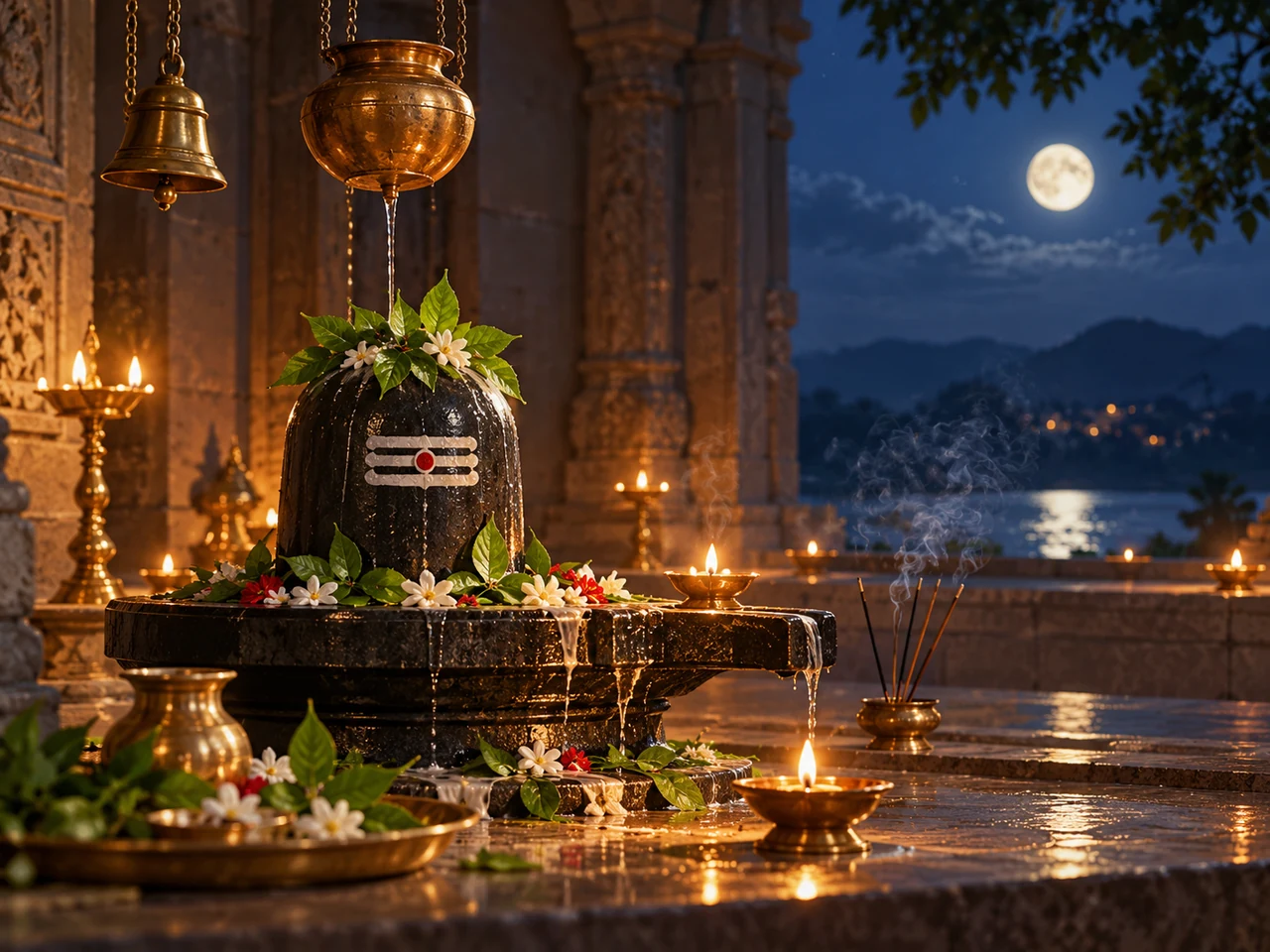
A great festival comes once a year. A quiet practice can return every month. Masik Shivratri (Māsika Shivratri, मासिक शिवरात्रि) is that recurring night of devotion to Shiva: an opportunity to step away from ordinary noise, reflect on one's actions, and make space for prayer. It usually draws less public attention than Mahashivratri, yet for many devotees its strength lies precisely in its rhythm. (Māsika Śivarātri, मासिक शिवरात्रि) is that recurring night of devotion to Shiva: an opportunity to step away from ordinary noise, reflect on one's actions, and make space for prayer. It usually draws less public attention than Mahashivratri, yet for many devotees its strength lies precisely in its rhythm. 1 2 5
The name means “monthly night of Shiva.” Its recurring lunar designation is Krishna Paksha Chaturdashi, the fourteenth tithi of the waning half of a lunar month. In many Shaiva and household observances, night worship—especially the interval called Nishita Kala—receives particular attention. Some followers undertake a vrata (religious observance that may include fasting), while others offer simple prayers or visit a nearby Shiva temple. These are related expressions of devotion, not a single mandatory procedure for everyone. 1 2 5
Masik Shivratri at a glance
| Question | Explanation |
|---|---|
| What is it? | A recurring Shaiva observance associated with Krishna Paksha Chaturdashi each lunar month. |
| Principal deity | Shiva—also reverently called Mahadeva, Shankara, Shambhu, Rudra and Bholenath. |
| Worship focus | Prayer, Shiva-linga worship, reflection, mantra remembrance and, in some traditions, a night vigil. |
| Key time concept | Nishita Kala: a locally determined interval near the middle of the night, not a universal clock hour. |
| Fasting | Followed in different forms by some devotees; not a universal obligation. |
| Relation to Mahashivratri | The specially celebrated annual Shivratri belongs to the same recurring series, with distinct festival significance. |
| Number each year | Approximately one per lunar month; an intercalary (adhika) month can add an occurrence. |
| Date and time | Must come from ShivGoraksh's separately reviewed, city-specific Calendar module; none are approved here. |
What does the Hindu calendar mean by “monthly”?
A tithi is a lunar phase interval determined by the changing angular relationship between the Moon and Sun. It is not necessarily a civil day running from midnight to midnight. Consequently, Krishna Chaturdashi can begin during one afternoon, continue past local midnight, and finish on the following morning—or follow another pattern. A published calendar needs to select which local civil date bears the observance according to a reviewed rule. 5 7
Krishna Paksha is the waning fortnight after the full moon; Chaturdashi is its fourteenth tithi, just before Amavasya in the lunar sequence. The descriptive label “the night before the new moon” is useful, but it is not an astronomical or observance-selection algorithm. A night can cross two civil dates, and a printed almanac may label a day by its tithi at sunrise even when the worship window requires different treatment. 5
Because a lunisolar year sometimes has an extra, adhika, month, it is misleading to promise that every Gregorian year or every Hindu lunar year contains exactly twelve Masik Shivratris. A monthly Panchang list can contain an additional observance, and some months also carry a special name or local emphasis. The occurrence engine should count actual qualified lunar months rather than assume a fixed twelve-item array. 5 7
Why is nighttime important?
The emphasis on night is not an arbitrary modern invention. The Shiva Purana, Kotirudra Samhita 38, associates the Shivratri observance with Krishna Chaturdashi, describes a Chaturdashi extending into the middle of the night, and discusses worship across the night. Verse 85 of that chapter explicitly speaks of performing the vrata every month. These passages establish a meaningful textual link to recurring Shiva devotion, although a digital calendar still requires separate interpretation of the precise modern Nishita and date-selection rules. 2
Contemporary Panchang publishers commonly identify the central worship period as Nishita Kala, a short interval around the middle of the local night. This is not safely replaced by “12:00 a.m.” printed in a general article: sunset, sunrise and the defined night-period convention vary by place and date. Nor can one simply select the civil day on which Chaturdashi exists at sunrise. A properly reviewed Panchang must evaluate the relevant tithi interval against the relevant night window. 5 2
For a reader, the meaning is simpler than the calculation: the night encourages quiet attention. The darkness can become a metaphor for what is difficult to see in oneself—restlessness, attachment, or habits carried without reflection. Worship turns that pause into an intentional act of remembrance. This is a devotional interpretation, not a scientific claim about what a particular lunar date can do to the body or mind.
Scriptural foundations: what can actually be attributed?
The Narada Purana, Purva-bhaga, Caturtha-pada, Chapter 123, discusses the observances of Chaturdashi. In its treatment of Vaishakha's dark-half Chaturdashi, it describes worship of Shiva with offerings such as bilva leaves; it then explicitly says that Shivaratra Vrata is to be observed on the dark-half Chaturdashi of all months. This is stronger evidence for a monthly tradition than an unsourced claim that the custom began on a particular historical date. 1
The Shiva Purana, Kotirudra Samhita, Chapter 38, describes the importance of Shivratri and its night rites, including prayer, mantra remembrance, gifts and worship in successive watches of the night. The text gives elevated attention to a particular Magha observance, while also referring to monthly performance. Its theological praise is the voice of a Shaiva religious text; the text does not function as historical evidence that every Indian household has always followed one identical procedure. 2
An illustrative narrative appears in Kotirudra Samhita, Chapter 40: a hunter stays awake in a bilva tree and, without intending to perform a ritual, lets water and leaves fall onto a Shiva-linga below. The narrative associates his developing compassion and truthfulness with the observance. It is a vrata-katha—a religious teaching story—not a report to be dated as a verified historical incident. Its central ethical movement is more illuminating than treating it as a promise of automatic results. 4
The Satikhanda of the Rudra Samhita, Chapter 15, depicts Sati following a sequence of Shiva-related observances across different months and mentions night worship with bilva on the dark-half Chaturdashi of Phalguna. That passage reflects the larger Shaiva vocabulary of devotion but does not by itself prove that one modern monthly home ritual was prescribed identically in every region. 3
Masik Shivratri and Mahashivratri: related, not interchangeable
Mahashivratri is the specially revered annual celebration, often marked by substantial temple participation, four-prahar worship and public festivities. Masik Shivratri names the recurring monthly observance. The annual Mahashivratri belongs to the larger series of Shiva nights; it does not create a second unrelated Chaturdashi in that month. 2 5 8
A common point of confusion is its month-name. Under the Purnimanta lunar naming convention, used across many parts of North India, the annual occasion is described as Phalguna Krishna Chaturdashi. Under the Amanta convention, used in large parts of western and southern India, the corresponding fortnight is called Magha Krishna Chaturdashi. These labels can refer to the same lunar occurrence. A reader should not infer two Mahashivratris from the different names. 5 7
Another important connection is Sawan/Shavana Shivratri. Certain North Indian communities give special prominence to the Krishna Chaturdashi associated with Shravana, while other regions label the same lunar fortnight differently. It should be treated as a regionally named occurrence within the monthly system, not mechanically generated as an additional festival on another date. 5
Is Masik Shivratri the same as Pradosha Vrat?
No. Both honour Shiva, and their lunar positions can be close. Pradosha Vrat is generally observed in connection with Trayodashi—the thirteenth tithi—of both the bright and dark fortnights, with a strong association with the post-sunset Pradosha interval. Masik Shivratri concerns Krishna Paksha Chaturdashi and the night, particularly Nishita in widely used contemporary calendars. They require separate records and separate reviewed selection functions. 6 5
Imagine looking at a Panchang for a single waning fortnight: its Pradosha worship may fall on one evening, while the monthly Shiva night follows in that same lunar sequence. The two devotional opportunities belong together culturally, but neither can be computed simply by adding twenty-four hours to the other. Tithi boundaries can shift relative to local sunset and midnight. 6
How is Masik Shivratri commonly observed at home?
There is no single household script followed everywhere. The following describes public, ordinary devotional practices, not initiation-based ritual instructions or an assurance that a particular act produces a guaranteed result. 2 5
- Prepare a quiet place. Some people clean a prayer space and arrange an image of Shiva or a Shiva-linga, along with a small lamp and simple offerings. Others worship in a temple rather than at home.
- Remember Shiva respectfully. A devotee may offer water, flowers or bilva leaves where the family tradition permits and where the temple's rules allow them.
- Pray or recite. Quiet japa of the publicly familiar devotional name Om Namah Shivaya, listening to a hymn or reading about Shiva are common expressions of bhakti. Mantras that a lineage treats as requiring initiation are outside the scope of a public guide.
- Keep the evening gentle. Some undertake a period of silence, devotional singing, contemplation or reading instead of an elaborate ceremony.
- Observe the night in a suitable way. An established vrata may involve wakefulness and more than one worship period. Many householders instead offer focused prayer without remaining awake all night.
- Conclude respectfully. Where fasting and a formal parana are part of the family custom, the method and time should come from that tradition and an approved local calendar rather than from an invented universal deadline.
The Shiva Purana describes more elaborate rites, including successive three-hour night periods and preceptor-associated practices. A descriptive festival article should not paste those lengthy rites into a universal “do-it-yourself” checklist, or imply that specialized nyasa, mandala, consecration or initiation procedures are available to everyone without guidance. 2 9
What offerings and symbols mean
Water is one of the simplest offerings. Poured over a Shiva-linga in many worship traditions, it can convey surrender and care. The practice is devotional; it is not necessary to use large quantities of water or other resources. A modest offering and a clean space are enough for many households.
Bilva (bael) leaves figure prominently in Shaiva literature, including the Narada Purana and Shiva Purana. Their presence in the hunter narrative and in discussions of worship shows how strongly they are associated with Shiva. Availability, local ecological considerations and temple-specific rules should guide their use; leaf-gathering need not harm a living tree. 1 2 4
The Shiva-linga is a sacred focus of Shiva worship. Devotional traditions understand it in varied, sophisticated ways—among them a sign of the formless and all-pervading. It should not be reduced to a single sensational explanation, nor should one shrine's liturgy be forced on all Shaiva communities.
The lamp, recitation and silence draw attention inward. In a busy life, such modest gestures may be more sustainable month after month than dramatic vows. This is an interpretation of the practice's human meaning, not a measurement of supernatural effects.
Fasting, a night vigil and parana: choices and limitations
Many traditional accounts of Shivratri include a vrata: some people eat lightly, some avoid selected foods, and others undertake a strict fast under their inherited customs. The Shiva Purana describes demanding observances, but a textual description is not a medical instruction or a rule imposed on every worshipper. 2 9
Fasting is not a test of worth. Children, older people, pregnant people and anyone with health or medication concerns should not be urged toward food or water restriction by a general educational website. Personal health advice belongs with qualified clinicians; religious accommodation may be discussed with a trusted teacher or family elder. It is possible to honour Shiva through prayer, service and reflection without a strenuous fast.
Jagaran means remaining awake in devotion. The four prahar idea refers to worship across successive portions of the night, especially in fuller Shivratri ritual traditions. Someone unable to keep vigil can still participate through a shorter, attentive observance. Claims that a particular night necessarily cures illness, resolves marriage difficulties or removes all adversity are belief claims, not verified outcomes. 2 5
Parana means concluding a fast. Contemporary published almanacs describe different practical treatments for Shivratri fast-breaking, and annual Mahashivratri guidance cannot automatically be copied to every monthly event. The exact locally valid date, allowed interval, and handling of Chaturdashi ending near sunrise require calendar-specialist and sampradaya review. This article does not declare an approved parana time. 8
Different communities, different rhythms
In North Indian households, Masik Shivratri often appears alongside Monday Shiva devotion, Shravana worship and the annual Mahashivratri. Names such as Sawan Shivratri carry particular regional resonance. One family may visit a Shiva temple, another may quietly keep a vrata at home. It would be misleading to claim that one form is compulsory throughout Uttar Pradesh, Haryana, Bihar or Rajasthan. 5
In Maharashtra, Karnataka, Andhra Pradesh and Telangana, Amanta lunar month naming commonly affects what the printed month is called, even when the underlying tithi is the same. Shaiva temple calendars may mark Shivaratri separately from Pradosham; individual temples determine their actual services and access rules. This page does not invent a temple-by-temple schedule or an identical South Indian liturgy. 7 6
In Tamil and other regional Panchang usages, monthly worship may appear under locally familiar forms of Sivarathri/Shivarathiri. Civil-calendar placement and naming should be checked against the selected regional almanac, rather than translated by substituting a North Indian month name without explanation. 5 7
Where Nath, Shaiva ascetic or teacher-disciple traditions are concerned, Shiva can be revered as Adinath and practice may centre on guru instruction, meditation and inward discipline. That spiritual context is relevant to ShivGoraksh, but the sources reviewed for this edition do not establish a unique, universal “Nath Masik Shivratri ritual.” No such rite is attributed to Gorakhnath or Matsyendranath without a verified textual or lineage source.
A monthly practice of attention, not an expensive occasion
The monthly cycle invites a question that a once-a-year festival may not ask: what changed since the last observance? A devotee might review an unkind reaction, an obligation neglected, a person who needs support, or a habit that deserves more patience. Such reflection makes the ritual a point of continuity.
One can also link devotional intention with ordinary seva—helping someone, protecting a shared resource, speaking honestly or treating animals and neighbours with care. The hunter story's movement away from harm gives a literary model for this reading, though no literal equation between a modern act and the Purana's narrative is intended. 4
The observance need not be bought into existence with costly materials, spectacular offerings or claims of instant blessing. A short prayer repeated with care across months can be meaningful without being marketed as a guarantee. Tradition provides the rhythm; conscience gives it substance.
Finding the next Masik Shivratri in your city
When ShivGoraksh's reviewed Calendar service supports the user's selected city and convention, the accompanying date module should identify the next occurrence, the local observance date, the applicable Krishna Chaturdashi interval, the locally computed Nishita window where authorized, the chosen rule profile and its verification status. Its data must be generated and reviewed by the Calendar/Panchang system, not inferred from this evergreen article. 5
Observance dates depend on the selected city and convention. If a result is unavailable, consult a suitable local Panchang; do not infer a date from this introductory article.