



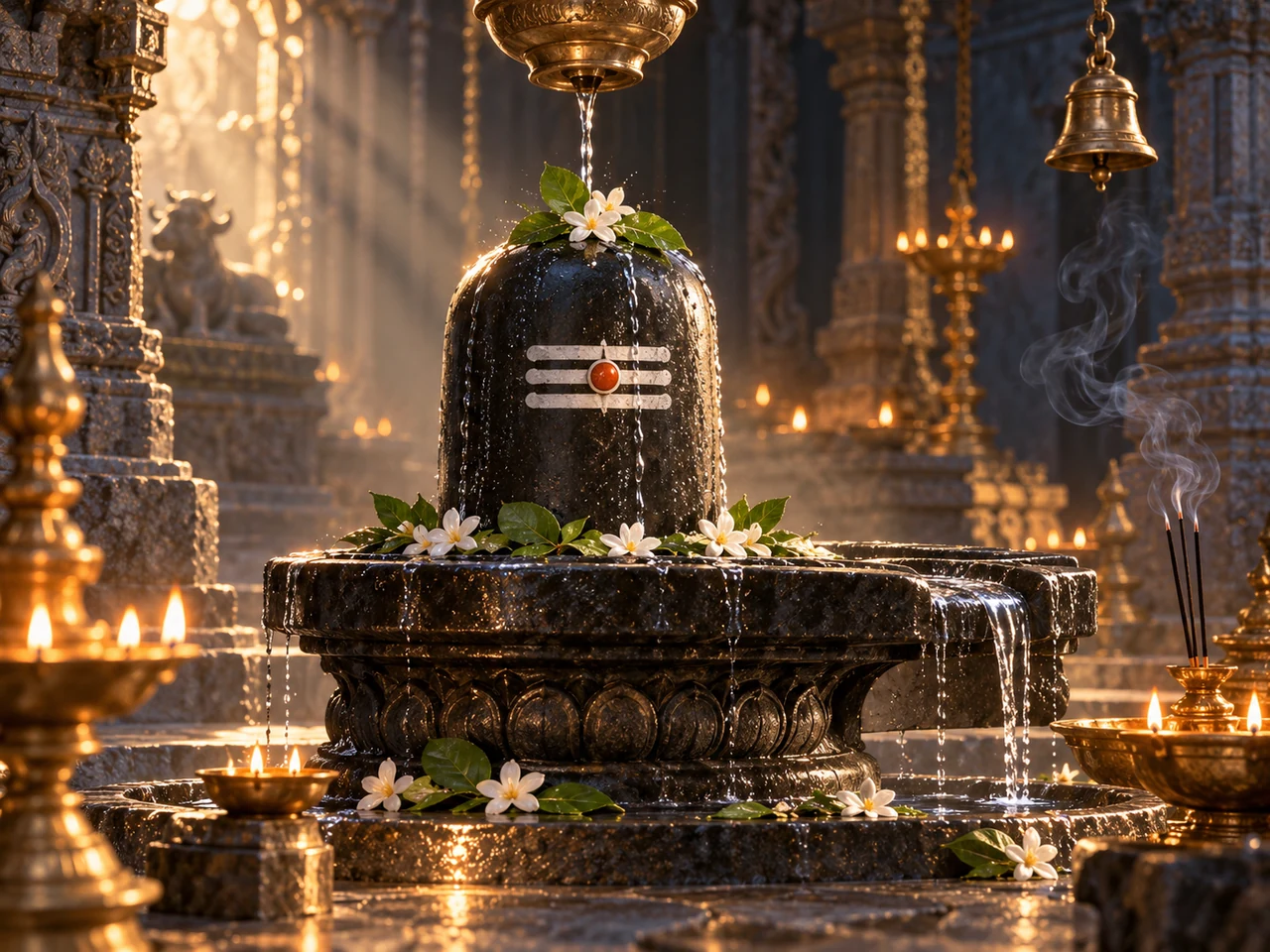
An accessible guide to the sacred emblem of Shiva: its names, changing artistic forms, scriptural narratives and the meanings devotees find in it.
Walk into a Shiva temple and the central object of attention may not resemble a human figure at all. In a quiet inner shrine, a smooth, upright form rises from a supporting base. Flowers may rest upon it; water may be offered during worship. The form is familiar across India, yet the questions it raises are surprisingly deep. Is it an image, a sign, a symbol of creation, a presence of Shiva—or several of these at once?
The Shiva linga (Shiva-linga, शिवलिङ्ग) has a history that cannot be reduced to a single English word or a single explanation. Its Sanskrit name has several meanings; its shapes vary across time and place; and devotees, authors and art historians approach it differently. This guide keeps (Śiva-liṅga, शिवलिङ्ग) has a history that cannot be reduced to a single English word or a single explanation. Its Sanskrit name has several meanings; its shapes vary across time and place; and devotees, authors and art historians approach it differently. This guide keeps three kinds of statement distinct: what surviving objects show, what specific sacred texts teach, and what worshippers understand through devotion. Understanding all three brings the symbol into clearer focus without asking readers to surrender either intellectual care or religious respect.
Key takeaways
- LingaLiṅga can mean a sign, mark or identifying characteristic; the word also has anatomical meanings in Sanskrit. Neither fact by itself exhausts the Shiva linga's religious meanings. 1
- In the Shiva PurāṇaŚiva Purāṇa, Shiva is explained as both niṣkala (beyond manifest parts or form) and sakala (having an expressed form). This is a text-specific theological interpretation, not a rule followed identically by all Shaiva traditions. 2
- The narrative of an immeasurable pillar of fire conveys Shiva's transcendence in a Shaiva sacred story. It is not an archaeological account of when linga worship began. 3
- Museum objects show simple shafts, forms with one or several Shiva faces, and combinations of nonfigural and human imagery. A description of the linga as aniconic is therefore useful but not exhaustive. 4 6
- The linga-and-yoni ensemble can carry generative and Shiva–Shakti symbolism, but meanings vary among temples, devotional communities and interpreters. 9
- Worship is not reducible to a debate about anatomy: for a devotee, the sanctified linga can serve as the focus of relationship with Shiva. 7 11
What does lingaliṅga mean?
The Sanskrit noun lingaliṅga (लिङ्ग) has a range of attested senses: sign, mark, characteristic, indication or evidence. It also denotes gender in grammatical usage and can refer to a sexual organ or phallus. A standard Sanskrit dictionary records both the broad semantic field and the specific Shiva-associated phallic sense. That is why translating every occurrence as only “symbol” would be incomplete—and translating every occurrence as only “phallus” would also be misleading. 1
A helpful comparison is the ordinary idea of a sign: a sign points beyond its own material. Smoke can serve as evidence of fire, although smoke is not fire itself. In devotional reading, a linga can likewise direct attention to Shiva, who is not limited by stone or metal. This analogy helps explain : a sign points beyond its own material. Smoke can serve as evidence of fire, although smoke is not fire itself. In devotional reading, a liṅga can likewise direct attention to Shiva, who is not limited by stone or metal. This analogy helps explain one possible aspect of the word, not the entire historical origin of the object. The object may simultaneously possess a material shape, a ritual identity and a theological meaning.
The preferred form in academic transliteration is Shiva-lingaŚiva-liṅga; everyday English also uses Shivling, Shivalinga or Shiva lingam. Liṅgam includes the neuter nominal ending often heard in southern Indian languages and English usage. Hindi readers commonly encounter शिवलिंग. Variations in spelling should not be mistaken for different deities or mutually exclusive doctrines.
Recognizing the form: shaft, base and sacred setting
Many temple lingas have a rounded upright shaft seated in a lower base. The base may be called yoni, pīṭha or, in particular contexts, pīṭhikā; terminology and construction differ. Some bases incorporate an outward channel for liquids offered in worship. The whole ensemble belongs to the architecture of the sanctuary, not simply to an isolated piece of sculpture. The British Museum catalogues an example specifically as a linga set in a yoni; it also records the cobra around its shaft as a protective motif. Its page could be located in the museum index, although full direct access was restricted during this research. 9
The words lingaliṅga and yoni are frequently read together as complementary generative principles. In some Shaiva–Shakta interpretations, that pairing becomes a way of contemplating Shiva and Shakti, without whom a world of living forms could not be envisioned. Yet it is not responsible to claim that each particular sculptural base was designed to illustrate exactly the same philosophical formula. It has ritual, artistic, functional and theological dimensions; local explanations deserve to be heard on their own terms.
A linga is often called aniconic—an image of the divine that does not represent a full human body. But aniconic does not mean “an empty object without sacred presence,” nor does it mean every linga lacks figurative features. Museum examples of ekamukha-lingaekamukha-liṅga (one-faced linga) place Shiva's face on the shaft. Others may bear four faces or a covering with several faces. The vocabulary distinguishes recognizable types; it does not create a rigid hierarchy of spiritual worth. 4 6
A sacred narrative: the pillar of fire
One widely told account begins with a dispute between Brahma and Vishnu. In the Shiva PurāṇaŚiva Purāṇa, Vidyeśvara-saṃhitā, Chapter 7, an immense column of fire appears between them. Vishnu searches downward and Brahma upward, yet neither discovers its limit. The narrative subsequently addresses truthfulness, pride and Shiva's manifestation. The published online edition also places the discussion of linga and embodied image in Chapter 5. These are identifiable chapters of one transmitted text, not free-floating quotations attributed to an imagined “ancient scripture.” 2 3
A beginner can read the column as a narrative image of the immeasurable. Brahma and Vishnu attempt to find a beginning and an end; the story refuses to let the divine be contained by their search. The point is theological: this Shaiva telling portrays Shiva as exceeding ordinary categories of size, form and precedence. Different religious communities may read relations among these deities differently. The tale should never be presented as scientific proof of an eternal physical column or as a dated archaeological record.
In the visual language of Liṅgodbhava, Shiva appears in relation to that fiery pillar. The theme is important in southern Indian Shaiva temple art and Tamil devotional explanations. A scholarly study of the Tēvāram tradition discusses the motif and references several Purana tellings. This establishes the reach of the story across artistic and devotional contexts; it does not establish a single original or unchanging version. 12 13
Form and formlessness: what a Shaiva text actually says
Shiva PurāṇaŚiva Purāṇa, Vidyeśvara-saṃhitā 5, raises a concrete question: why is Shiva worshipped in both a linga and a humanlike form? Its answer distinguishes niṣkala (formless, beyond divisions) and sakala (expressed in form). It understands the linga as suited to the former aspect, while the represented figure gives attention to the latter. Because Shiva encompasses both in this text's Shaiva theology, the two modes can stand together. 2
Imagine a temple with a linga in the sanctum and a sculpted Nataraja or Dakshinamurti elsewhere. Worshippers are not necessarily faced with a choice between “the real god” and “a mere substitute.” Images can direct attention toward different qualities of the deity, while the devotional encounter joins them. At Elephanta, an art-historical study discusses both the linga shrine and multiple figural forms of Shiva within one complex; that physical setting provides a striking illustration of their coexistence. 7
This explanation has limits. Terms such as niṣkala carry technical meanings in particular texts, and Shaiva Siddhanta, Kashmir Shaiva schools, Pashupata traditions and local temple communities should not be collapsed into a single philosophical system. The Shiva PurāṇaŚiva Purāṇa passage is excellent evidence for its own interpretation, but not proof that every Shaiva group would explain consciousness, matter, grace or liberation in precisely those terms.
The question of phallic meaning: neither denial nor reduction
Popular discussion often swings between two declarations: “the linga is nothing but a sexual organ” and “the linga has never had a phallic meaning.” Historical evidence supports neither absolute. Sanskrit lexicography acknowledges phallic meanings, and museum descriptions explicitly identify such features in some examples. The Metropolitan Museum's seventh-century Kashmir linga, for instance, combines a human face of Shiva with a shaft whose anatomical detailing is noted in the catalogue. 1 4
Yet an object that refers to generative power in its form may also represent divine presence, cosmic continuity, austerity, sovereignty and transcendence. The Metropolitan Museum's catalogue for a ninth-century Shahi example identifies generative meaning alongside an emerging figure of Shiva. An interpretation focused exclusively on sexuality misses this artistic and theological richness, while an account that erases phallic associations misses evidence too. 5
This is not an invitation to project modern embarrassment or modern celebration onto historical communities. Sexual, fertile, ascetic and nondual associations have been understood differently in different settings. Shiva is remembered both as an austere ascetic and as a household deity with Parvati; that tension is part of the living texture of Shaiva traditions. An introductory guide should illuminate the variety rather than police one obligatory emotion toward the symbol.
The linga and Shakti: an important but variable reading
The pairing of the upright linga and its yoni base is sometimes explained through Shiva and Shakti: stillness and activity, consciousness and expressive power, or the unity of generative principles. These are devotional and philosophical readings; they are not measurements of physics or evidence of a universal ancient doctrine. In some understandings Shakti is inseparable from Shiva; in other traditions she is revered as supreme in her own right. The shared imagery must not erase the real differences between Shaiva and Shakta theology. 9
Another common simplification says that the shaft stands for “male” and the base for “female” and that this exhausts the meaning. It can be a useful beginning for some contexts, but it is not a complete description. Philosophical terms such as consciousness and power do not map neatly onto actual human beings or dictate fixed roles for men and women. Devotees can encounter the linga as the presence of Shiva without consciously adopting any particular gender-based allegory.
A useful question: When someone explains this form, are they reporting an inscription or object, paraphrasing a particular text, or expressing their community's devotional reading? Each kind of statement is valuable—but the evidence behind it differs.
What historical objects can tell us
Sacred stories speak of timeless manifestation; archaeological objects belong to particular places and material histories. The two should not be confused. A carving's period can sometimes be estimated by style, inscriptions or excavated context. Such evidence establishes that a particular image existed in a particular era, not that its worship suddenly began at that date.
The often-discussed Gudimallam linga in present-day Andhra Pradesh combines an upright phallic form with a carved standing figure. A scholarly study hosted by the Indira Gandhi National Centre for the Arts cites it as an important early sculptural comparison; assessments of its exact date and of the early history of linga worship require careful attention to archaeological publications. It is better to introduce Gudimallam as early and consequential, with dating requiring source-specific review, than announce an unquestionable year of origin. 14
The Metropolitan Museum identifies an ekamukha-lingaekamukha-liṅga from Madhya Pradesh with the early Gupta era (first half of the fifth century), and a comparable Kashmir example from the seventh century. Such objects show how figural features could become part of a shaft whose form remained recognizably a linga. 4 8
At Elephanta, a sixth-century cave complex includes a linga within an architecturally prominent shrine as well as abundant images of Shiva in humanlike forms. At Rajarajesvara/Brihadisvara in Thanjavur, the monumental linga occupies the temple's sanctum and architectural center. Neither monument should be treated as identical to a small household icon. Their arrangements show how religious meaning and the design of space could shape one another. 7 10
Beyond India, the Metropolitan Museum catalogues a seventh- to early-eighth-century linga from present-day Thailand, describing its geometric base and cosmic-axis significance. A Nepalese four-faced linga altar dated 1045 demonstrates a different material and regional setting. Together, they discourage the notion that the object belonged to only one language, dynasty or artistic formula. 16 6
A concise comparison of evidence
| Lens | What it can establish | What it cannot establish alone |
|---|---|---|
| Sanskrit lexicon | Multiple meanings of the word lingaliṅga | One timeless meaning for every worshipper |
| Named Purana chapter | What a specific transmitted narrative teaches | A dated event or universal sectarian consensus |
| Archaeological object | Material features and an estimated period/context | The personal experience of all past devotees |
| Museum interpretation | Curated iconographic and historical analysis | The only possible local devotional reading |
| Living worship | How a community honors Shiva now | An unbroken reconstruction of all ancient practice |
Types of lingas and their artistic vocabulary
Not every Shaiva shrine uses one shape or material. A plain smooth shaft is common, but some lingas bear a face or a complete image associated with Shiva. Ekamukha means one-faced and caturmukha means four-faced. A Nepalese metal altar held by the Metropolitan Museum has four represented faces; its catalogue discusses the possibility of a fifth direction being understood rather than visibly carved. These forms show that visual and nonfigural symbolism can be combined rather than opposed. 4 6
Terms such as svayambhū-lingasvayambhū-liṅga (“self-manifest” in devotional usage), bāṇa-lingabāṇa-liṅga (a name used for particular naturally shaped stones) and pārthiva-lingapārthiva-liṅga (an earthen or clay-made linga in ritual literature) also circulate. These describe different devotional or material categories, not necessarily archaeologically demonstrated supernatural origins. Their precise definitions and worship rules vary by source and are not a licence to invent an all-purpose home ritual. The Shiva PurāṇaŚiva Purāṇa explicitly discusses the distinction between the linga and figural representation and includes material about earthen forms elsewhere in its Vidyeśvara section. 2
The temple itself can further transform the experience of the symbol. At Halebidu's Hoysaleshvara temple, two adjacent sanctums each enshrine a linga; an art-historical description interprets the image as a focus of divine presence. At the Shore Temple at Mamallapuram, a linga and other figurative images coexist in the sacred complex. Architecture helps the visitor understand how the worshipped form relates to movement, light, guardians and collective memory. 11 15
Devotion in context: what happens around a linga?
A worshipper may encounter a linga through darśana (seeing and being in the presence of the deity), abhisheka (ceremonial bathing or pouring of offerings), prayer, flowers and acts of reverence. In a functioning temple these actions belong to a local liturgy, maintained by particular communities and priests. The Shiva PurāṇaŚiva Purāṇa attests to linga worship within its ritual framework, but it would be inaccurate to claim its descriptions exhaust the practice of every temple in India. 2
Water flowing over stone can be understood devotionally as attention, offering and renewal; the channel in a base can also be understood practically as part of the shrine's construction. These explanations need not compete. The spiritual meaning is held by a community of worship, and the physical design allows its customary actions to occur. Readers should respect temple access rules, local stewardship and the difference between public observation and initiation-dependent practices.
Mahashivratri, Masik Shivratri, Pradosha Vrat and Shravana Somvar are related ShivGoraksh observance topics, but a guide to symbolism should not make up their dates or declare one universal puja procedure. Regional panchangas, fasting rules and priestly traditions may differ. Historical and conceptual learning is the purpose here; this is not a substitute for a reviewed practice manual.
Common misconceptions, reconsidered
“The linga is only an anatomical object.” Some works do have explicit phallic features, but the religious emblem also participates in ideas of divine presence, infinity, creation and ascetic power. The fuller interpretation must consider which object, text and community is under discussion. 4 5
“The linga has absolutely no phallic history.” That counterclaim is equally untenable in light of dictionaries and museum evidence. Faithful explanation need not be based on suppressing a historical meaning. 1 9
“Aniconic means Shiva is absent.” In devotional and art-historical usage, nonfigural representation can be a focused means of divine presence, not a denial of representation. 7 11
“Every linga-yoni ensemble teaches the same doctrine about gender.” Generative and Shiva–Shakti interpretations are significant, but claims of universality require evidence from particular traditions. A material base also has a setting and a practical structure.
“The fire-pillar legend proves a prehistoric monument existed.” The story belongs to the theological imagination of named Purana chapters. It is not a laboratory claim or a dated excavation report. 3
“Shiva is never represented as a person.” He appears in many humanlike forms—Nataraja, Dakshinamurti, Ardhanarishvara and others—sometimes in the same sacred space as a linga. 7
Connection to the ShivGoraksh learning collection
The linga offers a doorway into larger questions: how can the sacred be shown without containing it? How does a religious image join visible matter with invisible meaning? Why does Shiva appear as ascetic, dancer, teacher and unadorned emblem? For the broader historical setting, continue with Introduction to Shaivism: History, Beliefs and Traditions (Introduction to Shaivism). For the interplay of divine power and consciousness, see Shiva and Shakti: Understanding Their Relationship (Shiva and Shakti); for comparisons among traditions, Major Schools of Shaivism (Major Schools of Shaivism).
The most directly related entity profiles are Shiva Shiva, Shakti Shakti, Shankar Shankar, and Parvati Parvati. Festival-related connections include Mahashivratri: The Great Night of Shiva Mahashivratri, Pradosha Vrat: Meaning, Trayodashi & Shiva Worship Pradosha Vrat, Masik Shivratri: The Monthly Night of Shiva, Worship and Panchang Guide Masik Shivratri, and Shravana Somvar: Sawan Monday Worship, Vrat and Regional Calendar Guide Shravana Somvar. For readers interested in how liberation is discussed, Shaiva Siddhanta: Philosophy and Tradition Shaiva Siddhanta and Moksha, Meditation and Self-Realization in Shaiva and Nath Traditions Moksha, Meditation and Self-Realization offer different future learning routes. The content and approval status of related assets must be checked before any website navigation is activated.
1. Does “linga” simply mean “symbol”?
No. “Mark” or “sign” is a documented sense of the Sanskrit word, but the same word has other meanings, including an anatomical one. In Shiva worship, the material form and the religious interpretation must both be considered. 1
2. Is the Shiva linga a form of Shiva or something representing him?
The answer depends on context. A textual explanation may call it an emblem suited to Shiva's formless aspect, while a devotee may speak of Shiva being present for darśana. Representation and sacred presence need not be mutually exclusive. 2 11
3. Why is there a yoni base?
The base supports the shaft and, in many forms, serves the offering arrangement. It is also interpreted as a female generative symbol and in some traditions as related to Shakti. Neither one technical explanation nor one theological allegory covers every case. 9
4. What is the story of Brahma and Vishnu searching for the pillar?
In Shiva PurāṇaŚiva Purāṇa, Vidyeśvara-saṃhitā 7, they try unsuccessfully to find the ends of an immeasurable column of fire, which is revealed in the context of Shiva's manifestation. The story conveys theological meaning, not a testable natural event. 3
5. Can a linga have a face?
Yes. Museum examples include ekamukha and caturmukha forms. They unite features of a linga with sculpted faces of Shiva. 4 6
6. Are all Shiva lingas ancient or “self-manifested”?
No. Some are historically datable objects, while svayambhū belongs to a devotional category. A tradition's sacred account of a particular site should not automatically be used as archaeological dating evidence.
7. Is the linga the same thing as a Jyotirlinga?
A jyotirliṅga is a special designation for revered Shiva sanctuaries in specific devotional and pilgrimage traditions. It should not be used as an interchangeable label for every linga, and the legends and histories of individual shrines require separate verification.
8. How should a first-time visitor approach a Shiva linga shrine?
With attention and respect: look at the shrine's arrangement, consider how the community understands the form, and follow its visitor rules. You need not decide every philosophical question before appreciating the devotional importance of the place.
Glossary for beginners
| Term | Plain-language meaning |
|---|---|
| Linga / लिङ्गLiṅga / लिङ्ग | Sign, characteristic or emblem; also other senses in Sanskrit, including anatomical usage |
| Shiva-linga / शिवलिंगŚiva-liṅga / शिवलिंग | Sacred linga associated with and worshipped as Shiva |
| Yoni / योनि | Womb, source or generative symbol; a term for the supporting base in many ensembles |
| Pīṭha / पीठ | Seat or base; usage depends on context |
| Niṣkala / निष्कल | Beyond divisions or form, in particular theological vocabularies |
| Sakala / सकल | Manifest or expressed in form, in particular theological vocabularies |
| Liṅgodbhava / लिंगोद्भव | Shiva's manifestation associated with the immeasurable pillar of fire |
| Mukha-linga / मुखलिंगMukha-liṅga / मुखलिंग | Linga that incorporates one or more faces |
| Abhiṣeka / अभिषेक | Ceremonial bathing or pouring of offerings over a sacred form |
| Darśana / दर्शन | Reverential seeing or encounter with the deity in worship |