



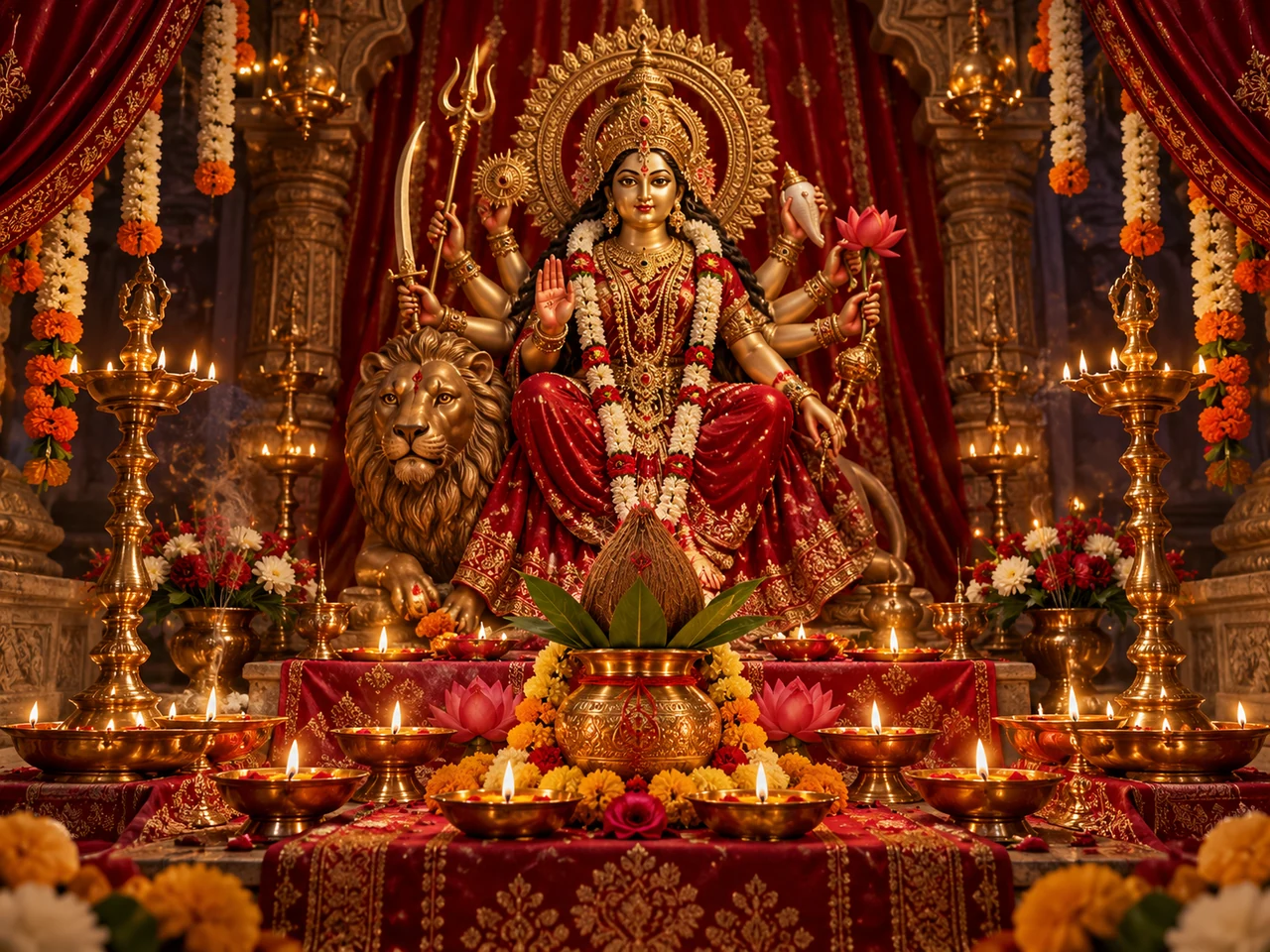
At a glance: Navratri (Navratri, नवरात्रि) means “nine nights.” It is a recurring Navratri (Navaratri, नवरात्रि) means “nine nights.” It is a recurring seasonal festival cycle, especially celebrated as Chaitra Navratri in spring and Sharad or Shardiya Navratri in autumn. Worship of Devi—under names including Durga, Amba, Parvati and other regional forms—is central to many observances. The autumn season also embraces Garba, Bengali Durga Puja, Golu displays and celebrations that culminate around Vijayadashami. There is no single set of household customs, goddess forms or local Gregorian dates shared by everyone. 5, 6, 8
What is Navratri, and why do people celebrate it?
For some families, Navratri begins with a lamp near an image of the Goddess and ends with a simple offering of food. In Gujarat, it can fill a public ground with circles of dancers. In Kolkata, artisans prepare immense images and neighbourhoods gather around elaborately designed pandals. In Tamil homes, tiered displays of dolls invite storytelling, music and visits. These very different scenes belong to a related festival season, but none by itself defines the whole of Navratri. 5, 6, 7
At its heart is a celebration of Shakti, divine power, often encountered as the protective, compassionate and formidable Mother. The festival gives worshippers time to attend to qualities such as courage, steadiness, learning and generosity. In Shakta theology the Goddess may be understood as supreme reality; in other Hindu settings she is revered in relationship with Shiva, Vishnu or a family's chosen deity. This diversity is part of the festival's history, not a problem to erase. 1, 4
“Navratri” is not one fixed event whose complete meaning can be reduced to nine colour codes or a particular fasting recipe. Its prayers, processions, family customs and temple programmes differ by community, region and lineage.
Names, seasons and the meaning of nine nights
Sanskrit nava means “nine” and rātri means “night”; the festival's name draws attention to a period of sustained devotion. Sharad Navratri belongs to the bright lunar fortnight of Ashvina/Ashwin, usually in the autumn season. Chaitra Navratri, sometimes called Vasant Navratri or Rama Navratri, belongs to the bright fortnight of Chaitra. Other, less publicly prominent observances in Magha and Ashadha are often called Gupta Navratri in particular traditions. Treating all four as equally widespread public festivals would be misleading. 8
Names such as Navarathri, NavratriNavarātri, Sharadiya Navratri, Durga Navratri and Devi Navratri appear in different languages and communities. In Bengal, the most visible overlapping celebration is Durga Puja; in parts of the south, Navratri commonly frames worship of Durga, Lakshmi and Saraswati. Names can overlap without the observances being interchangeable. ; in parts of the south, Navaratri commonly frames worship of Durga, Lakshmi and Saraswati. Names can overlap without the observances being interchangeable. 6, 7
Textual origins and historical development
There is no single securely datable “first Navratri.” Goddess worship, seasonal rites and later festival complexes developed in many settings. The Devi Mahatmyam (Durga Saptashati) (also known as Durga Saptashati or Chandi), a thirteen-chapter section of the Mārkaṇḍeya Purāṇa, gives a major literary and theological foundation for the Goddess's victories over destructive powers. It is a text used in many Devi-oriented devotional settings; it is not a diary documenting a festival's historical founding. 1, 2, 3, 4
The nine-form Navadurga sequence widely taught in northern communities belongs to a particular liturgical and devotional tradition. It should not be misrepresented as the chapter-by-chapter table of contents of the thirteen-chapter Devi Mahatmyam (Durga Saptashati). Separate ritual compendia, local customs and educational calendars organize nine nights in different ways. 8
Modern public celebrations have their own traceable histories. UNESCO describes Garba of Gujarat, inscribed in 2023 on its Intangible Cultural Heritage list, as a devotional dance centred on the Goddess and often on a lamp-bearing pot. UNESCO separately describes Durga Puja in Kolkata, inscribed in 2021, as a combination of worship, sculpture, public art and community participation. These records document living cultural expressions, not an exclusive or ancient origin of Navratri as a whole. 5, 6
1. Durga and Mahishasura: the courage to confront disorder
In Devi Mahatmyam (Durga Saptashati) chapters 2–3, the gods, having lost power to Mahishasura, unite their energies; the Goddess appears with weapons given by the gods. Her struggle culminates in the defeat of the buffalo-form adversary. This is a Puranic sacred narrative, not an independently dated military event. Worshippers often read it as the defeat of arrogance and oppression and as the power of a united response to danger. The text does not establish that every modern custom originated in this episode. 1, 2
2. Chanda, Munda and Raktabija: transformation takes many forms
The Devi Mahatmyam (Durga Saptashati) later recounts conflict with the forces of Shumbha and Nishumbha. Kali's defeat of Chanda and Munda gives rise to the epithet Chamunda in chapter 7; chapter 8 describes Raktabija, whose blood brings forth new adversaries, until the Goddess's forces stop his multiplication. The narrative is dramatic and can be interpreted as an image of harmful tendencies that reproduce when unchecked. It should not be reduced to an instruction for violence or mistakenly described as the original source of every Navadurga name. 3, 14
3. The Goddess as a refuge, not only a warrior
After victory, the gods praise the Goddess in the Narayani-stutiNārāyaṇī-stuti of Devi Mahatmyam (Durga Saptashati) chapter 11 as a cosmic sustaining power and a source of refuge. This devotional dimension explains why Navratri households may emphasize care, gratitude and prayer more than battle imagery. Protection, wisdom and tenderness are not separate from the idea of divine strength here. 4
4. Rama and the autumn invocation: a regional devotional layer
Some Bengali tellings connect Rama's worship of the Goddess before his conflict with Ravana to the idea of akāl bodhan, an “untimely awakening” or invocation. This is an important later regional religious narrative, but it is not the only explanation of autumn Navratri, nor should it be presented as an episode found identically in all versions of the Rāmāyaṇa. Its significance lies partly in connecting Rama devotion with Mother-Goddess worship. 8, 6
When is Navratri celebrated?
Most prominent public observances follow a lunar calendar, not a fixed Western date. Chaitra Navratri is generally associated with Chaitra Shukla Pratipada through Navami; Sharad Navratri with Ashvina Shukla Pratipada through Navami, followed by the closely related Dashami/Vijayadashami in many traditions. The exact civil dates, festival-day labelling and ritual windows depend on location and the selected Panchang and regional convention. 8, 9
A Tithi is a lunar angular phase interval, not a midnight-to-midnight date. Consequently a Tithi may start or end during a civil day, be absent at successive sunrises or be present at two sunrises. A nine-Tithi sequence need not be exactly nine civil dates; a local festival programme can therefore span a different number of numbered dates without ceasing to be Navratri. The Ghatasthapana/Kalasha-sthapana commencement rule requires more careful treatment than “Pratipada at sunrise”: traditions also discuss auspicious daytime windows and other Panchang conditions. Those unresolved selections belong in the reviewed Calendar layer, not in this article. 9, 12
For a future date, ShivGoraksh should show “Date/timing not yet verified for this city/year” until an approved calendar occurrence is available. Neither this guide nor an image of a crescent moon can supply a validated date.
How the nine nights unfold
Some households light a lamp and offer flowers, keep a clean worship space, recite prayers or visit a temple daily. Ghatasthapana, a ritual establishment of a pot or kalasha, is an important opening observance in many communities, but detailed procedures and timing are not uniform. Special worship may occur at Saptami, Ashtami or Navami. In some North Indian households, Kanya Puja honours young girls as embodiments of the Goddess. These are descriptions of public custom, not a compulsory ritual manual. 8, 9
A common North Indian teaching sequence associates the successive days with nine Navadurga forms:
| Common day association | Form | Accessible theme |
|---|---|---|
| 1 | Shailaputri | Mountain-born steadiness |
| 2 | Brahmacharini | Discipline and resolve |
| 3 | Chandraghanta | Courage and alertness |
| 4 | Kushmanda | Creative radiance |
| 5 | Skandamata | Nurturing strength |
| 6 | Katyayani | Protection and decisive action |
| 7 | Kalaratri | Facing fear |
| 8 | Mahagauri | Clarity and renewal |
| 9 | Siddhidatri | Fulfilment and spiritual accomplishment |
This is a widely followed association, not an immutable pan-Hindu schedule; some South Indian and other traditions use different deity sequences, and a Tithi's local placement may vary. The themes are introductory interpretations rather than translations of a particular Sanskrit verse. 8
Durga Ashtami (Durga Ashtami: North Indian Kanya Pujan, Mahagauri and Navratri) is a linked but separate educational topic. Some Bengali Durga Puja traditions observe a highly specific Sandhi Puja at the transition between Ashtami and Navami; no universal transition window is calculated here. Mahanavami may involve a distinct set of temple or family practices, while Vijayadashami (Dussehra and Vijayadashami: Meaning, Traditions and Celebrations) commonly marks completion or victory. These observances overlap but are not synonyms. 6, 8
Gujarat: Garba, circles and a light at the centre
In Gujarati Garba, dancers form circles around a lit earthen vessel or image of Amba. Clapping, singing and movement turn the celebration into a public language of devotion; dandiya raas is related but should not be treated as every Garba's defining action. Organised community gatherings now extend far beyond Gujarat through diaspora networks. UNESCO's inscription recognizes Garba as a living practice rooted in its communities, not as an instruction that all Navratri celebrants must dance. 5
Bengal: Durga Puja's artistic and public life
Kolkata's Durga Puja brings together clay-image workshops, pandals, drumming, worship and public art. The later days of the autumn festival are particularly prominent. UNESCO describes immersion and homecoming imagery within this distinctive festival. Bengali Durga Puja is closely connected with Sharad Navratri, but the two should not be flattened into the same nine daily actions or calendar selection rule. 6
Tamil Nadu and the diaspora: Golu, music and learning
In Tamil Nadu, Golu/Kolu/Bommai Golu arranges dolls of deities, people and everyday scenes on stepped displays. Friends visit, sing and share sundal, a preparation often made from cooked pulses. Saraswati worship, honouring books and instruments, and Vijayadashami beginnings in education are important in many homes and temples. The National Library Board of Singapore documents how Tamil-speaking families have maintained Golu across generations abroad. Specific step counts, visiting practices and gifts vary. 7, 10
Karnataka: Chamundeshwari and Mysuru Dasara
Mysuru's autumn celebration places Goddess Chamundeshwari at the centre of royal and public heritage, with cultural programmes and the concluding Dasara procession. This public tradition overlaps with Navratri but has its own institutional history and distinctive events. A yearly event poster can verify that year's programme; it cannot dictate an evergreen rule for all Navratri dates. 11
Telangana: the flowers of Bathukamma
Bathukamma is a distinctive seasonal floral festival, principally celebrated by women in Telangana. Seasonal flowers are arranged into decorative stacks, with songs and communal gatherings. Its cycle overlaps the wider autumn Goddess-festival season but does not necessarily begin on the same Pratipada as Ghatasthapana; state cultural material commonly places its opening around Mahalaya Amavasya. Navratri and Bathukamma are related cultural contexts, not identical calendars. 13
North India: home worship and community gatherings
Across northern communities, many families associate autumn Navratri with devotional singing, lamps, recitation, dietary observances, and worship of Durga's nine forms. Chaitra Navratri can connect with springtime renewal and Rama Navami. The intensity, exact sequence and meaning of fasting and Kanya Puja differ even within the same state. It is best to ask what a particular family or temple follows rather than assume one universal pattern. 8
Food, fasting and prasad
Food can express welcome as much as abstinence. In some households, fasting means avoiding certain grains or ingredients; others observe a partial or full-day fast, and many do not fast. North Indian vrat foods may feature fruit, milk, sabudana or regional flours; kuttu and singhara are familiar examples in some regions, not a rule for everyone. In Tamil Golu visits, sundal and small offerings to guests bring food, hospitality and devotion together. 7, 8
A fast is a voluntary, tradition-dependent practice, not a measure of religious worth. Children and those with health or nutritional concerns should not interpret cultural descriptions as medical instructions. This article does not prescribe fasting schedules or claim scientifically guaranteed effects.
Symbols, philosophy and the presence of Shakti
Lamps often suggest awareness; a kalasha may represent welcome and abundance; flowers mark care and seasonal rhythms. The lion or tiger shown with Durga commonly communicates courage and protective force. Weapons in the Devi Mahatmyam (Durga Saptashati) story communicate divine intervention against disorder, rather than a required set of props for every household. The central lamp of Garba and the carefully arranged Golu are especially effective visual lessons in the diversity of Shakti worship. 1, 5, 7
One reader may hear the Goddess story as a call to oppose injustice; another as the challenge of mastering pride, panic or harmful habits. A Shakta theologian may understand Devi as the ground of consciousness and existence. In a Shaiva setting Shakti may be spoken of in relation to Shiva; in a family celebration attention may rest simply on gratitude to the Mother. A respectful explanation can make room for each, while not claiming that Nath yogis or all Vaishnava communities follow the same ritual calendar.
Devotional literature and responsible practice
The Devi Mahatmyam (Durga Saptashati) is among the major texts recited or studied in Navratri settings. Its sacred battles, praises and philosophical imagery reward reading beyond an isolated list of names. Specific liturgical accompaniments—including the Devī Kavacha, Argala and KilakaKīlaka—belong to transmitted recital settings, with varying arrangements and textual witnesses. The popular Navadurga sequence, the thirteen main chapters and local prayer books should not be conflated. 1, 4
Publicly visible activities such as attending aarti, lighting lamps, singing or viewing pandals are educationally describable. Detailed Chandi homa, tantric worship, initiation-linked mantras and precise muhurta rules require community- and specialist-specific review. No purportedly universal initiation or guaranteed-result ritual is offered here. A future approved practice guide may provide more context.
Related observances and further reading
- Durga Ashtami (Durga Ashtami: North Indian Kanya Pujan, Mahagauri and Navratri): an important Ashtami-centred occasion, especially within autumn Goddess worship; it needs its own date and practice record.
- Dussehra/Vijayadashami (Dussehra and Vijayadashami: Meaning, Traditions and Celebrations): the connected Dashami festival with Durga and Rama associations that vary regionally.
- Rama Navami (Rama Navami (Ram Navami): Meaning, Birth Narrative and Traditions): often falls in the Chaitra Navratri season; it is not a synonym for all of Navratri.
- Hindu Calendar & Panchang (Hindu Calendar and Panchang: A Complete Beginner’s Guide): an explanation of Tithi, Paksha, regional month conventions and local date determination.
- Learn entities: Shakti (Shakti), Durga (Durga), Kali (Kali), Parvati (Parvati), Lakshmi (Lakshmi) and Saraswati (Saraswati).
- Devi Mahatmyam (Durga Saptashati): an already prepared scripture project; publication and link destination must be confirmed independently.