



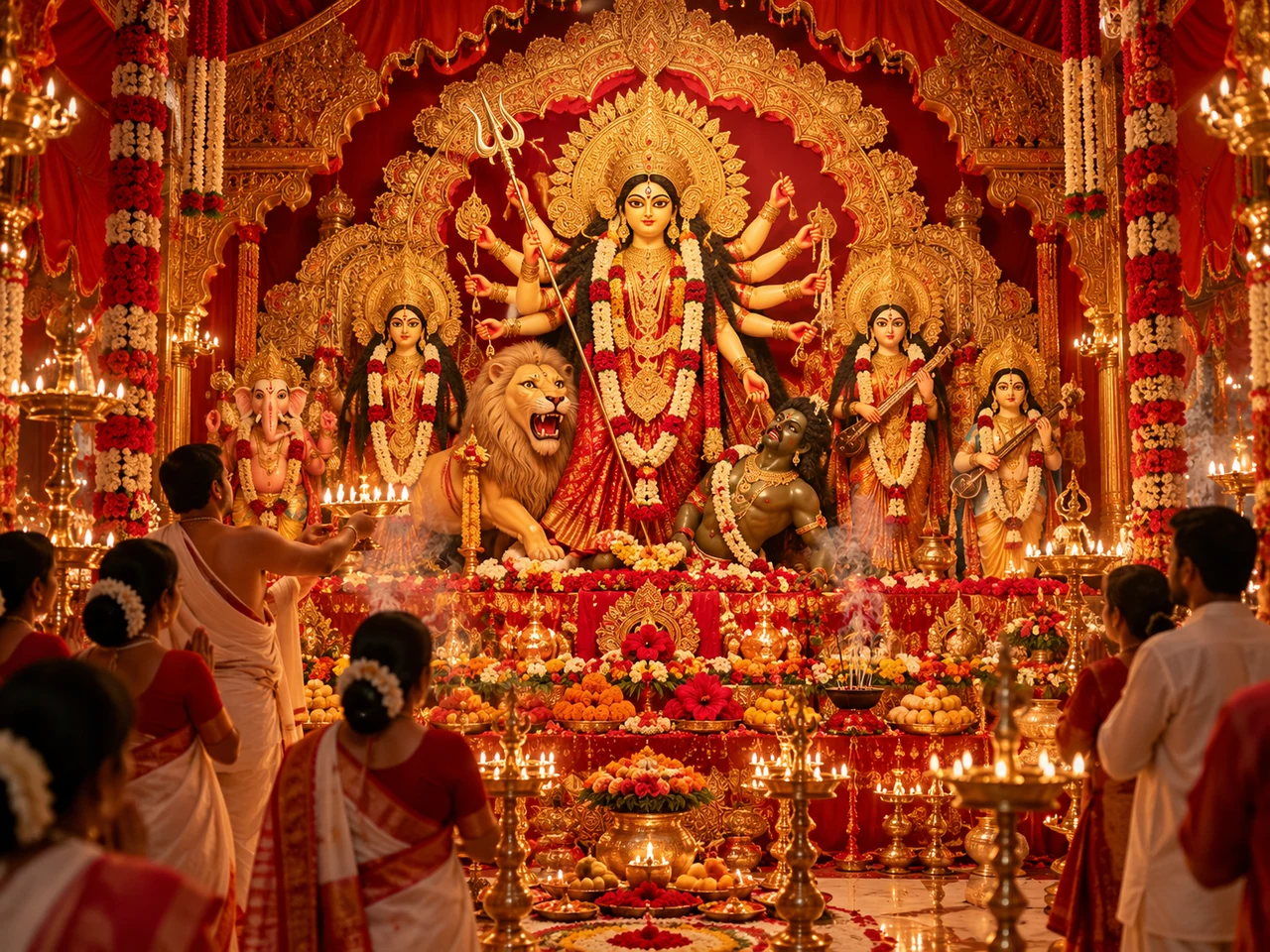
Why the eighth lunar day of Navratri matters, especially in North Indian homes—and why different communities celebrate it differently.
At a glance
Names: Durga Ashtami, Durgashtami, Maha Ashtami, Mahashtami, Ashtami Puja; in some North Indian homes simply Ashtami or Kanjak day. Associated divinity: Devi Durga, with Mahagauri especially associated with the eighth day in the familiar Navadurga sequence. Occasion: A major day of Chaitra and Sharad Navratri, traditionally associated with the bright-half (Shukla Paksha) eighth lunar day (Ashtami Tithi). Principal North Indian custom: Kanya Pujan/Kanjak, alongside household worship, offerings, and—in some families—the conclusion of a Navratri fast. Dates differ by year, place and observance convention; no city-specific date in this article is validated. 7 8 10
An Ashtami morning in a North Indian home
In a household in Delhi, Haryana, Punjab, western Uttar Pradesh or parts of Rajasthan, the festival may be remembered less for a large outdoor procession than for a small but deeply meaningful welcome at the door. The family has spent days worshipping the Goddess. On Ashtami morning, they prepare food, light a lamp and invite girls respectfully for Kanya Pujan, often called Kanjak locally. The girls are received as honoured guests and as living reminders of the Goddess's presence. The meal commonly includes black chickpeas, puri and halwa; small gifts may accompany it. A neighbouring family may perform exactly this welcome on Navami instead. Neither difference, by itself, proves that one household has abandoned the festival. 8
This family-centred scene is the main focus of this guide. Durga Ashtami is also an important day in Bengali Durga Puja, but its image worship, anjali, Kumari Puja, drumming and Sandhi Puja have their own ritual setting. Learning about both helps us avoid imagining that all Hindus observe one identical festival. 9 11
What does Durga Ashtami mean?
Ashtami literally indicates the eighth lunar Tithi: the Moon–Sun angular cycle is divided into thirty Tithis, fifteen in each paksha. Durga refers to the Goddess honoured as protectress, remover of peril and source of divine power. In the widely followed nine-form sequence, the eighth day's form is Mahagauri, associated in devotional explanations with purity, grace and luminous serenity; this is a symbolic and theological association, not an astronomical quality of the day. 10
Mahashtami often names the especially significant Ashtami of Sharad Navratri in Ashvina. Chaitra Navratri also has an important Ashtami in spring. Masik Durgashtami is a distinct, monthly recurring Shukla Ashtami devotion: not every such occurrence is the grand Navratri celebration. The terms overlap in popular speech, but a trustworthy calendar must store their actual scope and frequency separately. 13
Why is it celebrated? Three connected meanings
First, Durga Ashtami honours the Goddess as a power that protects the world when arrogance, oppression and disorder seem overwhelming. The Devi Mahatmyam (Durga Saptashati), a section of the Mārkaṇḍeya Purāṇa, narrates how divine energies together appear as the Goddess to confront Mahishasura. Later episodes show her defeating other destructive forces. These are sacred literary narratives, not independently dated historical battles. 1 2
Second, the day gives particular visibility to female divinity in ordinary life. In Kanya Pujan, the reverence offered to Durga is extended, symbolically, to girls who visit the home. The meaningful ethical challenge is not only to honour a child on a festival morning, but to treat girls and women with dignity, safety, educational opportunity and respect throughout the year. This ethical reflection is offered as an interpretation, not as a promise of a guaranteed ritual result. 8
Third, Ashtami marks a moment of concentration and, in many families, completion. A period of prayer, self-discipline or fasting may conclude with Kanjak, while other families observe through Navami and conclude later. The religious value of devotion is not reducible to one compulsory menu, number of guests or fast-breaking hour. 7 8
The Goddess and Mahishasura
In chapters 2–3 of the Devi Mahatmyam (Durga Saptashati), the gods are driven from their positions by Mahishasura. Their radiance converges in the form of a formidable Goddess. They present her with weapons; she advances, accompanied by a lion, and defeats the buffalo-shaped antagonist. The narrative celebrates protective strength combined with a power no single deity could exercise alone. It is closely associated with Durga's festival identity, but the epic battle is not assigned an independently verified civil date by this article. 1 2
Kaushiki and the Goddess's many forms
Chapter 5 depicts the Goddess emerging in a new form in connection with Parvati and introduces the conflict with Shumbha and Nishumbha. Readers encounter here a theological language in which the Divine Feminine can be one and many without every name becoming mechanically interchangeable across all sects. Durga, Parvati, Kali and Kaushiki are connected, yet narratives and schools describe their relationships differently. 3
Chanda–Munda, Chamunda and Raktabija
In chapter 7 a fierce form emerges from Ambika and defeats Chanda and Munda; the name Chamunda is explained in that context. Chapter 8 then relates the separate Raktabija battle, where the Goddess's strategy overcomes an enemy whose spilled blood reproduces his forms. Popular festival retellings sometimes compress these stories into a single Ashtami episode. The source chapters, however, should not be collapsed into a precise calendrical claim. 4 5
The Goddess praised as refuge
Chapter 11, the Narayani Stuti, offers a different tone: praise and gratitude toward the Goddess after conflict. It connects power with protection, wisdom and mercy. Families reading or listening to Durga Saptashati during Navratri therefore encounter not only battle scenes, but also prayer, reflection and the recognition of divine presence in the world.
Kanya Pujan or Kanjak
Across many North Indian households, people invite young girls for a respectful meal and offering, often during Ashtami or Navami. They are understood devotionally as symbols of the Goddess or her nine forms. Some families invite nine girls; others invite a different number or include a boy sometimes understood symbolically as Bhairava or Langur. These details are customs, not a single universal rule. The dignity and comfort of the visiting children must come before any display of ritual correctness. 8
Descriptions of customary practice include greeting the guests, offering a clean place to sit, sometimes washing their feet by mutual comfort and family custom, performing a simple aarti, and sharing food and gifts. This is an educational account of what communities do, not an obligatory step-by-step ritual prescription. Children and their guardians should be free to decline any action, and food should be prepared and offered safely. 8
Why some families choose Ashtami and others Navami
For one family the end of the seven or eight earlier days of fasting is marked by Kanya Pujan on Ashtami; another may continue worship and perform it on Navami. Some observe both days differently. The choice often follows household tradition (kul-parampara) and a locally followed Panchang. A website should not claim that one single North Indian Kanjak date fits every household, particularly when a Tithi spans or bypasses local sunrises. 8 7
The household shrine and Mahagauri
Families may decorate a small Durga image or picture, offer flowers, fruit, incense or a lamp, and sing bhajans or recite familiar devotional works. The eighth Navadurga form, Mahagauri, is commonly remembered on this day. The traditional name invites interpretations of clarity and compassion; an image's complexion or ornament is not evidence that a particular textual description applies in every locality. 7 10
Vrat, prayer and completion
Some devotees observe a nine-day dietary restriction, a selective fast, or a personal commitment of prayer. Others participate through worship and service without fasting. In particular, someone who is ill, pregnant, elderly, a child or otherwise medically vulnerable should not be presented with fasting as a religious obligation or medical recommendation. When worship concludes, families may share prasad and their usual food according to their health needs and custom. A date or hour for parana must come from an independently reviewed local rule, not an evergreen article. 7 8
Food and prasad: halwa, puri and kala chana
A familiar North Indian Kanjak thali contains suji ka halwa (a sweet semolina dish), puri (fried bread) and kale chane (black chickpeas). Fruit, sweets and small tokens of affection may also be offered. Families adapt to available ingredients, community preferences and food restrictions. These foods are expressions of generosity and hospitality—not an exclusive ingredient list that determines the festival's validity. 8 16
Food shared with visiting children should be hygienic, mindful of allergies and free of social pressure. Some households serve a wider neighbourhood meal or contribute to community kitchens. The underlying theme is hospitality that continues beyond one auspicious morning.
When does Durga Ashtami occur?
Durga Ashtami is commonly linked to Shukla Paksha Ashtami in the Chaitra and Ashvina/Ashwin Navratri cycles; the Sharad occurrence is particularly prominent. The Tithi is a lunar interval, not a midnight-to-midnight Gregorian day. The Hindu lunar month label, the civil day chosen for household observance and the special interval chosen for a regional ritual are separate questions. 7 9 13
North Indian Purnimanta and southern Amanta month naming do not necessarily label every lunar date identically, although Shukla Paksha month names often align in ordinary usage. A selected city, sunrise computation and named tradition profile are needed for publication-grade dates. Sunrise-day treatment, repeated or omitted sunrise Tithis, and Navami intersections can change which civil day a family or temple selects. No date, time or fasting break in this article has been reviewed for any particular year or city.
Calendar note: Once the ShivGoraksh Calendar engine has independently reviewed occurrence records, the page may display a local “Next Durga Ashtami” module with the chosen convention and a verification indicator. Until then the correct state is “Date/timing not yet verified for this city/year.”
Chaitra Ashtami and Sharad Maha Ashtami
Chaitra Navratri comes in the spring. In northern homes its Ashtami is often an intimate family observance, with the Kanjak meal, aarti, and concluding prayers. It sits near Rama Navami in the festival cycle, but their meanings and calendar records should not be merged. Depending on family practice, fasting may finish on Ashtami or continue through Navami. 7 8
Sharad Navratri comes in autumn. North Indian household Kanjak remains important, while temple worship and larger public celebrations often become more visible. This season also overlaps the great Bengali Durga Puja. Vijayadashami follows as another separately meaningful festival, not a synonym for Ashtami. 7 11
Delhi, Haryana, Punjab, western Uttar Pradesh and Rajasthan
Here the phrase Ashtami ki kanjak immediately evokes household invitations, offerings to the Goddess, meals for girls, and the sense of completing Navratri. Households may also visit neighbourhood Durga temples or sing devotional songs with relatives. These are broad patterns, not claims that every person or district participates identically. For Uttar Pradesh and Himalayan pilgrimage circuits, temple crowds and devotional gatherings can be part of the season, but their specific schedules require official confirmation. 7 8
Himachal Pradesh and other northern hill traditions
Durga's long-standing worship in the Himalayan region is visible in historic temple imagery as well as living devotion. A twelfth-century shrine image from the Chamba region, recorded by the Metropolitan Museum of Art, depicts Durga defeating Mahisha. Such objects provide evidence of regional goddess worship; they do not prove that present-day Ashtami rituals were performed identically at that time. 12
West Bengal, Assam and Bengali communities
In Kolkata and Bengali Durga Puja settings, Maha Ashtami involves formal image worship and congregational flower offerings (pushpanjali/anjali). In some lineages there is Kumari Puja. Sandhi Puja attends the junction of Ashtami and Navami, traditionally described in an approximately 48-minute window spanning the Tithi change; lamp offerings and other practices differ by institution. This is not a universal North Indian Kanjak timing rule. UNESCO documents Kolkata's Durga Puja as a collective artistic and religious heritage, including the seasonal production of images and public pandals. 9 11 14
Other regions and diaspora
The wider Navratri observance includes dance, temple programmes, community worship and different family calendars in Gujarat, southern India and diaspora communities. Some households perform Kumari Puja on Ashtami, some on Navami, and others do not practise it. Regional diversity should be recorded rather than ironed away into one national script. 7 8
Symbolism: the lamp, the child, the lion and the eighth form
The lamp often represents attentive devotion; the meal shared with girls can signify honour for the divine feminine; Durga's lion and weapons evoke protective courage; and Mahagauri's name is interpreted in devotional teaching through serenity and clarity. These are traditional and interpretive meanings, not scientifically established spiritual effects. The multiplicity of Durga's arms and weapons is attested in historic art with regional variation, including early eastern Indian and Himalayan sculpture. 1 12 15
One useful question follows from these images: What does protection mean away from the temple? For many readers, the answer can include speaking against mistreatment, protecting vulnerable people and taking education seriously. The festival offers a way to think about courage and kindness together.
Public worship, scriptures and practice boundaries
A visitor may encounter bhajans, aarti, Durga Saptashati recitation, household Kanjak or temple services. The Devi Mahatmyam (Durga Saptashati) is central to many Shakta devotional contexts, but the thirteen-chapter text is not itself a procedural Ashtami date manual. Its story of Chamunda should not be mistaken for proof of a precise Sandhi Puja clock time. 1 4 9
Public explanations of Kanjak or temple offerings are appropriate for a learning site. Priest-led consecrations, homa variants, lineage-specific tantric rites, initiation-bound mantras and sacrificial practices require separate competent review and cannot be reconstructed from a short online description. No such instructions are authorized here. The educational classifications are PUBLIC for ordinary descriptions, tradition-specific for household/temple custom, and initiation-dependent or UNKNOWN_REVIEW_REQUIRED for relevant esoteric procedures.
Related festivals and what not to confuse
Navratri (Navratri: Nine Nights of the Goddess) is the wider seasonal cycle; Durga Ashtami (Durga Ashtami: North Indian Kanya Pujan, Mahagauri and Navratri) is the distinctive eighth-Tithi observance within that cycle. Vijayadashami/Dussehra (Dussehra and Vijayadashami: Meaning, Traditions and Celebrations) follows with separate meanings. Masik Durgashtami is a recurring monthly observance, not automatically another occasion of the full Navratri festival. Rama Navami (Rama Navami (Ram Navami): Meaning, Birth Narrative and Traditions) belongs nearby in the Chaitra cycle, but celebrates Rama's birth tradition.
Common questions about Durga Ashtami
1. Is Durga Ashtami the same as Maha Ashtami? Frequently the names overlap, especially for Sharad Navratri, but the exact name and observance setting vary by region. 7 9
2. Is Kanya Pujan performed on Ashtami or Navami? Both practices exist in North Indian households. Family tradition and the reviewed local calendar convention matter; this article does not prescribe a universal day. 8
3. Must exactly nine girls be invited? Nine is a familiar symbolic number, but customs differ. Respect for the children matters more than treating a number as a guarantee of benefit. 8
4. Why is halwa-puri-chana offered? It is a widely recognized North Indian hospitality and prasad meal, not the only acceptable food across India. 8 16
5. Which form of Durga is associated with the eighth day? The common Navadurga sequence associates the eighth day with Mahagauri. 10
6. Is Ashtami always the last day of fasting? No. Some families conclude on Ashtami and others after Navami worship; health and household custom matter. 7 8
7. Is the Bengali Sandhi Puja the same as North Indian Kanjak? No. Sandhi Puja concerns the Ashtami–Navami junction in specific Durga Puja traditions; Kanjak honours visiting girls and is commonly observed by northern households. 8 9
8. Does Durga Ashtami occur only once a year? Major Chaitra and Sharad Navratri Ashtamis are prominent; monthly Masik Durgashtami also exists as a separate recurring category. 13
9. Does the Devi Mahatmyam (Durga Saptashati) state a universal modern Ashtami date? No. It supplies major Goddess narratives and praise; observance-date selection requires a separate reviewed rule. 1 4
10. Why may two Panchangs display different dates? Location, Tithi boundaries, sunrise conventions and differing regional ritual rules can matter. Without a documented comparison, neither date should be presented as ShivGoraksh-approved. 7 9
11. Are temple or tantric rites necessary for household participation? No universal requirement can be inferred. Public household devotion is distinct from specialised, sometimes restricted ritual systems.
12. How can the occasion be meaningful beyond worship? Many see it as a reminder to combine devotion to Shakti with concrete respect for girls and women, generosity and protection of others.