



About these reading aids

Easy Roman is a Devanagari-based Sanskrit reading aid. IAST preserves scholarly distinctions. Where no Roman text was supplied, IAST is derived automatically from the Devanagari; this is not a certified pronunciation guide. Vernacular songs retain their supplied word forms and spoken endings. Easy Roman simplifies unambiguous diacritics; their scholarly view retains the supplied Roman form rather than inventing Sanskrit pronunciation. Selected bija spellings are kept where unambiguous.

Aarti

Om Jai Shiv Omkara — Shiva Aarti

Complete eight-stanza Shiva Aarti in Roman Hindi, followed by English meanings and source-aware commentary.

Reading settings

Settings are saved in this page’s URL and carried to adjacent chapters. Bookmark the URL to keep them. Devanagari keeps its dedicated reading font.

Reset settings

Text, Meaning & Explanation

1

ॐ जय शिव ओंकारा, स्वामी जय शिव ओंकारा। ब्रह्मा विष्णु सदाशिव, अर्द्धांगी धारा ॥ ॐ जय शिव ओंकारा॥

Roman Hindi

Om Jai Shiv Omkara, Swami Jai Shiv Omkara. Brahma Vishnu Sadashiv, Ardhaangi Dhaara. Om Jai Shiv Omkara.Om Jai Shiv Omkara, Swami Jai Shiv Omkara. Brahma Vishnu Sadashiv, Ardhaangi Dhaara. Om Jai Shiv Omkara.

Meaning

The singer praises Shiva through Omkara and introduces Brahma, Vishnu and Sadashiva with the divine feminine. The threefold image prepares the theme of unity.

Explanation

“Ardhaangi” evokes the shared presence of Parvati with Shiva, but is poetic devotional language; it does not by itself establish a specific philosophical system.

2

एकानन चतुरानन पंचानन राजे। शिव पंचानन राजे। हंसासन गरुड़ासन वृषवाहन साजे ॥ ॐ जय शिव ओंकारा.॥

Roman Hindi

Ekanan Chaturanan Panchanan Raaje. Shiv Panchanan Raaje. Hansasan Garudasan Vrishvahan Saaje. Om Jai Shiv Omkara.Ekanan Chaturanan Panchanan Raaje. Shiv Panchanan Raaje. Hansasan Garudasan Vrishvahan Saaje. Om Jai Shiv Omkara.

Meaning

One, four and five faces, together with the swan, Garuda and bull, evoke familiar iconographic forms associated with the three deities.

Explanation

The aarti arranges emblems poetically, not as an exhaustive or universally fixed list of divine images.

3

दो भुज चार चतुर्भुज दस भुज अति सोहे। स्वामी दस भुज अति सोहे। तीनों रूप निरखते। त्रिभुवन मन मोहे ॥ ॐ जय शिव ओंकारा॥

Roman Hindi

Do Bhuj Chaar Chaturbhuj Das Bhuj Ati Sohe. Swami Das Bhuj Ati Sohe. Teeno Roop Nirakhte. Tribhuvan Man Mohe. Om Jai Shiv Omkara.Do Bhuj Chaar Chaturbhuj Das Bhuj Ati Sohe. Swami Das Bhuj Ati Sohe. Teeno Roop Nirakhte. Tribhuvan Man Mohe. Om Jai Shiv Omkara.

Meaning

Different numbers of arms suggest distinct divine representations; seeing the three forms delights beings across the three worlds.

Explanation

Numbers here serve visual devotional poetry, not an argument that all historical sculptures have these exact arms.

4

अक्षमाला बनमाला मुण्डमाला धारी। शिव मुण्डमाला धारी। चंदन मृगमद चंदा, सोहे त्रिपुरारी॥ ॐ जय शिव ओंकारा॥

Roman Hindi

Akshamala Banmala Mundmala Dhaari. Shiv Mundmala Dhaari. Chandan Mrigmad Chanda, Sohe Tripuraari. Om Jai Shiv Omkara.Akshamala Banmala Mundmala Dhaari. Shiv Mundmala Dhaari. Chandan Mrigmad Chanda, Sohe Tripuraari. Om Jai Shiv Omkara.

Meaning

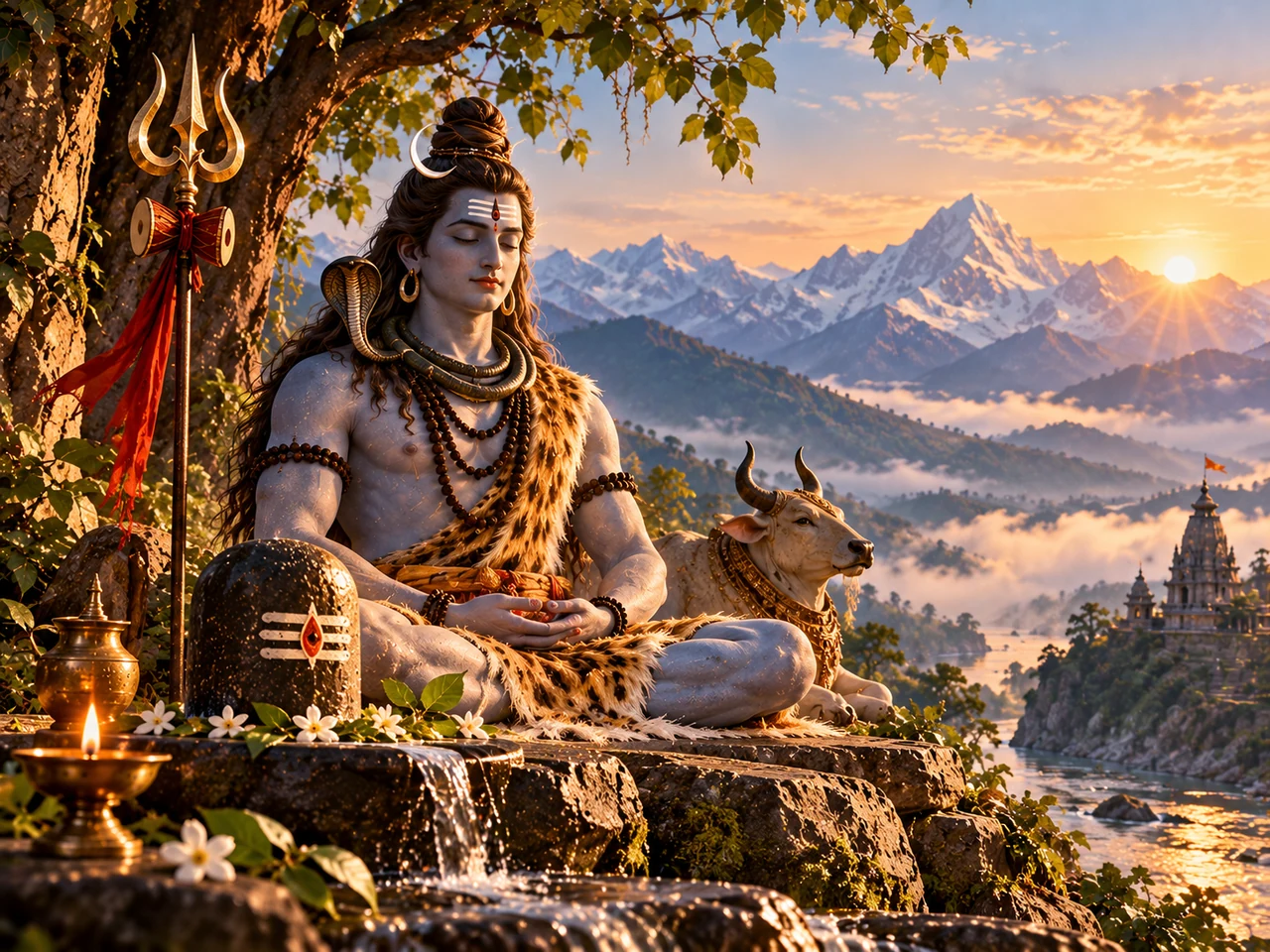
Prayer beads, forest flowers, a skull garland, fragrant marks and the moon create a rich image of divine ornament; Tripurari names Shiva as conqueror of the three cities.

Explanation

This witness reads “chandan mrigmad chanda”; another witness may preserve a different line, which must be recorded as a variant.

5

श्वेताम्बर पीताम्बर बाघम्बर अंगे। शिव बाघम्बर अंगे। ब्रह्मादिक सनकादिक भूतादिक संगे ॥ ॐ जय शिव ओंकारा॥

Roman Hindi

Shvetambar Peetambar Baghambar Ange. Shiv Baghambar Ange. Brahmadik Sanakadik Bhootadik Sange. Om Jai Shiv Omkara.Shvetambar Peetambar Baghambar Ange. Shiv Baghambar Ange. Brahmadik Sanakadik Bhootadik Sange. Om Jai Shiv Omkara.

Meaning

White, yellow and tiger-skin clothing evoke varied divine attire; beings and attendants are pictured in the divine gathering.

Explanation

Tiger-skin symbolism belongs to Shiva’s iconography; the poem’s imagery need not be enacted literally in worship.

6

कर के मध्य कमंडलु चक्र त्रिशूल धर्ता। शिव कर में त्रिशूल धर्ता। जगकर्ता जगहर्ता जगपालनकर्ता॥ ॐ जय शिव ओंकारा॥

Roman Hindi

Kar Ke Madhya Kamandalu Chakra Trishul Dharta. Shiv Kar Mein Trishul Dharta. Jagkarta Jagaharta Jagpalan Karta. Om Jai Shiv Omkara.Kar Ke Madhya Kamandalu Chakra Trishul Dharta. Shiv Kar Mein Trishul Dharta. Jagkarta Jagaharta Jagpalan Karta. Om Jai Shiv Omkara.

Meaning

The water vessel, discus and trident allude to divine attributes; the hymn names cosmic creating, ending and preserving.

Explanation

The exact printed reading is “jagkarta jagaharta jagpalan karta”; other recensions use a different order or terms.

7

ब्रह्मा विष्णु सदाशिव जानत अविवेका। स्वामी जानत अविवेका। प्रणवाक्षर के मध्ये ये तीनों एका ॥ ॐ जय शिव ओंकारा॥

Roman Hindi

Brahma Vishnu Sadashiv Jaanat Aviveka. Swami Jaanat Aviveka. Pranavakshar Ke Madhye Ye Teeno Eka. Om Jai Shiv Omkara.Brahma Vishnu Sadashiv Jaanat Aviveka. Swami Jaanat Aviveka. Pranavakshar Ke Madhye Ye Teeno Eka. Om Jai Shiv Omkara.

Meaning

The hymn declares that Brahma, Vishnu and Sadashiva share an underlying unity in the pranava, Om, while those who see only division have missed that perspective.

Explanation

This is the aarti’s devotional claim; other Hindu schools explain divine identity and difference differently.

त्रिगुण शिवजी की आरती जो कोई नर गावे। स्वामी प्रेम सहित गावे। कहत शिवानन्द स्वामी मनवांछित फल पावे ॥ ॐ जय शिव ओंकारा॥

Roman Hindi

Trigun Shivji Ki Aarti Jo Koi Nar Gaave. Swami Prem Sahit Gaave. Kahat Shivanand Swami Manvanchhit Phal Paave. Om Jai Shiv Omkara.Trigun Shivji Ki Aarti Jo Koi Nar Gaave. Swami Prem Sahit Gaave. Kahat Shivanand Swami Manvanchhit Phal Paave. Om Jai Shiv Omkara.

Meaning

The closing stanza honours loving singing of the aarti and voices the hope of receiving a cherished blessing; it mentions Shivanand Swami.

Explanation

The poet-name is an internal signature, not independently proven historical authorship. Devotional fruit-language is not a guaranteed outcome.

Context & Usage

What is Om Jai Shiv Omkara? This is a Hindi-language aarti used to honour Shiva. Aarti names both a song of praise and, in many contexts, an offering of light. Repetition and short clusters of visual images make the hymn memorable. The title salutes Shiva as Omkara, a name invoking the sacred syllable Om. The poem brings Brahma, Vishnu and Shiva together with images of faces, vehicles, garments and attributes, eventually placing the three within a single contemplative frame through pranava. 6

Language note: The Aarti is sung in Hindi devotional language, with Sanskrit-derived names and expressions. Reading the Hindi words in Roman letters is transliteration, not a replacement by English lyrical words. English meanings come below the original text, not inside it.

Why the number of stanzas differs

The eight displayed stanzas follow the structure of the licensed Wikipedia revision, with the two declared reader-preferred substitutions. An independently inspected university book published in 2024 prints nine numbered stanzas, including a Kashi–Vishvanath and Nandi passage; it also has additional unnumbered sung material. That text was the witness discussed in the earlier draft. Its additional stanza is not inserted into this rendition, because doing so would merge distinct textual witnesses. Nor is the separate Karpura Gauram prayer counted as the first stanza. 1 6

The base Wikipedia witness reads Om Har Har Har Mahadev, whereas this explicitly labelled preferred rendition sings Om Jai Shiv Omkara at each close and changes Prabhu to Swami. Those alternative singing forms are independently documented 7 8. Other words and ordering vary too, especially in stanzas four and six. We preserve the original witness readings separately in the edition notes; the displayed performance text is editorially adapted and pending its own collation, not a source-verbatim edition. Eight is the count for this constructed reader rendition, not a claim all temples sing eight.

Shiva, Shakti and the three divine figures

The first stanza uses ardhaangi, an epithet evoking the divine feminine's close relation to Shiva. It may remind readers of Ardhanarishvara, Shiva and Parvati joined in one image; however, one poetic word does not prove that the hymn promotes one narrowly defined metaphysics or derives from any particular statue. The Metropolitan Museum provides a separate historical iconographic reference to the composite image. 4

The following sequences use familiar signs of Brahma, Vishnu and Shiva: the swan, Garuda and bull; a water pot, discus and trident; and different forms of attire. Such combinations are devotional poetry, not precise rules about the number of arms on every historical sculpture. The claim that the three are one within pranava is the voice of this aarti; diverse Hindu theological systems interpret identity and distinction in different ways. 5 6

Who wrote this Aarti? Its concluding stanza says Kahat Shivanand Swami. That is an internal poetic signature and the basis of an often repeated traditional attribution. It does not independently establish a dated writer, manuscript or moment of composition. The Hindi Wikipedia introductory paragraph attributes the Aarti to Shraddha Ram Phillauri, but the evidence cited there does not securely establish that attribution for this specific Shiva hymn; it may be confused with the different hymn Om Jai Jagdish Hare. For ShivGoraksh, the author remains historically unverified. 6

When and how is it sung? It is associated with Shiva devotion in homes and temples, including contexts around Mondays, Shravan and Mahashivratri. This is descriptive cultural context, not a universally binding timetable. Music, lyric variants and the offering of light vary among families and temples. This entry does not prescribe fire use, recitation quotas, ritual prerequisites or assured supernatural outcomes. References to receiving manvanchhit phal are devotional hopes, not verified guarantees. No public Calendar date is asserted.

Terms to know

  • Omkara: a devotional name connected with sacred Om.
  • Pranavakshar: the syllable Om, understood here as encompassing divine unity.
  • Ardhaangi: the intimate counterpart or half, associated here with Parvati.
  • Tripurari: a name of Shiva connected with the conquest of the three cities.
  • Vahana: a deity's symbolic mount, such as Nandi the bull.
  • Phalashruti: a concluding statement about the believed benefit of recitation.

FAQs

Are the words above in English? No. They are the original Hindi devotional words written in Roman letters (Roman Hindi), followed by an English explanation. The Hindi page displays Devanagari.

Is this the complete Aarti? It is a complete eight-stanza reading arrangement, with the two explicitly declared substitutions from a separately preserved eight-stanza base witness. Other historical or sung versions may have more or fewer stanzas; the nine-stanza witness is documented separately. 1 6

Why is the refrain Om Jai Shiv Omkara? You requested this common sung refrain and Swami in place of Prabhu. Both forms are supported by other attested singing/transcription sources 7 8. The original 6 base witness has a different refrain; it is preserved unchanged for comparison in the edition notes. This rendition is editorially adapted, not a verbatim quote from 6.

Is it originally Sanskrit? No. It is a Hindi devotional Aarti with Sanskrit-derived terminology.

Does it say Brahma, Vishnu and Shiva are one? The seventh stanza places them together within pranavakshar (Om). This is the hymn's expression of unity, not proof that all Hindu schools have identical teachings. 6

Does it include a Kashi stanza? Not in this eight-stanza witness. A separate nine-stanza printed witness includes a passage on Vishvanath in Kashi and Nandi. 1

Is Shivanand Swami definitively the author? No. His name appears in the closing stanza; historical authorship remains unproven. 6

Sources, Credits & Licensing

Founder-authorized educational edition. Independent textual and specialist review remains incomplete; this reading does not confer initiation or ritual authorization.

Hindi Wikipedia contributors; individual historic poet not established. Based on शिव की आरती. Original words, new Roman rendering and derivative meanings: CC BY-SA 4.0. Script conversion, punctuation, Romanization and any declared editorial lyric changes are adaptations; no independent textual certification.

Text licence

Original Roman reading

The Roman reading recorded with this edition, retaining its spelling and word forms before the Easy Roman display conversion.

  1. 1

    Om Jai Shiv Omkara, Swami Jai Shiv Omkara. Brahma Vishnu Sadashiv, Ardhaangi Dhaara. Om Jai Shiv Omkara.

  2. 2

    Ekanan Chaturanan Panchanan Raaje. Shiv Panchanan Raaje. Hansasan Garudasan Vrishvahan Saaje. Om Jai Shiv Omkara.

  3. 3

    Do Bhuj Chaar Chaturbhuj Das Bhuj Ati Sohe. Swami Das Bhuj Ati Sohe. Teeno Roop Nirakhte. Tribhuvan Man Mohe. Om Jai Shiv Omkara.

  4. 4

    Akshamala Banmala Mundmala Dhaari. Shiv Mundmala Dhaari. Chandan Mrigmad Chanda, Sohe Tripuraari. Om Jai Shiv Omkara.

  5. 5

    Shvetambar Peetambar Baghambar Ange. Shiv Baghambar Ange. Brahmadik Sanakadik Bhootadik Sange. Om Jai Shiv Omkara.

  6. 6

    Kar Ke Madhya Kamandalu Chakra Trishul Dharta. Shiv Kar Mein Trishul Dharta. Jagkarta Jagaharta Jagpalan Karta. Om Jai Shiv Omkara.

  7. 7

    Brahma Vishnu Sadashiv Jaanat Aviveka. Swami Jaanat Aviveka. Pranavakshar Ke Madhye Ye Teeno Eka. Om Jai Shiv Omkara.

  8. 8

    Trigun Shivji Ki Aarti Jo Koi Nar Gaave. Swami Prem Sahit Gaave. Kahat Shivanand Swami Manvanchhit Phal Paave. Om Jai Shiv Omkara.

Sources, licence and editorial status

Text witness: 6 Hindi Wikipedia contributors, “शिव की आरती”, permanent revision: https://hi.wikipedia.org/w/index.php?title=%E0%A4%B6%E0%A4%BF%E0%A4%B5_%E0%A4%95%E0%A5%80_%E0%A4%86%E0%A4%B0%E0%A4%A4%E0%A5%80&oldid=6550774. Licence: Creative Commons Attribution–ShareAlike, https://creativecommons.org/licenses/by-sa/4.0/. Changes made: explicit substitution of Swami for Prabhu and Om Jai Shiv Omkara for the base refrain throughout the displayed reading, plus new Roman Hindi transliteration, verse division and original English/Hindi meanings/commentary. The base source remains unchanged in structured provenance; this is an adaptation, subject to CC BY-SA change indication and review. Reuse of the licensed text requires the licence's attribution/share-alike conditions. 1 is the separate nine-stanza comparison, not the base for these reproduced verses. Additional iconographic context 4 and broader triadic context 5.

Additional passage commentary

Stanza 1 — Meaning and explanation

Meaning: The singer praises Shiva through Omkara and introduces Brahma, Vishnu and Sadashiva with the divine feminine. The threefold image prepares the theme of unity. Explanation: “Ardhaangi” evokes the shared presence of Parvati with Shiva, but is poetic devotional language; it does not by itself establish a specific philosophical system.

Stanza 2 — Meaning and explanation

Meaning: One, four and five faces, together with the swan, Garuda and bull, evoke familiar iconographic forms associated with the three deities. Explanation: The aarti arranges emblems poetically, not as an exhaustive or universally fixed list of divine images.

Stanza 3 — Meaning and explanation

Meaning: Different numbers of arms suggest distinct divine representations; seeing the three forms delights beings across the three worlds. Explanation: Numbers here serve visual devotional poetry, not an argument that all historical sculptures have these exact arms.

Stanza 4 — Meaning and explanation

Meaning: Prayer beads, forest flowers, a skull garland, fragrant marks and the moon create a rich image of divine ornament; Tripurari names Shiva as conqueror of the three cities. Explanation: This witness reads “chandan mrigmad chanda”; another witness may preserve a different line, which must be recorded as a variant.

Stanza 5 — Meaning and explanation

Meaning: White, yellow and tiger-skin clothing evoke varied divine attire; beings and attendants are pictured in the divine gathering. Explanation: Tiger-skin symbolism belongs to Shiva’s iconography; the poem’s imagery need not be enacted literally in worship.

Stanza 6 — Meaning and explanation

Meaning: The water vessel, discus and trident allude to divine attributes; the hymn names cosmic creating, ending and preserving. Explanation: The exact printed reading is “jagkarta jagaharta jagpalan karta”; other recensions use a different order or terms.

Stanza 7 — Meaning and explanation

Meaning: The hymn declares that Brahma, Vishnu and Sadashiva share an underlying unity in the pranava, Om, while those who see only division have missed that perspective. Explanation: This is the aarti’s devotional claim; other Hindu schools explain divine identity and difference differently.

Stanza 8 — Meaning and explanation

Meaning: The closing stanza honours loving singing of the aarti and voices the hope of receiving a cherished blessing; it mentions Shivanand Swami. Explanation: The poet-name is an internal signature, not independently proven historical authorship. Devotional fruit-language is not a guaranteed outcome.

  1. नित्यकर्म, देवपूजन एवं कर्मकाण्ड का वैज्ञानिक स्वरूप (BAKA(N)-102) · Open source
  2. Om Jai Shiv Omkara Aarti Lyrics in Hindi & English | Meaning · Open source
  3. GP0153 Aarti Sangrah · Open source
  4. Ardhanarishvara (Composite of Shiva and Parvati) · Open source
  5. Mumbai + London: New Perspectives on the Ancient World — Large Print Guide · Open source
  6. शिव की आरती · Open source
  7. Om Jai Shiv Omkara — Shiva Aarti / published singing rendition · Open source
  8. श्री शिव आरती - ॐ जय शिव ओंकारा · Open source