Text, Meaning & Explanation
जय काली जगदम्ब जय, हरनि ओघ अघ पुंज।
वास करहु निज दास के, निशदिन हृदय निकुंज॥
Roman Hindijaya kaalee jagadamba jaya, harani ogha agha pumja|
vaasa karahu nija daasa ke, nishadina hridaya nikumja||jaya kālī jagadamba jaya, harani ogha agha puṃja|
vāsa karahu nija dāsa ke, niśadina hṛdaya nikuṃja||
Meaning
Victory to Kali, Mother of the world; dispel wrongdoing and dwell in the devotee's heart.
Explanation
The hymn gathers divine names in praise of Kali. These poetic identifications do not make the associated traditions or ritual practices interchangeable.
जयति कपाली कालिका, कंकाली सुख दानि।
कृपा करहु वरदायिनी, निज सेवक अनुमानि॥
Roman Hindijayati kapaalee kaalikaa, kamkaalee sukha daani|
kripaa karahu varadaayinee, nija sevaka anumaani||jayati kapālī kālikā, kaṃkālī sukha dāni|
kṛpā karahu varadāyinī, nija sevaka anumāni||
Meaning
Praise to skull-bearing Kalika, giver of joy; regard this servant with kindness.
Explanation
The hymn gathers divine names in praise of Kali. These poetic identifications do not make the associated traditions or ritual practices interchangeable.
जय जय जय काली कंकाली।
जय कपालिनी, जयति कराली॥
Roman Hindijaya jaya jaya kaalee kamkaalee|
jaya kapaalinee, jayati karaalee||jaya jaya jaya kālī kaṃkālī|
jaya kapālinī, jayati karālī||
Meaning
Praise to Kali in her fierce skull-adorned forms.
Explanation
The hymn gathers divine names in praise of Kali. These poetic identifications do not make the associated traditions or ritual practices interchangeable.
शंकर प्रिया, अपर्णा, अम्बा।
जय कपर्दिनी, जय जगदम्बा॥
Roman Hindishamkara priyaa, aparnaa, ambaa|
jaya kapardinee, jaya jagadambaa||śaṃkara priyā, aparṇā, ambā|
jaya kapardinī, jaya jagadambā||
Meaning
You are beloved of Shankara, Aparna, Mother and Jagadamba.
Explanation
The hymn gathers divine names in praise of Kali. These poetic identifications do not make the associated traditions or ritual practices interchangeable.
आर्या, हला, अम्बिका, माया।
कात्यायनी उमा जगजाया॥
Roman Hindiaaryaa, halaa, ambikaa, maayaa|
kaatyaayanee umaa jagajaayaa||āryā, halā, ambikā, māyā|
kātyāyanī umā jagajāyā||
Meaning
The hymn praises you as Arya, Hala, Ambika, Maya, Katyayani and Uma.
Explanation
The hymn gathers divine names in praise of Kali. These poetic identifications do not make the associated traditions or ritual practices interchangeable.
गिरिजा गौरी दुर्गा चण्डी।
दाक्षाणायिनी शाम्भवी प्रचंडी॥
Roman Hindigirijaa gauree durga chandee|
daakshaanaayinee shaambhavee prachamdee||girijā gaurī durgā caṇḍī|
dākṣāṇāyinī śāmbhavī pracaṃḍī||
Meaning
You are Girija, Gauri, Durga, Chandi, Dakshayani and Shambhavi.
Explanation
The hymn gathers divine names in praise of Kali. These poetic identifications do not make the associated traditions or ritual practices interchangeable.
पार्वती मंगला भवानी।
विश्वकारिणी सती मृडानी॥
Roman Hindipaarvatee mamgalaa bhavaanee|
vishvakaarinee satee mridaanee||pārvatī maṃgalā bhavānī|
viśvakāriṇī satī mṛḍānī||
Meaning
You are Parvati, Mangala, Bhavani, Sati and Mridani, sustaining the world.
Explanation
The hymn gathers divine names in praise of Kali. These poetic identifications do not make the associated traditions or ritual practices interchangeable.
सर्वमंगला शैल नन्दिनी।
हेमवती तुम जगत वन्दिनी॥
Roman Hindisarvamamgalaa shaila nandinee|
hemavatee tuma jagata vandinee||sarvamaṃgalā śaila nandinī|
hemavatī tuma jagata vandinī||
Meaning
You are auspicious Shailanandini and Haimavati, revered throughout the world.
Explanation
The hymn gathers divine names in praise of Kali. These poetic identifications do not make the associated traditions or ritual practices interchangeable.
ब्रह्मचारिणी कालरात्रि जय।
महारात्रि जय मोहरात्रि जय॥
Roman Hindibrahmachaarinee kaalaraatri jaya|
mahaaraatri jaya moharaatri jaya||brahmacāriṇī kālarātri jaya|
mahārātri jaya moharātri jaya||
Meaning
Praise to Brahmacharini, Kalaratri, Maharatri and Moharatri.
Explanation
The hymn gathers divine names in praise of Kali. These poetic identifications do not make the associated traditions or ritual practices interchangeable.
तुम त्रिमूर्ति रोहिणी कालिका।
कूष्माण्डा कार्तिका चण्डिका॥
Roman Hindituma trimoorti rohinee kaalikaa|
kooshmaandaa kaartikaa chandikaa||tuma trimūrti rohiṇī kālikā|
kūṣmāṇḍā kārtikā caṇḍikā||
Meaning
The hymn calls you Trimurti, Rohini, Kalika, Kushmanda, Kartika and Chandika.
Explanation
The hymn gathers divine names in praise of Kali. These poetic identifications do not make the associated traditions or ritual practices interchangeable.
तारा भुवनेश्वरी अनन्या।
तुम्हीं छिन्नमस्ता शुचिधन्या॥
Roman Hinditaaraa bhuvaneshvaree ananyaa|
tumheem chhinnamastaa shuchidhanyaa||tārā bhuvaneśvarī ananyā|
tumhīṃ chinnamastā śucidhanyā||
Meaning
You are incomparable Tara and Bhuvaneshwari, and the radiant Chhinnamasta.
Explanation
The hymn gathers divine names in praise of Kali. These poetic identifications do not make the associated traditions or ritual practices interchangeable.
धूमावती षोडशी माता।
बगला मातंगी विख्याता॥
Roman Hindidhoomaavatee shodashee maataa|
bagalaa maatamgee vikhyaataa||dhūmāvatī ṣoḍaśī mātā|
bagalā mātaṃgī vikhyātā||
Meaning
You are Mother Dhumavati, Shodashi, Bagala and renowned Matangi.
Explanation
The hymn gathers divine names in praise of Kali. These poetic identifications do not make the associated traditions or ritual practices interchangeable.
तुम भैरवी मातु तुम कमला।
रक्तदन्तिका कीरति अमला॥
Roman Hindituma bhairavee maatu tuma kamalaa|
raktadantikaa keerati amalaa||tuma bhairavī mātu tuma kamalā|
raktadantikā kīrati amalā||
Meaning
You are Bhairavi and Kamala, and the renowned Raktadantika.
Explanation
The hymn gathers divine names in praise of Kali. These poetic identifications do not make the associated traditions or ritual practices interchangeable.
शाकम्भरी कौशिकी भीमा।
महातमा अग जग की सीमा॥
Roman Hindishaakambharee kaushikee bheemaa|
mahaatamaa aga jaga kee seemaa||śākambharī kauśikī bhīmā|
mahātamā aga jaga kī sīmā||
Meaning
You are Shakambhari, Kaushiki and Bhima, beyond the limits of the moving and unmoving world.
Explanation
The hymn gathers divine names in praise of Kali. These poetic identifications do not make the associated traditions or ritual practices interchangeable.
चन्द्रघण्टिका तुम सावित्री।
ब्रह्मवादिनी मां गायत्री॥
Roman Hindichandraghantikaa tuma saavitree|
brahmavaadinee maam gaayatree||candraghaṇṭikā tuma sāvitrī|
brahmavādinī māṃ gāyatrī||
Meaning
You are Chandraghantika, Savitri, Brahmavadini and Mother Gayatri.
Explanation
The hymn gathers divine names in praise of Kali. These poetic identifications do not make the associated traditions or ritual practices interchangeable.
रूद्राणी तुम कृष्ण पिंगला।
अग्निज्वाला तुम सर्वमंगला॥
Roman Hindiroodraanee tuma krishna pimgalaa|
agnijvaalaa tuma sarvamamgalaa||rūdrāṇī tuma kṛṣṇa piṃgalā|
agnijvālā tuma sarvamaṃgalā||
Meaning
You are Rudrani, dark and tawny in form, fiery and wholly auspicious.
Explanation
The hymn gathers divine names in praise of Kali. These poetic identifications do not make the associated traditions or ritual practices interchangeable.
मेघस्वना तपस्विनि योगिनी।
सहस्राक्षि तुम अगजग भोगिनी॥
Roman Hindimeghasvanaa tapasvini yoginee|
sahasraakshi tuma agajaga bhoginee||meghasvanā tapasvini yoginī|
sahasrākṣi tuma agajaga bhoginī||
Meaning
You are thunder-voiced, ascetic, yogini and thousand-eyed, present throughout the world.
Explanation
The hymn gathers divine names in praise of Kali. These poetic identifications do not make the associated traditions or ritual practices interchangeable.
जलोदरी सरस्वती डाकिनी।
त्रिदशेश्वरी अजेय लाकिनी॥
Roman Hindijalodaree saraswati daakinee|
tridasheshvaree ajeya laakinee||jalodarī sarasvatī ḍākinī|
tridaśeśvarī ajeya lākinī||
Meaning
The hymn invokes Jalodari, Saraswati, Dakini, Tridasheshwari and unconquered Lakini.
Explanation
The hymn gathers divine names in praise of Kali. These poetic identifications do not make the associated traditions or ritual practices interchangeable.
पुष्टि तुष्टि धृति स्मृति शिव दूती।
कामाक्षी लज्जा आहूती॥
Roman Hindipushti tushti dhriti smriti shiva dootee|
kaamaakshee lajjaa aahootee||puṣṭi tuṣṭi dhṛti smṛti śiva dūtī|
kāmākṣī lajjā āhūtī||
Meaning
You are nourishment, contentment, resolve, memory, Shivaduti, Kamakshi, modesty and offering.
Explanation
The hymn gathers divine names in praise of Kali. These poetic identifications do not make the associated traditions or ritual practices interchangeable.
महोदरी कामाक्षि हारिणी।
विनायकी श्रुति महा शाकिनी॥
Roman Hindimahodaree kaamaakshi haarinee|
vinaayakee shruti mahaa shaakinee||mahodarī kāmākṣi hāriṇī|
vināyakī śruti mahā śākinī||
Meaning
The hymn addresses Mahodari, Kamakshi, Vinayaki and Mahashakini among your names.
Explanation
The hymn gathers divine names in praise of Kali. These poetic identifications do not make the associated traditions or ritual practices interchangeable.
अजा कर्ममोही ब्रह्माणी।
धात्री वाराही शर्वाणी॥
Roman Hindiajaa karmamohee brahmaanee|
dhaatree vaaraahee sharvaanee||ajā karmamohī brahmāṇī|
dhātrī vārāhī śarvāṇī||
Meaning
You are unborn, Brahmani, the sustaining mother, Varahi and Sharvani.
Explanation
The hymn gathers divine names in praise of Kali. These poetic identifications do not make the associated traditions or ritual practices interchangeable.
स्कन्द मातु तुम सिंह वाहिनी।
मातु सुभद्रा रहहु दाहिनी॥
Roman Hindiskanda maatu tuma simha vaahinee|
maatu subhadraa rahahu daahinee||skanda mātu tuma siṃha vāhinī|
mātu subhadrā rahahu dāhinī||
Meaning
You are Skandamata and the lion-riding mother; remain gracious as Subhadra.
Explanation
The hymn gathers divine names in praise of Kali. These poetic identifications do not make the associated traditions or ritual practices interchangeable.
नाम रूप गुण अमित तुम्हारे।
शेष शारदा बरणत हारे॥
Roman Hindinaama roopa guna amita tumhaare|
shesha shaaradaa baranata haare||nāma rūpa guṇa amita tumhāre|
śeṣa śāradā baraṇata hāre||
Meaning
Your names, forms and qualities are boundless; even Shesha and Sharada cannot describe them fully.
Explanation
The hymn gathers divine names in praise of Kali. These poetic identifications do not make the associated traditions or ritual practices interchangeable.
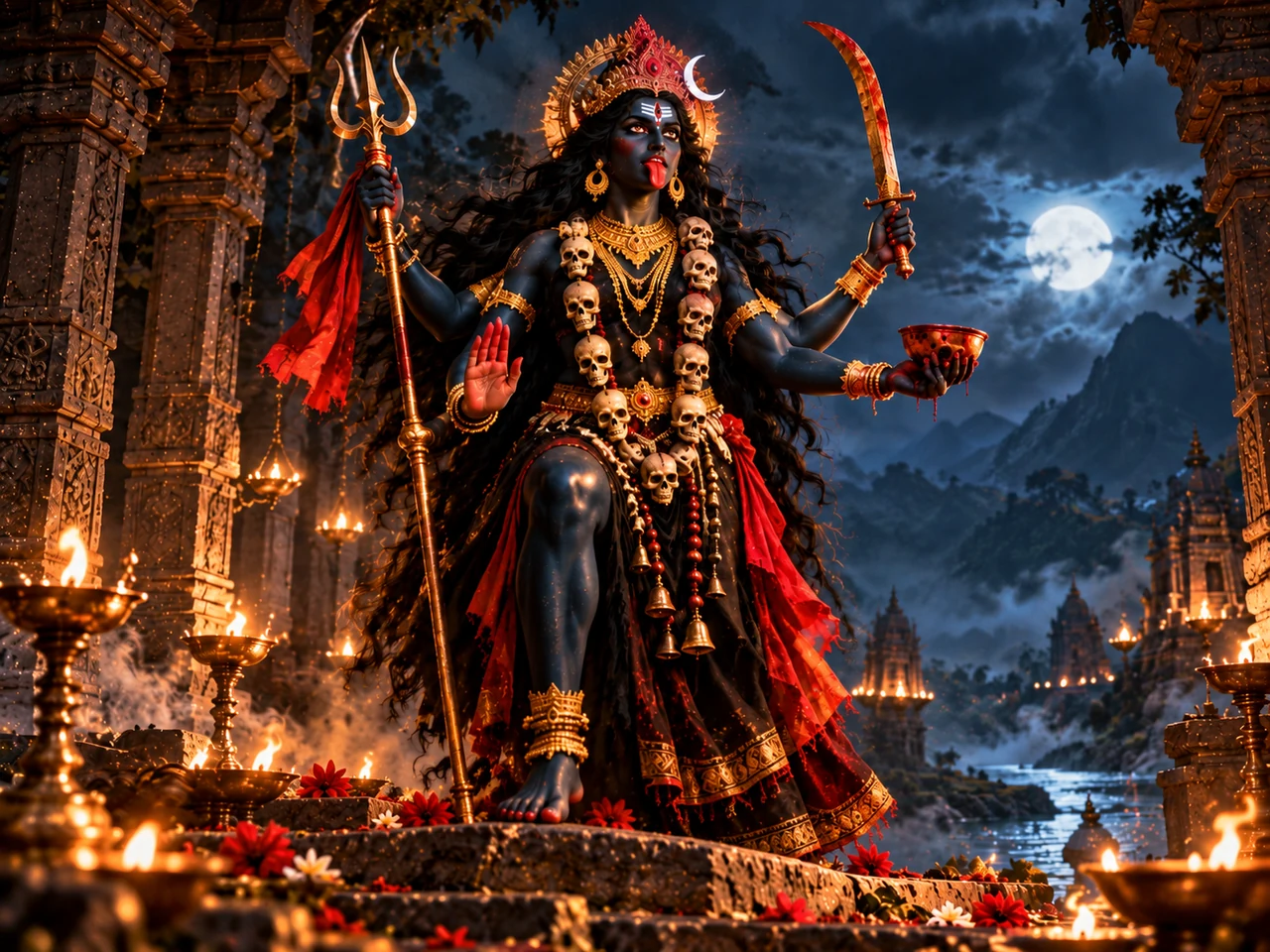
तनु छवि श्यामवर्ण तव माता।
नाम कालिका जग विख्याता॥
Roman Hinditanu chhavi shyaamavarna tava maataa|
naama kaalikaa jaga vikhyaataa||tanu chavi śyāmavarṇa tava mātā|
nāma kālikā jaga vikhyātā||
Meaning
Your form is dark-hued, Mother, and you are renowned as Kalika.
Explanation
The imagery belongs to devotional iconography and goddess narratives. It is presented as religious poetry, not advice to enact violence, intoxication or restricted rites.
अष्टादश तब भुजा मनोहर।
तिनमहँ अस्त्र विराजत सुन्दर॥
Roman Hindiashtaadasha taba bhujaa manohara|
tinamaham̐ astra viraajata sundara||aṣṭādaśa taba bhujā manohara|
tinamaham̐ astra virājata sundara||
Meaning
The hymn describes eighteen lovely arms bearing splendid weapons.
Explanation
The imagery belongs to devotional iconography and goddess narratives. It is presented as religious poetry, not advice to enact violence, intoxication or restricted rites.
शंख चक्र अरू गदा सुहावन।
परिघ भुशण्डी घण्टा पावन॥
Roman Hindishamkha chakra aroo gadaa suhaavana|
parigha bhushandee ghantaa paavana||śaṃkha cakra arū gadā suhāvana|
parigha bhuśaṇḍī ghaṇṭā pāvana||
Meaning
Conch, discus, mace, iron bar, bhushundi and sacred bell adorn your hands.
Explanation
The imagery belongs to devotional iconography and goddess narratives. It is presented as religious poetry, not advice to enact violence, intoxication or restricted rites.
शूल बज्र धनुबाण उठाए।
निशिचर कुल सब मारि गिराए॥
Roman Hindishoola bajra dhanubaana uthaae|
nishichara kula saba maari giraae||śūla bajra dhanubāṇa uṭhāe|
niśicara kula saba māri girāe||
Meaning
Bearing spear, thunderbolt, bow and arrows, you overcome the demonic hosts.
Explanation
The imagery belongs to devotional iconography and goddess narratives. It is presented as religious poetry, not advice to enact violence, intoxication or restricted rites.
शुंभ निशुंभ दैत्य संहारे।
रक्तबीज के प्राण निकारे॥
Roman Hindishumbha nishumbha daitya samhaare|
raktabeeja ke praana nikaare||śuṃbha niśuṃbha daitya saṃhāre|
raktabīja ke prāṇa nikāre||
Meaning
You defeat Shumbha, Nishumbha and Raktabija.
Explanation
The imagery belongs to devotional iconography and goddess narratives. It is presented as religious poetry, not advice to enact violence, intoxication or restricted rites.
चौंसठ योगिनी नाचत संगा।
मद्यपान कीन्हैउ रण गंगा॥
Roman Hindichaumsatha yoginee naachata samgaa|
madyapaana keenhaiu rana gamgaa||cauṃsaṭha yoginī nācata saṃgā|
madyapāna kīnhaiu raṇa gaṃgā||
Meaning
Sixty-four yoginis dance beside you in the tumult of battle; the verse mentions drinking wine.
Explanation
The imagery belongs to devotional iconography and goddess narratives. It is presented as religious poetry, not advice to enact violence, intoxication or restricted rites.
कटि किंकिणी मधुर नूपुर धुनि।
दैत्यवंश कांपत जेहि सुनि-सुनि॥
Roman Hindikati kimkinee madhura noopura dhuni|
daityavamsha kaampata jehi suni-suni||kaṭi kiṃkiṇī madhura nūpura dhuni|
daityavaṃśa kāṃpata jehi suni-suni||
Meaning
The music of your waist-bells and anklets makes the demonic hosts tremble.
Explanation
The imagery belongs to devotional iconography and goddess narratives. It is presented as religious poetry, not advice to enact violence, intoxication or restricted rites.
कर खप्पर त्रिशूल भयकारी।
अहै सदा सन्तन सुखकारी॥
Roman Hindikara khappara trishoola bhayakaaree|
ahai sadaa santana sukhakaaree||kara khappara triśūla bhayakārī|
ahai sadā santana sukhakārī||
Meaning
Your skull-bowl and trident are fearsome, yet your presence comforts the devoted.
Explanation
The imagery belongs to devotional iconography and goddess narratives. It is presented as religious poetry, not advice to enact violence, intoxication or restricted rites.
शव आरूढ़ नृत्य तुम साजा।
बजत मृदंग भेरी के बाजा॥
Roman Hindishava aarooriha nritya tuma saajaa|
bajata mridamga bheree ke baajaa||śava ārūṛha nṛtya tuma sājā|
bajata mṛdaṃga bherī ke bājā||
Meaning
You dance upon a corpse while drums and kettledrums resound.
Explanation
The imagery belongs to devotional iconography and goddess narratives. It is presented as religious poetry, not advice to enact violence, intoxication or restricted rites.
रक्त पान अरिदल को कीन्हा।
प्राण तजेउ जो तुम्हिं न चीन्हा॥
Roman Hindirakta paana aridala ko keenhaa|
praana tajeu jo tumhim na cheenhaa||rakta pāna aridala ko kīnhā|
prāṇa tajeu jo tumhiṃ na cīnhā||
Meaning
In battle imagery you drink the enemy host's blood and overcome those opposing you.
Explanation
The imagery belongs to devotional iconography and goddess narratives. It is presented as religious poetry, not advice to enact violence, intoxication or restricted rites.
लपलपाति जिव्हा तव माता।
भक्तन सुख दुष्टन दुःख दाता॥
Roman Hindilapalapaati jivhaa tava maataa|
bhaktana sukha dushtana duhkha daataa||lapalapāti jivhā tava mātā|
bhaktana sukha duṣṭana duḥkha dātā||
Meaning
Your tongue flashes; you bring comfort to devotees and confront wrongdoing.
Explanation
The imagery belongs to devotional iconography and goddess narratives. It is presented as religious poetry, not advice to enact violence, intoxication or restricted rites.
लसत भाल सेंदुर को टीको।
बिखरे केश रूप अति नीको॥
Roman Hindilasata bhaala semdura ko teeko|
bikhare kesha roopa ati neeko||lasata bhāla seṃdura ko ṭīko|
bikhare keśa rūpa ati nīko||
Meaning
Vermilion shines on your brow, and your loosened hair is striking.
Explanation
The imagery belongs to devotional iconography and goddess narratives. It is presented as religious poetry, not advice to enact violence, intoxication or restricted rites.
मुंडमाल गल अतिशय सोहत।
भुजामल किंकण मनमोहन॥
Roman Hindimumdamaala gala atishaya sohata|
bhujaamala kimkana manamohana||muṃḍamāla gala atiśaya sohata|
bhujāmala kiṃkaṇa manamohana||
Meaning
A garland of heads, arm ornaments and bracelets adorn your form.
Explanation
The imagery belongs to devotional iconography and goddess narratives. It is presented as religious poetry, not advice to enact violence, intoxication or restricted rites.
प्रलय नृत्य तुम करहु भवानी।
जगदम्बा कहि वेद बखानी॥
Roman Hindipralaya nritya tuma karahu bhavaanee|
jagadambaa kahi veda bakhaanee||pralaya nṛtya tuma karahu bhavānī|
jagadambā kahi veda bakhānī||
Meaning
You dance at dissolution; the hymn praises you as the world's mother.
Explanation
The imagery belongs to devotional iconography and goddess narratives. It is presented as religious poetry, not advice to enact violence, intoxication or restricted rites.
तुम मशान वासिनी कराला।
भजत तुरत काटहु भवजाला॥
Roman Hindituma mashaana vaasinee karaalaa|
bhajata turata kaatahu bhavajaalaa||tuma maśāna vāsinī karālā|
bhajata turata kāṭahu bhavajālā||
Meaning
Fierce dweller in the cremation ground, the hymn seeks freedom from worldly entanglement through devotion.
Explanation
The imagery belongs to devotional iconography and goddess narratives. It is presented as religious poetry, not advice to enact violence, intoxication or restricted rites.
बावन शक्ति पीठ तव सुन्दर।
जहाँ बिराजत विविध रूप धर॥
Roman Hindibaavana shakti peetha tava sundara|
jahaam̐ biraajata vividha roopa dhara||bāvana śakti pīṭha tava sundara|
jahām̐ birājata vividha rūpa dhara||
Meaning
The hymn speaks of fifty-two Shakti Peethas where you appear in diverse forms.
Explanation
The verse recalls a goddess name, sacred place or narrative. Traditions differ; the wording does not establish a universal list or a date for observance.
विन्ध्यवासिनी कहूँ बड़ाई।
कहँ कालिका रूप सुहाई॥
Roman Hindivindhyavaasinee kahoom̐ bariaaee|
kaham̐ kaalikaa roopa suhaaee||vindhyavāsinī kahūm̐ baṛāī|
kaham̐ kālikā rūpa suhāī||
Meaning
In one place you are praised as Vindhyavasini, elsewhere as Kalika.
Explanation
The verse recalls a goddess name, sacred place or narrative. Traditions differ; the wording does not establish a universal list or a date for observance.
शाकम्भरी बनी कहँ ज्वाला।
महिषासुर मर्दिनी कराला॥
Roman Hindishaakambharee banee kaham̐ jwala|
mahishaasura mardinee karaalaa||śākambharī banī kaham̐ jvālā|
mahiṣāsura mardinī karālā||
Meaning
You are also invoked as Shakambhari, Jwala and the fierce slayer of Mahishasura.
Explanation
The verse recalls a goddess name, sacred place or narrative. Traditions differ; the wording does not establish a universal list or a date for observance.
कामाख्या तव नाम मनोहर।
पुजवहिं मनोकामना द्रुततर॥
Roman Hindikaamaakhyaa tava naama manohara|
pujavahim manokaamanaa drutatara||kāmākhyā tava nāma manohara|
pujavahiṃ manokāmanā drutatara||
Meaning
Your name Kamakhya is cherished, and worshippers seek the fulfilment of their wishes.
Explanation
The verse recalls a goddess name, sacred place or narrative. Traditions differ; the wording does not establish a universal list or a date for observance.
चंड मुंड वध छिन महं करेउ।
देवन के उर आनन्द भरेउ॥
Roman Hindichamda mumda vadha chhina maham kareu|
devana ke ura aananda bhareu||caṃḍa muṃḍa vadha china mahaṃ kareu|
devana ke ura ānanda bhareu||
Meaning
You swiftly overcome Chanda and Munda, bringing joy to the gods.
Explanation
The verse recalls a goddess name, sacred place or narrative. Traditions differ; the wording does not establish a universal list or a date for observance.
सर्व व्यापिनी तुम माँ तारा।
अरिदल दलन लेहु अवतारा॥
Roman Hindisarva vyaapinee tuma maam̐ taaraa|
aridala dalana lehu avataaraa||sarva vyāpinī tuma mām̐ tārā|
aridala dalana lehu avatārā||
Meaning
All-pervading Mother Tara, the hymn asks you to manifest against the demonic hosts.
Explanation
The speaker expresses devotion and seeks grace. Statements of benefit belong to the hymn’s faith-language and are not guaranteed personal outcomes.
खलबल मचत सुनत हुँकारी।
अगजग व्यापक देह तुम्हारी॥
Roman Hindikhalabala machata sunata hum̐kaaree|
agajaga vyaapaka deha tumhaaree||khalabala macata sunata hum̐kārī|
agajaga vyāpaka deha tumhārī||
Meaning
Your resounding cry unsettles hostile forces; your presence pervades all existence.
Explanation
The speaker expresses devotion and seeks grace. Statements of benefit belong to the hymn’s faith-language and are not guaranteed personal outcomes.
तुम विराट रूपा गुणखानी।
विश्व स्वरूपा तुम महारानी॥
Roman Hindituma viraata roopaa gunakhaanee|
vishva svaroopaa tuma mahaaraanee||tuma virāṭa rūpā guṇakhānī|
viśva svarūpā tuma mahārānī||
Meaning
You are vast in form, a treasury of qualities and queen whose form is the universe.
Explanation
The speaker expresses devotion and seeks grace. Statements of benefit belong to the hymn’s faith-language and are not guaranteed personal outcomes.
उत्पत्ति स्थिति लय तुम्हरे कारण।
करहु दास के दोष निवारण॥
Roman Hindiutpatti sthiti laya tumhare kaarana|
karahu daasa ke dosha nivaarana||utpatti sthiti laya tumhare kāraṇa|
karahu dāsa ke doṣa nivāraṇa||
Meaning
You are praised as the source of creation, continuance and dissolution; remove this servant's faults.
Explanation
The speaker expresses devotion and seeks grace. Statements of benefit belong to the hymn’s faith-language and are not guaranteed personal outcomes.
माँ उर वास करहू तुम अंबा।
सदा दीन जन की अवलंबा॥
Roman Hindimaam̐ ura vaasa karahoo tuma ambaa|
sadaa deena jana kee avalambaa||mām̐ ura vāsa karahū tuma aṃbā|
sadā dīna jana kī avalaṃbā||
Meaning
Mother Amba, dwell in the heart as the unfailing support of those in need.
Explanation
The speaker expresses devotion and seeks grace. Statements of benefit belong to the hymn’s faith-language and are not guaranteed personal outcomes.
तुम्हारो ध्यान धरै जो कोई।
ता कहँ भीति कतहुँ नहिं होई॥
Roman Hinditumhaaro dhyaana dharai jo koee|
taa kaham̐ bheeti katahum̐ nahim hoee||tumhāro dhyāna dharai jo koī|
tā kaham̐ bhīti katahum̐ nahiṃ hoī||
Meaning
The hymn praises meditation on you as a refuge from fear.
Explanation
The speaker expresses devotion and seeks grace. Statements of benefit belong to the hymn’s faith-language and are not guaranteed personal outcomes.
विश्वरूप तुम आदि भवानी।
महिमा वेद पुराण बखानी॥
Roman Hindivishvaroopa tuma aadi bhavaanee|
mahimaa veda puraana bakhaanee||viśvarūpa tuma ādi bhavānī|
mahimā veda purāṇa bakhānī||
Meaning
Primordial Bhavani, your universal form is praised in sacred literature.
Explanation
The speaker expresses devotion and seeks grace. Statements of benefit belong to the hymn’s faith-language and are not guaranteed personal outcomes.
अति अपार तव नाम प्रभावा।
जपत न रहन रंच दुःख दावा॥
Roman Hindiati apaara tava naama prabhaavaa|
japata na rahana ramcha duhkha daavaa||ati apāra tava nāma prabhāvā|
japata na rahana raṃca duḥkha dāvā||
Meaning
Your name is praised as a support in suffering and distress.
Explanation
The speaker expresses devotion and seeks grace. Statements of benefit belong to the hymn’s faith-language and are not guaranteed personal outcomes.
महाकालिका जय कल्याणी।
जयति सदा सेवक सुखदानी॥
Roman Hindimahaakaalikaa jaya kalyaanee|
jayati sadaa sevaka sukhadaanee||mahākālikā jaya kalyāṇī|
jayati sadā sevaka sukhadānī||
Meaning
Praise to Mahakalika, auspicious mother who brings joy to her servants.
Explanation
The speaker expresses devotion and seeks grace. Statements of benefit belong to the hymn’s faith-language and are not guaranteed personal outcomes.
तुम अनन्त औदार्य विभूषण।
कीजिए कृपा क्षमिये सब दूषण॥
Roman Hindituma ananta audaarya vibhooshana|
keejie kripaa kshamiye saba dooshana||tuma ananta audārya vibhūṣaṇa|
kījie kṛpā kṣamiye saba dūṣaṇa||
Meaning
You are adorned with boundless generosity; be gracious and forgive every fault.
Explanation
The speaker expresses devotion and seeks grace. Statements of benefit belong to the hymn’s faith-language and are not guaranteed personal outcomes.
दास जानि निज दया दिखावहु।
सुत अनुमानित सहित अपनावहु॥
Roman Hindidaasa jaani nija dayaa dikhaavahu|
suta anumaanita sahita apanaavahu||dāsa jāni nija dayā dikhāvahu|
suta anumānita sahita apanāvahu||
Meaning
Regard me as your servant, show compassion, and accept me as your child.
Explanation
The speaker expresses devotion and seeks grace. Statements of benefit belong to the hymn’s faith-language and are not guaranteed personal outcomes.
जननी तुम सेवक प्रति पाली।
करहु कृपा सब विधि माँ काली॥
Roman Hindijananee tuma sevaka prati paalee|
karahu kripaa saba vidhi maam̐ kaalee||jananī tuma sevaka prati pālī|
karahu kṛpā saba vidhi mām̐ kālī||
Meaning
Mother, protect your servant and show kindness in every way.
Explanation
The speaker expresses devotion and seeks grace. Statements of benefit belong to the hymn’s faith-language and are not guaranteed personal outcomes.
पाठ करै चालीसा जोई।
तापर कृपा तुम्हारी होई॥
Roman Hindipaatha karai chaaleesaa joee|
taapara kripaa tumhaaree hoee||pāṭha karai cālīsā joī|
tāpara kṛpā tumhārī hoī||
Meaning
The closing verse expresses the devotee's hope that this recitation receives your grace.
Explanation
The speaker expresses devotion and seeks grace. Statements of benefit belong to the hymn’s faith-language and are not guaranteed personal outcomes.
जय तारा, जय दक्षिणा, कलावती सुखमूल।
शरणागत 'भक्त' है, रहहु सदा अनुकूल॥
Roman Hindijaya taaraa, jaya dakshinaa, kalaavatee sukhamoola|
sharanaagata 'bhakta' hai, rahahu sadaa anukoola||jaya tārā, jaya dakṣiṇā, kalāvatī sukhamūla|
śaraṇāgata 'bhakta' hai, rahahu sadā anukūla||
Meaning
Praise to Tara, Dakshina and Kalavati; remain gracious to the devotee who takes refuge.
Explanation
The speaker expresses devotion and seeks grace. Statements of benefit belong to the hymn’s faith-language and are not guaranteed personal outcomes.
Context & Usage
Context and edition
This is a separately versioned traditional-text presentation based on hindu-devotional-texts 0.8.0 under MIT. It is not identical to the earlier manuscript edition. It preserves the selected edition’s actual 57 reading units. Roman text is an orthographic IAST rendering of the supplied Devanagari, retaining written inherent vowels; spoken Hindi schwa deletion may differ. Independent linguistic and prosody review remains incomplete.
Usage notes
Read as devotional poetry. No initiation, ritual qualification, guaranteed health, wealth or prescribed fire practice is conferred. For the traditional witnesses, names, narrative imagery and recitation claims remain the voice of that particular hymn.




Additional passage commentary
Victory to Kali, Mother of the world; dispel wrongdoing and dwell in the devotee's heart. The hymn gathers divine names in praise of Kali. These poetic identifications do not make the associated traditions or ritual practices interchangeable. Praise to skull-bearing Kalika, giver of joy; regard this servant with kindness. The hymn gathers divine names in praise of Kali. These poetic identifications do not make the associated traditions or ritual practices interchangeable. Praise to Kali in her fierce skull-adorned forms. The hymn gathers divine names in praise of Kali. These poetic identifications do not make the associated traditions or ritual practices interchangeable. You are beloved of Shankara, Aparna, Mother and Jagadamba. The hymn gathers divine names in praise of Kali. These poetic identifications do not make the associated traditions or ritual practices interchangeable. The hymn praises you as Arya, Hala, Ambika, Maya, Katyayani and Uma. The hymn gathers divine names in praise of Kali. These poetic identifications do not make the associated traditions or ritual practices interchangeable. You are Girija, Gauri, Durga, Chandi, Dakshayani and Shambhavi. The hymn gathers divine names in praise of Kali. These poetic identifications do not make the associated traditions or ritual practices interchangeable. You are Parvati, Mangala, Bhavani, Sati and Mridani, sustaining the world. The hymn gathers divine names in praise of Kali. These poetic identifications do not make the associated traditions or ritual practices interchangeable. You are auspicious Shailanandini and Haimavati, revered throughout the world. The hymn gathers divine names in praise of Kali. These poetic identifications do not make the associated traditions or ritual practices interchangeable. Praise to Brahmacharini, Kalaratri, Maharatri and Moharatri. The hymn gathers divine names in praise of Kali. These poetic identifications do not make the associated traditions or ritual practices interchangeable. The hymn calls you Trimurti, Rohini, Kalika, Kushmanda, Kartika and Chandika. The hymn gathers divine names in praise of Kali. These poetic identifications do not make the associated traditions or ritual practices interchangeable. You are incomparable Tara and Bhuvaneshwari, and the radiant Chhinnamasta. The hymn gathers divine names in praise of Kali. These poetic identifications do not make the associated traditions or ritual practices interchangeable. You are Mother Dhumavati, Shodashi, Bagala and renowned Matangi. The hymn gathers divine names in praise of Kali. These poetic identifications do not make the associated traditions or ritual practices interchangeable. You are Bhairavi and Kamala, and the renowned Raktadantika. The hymn gathers divine names in praise of Kali. These poetic identifications do not make the associated traditions or ritual practices interchangeable. You are Shakambhari, Kaushiki and Bhima, beyond the limits of the moving and unmoving world. The hymn gathers divine names in praise of Kali. These poetic identifications do not make the associated traditions or ritual practices interchangeable. You are Chandraghantika, Savitri, Brahmavadini and Mother Gayatri. The hymn gathers divine names in praise of Kali. These poetic identifications do not make the associated traditions or ritual practices interchangeable. You are Rudrani, dark and tawny in form, fiery and wholly auspicious. The hymn gathers divine names in praise of Kali. These poetic identifications do not make the associated traditions or ritual practices interchangeable. You are thunder-voiced, ascetic, yogini and thousand-eyed, present throughout the world. The hymn gathers divine names in praise of Kali. These poetic identifications do not make the associated traditions or ritual practices interchangeable. The hymn invokes Jalodari, Saraswati, Dakini, Tridasheshwari and unconquered Lakini. The hymn gathers divine names in praise of Kali. These poetic identifications do not make the associated traditions or ritual practices interchangeable. You are nourishment, contentment, resolve, memory, Shivaduti, Kamakshi, modesty and offering. The hymn gathers divine names in praise of Kali. These poetic identifications do not make the associated traditions or ritual practices interchangeable. The hymn addresses Mahodari, Kamakshi, Vinayaki and Mahashakini among your names. The hymn gathers divine names in praise of Kali. These poetic identifications do not make the associated traditions or ritual practices interchangeable. You are unborn, Brahmani, the sustaining mother, Varahi and Sharvani. The hymn gathers divine names in praise of Kali. These poetic identifications do not make the associated traditions or ritual practices interchangeable. You are Skandamata and the lion-riding mother; remain gracious as Subhadra. The hymn gathers divine names in praise of Kali. These poetic identifications do not make the associated traditions or ritual practices interchangeable. Your names, forms and qualities are boundless; even Shesha and Sharada cannot describe them fully. The hymn gathers divine names in praise of Kali. These poetic identifications do not make the associated traditions or ritual practices interchangeable. Your form is dark-hued, Mother, and you are renowned as Kalika. The imagery belongs to devotional iconography and goddess narratives. It is presented as religious poetry, not advice to enact violence, intoxication or restricted rites. The hymn describes eighteen lovely arms bearing splendid weapons. The imagery belongs to devotional iconography and goddess narratives. It is presented as religious poetry, not advice to enact violence, intoxication or restricted rites. Conch, discus, mace, iron bar, bhushundi and sacred bell adorn your hands. The imagery belongs to devotional iconography and goddess narratives. It is presented as religious poetry, not advice to enact violence, intoxication or restricted rites. Bearing spear, thunderbolt, bow and arrows, you overcome the demonic hosts. The imagery belongs to devotional iconography and goddess narratives. It is presented as religious poetry, not advice to enact violence, intoxication or restricted rites. You defeat Shumbha, Nishumbha and Raktabija. The imagery belongs to devotional iconography and goddess narratives. It is presented as religious poetry, not advice to enact violence, intoxication or restricted rites. Sixty-four yoginis dance beside you in the tumult of battle; the verse mentions drinking wine. The imagery belongs to devotional iconography and goddess narratives. It is presented as religious poetry, not advice to enact violence, intoxication or restricted rites. The music of your waist-bells and anklets makes the demonic hosts tremble. The imagery belongs to devotional iconography and goddess narratives. It is presented as religious poetry, not advice to enact violence, intoxication or restricted rites. Your skull-bowl and trident are fearsome, yet your presence comforts the devoted. The imagery belongs to devotional iconography and goddess narratives. It is presented as religious poetry, not advice to enact violence, intoxication or restricted rites. You dance upon a corpse while drums and kettledrums resound. The imagery belongs to devotional iconography and goddess narratives. It is presented as religious poetry, not advice to enact violence, intoxication or restricted rites. In battle imagery you drink the enemy host's blood and overcome those opposing you. The imagery belongs to devotional iconography and goddess narratives. It is presented as religious poetry, not advice to enact violence, intoxication or restricted rites. Your tongue flashes; you bring comfort to devotees and confront wrongdoing. The imagery belongs to devotional iconography and goddess narratives. It is presented as religious poetry, not advice to enact violence, intoxication or restricted rites. Vermilion shines on your brow, and your loosened hair is striking. The imagery belongs to devotional iconography and goddess narratives. It is presented as religious poetry, not advice to enact violence, intoxication or restricted rites. A garland of heads, arm ornaments and bracelets adorn your form. The imagery belongs to devotional iconography and goddess narratives. It is presented as religious poetry, not advice to enact violence, intoxication or restricted rites. You dance at dissolution; the hymn praises you as the world's mother. The imagery belongs to devotional iconography and goddess narratives. It is presented as religious poetry, not advice to enact violence, intoxication or restricted rites. Fierce dweller in the cremation ground, the hymn seeks freedom from worldly entanglement through devotion. The imagery belongs to devotional iconography and goddess narratives. It is presented as religious poetry, not advice to enact violence, intoxication or restricted rites. The hymn speaks of fifty-two Shakti Peethas where you appear in diverse forms. The verse recalls a goddess name, sacred place or narrative. Traditions differ; the wording does not establish a universal list or a date for observance. In one place you are praised as Vindhyavasini, elsewhere as Kalika. The verse recalls a goddess name, sacred place or narrative. Traditions differ; the wording does not establish a universal list or a date for observance. You are also invoked as Shakambhari, Jwala and the fierce slayer of Mahishasura. The verse recalls a goddess name, sacred place or narrative. Traditions differ; the wording does not establish a universal list or a date for observance. Your name Kamakhya is cherished, and worshippers seek the fulfilment of their wishes. The verse recalls a goddess name, sacred place or narrative. Traditions differ; the wording does not establish a universal list or a date for observance. You swiftly overcome Chanda and Munda, bringing joy to the gods. The verse recalls a goddess name, sacred place or narrative. Traditions differ; the wording does not establish a universal list or a date for observance. All-pervading Mother Tara, the hymn asks you to manifest against the demonic hosts. The speaker expresses devotion and seeks grace. Statements of benefit belong to the hymn’s faith-language and are not guaranteed personal outcomes. Your resounding cry unsettles hostile forces; your presence pervades all existence. The speaker expresses devotion and seeks grace. Statements of benefit belong to the hymn’s faith-language and are not guaranteed personal outcomes. You are vast in form, a treasury of qualities and queen whose form is the universe. The speaker expresses devotion and seeks grace. Statements of benefit belong to the hymn’s faith-language and are not guaranteed personal outcomes. You are praised as the source of creation, continuance and dissolution; remove this servant's faults. The speaker expresses devotion and seeks grace. Statements of benefit belong to the hymn’s faith-language and are not guaranteed personal outcomes. Mother Amba, dwell in the heart as the unfailing support of those in need. The speaker expresses devotion and seeks grace. Statements of benefit belong to the hymn’s faith-language and are not guaranteed personal outcomes. The hymn praises meditation on you as a refuge from fear. The speaker expresses devotion and seeks grace. Statements of benefit belong to the hymn’s faith-language and are not guaranteed personal outcomes. Primordial Bhavani, your universal form is praised in sacred literature. The speaker expresses devotion and seeks grace. Statements of benefit belong to the hymn’s faith-language and are not guaranteed personal outcomes. Your name is praised as a support in suffering and distress. The speaker expresses devotion and seeks grace. Statements of benefit belong to the hymn’s faith-language and are not guaranteed personal outcomes. Praise to Mahakalika, auspicious mother who brings joy to her servants. The speaker expresses devotion and seeks grace. Statements of benefit belong to the hymn’s faith-language and are not guaranteed personal outcomes. You are adorned with boundless generosity; be gracious and forgive every fault. The speaker expresses devotion and seeks grace. Statements of benefit belong to the hymn’s faith-language and are not guaranteed personal outcomes. Regard me as your servant, show compassion, and accept me as your child. The speaker expresses devotion and seeks grace. Statements of benefit belong to the hymn’s faith-language and are not guaranteed personal outcomes. Mother, protect your servant and show kindness in every way. The speaker expresses devotion and seeks grace. Statements of benefit belong to the hymn’s faith-language and are not guaranteed personal outcomes. The closing verse expresses the devotee's hope that this recitation receives your grace. The speaker expresses devotion and seeks grace. Statements of benefit belong to the hymn’s faith-language and are not guaranteed personal outcomes. Praise to Tara, Dakshina and Kalavati; remain gracious to the devotee who takes refuge. The speaker expresses devotion and seeks grace. Statements of benefit belong to the hymn’s faith-language and are not guaranteed personal outcomes.