



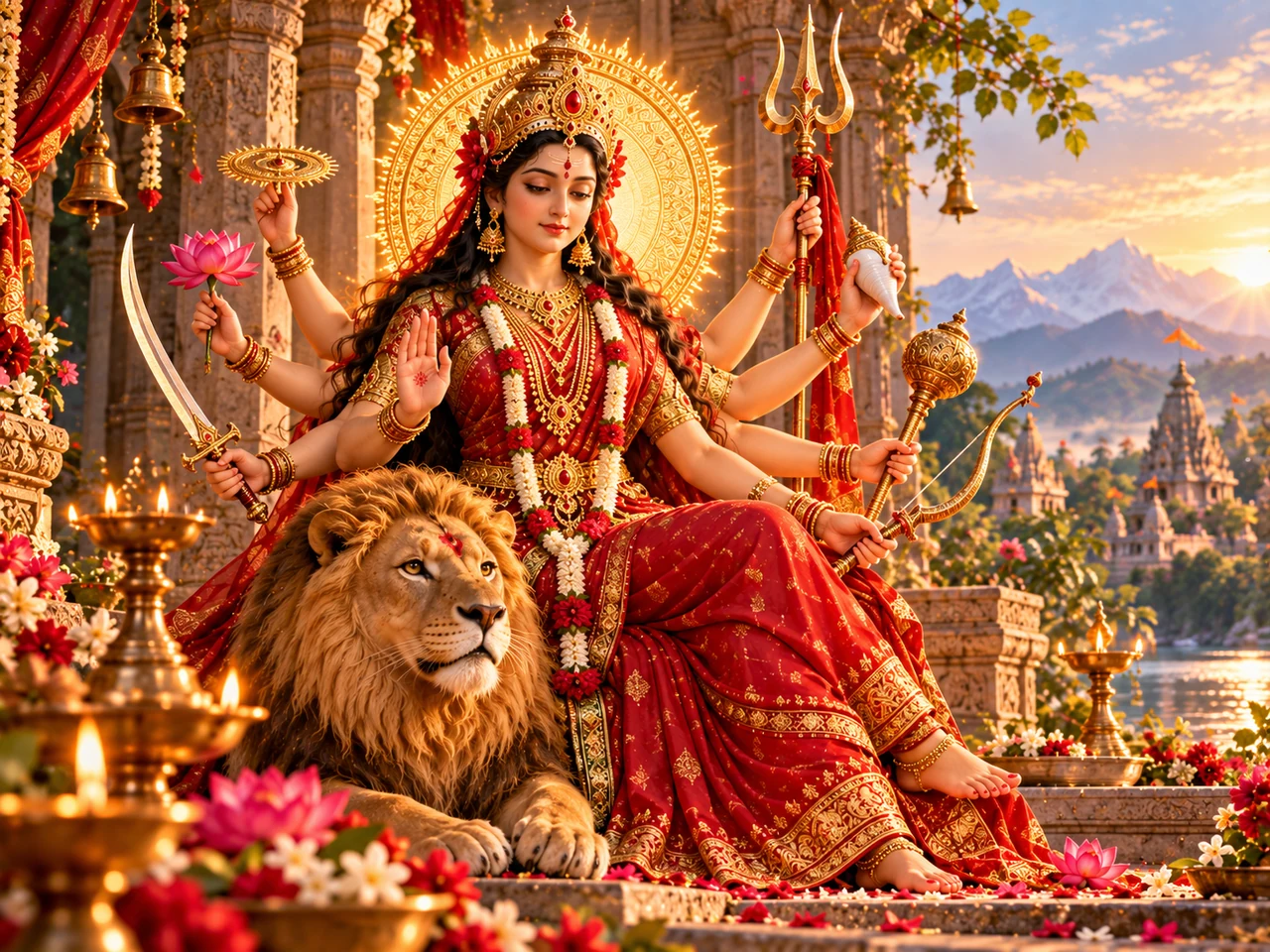
What is Jai Ambe Gauri? Jai Ambe Gauri is a Hindi-language Aarti sung in praise of Mother Ambe, widely identified with Durga and honoured within Shakta worship. An Aarti is both the devotional song and, in many worship settings, a rite in which light is offered to the deity. This page explains the song; it is not a handbook for initiation, temple officiation or performing specialized rituals. The selected source presents it as Aarti Shri Amba Ji. 1
The hymn is unusually vivid. Its first half makes a portrait: moon-like face, vermilion, red robes, ornaments and a lion. The middle summons a series of goddess victories. The final passages broaden the picture to Brahmani, Rudrani, Kamala, Yoginis, Bhairava, music, the flame of the Aarti plate and a closing blessing. The reader moves from seeing the goddess through imagery to remembering her power and finally making a personal offering.
A hymn to Shakti — but not a substitute for scripture
The song’s names and battles resonate with the Devi Mahatmyam (Durga Saptashati), a section of the Mārkaṇḍeya Purāṇa, especially episodes concerning Mahishasura and the later conflicts with Shumbha, Nishumbha, Chanda–Munda and Raktabija. But the Aarti is not a chapter of that scripture and is not itself an ancient Sanskrit verse collection. The appearance of a battle name in a song is a thematic reference, not a verbatim quotation or proof that every detail corresponds exactly with a single episode. Museum collections preserve contrasting forms of Durga and Kali showing how the iconography developed and circulated. 4 5 6 7
In particular, Kali’s role in Chanda–Munda and Raktabija episodes deserves its own explanation. The Aarti brings many victories under the affectionate title Ambe, while narrative versions distinguish participating goddesses and their relationships. This devotional compression is meaningful but should not erase the individuality of those forms. The coexistence of Gauri, Shyama, lion, sword, skull-bowl and a boon-giving gesture likewise does not mean that every statue combines all of them. 5 6
Words and images worth knowing
| Word | Reader-friendly meaning | Why it matters |
|---|---|---|
| Ambe / Maiya | Mother | Direct, affectionate address rather than an abstract description |
| Gauri / Shyama | Radiant/fair and dark-associated names | Invokes multiple modes of goddess imagery without forcing a rigid colour theology |
| Mrigamad | Musk, in traditional poetic usage | Explains the forehead mark |
| Raktaambar | Red garment | The devotional palette of splendour and energy |
| Kehari | Lion | Iconographic mount of Durga |
| Khadg / Khappar | Sword / skull-bowl | Fierce and protective representations in Shakta imagery |
| Shonit beej | Blood-seed, an allusion to Raktabija | Connects the song to a famous mythic conflict |
| Bhairun / Yogini | Vernacular Bhairava and a collective of goddesses | The song’s Shakta–Shaiva cosmic assembly; not a practice authorization |
| Var-mudra | Gesture of granting a boon | Symbol of welcome, compassion and divine gift |
| Agam / Nigam | Traditional terms for revelatory/scriptural corpora | Broad praise, not a traceable quotation from a named text |
The historical and textual question
The closing line names Shivanand Swami, but this internal signature alone cannot prove the person’s identity, dates or that every version came from a single historical hand. We therefore label it traditional attribution and leave the historical author unverified. A different available online witness begins the refrain with Om and prints Shivji where this selected text has Shivri; these are real reading differences, not errors for the editor to silently correct. 1 8
Why thirteen? We count exactly what the chosen source displays: opening invocation plus twelve following stanzas, including the signed ending. Some songbooks count the refrain separately, reorder passages or have a shorter performed sequence. This is a witness count, not the claim that an immutable original must have thirteen verses. A Gita Press-associated archive catalogue has been located, but its relevant print pages have not yet been independently checked against every line. 1 2 3
The expressions “Dhoomra vilochan naina” and “Shri Maalketu” need printed-witness and philological review. It would be misleading to assign them confident modern meanings that the available evidence does not support. Meanwhile, the original poem’s copyright history and the selected website transcription’s reuse licence have not been independently established. Those issues block publication even though this draft reproduces a complete online witness for editorial alignment.
Singing, learning and responsible devotional reading
Families and communities sing different versions during Devi worship and Navratri. The existence of these practices should not be converted into a single mandatory tune, duration, lamp count or daily prescription. People who simply wish to read can follow the refrain, the stanza meanings and the source notes without treating the page as a specialized ritual guide. Any festival date or muhurta must come from a separately approved Panchang service, not from this article. 1
References to removal of sorrow, blessing, courage or prosperity are statements of devotional faith. They should not be marketed as guaranteed medical cures, financial outcomes or the unavoidable consequence of repeating a particular number of times. The reader can appreciate the Aarti as poetry, living devotion and a window into the Mother Goddess’s many forms without making such claims.
Frequently asked questions
1. Is the complete Aarti included here? Yes: this page opens with all 13 parts of the selected online version, in Roman Hindi. Other printed and sung recensions may not share that count. The Devanagari version is in the supplied article; structured bilingual stanza records are in the edition notes. 2. Why is the Aarti in Roman Hindi instead of an English-language poem? The English page preserves the same Hindi words in Latin script so readers can follow the recitation. English translations and explanations follow separately. 3. Why does the song use both Gauri and Shyama? The paired forms of address honour the Mother through different colours and modes of goddess imagery. They do not demand one single theological interpretation in all traditions. 4. Does the Aarti come directly from the Durga Saptashati? No. It recalls myths associated with that scripture but is a later vernacular devotional hymn; it should not be cited as a Sanskrit Saptashati chapter. 5. Was it definitely written by Shivanand Swami? That name occurs within the closing stanza. Independent evidence for a specific author and date remains unsettled. 6. Why do some versions begin with “Om Jai” and others only “Jai”? Both readings circulate. The selected witness uses Jai; an independently discovered version uses Om Jai. We record the difference instead of mixing readings. 1 8
7. Why are different numbers of arms or goddess names mentioned? The poet draws on multiple goddess forms. Religious icons are diverse; a single verse need not be an exact description of every temple image. 8. Can this reader teach me advanced yogini or tantric practice? No. It explains imagery for a broad readership and does not supply initiatory rituals, personalized instructions or promised results.
Additional passage commentary
The meaning is a new explanatory translation; the explanation is ShivGoraksh’s interpretive prose. Neither should be confused with another printed stanza, the original composition, or a direct quotation from the Devi Mahatmyam (Durga Saptashati). See the stable stanza records in the edition notes.
Stanza 1 — Meaning and reflection
Meaning: Victory to Mother Ambe, praised as both Gauri and Shyama. The singer pictures Vishnu, Brahma and Shiva as honouring her constantly. Explanation: The opening does not demand that the two colour-associated names describe a single fixed physical appearance. They evoke the many-sided Mother within Shakta devotion; “Shivri” is preserved as the chosen witness reads it, while interpretations commonly understand an invocation of Shiva.
Stanza 2 — Meaning and reflection
Meaning: Vermilion adorns her hair parting, a musk mark her forehead; her two eyes shine and her face is compared with the moon. Explanation: Rather than cataloguing a compulsory ornament for every shrine, the poet dresses the divine Mother in affectionate visual detail. Mrigamad is traditionally associated with musk, and chandra-vadan means a moon-like face.
Stanza 3 — Meaning and reflection
Meaning: Her form glows like gold; red garments and a necklace of red blossoms adorn her. Explanation: Gold expresses radiance; crimson flowers and clothing create a visual language of Shakti and auspicious strength. These descriptions belong to a devotional portrait, not to one historically fixed costume.
Stanza 4 — Meaning and reflection
Meaning: She appears riding a lion, holding a sword and skull-bowl; gods, human beings and sages praise her as a compassionate reliever of suffering. Explanation: The lion recalls Durga’s familiar iconography. The sword and khappar also recall fiercer Shakta images; the hymn compresses multiple devotional associations into one portrait. A promise to remove suffering is faith-language, not a clinical guarantee.
Stanza 5 — Meaning and reflection
Meaning: Earrings shine at her ears and a pearl decorates her nose; her brilliance is compared to countless suns and moons. Explanation: “Millions of suns and moons” is a devotional measure of splendour, not a numerical astronomical claim. The beauty imagery invites the reader to contemplate divine presence through familiar human ornaments.
Stanza 6 — Meaning and reflection
Meaning: The singer praises the goddess associated with the defeat of Shumbha, Nishumbha and Mahishasura; the following wording vividly describes her eyes and ecstatic or fierce presence. Explanation: The named battles recall Devi Mahatmyam (Durga Saptashati), but the latter half is textually difficult: “dhoomra vilochan naina” may evoke smoky eyes or the Dhumralochana cycle. It should not be rewritten as an unambiguous verbatim statement that she killed Dhumralochana. The stanza compresses separate narrative episodes.
Stanza 7 — Meaning and reflection
Meaning: The Aarti recalls the defeat of Chanda and Munda, the blood-born Raktabija, and Madhu and Kaitabha; the gods are pictured as released from fear. Explanation: These names point readers toward several Devi Mahatmyam (Durga Saptashati) chapters, not to a single continuous fight by one iconographic figure. The scripture distinguishes the roles of Ambika, Kali/Chamunda, Vishnu and the goddess’s power across episodes. “Shonit beej” functions as a vernacular allusion to Raktabija.
Stanza 8 — Meaning and reflection
Meaning: The Mother is praised through names associated with Brahma, Rudra and Kamala/Lakshmi, and is celebrated as Shiva’s queen in the religious language of Agamas and Vedas. Explanation: This is a devotional vision of Shakti embracing several goddess associations. Brahmani, Rudrani and Kamala also have distinct identities in particular iconographies and traditions; the poet’s identification should not erase them. “Agama–Nigama” points broadly to scriptural authority, not a verified verse quotation.
Stanza 9 — Meaning and reflection
Meaning: The sixty-four Yoginis sing auspicious praises while Bhairava dances; cymbals, mridanga and damaru fill the scene with music. Explanation: The verse imagines a divine assembly, joining Shakta and Shaiva figures. The number sixty-four recalls Yogini traditions but does not authorize the reader to infer a specific historical lineage, initiation or secret ritual. Bhairun is a vernacular form associated with Bhairava.
Stanza 10 — Meaning and reflection
Meaning: You are Mother of the world and its sustainer, the one devotees approach for relief, well-being and prosperity. Explanation: “Bharta” is understood here as supporter or sustainer, not as a modern literal marital role. This is the voice of loving dependence on the Mother; the claims of prosperity are devotional hopes, not certain financial predictions.
Stanza 11 — Meaning and reflection
Meaning: Her four arms look beautiful, and her hand is shown in a boon-granting gesture; women and men devoted to her seek blessings. Explanation: Four arms here describe one possible iconographic form, not every depiction of Durga. The boon gesture expresses welcome and compassion; the prospect of receiving wishes is part of the Aarti’s religious idiom, not a guarantee of results.
Stanza 12 — Meaning and reflection
Meaning: A golden offering plate holds fragrant and camphor light; a later phrase evokes immeasurable jewel-like brilliance, though its precise wording remains uncertain. Explanation: This stanza brings the Aarti’s own lamp offering into the song. “Shri Maalketu” is preserved as in the selected witness because its referent cannot be securely identified from the consulted evidence; invented temple, crown or geography explanations are avoided.
Stanza 13 — Meaning and reflection
Meaning: The closing stanza speaks of singing Mother Ambe’s Aarti with devotion and hoping for happiness and well-being; it names Shivanand Swami in its signature. Explanation: “Kahat Shivanand Swami” is a traditional textual signature, not independent proof of an author’s biography, century or exclusive authorship. The final blessing belongs to the song’s devotional aspiration; it is not a measurable guaranteed reward.