



Imagine a public ground filling with the voices of a Ramlila performance. Elsewhere, an image of Durga is carried toward a river, a chariot of local deities gathers in the Himalayas, and a child in Kerala traces a first letter into rice. These scenes belong to the same broad season, yet they do not tell precisely the same story. Dussehra, also called Dasara or Vijayadashami, is a major autumn celebration whose meanings include the triumph of Rama, the victory of the Goddess, the renewal of communal ties, and an auspicious beginning for learning and work. 3, 4, 5, 10
At a glance
- Names: Dussehra, Dasara, Vijayadashami, Vijaya Dashami; दशहरा, दशहरा/दसरा, विजयादशमी.
- Occasion: An annual autumn festival, ordinarily associated with Ashvina Shukla Dashami, the tenth lunar Tithi of the bright fortnight; its place in the Navratri cycle differs by local convention.
- Devotional settings: Rama–Ravana narratives; Durga and Chamundeshwari traditions; local goddess and deity festivals; Saraswati and learning traditions.
- Typical public forms: Ramlila and effigies in parts of northern India, goddess processions, family blessings, temple celebrations, performances, and regional fairs.
- Calendar caution: The date for a city and year requires a reviewed Panchang occurrence. This article deliberately gives no unverified Gregorian date or Muhurta. 3, 4, 12
Names, meanings and identity
Vijaya means victory and dashami the tenth lunar Tithi; the name therefore evokes a victorious tenth day. Dasara and Dussehra are regional vernacular forms, commonly associated with the same seasonal celebration. Popular explanations connect “Dussehra” with the defeat of ten-headed Ravana, but the linguistic history of the word and the many local traditions should not be reduced to that interpretation alone. Dussehra is neither a synonym for every Navratri ritual nor merely another name for a Ravana-burning ceremony. 13, 3
The day often marks the culmination of Sharad Navratri and is closely related to Durga Ashtami and Mahanavami, but each observance has its own practices and sometimes its own date-selection rules. In Bengal, Bijoya Dashami often emphasizes farewell to the Goddess and reunion with others. In Mysuru, Dasara evokes royal and civic pageantry centred on Chamundeshwari. The variety is not a modern error: it is a feature of the festival's living history. 4, 5, 9
How the festival developed
The Ramayana and Devi Mahatmyam (Durga Saptashati) offer celebrated narrative foundations; they are not interchangeable certificates of the modern festival's exact origin. The Valmiki Ramayana, Yuddha Kanda 108, describes Rama's decisive defeat of Ravana. It does not, in the passage checked here, assign the battle an annually repeating Ashvina Dashami date. The Devi Mahatmyam (Durga Saptashati)—a section of the Markandeya Purana—recounts the Goddess's battle with Mahishasura, especially in chapters 2–3; chapter 3 narrates his defeat. One should not quietly rewrite that account as a timestamped chronicle of an autumn festival. 1, 2
Centuries of local performance, temple patronage, royal processions, seasonal celebrations and community memory have shaped the observances known today. UNESCO documents Ramlila as a performed Ramayana tradition particularly associated with northern Indian Dussehra, while its account of Durga Puja in Kolkata documents a living artistic and religious festival centred on clay images and their immersion. These are documented cultural practices, not evidence that one universal Dussehra ceremony existed unchanged across India. 3, 4
Rama, Ravana and the responsibility of dharma
In the Yuddha Kanda, Rama's allies have endured a fierce war in Lanka. The culminating struggle against Ravana demands courage, judgment and persistence. Guided by Matali, Rama employs a powerful weapon, and Ravana falls. The story is remembered not simply as a contest of strength but also as a reflection on the consequences of arrogance, the importance of loyalty, and the difficulty of acting responsibly in conflict. 1
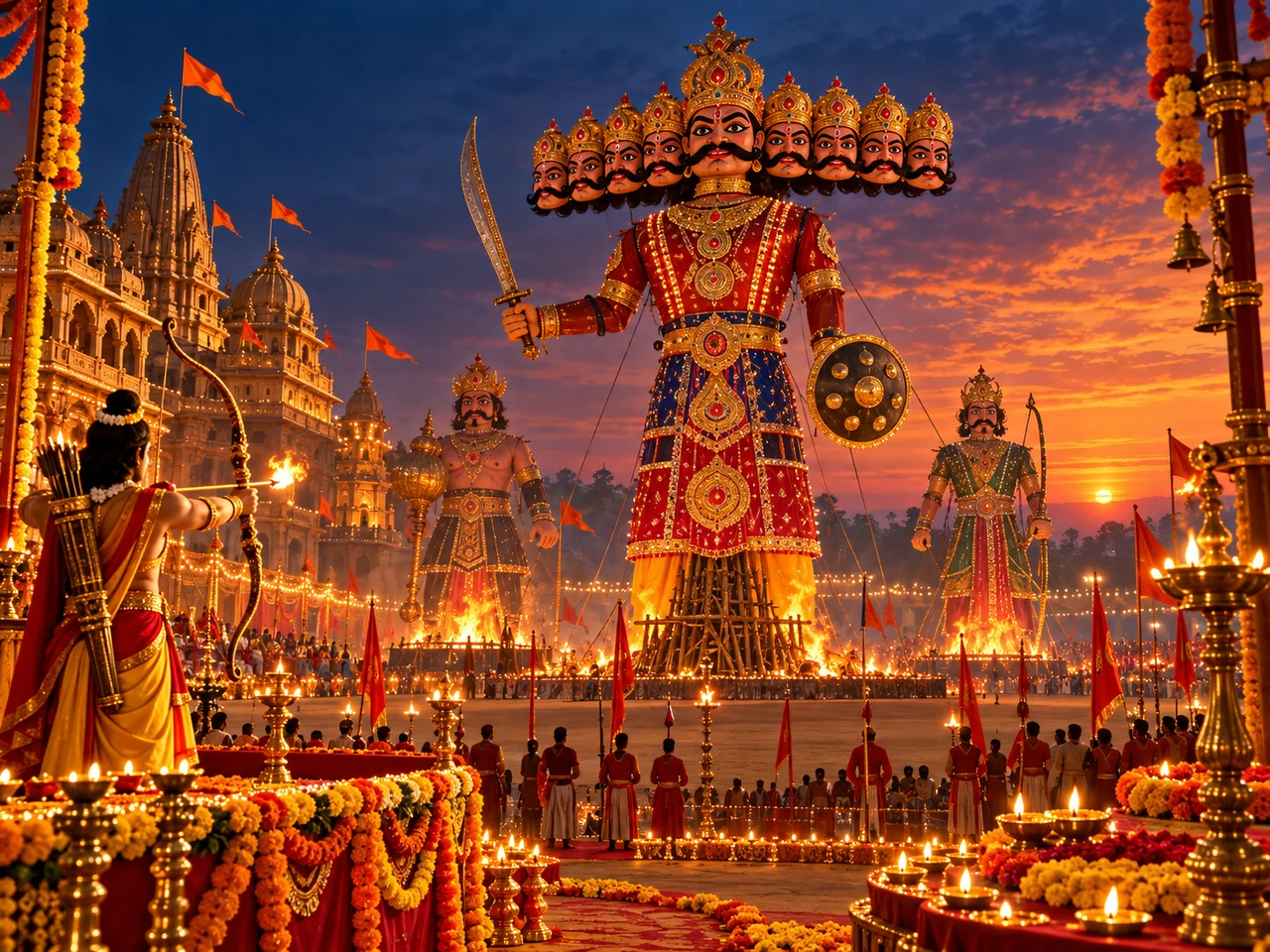
In many northern Indian communities, Ramlila performances gradually tell the larger story and end in a public depiction of Ravana's defeat. Ravana effigies may be burned; that stage practice should not be projected onto every regional celebration or claimed to be described in that form in the ancient epic. UNESCO notes the special influence of Tulsidas's Ramcharitmanas on Ramlila performances. 3
Durga and Mahishasura: strength that restores balance
The Devi Mahatmyam (Durga Saptashati) presents the gods facing Mahishasura's destructive domination. Divine powers converge in the Goddess, who battles his forces and overcomes the buffalo-shaped adversary. In Shakta devotional interpretation, the narrative communicates that protection and compassionate power can restore order when it has been disrupted. The text's goddess-centred theology is not an appendix to the Rama story; it deserves attention on its own terms. 2
The worship of Durga through Navratri, Durga Puja and Vijayadashami draws on wider liturgical and regional traditions. Do not assume that every community places the slaying of Mahishasura at precisely the same ritual moment, or that the entire 13-chapter Devi Mahatmyam (Durga Saptashati) corresponds one-to-one with nine festival nights. 2, 4
Farewell to the visiting Goddess
For many Bengali families, the end of Durga Puja is emotionally complex: celebration meets separation. Bijoya Dashami is associated with taking leave of the Goddess and, in many settings, immersion of the image. UNESCO describes how Kolkata's clay-image tradition ties artistry, urban community and homecoming to the festival. A farewell to Durga does not mean that devotees believe divinity has simply ceased to exist; the ceremony is framed through return, memory and renewal. 4
A new beginning in knowledge and work
In Kerala, the final day of Navratri is especially associated with Vidyarambham: a child's symbolic entrance into letters and learning. Books and instruments may have been placed in worship during the preceding days; educational and artistic activity resumes with reverence. Kerala Tourism documents this pattern at Panachikkadu and in the broader state's observances. This is another expression of vijaya: the hope that effort and knowledge will bear fruit. 10, 14
When is Dussehra in the Hindu calendar?
The festival is ordinarily associated with Ashvina Shukla Dashami, in the autumn Navratri season. Shukla Paksha is the waxing fortnight and Dashami its tenth lunar Tithi. This is not simply “the tenth day of October,” nor does Dashami begin at local midnight. Tithi boundaries follow the angular separation of Sun and Moon; civic dates depend on time zone and location. In some regional month systems, names and adjacent observance labels differ, even where the astronomical interval is shared. 12
Selection also depends on which ritual the calendar is identifying. Traditions may discuss Aparahna (the later part of the daytime), Vijaya Muhurta, Shravana Nakshatra, Shami/Aparajita worship or Bengal's distinct Bijoya Dashami convention. An almanac may therefore show different festival entries on neighbouring civil days. The published date must come from a reviewed convention profile applied to local astronomical intervals, with a rationale and source—not a general-purpose “Tithi at sunrise” shortcut. 12
For ShivGoraksh, the adjacent reviewed Calendar module will eventually provide a supported city's date and explanation. Until a reviewed occurrence is available, the truthful display is “Date/timing not yet verified for this city/year.” This article intentionally does not print a current or future festival date.
How people observe the day
Public programmes in parts of northern India culminate in Ramlila, procession, music, dramatic enactment and sometimes Ravana effigies. Families may visit temples, offer prayers, greet relatives and participate in fairs. Other households focus on Devi worship, family blessings, a first lesson, tools of livelihood, or a community's own goddess tradition. There is no single mandatory household template. 3, 13
Some traditions describe Shami Puja, Aparajita Puja, Ayudha Puja (honouring tools, books, instruments or equipment) and Seemollanghan or symbolic crossing of a boundary. Their local timing, objects and meanings vary. A published cultural account of these customs is not an authorization to invent exact mantras, auspicious periods or a universal sequence of worship. 12, 10
Fasting is practised in some homes within the wider Navratri period, but Dussehra is not universally a compulsory fast. Food, health, age, circumstances and family custom differ. Descriptions here are educational, not medical or prescriptive advice.
Northern India: Ramlila and public performance
UNESCO documents a wide geography of Ramlila, including Ayodhya, Varanasi/Ramnagar, Vrindavan and other towns. Performances may run over many evenings; the audience participates through music, dialogue and shared memory. Some local cycles last longer than the familiar ten-night pattern. 3
West Bengal and Bengali communities: Bijoya Dashami
In and around Kolkata, carefully crafted Durga images, pandals, dhak drumming and community art mark the Durga Puja season. On the concluding Dashami, many communities bid farewell to the Goddess through processions and immersion. Sindoor Khela is practised in some communities, though not every household participates or interprets it identically. UNESCO's documentation emphasizes both worship and the artisanal work that sustains the festival. 4
Karnataka: Mysuru Dasara
Mysuru Dasara is celebrated in a royal and civic setting associated with Goddess Chamundeshwari. Karnataka Tourism describes the procession, palace setting, decorated animals, cultural activity and the city's role in preserving this heritage. Its specific route, programme and timing can change and are not an evergreen festival rule. 5
Himachal Pradesh: Kullu Dussehra
Kullu's Dhalpur gathering is famed for the participation of local deities and chariots, with Raghunath at the centre of the principal tradition. Government sources describe a week-long celebration that begins on Vijayadashami, rather than simply imitating a northern-city Ravana-effigy programme. The local devta network gives the festival a distinctive social character. 6, 7
Chhattisgarh: Bastar Dussehra
Bastar's celebration honours Danteshwari and local deities, bringing together Adivasi communities and regional heritage. It is frequently described as extending over approximately 75 days through multiple preparations and processions. Importantly, burning a Ravana effigy is not its central purpose. Sahapedia's extensive documentation describes the chariot traditions and their local histories; such local histories are preserved as accounts, not flattened into one certain founding year. 8, 9
Kerala: Vidyarambham and Saraswati
Kerala's Navratri may include placement and subsequent retrieval of books, worship of tools and instruments, music and children's first writing lesson. At Panachikkadu and Thunchan Parambu, Vidyarambham is a particularly important cultural practice. Its essential theme is the dignity of learning, not military victory. 10, 14
Nepal: Dashain
Nepal's Dashain is a broader multiday family and Durga-devotional season, rather than a direct replica of India's public Dussehra fairs. The Nepal Tourism Board documents Ghatasthapana, Phulpati, Maha Ashtami, Navami, and Vijayadashami, including family visits and elders giving tika and blessings; practices such as jamara are part of many households. Diaspora families likewise sustain their own forms of reunion. 11
Sequence and relationships to neighbouring observances
A helpful way to read the season is as a series, not a single undifferentiated holiday. Sharad Navratri spans its own Tithis and regional ceremonies. Durga Ashtami and Mahanavami have separate devotional roles; some communities emphasize Ayudha Puja before Vijayadashami. Dashami marks the culmination or transition: Ravana defeat performances in one setting, immersion and farewell in another, chariot processions or first lessons elsewhere. Kullu may begin its own large public gathering on that very day. 3, 4, 7, 10
The related ShivGoraksh records are Navratri: Nine Nights of the Goddess Navratri and Durga Ashtami: North Indian Kanya Pujan, Mahagauri and Navratri Durga Ashtami. See also Hindu Calendar and Panchang: A Complete Beginner’s Guide Hindu Calendar & Panchang for the mechanics of Tithi and local date determination.
Symbolism, food and the meaning of celebration
An effigy burned after a play can prompt reflection on arrogance or harmful conduct; a clay image immersed in water can express renewal and parting; a chariot can embody local obligations between people and deities; a book or musical instrument can represent disciplined learning. These are interpretations associated with particular practices, not fixed scientific or universal explanations for every visual object. 3, 4, 6, 10
Food varies enormously: festival sweets and shared meals in many northern homes, community hospitality in Mysuru and Kullu, Bengali festive meals and sweets, and family feasts during Dashain. In other households, food practices reflect Navratri fasting conventions. There is no single Dussehra prasad or menu obligatory across Hindu communities. In some regions, symbolic exchanges of leaves or gifts represent goodwill; any exact plant identification should be checked against the local custom before a ritual guide is published.
Devotion, philosophy and careful practice boundaries
For Rama devotees, Dussehra can be a meditation on dharma and responsibility. For Shakta devotees, it can honour the Goddess's protective power; for learners, Saraswati-centred Vijayadashami can express respect for teachers and effort. Nath and Shaiva readers may find the wider themes of disciplined conduct and overcoming pride meaningful, without recasting this predominantly diverse festival as uniquely Nath or Shaiva.
Public observances such as attending Ramlila, listening to a narrative, offering respectful greetings or visiting a temple are publicly describable. Specific mantras, consecrations, sacrifices, initiation-bound rites or intricate timing decisions may require qualified local guidance and specialist review. No ritual efficacy is guaranteed here, and no part of this article substitutes for that review.
Texts and devotional reading
The directly checked Valmiki Ramayana, Yuddha Kanda 108, narrates Ravana's defeat; Ramlila performance traditions commonly also draw on Tulsidas's Ramcharitmanas. The Devi Mahatmyam (Durga Saptashati), chapters 2–3, recounts the battle with Mahishasura. The first two sources support their stories; neither inspected passage, by itself, establishes a complete universal Dashami date-selection algorithm. 1, 2, 3
Readers may also explore separately prepared ShivGoraksh material on the Devi Mahatmyam (Durga Saptashati), subject to its source-verification and publication status. No internal scripture URL is asserted live. Local stotras, aartis and family recitations differ; this page does not reproduce unverified verses or copyrighted translations.
Questions readers commonly ask
1. Are Dussehra, Dasara and Vijayadashami the same? They commonly name the same broad autumn occasion, but their regional ceremonies and emphases differ.
2. Why is Dussehra celebrated? Many celebrate Rama's victory over Ravana; others focus on Durga, local deities, auspicious work or learning. There is no single explanation that fits every community.
3. Is Dussehra always the tenth day of Navratri? It is associated with Ashvina Shukla Dashami and the autumn Navratri culmination, but the mapping of ritual days to civil dates depends on calendar conventions.
4. Is Ravana burned everywhere? No. Kullu, Bastar, Mysuru, Bengal, Kerala and Nepal illustrate very different observances.
5. Does the Valmiki Ramayana state Ravana died on Ashvina Dashami? The checked Yuddha Kanda passage narrates his defeat but does not establish that precise annual festival date.
6. Is Durga Ashtami the same as Vijayadashami? No. They are distinct Tithis and observance topics, although both belong to related festival cycles.
7. Why can two Panchangs display different days? Different localities, Tithi boundaries, interval criteria and named regional profiles can produce different observed civil dates. A reviewed comparison is necessary.
8. What is Bijoya Dashami? In many Bengali traditions it is the concluding Durga Puja day of farewell, immersion and community greetings.
9. Why is Mysuru Dasara famous? For its Chamundeshwari-centred royal and civic celebrations, including an elaborate procession.
10. What makes Bastar Dussehra different? It centres on Danteshwari and regional deity/community processions rather than Ravana effigy burning.
11. What is Vidyarambham? A ceremonial first encounter with letters or learning, especially prominent in Kerala's Vijayadashami traditions.
12. Is fasting required? Customs vary. Fasting is associated with some Navratri observances but is not a universal condition for Dussehra participation.