



At a glance
Rama Navami (राम नवमी), also written Ram Navami, Shri Rama NavamiSri Rama Navami or Shri Ram Navami, is an annual Hindu festival honouring the birth of Rama. In many Vaishnava traditions Rama is revered as an incarnation (avatara) of Vishnu; for devotees of Rama, he is also worshipped as the supreme Lord. The festival is associated with Chaitra Shukla Navami, the ninth lunar Tithi of Chaitra's bright fortnight, and commonly coincides with the concluding part of Chaitra Navratri. 1, 2, 3
For many households, the day is quiet and intimate: an image of the child Rama, flowers, a lamp, a prayer and the telling of a familiar story. Elsewhere, temples welcome congregations for devotional music, a symbolic birth celebration, public reading, or processions. In parts of the south, celebrations include a ceremonial wedding of Sita and Rama. The shared focus is devotion to Rama; the forms are not identical everywhere. 3, 4, 5, 6
What does Rama Navami mean?
Navami denotes the ninth lunar Tithi. Rama Navami therefore names the ninth-Tithi observance dedicated to Rama's appearance. Janmotsava means a celebration of birth, while Rama Janmotsava is the festive commemoration of Rama's birth. Chaitra names the lunar month and Shukla Paksha the fortnight of the waxing Moon. These terms tell us the festival's place in a traditional calendar, not a fixed date on a modern wall calendar. 1, 2
The name Rama is much more than a calendar label. Across the Ramayana tradition, devotees meet him as a beloved son, a prince who experiences exile, an ally, a ruler and a focus of prayer. The epithet Maryada Purushottama—the exemplary person who honours moral boundaries—is widely used in later devotion. It is a devotional ideal to reflect on, not a claim that every reader or every retelling interprets every choice in the epic in the same way. 1, 8
The birth narrative in the Valmiki Ramayana
The festival's most direct early textual anchor is the Valmiki Ramayana, Balakanda, sarga 18. King Dasharatha of Ayodhya longs for children. After sacrifices associated in the narrative with the sage Rishyashringa, his queens bear four sons: Kausalya bears Rama, Kaikeyi bears Bharata, and Sumitra bears Lakshmana and Shatrughna. The episode belongs to the epic's sacred narrative, not an independently verified modern birth record. 1
The text locates Rama's birth in Chaitra, on the ninth Tithi, and refers to Punarvasu as well as an elaborate planetary configuration. In verses 1.18.8–11, Kausalya gives birth to Rama, whom the passage associates with Vishnu. These are verifiable features of the consulted text; a historical year or exact astronomical timestamp cannot responsibly be calculated from them here. The text's own details are also interpreted differently by commentators, so a narrative birth configuration should not be silently converted into a compulsory annual festival algorithm. 1
Sarga 18 continues beyond the moment of birth. It describes rejoicing in Ayodhya, gifts, the princes' naming and the brothers' early closeness. This fuller scene helps explain why the observance is not only about a celestial event: Rama arrives within a family and a community. For many devotees, celebrating his birth also means welcoming the qualities they associate with him into everyday relationships. 1
The four brothers—and why they matter
Rama's story does not stand apart from Bharata, Lakshmana and Shatrughna. Lakshmana's companionship and Bharata's devotion to duty become especially important later in the narrative. Rama Navami is the birth observance of Rama, not a separate annual birthday festival for each brother, but household storytelling often introduces all four. In some homes Sita, Lakshmana and Hanuman appear alongside Rama in the worship image: these figures represent relationships central to the larger Rama tradition, even though Sita's marriage and Hanuman's later service are not episodes of the birth itself. 1, 3
Rama across different sacred and devotional traditions
Valmiki's Sanskrit epic and Tulsidas's Ramcharitmanas must not be treated as identical books. The latter is an Awadhi-language devotional telling associated with the early modern North Indian Rama-bhakti tradition. Its language and poetic idiom made Rama's story especially resonant through communal recitation and singing. The British Library's catalogue also documents historical manuscripts containing Ramcharitmanas, confirming its distinct textual circulation; a particular birth-verse from that manuscript has not been collated for this article. 8
Rama's role also varies in theological emphasis. In many Vaishnava settings Rama is explicitly an avatara of Vishnu. In Rama-centred worship, the name and form of Rama may themselves be the ultimate focus of devotion. A family may simply describe him as Bhagwan Shri Ram. These expressions are related, but not an instruction to rank one community's theology above another's. 1, 3
Narratives about Rama are shared through oral storytelling, regional languages, public performance and devotional poetry. Rama-katha broadly means the telling of Rama's story. Ramayana parayana refers to reading or recitation of a Ramayana text; families choose different works, editions and durations. A mention of a particular composition is not proof that all its verses belong to the Valmiki Ramayana. The Ramcharitmanas is especially important in many Hindi-speaking households, but it is not the only Ramayana tradition. 4, 8
Why do devotees celebrate?
At its simplest, Rama Navami is an expression of love for Rama. For some, it is a sacred birthday; for others it is also a day to think seriously about dharma—how to act when loyalty, duty, compassion and competing responsibilities are difficult to reconcile. People read the story of exile and return, or the friendship of Rama and Hanuman, not merely as episodes in a distant tale but as invitations to reflect on their own conduct. This is a religious and ethical interpretation rather than a testable claim about the festival's effects. 1, 3
Rama Rajya, the ideal of good rule associated with Rama, is often invoked to discuss justice, care and public responsibility. An accessible way to explore it is to ask: What obligations does power create? How should someone treat those who depend on them? How can promises be honoured without losing compassion? The tradition has given many answers; thoughtful reading may also involve difficult questions about particular epic decisions. Respect for the story does not require pretending that every interpretive problem has a simple solution. 1
When is Rama Navami celebrated?
The general annual recurrence is Chaitra Shukla Navami. Because a Tithi is determined by the Sun–Moon angular relationship, it does not have to begin at midnight or last exactly one civil day. Rama Navami can therefore fall on different Gregorian dates in different years, and an observance date may depend on the location and the calendrical convention selected. In North Indian contexts a Purnimanta month-counting framework is often discussed; southern and western regions commonly use Amanta naming. The impact of that choice must be assessed for the specified festival profile rather than guessed. 1, 2
Many Rama Navami practice guides emphasize Madhyahna, the traditional middle part of the day, for the symbolic celebration of Rama's birth. Madhyahna is not automatically 12:00 noon on the civil clock: it depends on the locally defined daytime and a tradition's division of that interval. The online almanac consulted distinguishes this birth celebration from a generic sunrise-only Tithi assignment. It is a documented practice convention, not a universal rule for every tradition. 2
Difficult calendar cases include Navami spanning two afternoons, a Navami that misses a local Madhyahna interval, Tithi boundaries near sunrise, and a Tithi that is repeated or omitted in sunrise-based day names. A reviewer must also decide whether any Punarvasu consideration affects the chosen observance profile, rather than treating the epic's birth-star description as a universal tie-breaker. No Gregorian date, muhurta, fasting completion time or city-specific occurrence is supplied in this evergreen article. The eventual calendar module must show only independently reviewed results. 1, 2, 5
Rama Navami and Chaitra Navratri are related, not interchangeable
For many communities, Rama Navami falls at or near the end of the nine-night Chaitra Navratri cycle. In some homes, Devi worship, the concluding Navami observance and Rama's birth celebration are marked together; elsewhere the rituals remain distinct. Kanya Pujan or other regional Navratri customs should not be represented as required ingredients of Rama worship. Similarly, Durga Ashtami is connected with Ashtami, not synonymous with Rama's Navami. The dates and order of household rites can vary with local and sectarian practice. 3
What happens in a home celebration?
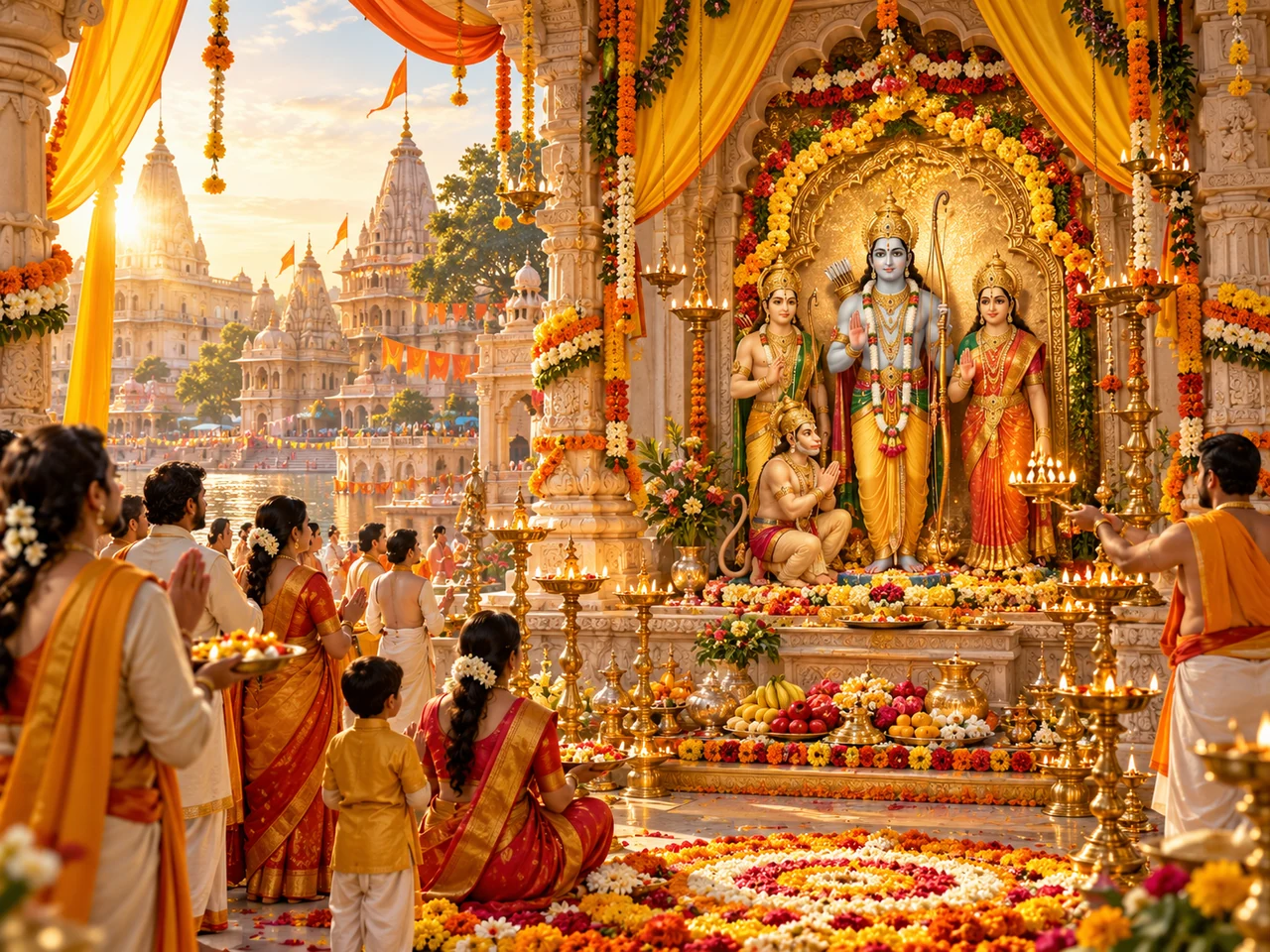
There is no single compulsory domestic script. In many Rama-devoted households people clean a worship space, place an image of Rama or Rama with Sita, Lakshmana and Hanuman, light a lamp, offer flowers and fruit, and spend time in prayer. Some use a small cradle or a decorated image of Bal Rama for a symbolic birthday welcome. The symbolic joy of arrival matters more than costly decoration. These are descriptions of familiar public religious customs, not an attempt to prescribe a priestly ceremony. 2, 3
Families may read from a Ramayana, listen to Rama-katha, sing bhajans, repeat Rama's name or join a community kirtan. One household may complete a selected section of a text; another may have participated in daily reading throughout Chaitra Navratri. Many also share prasad, visit a temple, make charitable offerings or take time for reconciliation with relatives. Exact mantras, consecration rites or lineage-specific procedures belong with the appropriate teacher or separately approved worship guide. 3, 4
What about fasting?
Vrata means a religious observance or vow; it may include dietary restraint, worship, charity or prayer. Some devotees fast on Rama Navami, some observe a Navratri discipline, and others participate without fasting at all. Different families use different foods, meal patterns and endings to a vow. Describing this diversity does not establish one universal religious rule, and no one should infer that a visitor must fast to honour Rama. A person with relevant health needs should not treat a general cultural article as dietary advice. 2, 3
Ayodhya: Rama's city in sacred geography
Ayodhya, on the Sarayu in Uttar Pradesh, is associated with Rama's birth in the epic and in long-standing Hindu pilgrimage belief. Government tourism material describes Rama Navami festivities involving temple visits, prayers, bhajans and processional devotion; Ayodhya district's cultural account records performance of Ramayana narratives and local music during the festival season. The city is a major devotional centre, but tourism promotion should not be read as independent archaeological proof for a precisely dated ancient birth. 4, 9
Many visitors think first of the celebration of the child Rama at the Shri Ram Janmabhoomi temple, but a reader planning to travel needs current official announcements for entry, special ceremonies and crowd-management arrangements. No temple timetable is supplied here. Even where a dramatic ritual feature attracts attention in a particular year, it should not be presented as a timeless requirement across all Rama temples. 9
Bhadrachalam, Telangana: Sita and Rama together
In Bhadrachalam, the Shri Sita Ramachandra Swamy temple is especially associated with , the Sri Sita Ramachandra Swamy temple is especially associated with Shri Sita Rama KalyanamahotsavamSri Sita Rama Kalyanamahotsavam, a ceremonial celebration of the divine couple's marriage linked to the Rama Navami season. The Government of India's Utsav portal describes the festival, and Telangana government reporting documents the temple's kalyanam observance. The wedding ceremony is a significant feature of this specific temple tradition; it should not be confused with the literal birth of Rama or assigned the same day at every temple. 5, 6
The link to Sita adds another dimension to Rama devotion: marriage and mutual responsibility appear beside birth and kingship. The ceremony unfolds according to the temple's own liturgical direction; a general festival article does not reproduce its priestly procedure or claim to authorize one. 5
Vontimitta, Andhra Pradesh: festival days beyond a single Navami
At Shri Kodandarama Swamy Temple in VontimittaSri Kodandarama Swamy Temple in Vontimitta, Tirumala Tirupati Devasthanams documents a Rama Navami Brahmotsavam programme with processional worship, observances for Rama and a Sita–Rama Kalyanotsavam. A documented annual programme has multiple ceremonial days rather than compressing all worship into one household Navami. That example shows why a temple's longer celebration and the single lunar birth observance should be modelled separately in a calendar. 7
Other Vaishnava institutions hold their own services and processions. Temple management, local language and priestly tradition explain much of the variation; one public schedule is not a perpetual national calendar rule. 7
North Indian households and the wider community
In Hindi-speaking regions the festival is frequently woven into recitation of the Ramcharitmanas, songs about Rama's birth and family devotion. Groups may organise Rama-katha, bhajan gatherings or processions, while many celebrate quietly at home. A listener might hear the same Rama story narrated in Awadhi, Hindi, Sanskrit or another language. This plural setting is part of the festival's vitality rather than a problem to be ironed out. 4, 8
Prasad, seasonal foods and sharing
Offerings vary by home, region and temple. Fruit, sweets and simple vegetarian foods commonly accompany a household birthday celebration; none is a universally compulsory ingredient. In South Indian Rama Navami contexts, panakam—a drink commonly prepared with jaggery, water and flavourings—and kosambari or kosumbari, a pulse-based salad, are documented as prasada preparations. ISKCON Bangalore also records other regional preparations such as huli avalakki. These are examples associated with a particular institutional and regional practice, not an all-India festival menu. 10
The act of offering and sharing food can convey welcome, gratitude and care for guests. Community food distribution may be part of temple festivals, while families might simply share what they have prepared. A devotional offering is not evidence of a medical benefit and should not be advertised as such. 7, 10
Symbols readers often notice
A cradle or child image expresses the birthday's tenderness; a lamp offers a familiar sign of welcome and prayer. A bow recalls Rama as the prince and hero of the larger epic, while the presence of Sita, Lakshmana and Hanuman places him within love, service and loyalty. A book or recitation stand points toward listening and learning. These meanings are interpretive descriptions of common devotional symbolism, not a claim that every household uses every object. 1, 3
One particularly revealing distinction is between Rama's birth and Sita–Rama Kalyanam. Both express devotion to Rama, but the ceremony's narrative subject is different. Likewise, the festival may include joyful public processions in one area without a procession being mandatory in another. 5, 7
Devotion, ethics and respectful differences
Rama Navami belongs primarily to the world of Rama devotion. ShivGoraksh's interest in Shiva, Shakti and Nath lineages does not change that identity. Readers familiar with the Ramcharitmanas will encounter a devotional world in which reverence for Rama and respect for Shiva can coexist. That is a meaningful literary and devotional connection, not evidence that Rama Navami is originally a Nath or Shaiva festival. 8
The most useful lesson a family may take from the day is not identical for everyone. One person reflects on truthfulness; another on courage tempered by compassion; another on the support of Lakshmana, Bharata, Sita or Hanuman. When different Ramayana retellings disagree in emphasis, understanding the differences is better than attributing every popular line to one Sanskrit source. 1, 8