



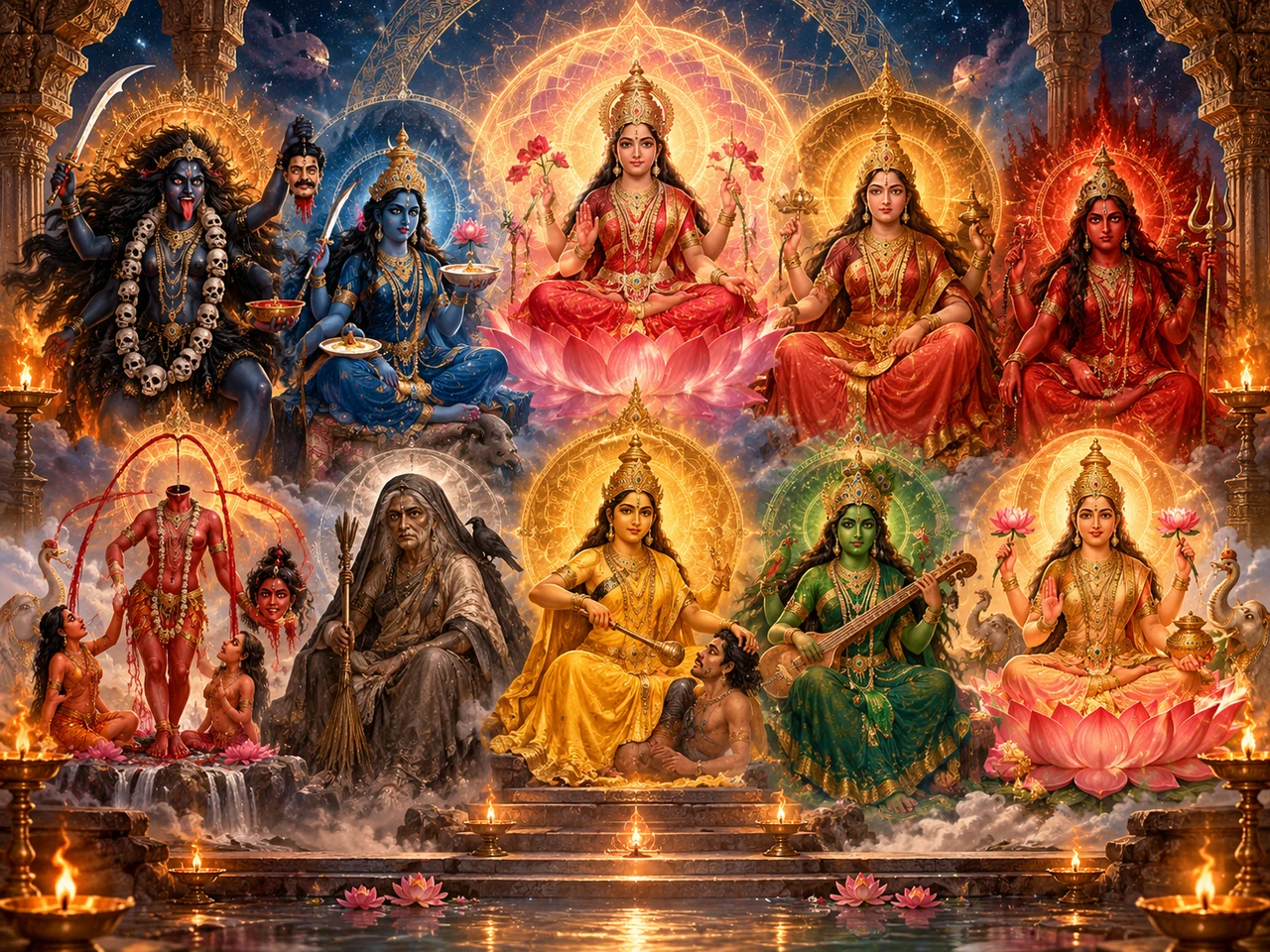
The Ten Mahavidyas (Daśamahāvidyā, दशमहाविद्या) are a group of ten powerful goddess forms revered in streams of Hindu ShaktaŚākta devotion and Tantra. Devotees may understand them as ten manifestations of one Supreme Mother (Mahāśakti), yet each also possesses a distinctive history, visual language, body of prayer, and religious community. Some forms are gentle and radiant; others challenge ordinary expectations of beauty, security, purity or social respectability. Taken together, they invite a larger question: can divine wisdom be encountered not only in comfort and abundance, but also in loss, change, silence, and what society tends to overlook? 12
This is a collective educational profile, not a set of ten independent entity pages, a universal worship sequence, or permission to undertake restricted tantric rites. Its symbolic readings are interpretations used by devotees and scholars; they are not one compulsory theology. The ten forms should neither be collapsed into identical meanings nor artificially separated from the overarching theology of Devī.
Quick facts
| Topic | Profile |
|---|---|
| Collective name | Daśamahāvidyā / दशमहाविद्या; Ten Great Wisdom Goddesses |
| Tradition | Shakta Hindu traditions; diverse tantric, temple and devotional settingsŚākta Hindu traditions; diverse tantric, temple and devotional settings |
| Nature | A goddess collective; individual members also have independent worship traditions |
| Standard list used here | Kali, Tārā, Tripurasundarī/Ṣoḍaśī, Bhuvaneshwari, Bhairavi, Chhinnamasta, Dhumavati, Bagalamukhi, Matangi, KamalaKālī, Tārā, Tripurasundarī/Ṣoḍaśī, Bhuvaneśvarī, Bhairavī, Chinnamastā, Dhūmāvatī, Bagalāmukhī, Mātaṅgī, Kamalā |
| Definitive ancient author or single canon | None established for the group as a whole |
| Principal scholarly guides | David Kinsley, Tantric Visions of the Divine Feminine; Jae-Eun Shin, Change, Continuity and Complexity 12 |
| Suitable content here | Names, meanings, symbolism, history, public devotion and literature |
| Not included | Initiation, bija-mantra application, nyāsa, yantra construction, homa, coercive or specialized ritesInitiation, bīja-mantra application, nyāsa, yantra construction, homa, coercive or specialized rites |
What does “Mahavidya” mean?
In Sanskrit mahā means “great” and vidyā can mean knowledge, insight, or a sacred wisdom/knowledge-form. Within tantric contexts vidyā may also be connected with a goddess and a mantra, but that does not make every associated mantra a public, freely interchangeable formula. “Ten Great Wisdoms” is a useful translation, provided we remember that these are worshipped goddesses, not merely ten abstract subjects in a philosophy textbook. 13
ShaktiŚakti is divine potency or power; ShaktaŚākta describes traditions that accord the Goddess primary religious importance. In a number of goddess-centered theologies the ten are manifestations of one supreme reality. Other lineages foreground a particular Mahavidya—especially Kali or Tripurasundari—without claiming that all devotees must rank them identically. describes traditions that accord the Goddess primary religious importance. In a number of goddess-centered theologies the ten are manifestations of one supreme reality. Other lineages foreground a particular Mahavidya—especially Kālī or Tripurasundarī—without claiming that all devotees must rank them identically. 12
The ten forms, in the chosen editorial order
The list below follows the ten names and sequence approved for this ShivGoraksh page. Other published lists reverse BhairaviBhairavī and ChhinnamastaChinnamastā, and some historical lists vary in membership. An editorial sequence is not a ranking of spiritual power. 13
| No. | Name | A first orientation |
|---|---|---|
| 1 | Kali — कालीKālī — काली | Time, radical transformation and liberation from clinging |
| 2 | Tārā — तारा | The guiding and saving Goddess; passage through difficulty |
| 3 | Tripurasundari / Shodashi — त्रिपुरसुन्दरी / षोडशीTripurasundarī / Ṣoḍaśī — त्रिपुरसुन्दरी / षोडशी | Auspicious beauty, fullness and the unity of consciousness |
| 4 | Bhuvaneshwari — भुवनेश्वरीBhuvaneśvarī — भुवनेश्वरी | Sovereignty and the spacious world that holds all life |
| 5 | Bhairavi — भैरवीBhairavī — भैरवी | Fierce clarity, resolve and transformative spiritual heat |
| 6 | Chhinnamasta — छिन्नमस्ताChinnamastā — छिन्नमस्ता | Disruptive interdependence, life-energy and impermanence |
| 7 | Dhumavati — धूमावतीDhūmāvatī — धूमावती | Lack, disappointment and wisdom beyond idealized success |
| 8 | Bagalamukhi — बगलामुखीBagalāmukhī — बगलामुखी | Arresting hostile speech and disciplined stilling power |
| 9 | Matangi — मातंगीMātaṅgī — मातंगी | Speech, music, creativity and challenges to exclusion |
| 10 | Kamala — कमलाKamalā — कमला | Lotus-like auspiciousness, flourishing and generous abundance |
1. Kali — काली: transformation without denial1. Kālī — काली: transformation without denial
Identity: A fierce and profoundly maternal goddess associated with time, death, protection and liberation.
The name Kali is associated with The name Kālī is associated with kāla—time and, in many contexts, darkness. Her dark complexion, flowing hair and striking imagery can unsettle a first-time viewer. Rather than presenting destruction as her whole personality, many devotees understand her as the Mother who breaks the grip of fear and attachment. In some well-known representations she stands upon Shiva; the interpretation varies across devotional and tantric sources and should not be reduced to one universal picture. 1
Key qualities: time, protective strength, impermanence, freedom, compassionate fierceness. Contemplative relevance: meeting unavoidable change honestly rather than denying it. Her public temple worship is not equivalent to permission for every cremation-ground or initiatory practice bearing her name. Kali already has a distinct ShivGoraksh entity page, meeting unavoidable change honestly rather than denying it. Her public temple worship is not equivalent to permission for every cremation-ground or initiatory practice bearing her name. Kālī already has a distinct ShivGoraksh entity page, Kali; this entry explains her Mahavidya role, not the entirety of Kali tradition., not the entirety of Kālī tradition.
2. Tārā — तारा: the one who helps across
Identity: A saving and guiding goddess whose name resonates with tāraṇa, crossing or carrying across difficulty.
In Hindu Shakta contexts Tārā is often fierce, nurturing and closely connected with liberating wisdom. Her image may display dark color and startling attributes, emphasizing that help can appear in unexpected forms. In Hindu Śākta contexts Tārā is often fierce, nurturing and closely connected with liberating wisdom. Her image may display dark color and startling attributes, emphasizing that help can appear in unexpected forms. Tārāpīṭh in West Bengal is a living center of Hindu Tārā devotion; official West Bengal materials also describe its tantric heritage. 18
Key qualities: guidance, protection, compassionate rescue, insight into difficulty. Contemplative relevance: finding orientation during uncertainty. Buddhist Tārā traditions and Hindu Tārā worship have histories of interaction, but should not be treated as a single identical ritual system or given an invented common origin. This matters particularly when reading mantras or iconographic descriptions across traditions. 2
3. Tripurasundari / Shodashi — त्रिपुरसुन्दरी / षोडशी: beauty as awakened awareness3. Tripurasundarī / Ṣoḍaśī — त्रिपुरसुन्दरी / षोडशी: beauty as awakened awareness
Identity: The “Beauty of the Three Worlds,” honored centrally in ShrividyaŚrīvidyā traditions.
Tripurasundari's radiance, youth and regal setting symbolize more than physical beauty. Shrividya interpretations associate her with the fullness of consciousness, auspicious order, bliss and the non-separation of the divine and the cosmos. Tripurasundarī's radiance, youth and regal setting symbolize more than physical beauty. Śrīvidyā interpretations associate her with the fullness of consciousness, auspicious order, bliss and the non-separation of the divine and the cosmos. ShodashiṢoḍaśī, a closely associated name, carries the symbolism of sixteen and fullness; exact theological identifications vary among Shrividya texts and lineages. Her ritual imagery may include the , a closely associated name, carries the symbolism of sixteen and fullness; exact theological identifications vary among Śrīvidyā texts and lineages. Her ritual imagery may include the Śrīcakra, but this page does not teach its consecration or any secret mantra sequence. 12
Key qualities: beauty, integration, benevolent sovereignty, fulfillment, luminous awareness. Contemplative relevance: seeing beauty as an invitation to clarity and reverence, not superficial appearance. Tripura's Mātābāri/Tripurasundarī Temple documents an important regional devotional setting. 9
4. Bhuvaneshwari — भुवनेश्वरी: the sovereign spaciousness of existence4. Bhuvaneśvarī — भुवनेश्वरी: the sovereign spaciousness of existence
Identity: “Mistress of the Worlds,” a Goddess of the encompassing cosmos.
The word bhuvana refers to worlds or domains of existence and īśvarī to a sovereign lady. Many iconographic descriptions give Bhuvaneshwari a calm, gracious presence; others vary in color and attributes. In contemplative explanation she can be approached as the to a sovereign lady. Many iconographic descriptions give Bhuvaneśvarī a calm, gracious presence; others vary in color and attributes. In contemplative explanation she can be approached as the space of possibility in which experiences arise, rather than merely as one more ruler occupying a throne. That is an interpretive metaphor, not a claim made identically by all scriptures. 1
Key qualities: expanse, shelter, sovereignty, presence, maternal inclusion. Contemplative relevance: spaciousness of mind and the ethical duty to make room for others. The Kamakhya sacred complex is among the regional settings where Bhuvaneshwari is revered. spaciousness of mind and the ethical duty to make room for others. The Kamakhya sacred complex is among the regional settings where Bhuvaneśvarī is revered. 7
5. Bhairavi — भैरवी: clarity that refuses complacency5. Bhairavī — भैरवी: clarity that refuses complacency
Identity: A powerful Goddess whose fearsome or intense appearance is associated with awakening, force and tapas (disciplined ardor).
Bhairavi can be portrayed in red, radiant, or fierce forms; some images combine ornaments of beauty with symbols of mortality or knowledge. Her intensity need not be interpreted as uncontrolled anger. Within Shakta readings it can suggest the courage and concentration required to confront ignorance. The name evokes associations with Bhairavī can be portrayed in red, radiant, or fierce forms; some images combine ornaments of beauty with symbols of mortality or knowledge. Her intensity need not be interpreted as uncontrolled anger. Within Śākta readings it can suggest the courage and concentration required to confront ignorance. The name evokes associations with Bhairava in some Shaiva–Shakta contexts, but she is not reducible simply to “Bhairava's wife,” nor is every Bhairavi form the same theological figure. in some Śaiva–Śākta contexts, but she is not reducible simply to “Bhairava's wife,” nor is every Bhairavī form the same theological figure. 1
Key qualities: resolve, energy, discernment, disciplined transformation. Contemplative relevance: honest self-examination and responsible perseverance. Strong austerities or lineage-specific practices are not inferred from these symbolic descriptions.
6. Chhinnamasta — छिन्नमस्ता: difficult imagery, profound questions6. Chinnamastā — छिन्नमस्ता: difficult imagery, profound questions
Identity: A Goddess whose distinctive severed-head iconography dramatically joins life and death, nourishment and sacrifice.
Chhinnamasta's image is deliberately unsettling. Scholarly interpretations consider connections among vital energy, the paradoxes of existence, and the interdependence of giving and receiving. Some iconographic traditions show companions receiving streams of life-giving blood; the image is Chinnamastā's image is deliberately unsettling. Scholarly interpretations consider connections among vital energy, the paradoxes of existence, and the interdependence of giving and receiving. Some iconographic traditions show companions receiving streams of life-giving blood; the image is symbolic and religious, not a command or model for bodily injury. No practice of cutting, harm, or advanced bodily discipline is taught or endorsed here. 1
Key qualities: impermanence, paradox, transformation, interdependence. Contemplative relevance: recognizing that personal flourishing is interconnected with wider life. The Goddess is present in the Kamakhya Mahavidya landscape. 7
7. Dhumavati — धूमावती: insight when familiar supports disappear7. Dhūmāvatī — धूमावती: insight when familiar supports disappear
Identity: The “Smoky One,” often depicted as elderly or widowed in conventional iconographic accounts.
Dhumavati is connected with absence, hunger, disappointment, and the reality that not every stage of life is auspicious in a conventional social sense. Her imagery can challenge the tendency to associate divinity only with prosperity or youthful beauty. A reflective reading sees the possibility of discernment even in uncertainty and scarcity. Dhūmāvatī is connected with absence, hunger, disappointment, and the reality that not every stage of life is auspicious in a conventional social sense. Her imagery can challenge the tendency to associate divinity only with prosperity or youthful beauty. A reflective reading sees the possibility of discernment even in uncertainty and scarcity. Her iconographic widowhood is not a judgment on actual widows, whose lives and dignity should never be reduced to an omen. 1
Key qualities: disillusionment, resilience, uncompromising truth, seeing beyond appearances. Contemplative relevance: allowing grief and limitation to be acknowledged without glorifying suffering. The official Datia district account documents worship of Dhumavati alongside Bagalamukhi at Pītāmbarā Pīṭha. allowing grief and limitation to be acknowledged without glorifying suffering. The official Datia district account documents worship of Dhūmāvatī alongside Bagalāmukhī at Pītāmbarā Pīṭha. 10
8. Bagalamukhi — बगलामुखी: stilling the force of harmful speech8. Bagalāmukhī — बगलामुखी: stilling the force of harmful speech
Identity: A Goddess associated with stambhana, arresting or immobilizing hostile force, including the power of speech.
Images may show her grasping an adversary's tongue. This dramatic imagery has multiple tantric interpretations; a responsible public explanation emphasizes the seriousness of language and the possibility of halting harm, not instructions for controlling another person's mind or silencing legitimate disagreement. Traditions associated with Bagalamukhi include rites reserved for competent teachers and authorized participants. Images may show her grasping an adversary's tongue. This dramatic imagery has multiple tantric interpretations; a responsible public explanation emphasizes the seriousness of language and the possibility of halting harm, not instructions for controlling another person's mind or silencing legitimate disagreement. Traditions associated with Bagalāmukhī include rites reserved for competent teachers and authorized participants. 111
Key qualities: restraint, discernment, protection, steadiness. Contemplative relevance: choosing careful speech over impulsive reaction. Pītāmbarā Pīṭha at Datia is an important contemporary center of worship, but its existence does not make every ritual technique publicly appropriate. 10
9. Matangi — मातंगी: speech and wisdom beyond social boundaries9. Mātaṅgī — मातंगी: speech and wisdom beyond social boundaries
Identity: A Goddess associated with spoken expression, music, learning and ideas of what society treats as outside respectable boundaries.
Matangi is sometimes compared with Saraswati because of the shared sphere of arts and speech, while tantric accounts give her a strongly distinctive identity. Some narratives and rites intentionally challenge orthodox notions of purity and caste status. These should be described as historically situated religious challenges—not as license to stigmatize contemporary communities or treat people as “impure.” Her iconography can include musical instruments, regal signs, or unusual attributes depending on the tradition. Mātaṅgī is sometimes compared with Sarasvatī because of the shared sphere of arts and speech, while tantric accounts give her a strongly distinctive identity. Some narratives and rites intentionally challenge orthodox notions of purity and caste status. These should be described as historically situated religious challenges—not as license to stigmatize contemporary communities or treat people as “impure.” Her iconography can include musical instruments, regal signs, or unusual attributes depending on the tradition. 12
Key qualities: eloquence, creative intelligence, artistic expression, challenging exclusion. Contemplative relevance: attending to voices pushed aside by social convention. Matangi and Saraswati may be compared but must not be merged into a single identical deity or ritual system. attending to voices pushed aside by social convention. Mātaṅgī and Sarasvatī may be compared but must not be merged into a single identical deity or ritual system.
10. Kamala — कमला: the lotus of flourishing10. Kamalā — कमला: the lotus of flourishing
Identity: A lotus goddess closely associated with Śrī/Lakṣmī and auspicious well-being.
The name kamala means lotus. Kamala is commonly shown on a lotus, sometimes attended by elephants. Her imagery emphasizes fertility, prosperity, beauty and the sustaining gifts that allow household and social life to flourish. Within the Mahavidya group she provides an important counterpoint to Dhumavati's themes of loss: both abundance and deprivation become occasions for religious reflection, without implying that poverty is a personal spiritual failure. means lotus. Kamalā is commonly shown on a lotus, sometimes attended by elephants. Her imagery emphasizes fertility, prosperity, beauty and the sustaining gifts that allow household and social life to flourish. Within the Mahavidya group she provides an important counterpoint to Dhūmāvatī's themes of loss: both abundance and deprivation become occasions for religious reflection, without implying that poverty is a personal spiritual failure. 1
Key qualities: nourishment, generosity, grace, material and spiritual flourishing. Contemplative relevance: gratitude, ethical use of resources and generosity. Her relation to Lakshmi is close, but contextual distinctions between gratitude, ethical use of resources and generosity. Her relation to Lakṣmī is close, but contextual distinctions between Kamala as MahavidyaKamalā as Mahavidya and wider Lakshmi worship should remain visible ( and wider Lakṣmī worship should remain visible (Lakshmi).
How did the Mahavidyas become a group?
There is no single securely established moment when ten completely separate goddesses became a uniformly defined collective. Historical research identifies a complex meeting of regional goddess cults, Shakta and Shaiva systems, Shrividya, traditions of yoginīs, and other South Asian religious networks. Jae-Eun Shin documents change over time in the lower Gaṅgā and Brahmaputra regions, particularly from roughly the ninth to fifteenth centuries, rather than presenting the present-day list as timelessly fixed in every source. when ten completely separate goddesses became a uniformly defined collective. Historical research identifies a complex meeting of regional goddess cults, Śākta and Śaiva systems, Śrīvidyā, traditions of yoginīs, and other South Asian religious networks. Jae-Eun Shin documents change over time in the lower Gaṅgā and Brahmaputra regions, particularly from roughly the ninth to fifteenth centuries, rather than presenting the present-day list as timelessly fixed in every source. 24
Traditional narratives sometimes explain the ten as manifestations displayed by Satī or the Goddess to Shiva. Such stories are important Traditional narratives sometimes explain the ten as manifestations displayed by Satī or the Goddess to Śiva. Such stories are important theological narratives, not evidence that every historical community used exactly the same list. The Bṛhaddharma Purāṇa and several tantric works are discussed in secondary scholarship in this connection, including variations in lists associated with the Muṇḍamālā Tantra. In this draft, their exact Sanskrit passages have not been independently collated, so we do not print verses or assign purported verbatim quotations. 1312
Important textual distinction: The Devi Mahatmyam (Durga Saptashati) is indispensable for understanding wider Goddess theology, yet it is not being cited as a verbatim canonical ten-Mahavidya catalogue. Its roles in Shakta devotion and the historical formation of Mahavidya traditions are related, not identical. 213
Common themes: why fierce and gentle forms belong together
Time and change. Kali's imagery confronts impermanence; Chhinnamasta intensifies questions about life, sustenance and loss. Their visual language is not an invitation to imitate dangerous actions. Kālī's imagery confronts impermanence; Chinnamastā intensifies questions about life, sustenance and loss. Their visual language is not an invitation to imitate dangerous actions.
Beauty and expansive consciousness. Tripurasundari and Bhuvaneshwari suggest different forms of splendor—intimate harmony and wide cosmic presence. The meaning of “beauty” here is theological and contemplative, not a narrow social beauty standard. Tripurasundarī and Bhuvaneśvarī suggest different forms of splendor—intimate harmony and wide cosmic presence. The meaning of “beauty” here is theological and contemplative, not a narrow social beauty standard.
Speech and the limits of power. Tārā guides; Matangi highlights expression; Bagalamukhi dramatizes stopping harmful speech. These are Tārā guides; Mātaṅgī highlights expression; Bagalāmukhī dramatizes stopping harmful speech. These are distinct possibilities, not one undifferentiated “speech goddess.”
The overlooked and uncomfortable. Dhumavati's social marginality and Matangi's boundary-crossing associations challenge easy equations of spiritual worth with prosperity, status or social purity. Historical descriptions of transgressive rites must be treated critically and compassionately. Dhūmāvatī's social marginality and Mātaṅgī's boundary-crossing associations challenge easy equations of spiritual worth with prosperity, status or social purity. Historical descriptions of transgressive rites must be treated critically and compassionately. 12
Abundance and responsibility. Kamala's lotus suggests flourishing, while Bhairavi's intensity reminds readers that energy and privilege demand discipline. Such pairings are Kamalā's lotus suggests flourishing, while Bhairavī's intensity reminds readers that energy and privilege demand discipline. Such pairings are editorial contemplative comparisons, not an attested ancient ten-stage meditation manual.
Where are the Mahavidyas revered?
The Mahavidyas appear in Shakta temples, household and public devotional settings, guru-lineage traditions, mantra and stotra literature, and specialized tantric communitiesŚākta temples, household and public devotional settings, guru-lineage traditions, mantra and stotra literature, and specialized tantric communities. Not all ten are necessarily worshipped together in one temple or one daily rite. Their individual cults and local histories are diverse. 12
- Nīlācala/Kāmākhyā, Assam: an especially important sacred landscape for Shakta and tantric traditions; Assam government and tourism sources identify multiple Mahavidya shrines or Goddess forms within the complex. an especially important sacred landscape for Śākta and tantric traditions; Assam government and tourism sources identify multiple Mahavidya shrines or Goddess forms within the complex. 67
- Tārāpīṭh, West Bengal: a major center of Tārā devotion, with strong local narrative and ritual specificity. 8
- Mātābāri, Tripura: an important Tripurasundari temple, embedded in local Shakti-pīṭha and state pilgrimage traditions. an important Tripurasundarī temple, embedded in local Shakti-pīṭha and state pilgrimage traditions. 9
- Pītāmbarā Pīṭha, Datia, Madhya Pradesh: a living Bagalamukhi and Dhumavati shrine identified by the district administration. a living Bagalāmukhī and Dhūmāvatī shrine identified by the district administration. 10
These are examples, not a list of the only authentic sites; legends of a place and verifiable institutional history are different kinds of statements. Temple opening hours and observance dates have not been checked for visitor planning.
Devotion, reading and responsible practice
A reader can begin with learning: understand a goddess's names and iconography, listen respectfully to public temple discourse, read published prayers with clear provenance, or visit a shrine following its local etiquette. Common practices such as offering flowers, singing a public stotra or keeping a devotional image may occur in particular households; this is descriptive, not a universal ritual prescription. Even public mantra-japa should use an identifiable publicly approved text and follow the limits of its own tradition. 12
Some Mahavidya upāsanā is specialized. Bija mantras, initiation ( Bīja mantras, initiation (dikshadīkṣā), nyāsa, chakra or yantra installation, fire rites (), nyāsa, cakra or yantra installation, fire rites (homa), deity-specific ritual visualization and intense austerities may be governed by lineage-specific prerequisites. A text being easy to find online does not establish eligibility or authorize republishing a practice. ShivGoraksh does not teach or authorize these procedures here. Individual research, mantra accuracy, source rights and competent practitioner review would all be required before instruction in those tradition-specific practices could be considered.
Navratri is not a compulsory one-to-one Mahavidya calendar. Some communities connect Goddess forms with Navratri observances, but the familiar nine Navadurga days are not the same as this ten-form catalogue. No date, tithi, auspicious interval or mandatory practice count is asserted here.
Glossary
- Daśamahāvidyā (दशमहाविद्या): the Ten Great Wisdom Goddesses in a recognized Shakta grouping. the Ten Great Wisdom Goddesses in a recognized Śākta grouping.
- Shakta (शाक्त):Śākta (शाक्त): a devotee or tradition that centers the Goddess or divine Shakti. a devotee or tradition that centers the Goddess or divine Śakti.
- Tantra (तन्त्र): a diverse family of scriptures, theological frameworks and practices; not a single fixed technique.
- Upāsanā (उपासना): sustained worship or spiritual approach, whose requirements depend on tradition.
- Diksha (दीक्षा):Dīkṣā (दीक्षा): initiation in a tradition, sometimes prerequisite for specific ritual applications.
- Bija (बीज):Bīja (बीज): a seed-syllable used in particular mantra traditions; use is not automatically public.
- Stotra (स्तोत्र): devotional hymn of praise.
- Yantra (यन्त्र): sacred geometric ritual diagram in appropriate traditions; technical construction not provided here.