



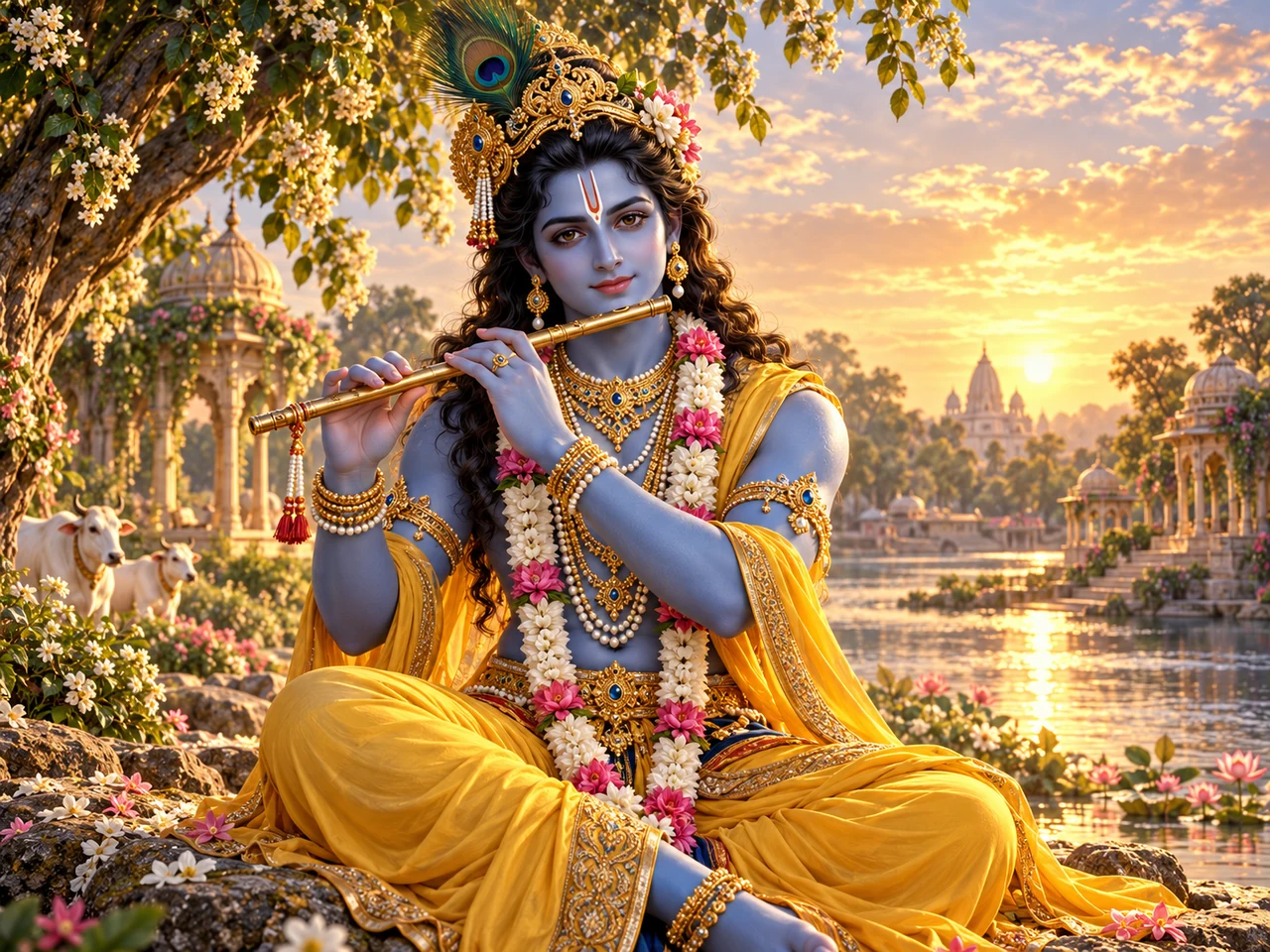
Krishna (Krishna, कृष्ण) is at once the child loved by Yaśodā, the cowherd of Vraja, the trusted friend and guide of Arjuna, a statesman associated with Dvārakā, and the divine beloved of many Vaishnava traditions. These portraits are complementary within devotional life, but their Krishna (Kṛṣṇa, कृष्ण) is at once the child loved by Yaśodā, the cowherd of Vraja, the trusted friend and guide of Arjuna, a statesman associated with Dvārakā, and the divine beloved of many Vaishnava traditions. These portraits are complementary within devotional life, but their literary sources and historical layers differ. The Mahābhārata and its Bhagavad Gītā are especially important for the adult Krishna's ethical counsel; the Harivaṃśa and Bhāgavata Purāṇa, especially Book 10, narrate his family history, childhood and other celebrated deeds. Jayadeva and later Krishna-bhakti traditions give Radha–Krishna devotion further distinctive expression. 1 12 13 16
Reading note: This is an educational profile. Epic and Purāṇic scenes are presented as scriptural narratives, theology as tradition-specific interpretation, and temple history as institutional or historical evidence. It is not a claim that every detail of these texts is established as a modern historical event. Original interpretations are ShivGoraksh editorial prose, not quotations from a translated commentary.
1. Who is Krishna?
The Sanskrit name KrishnaKṛṣṇa ordinarily carries the sense “dark” or “dark-hued,” though theological texts and teachers also develop devotional meanings. In classical images he may appear deep blue, dark as a rain cloud, or dark-luminous rather than as a realistically painted portrait. The figure at the centre of the Gītā is Vāsudeva KrishnaVāsudeva Kṛṣṇa, identified in epic and Vaishnava contexts with a divine presence active in human relationships and history. Krishna's worship may focus on the playful child (Bāla KrishnaBāla Kṛṣṇa), cowherd (Gopāla), Lord of Dvārakā (Dvārakādhīśa), charioteer, or supreme Bhagavān, depending on the tradition. 12 13 21
An important distinction: KrishnaKṛṣṇa is not simply an epithet that always means the same thing in every Sanskrit context. Different texts also use KrishnaKṛṣṇa as a personal name for others, including Draupadī as KrishnaKṛṣṇā. This page concerns the deity and epic figure, not every bearer of the name.
2. Names and their significance
Vāsudeva commonly means son of Vasudeva, while carrying theological significance as a divine name. Devakīnandana honours Devakī; Yaśodānandana remembers the foster-mother's intimate care; Nanda-lāla and Gopāla evoke village childhood and the tending of cows. Govinda and Mādhava have several traditional explanations and should not be reduced to one unqualified dictionary gloss. Keśava, Janārdana, Acyuta, Hari, Mukunda, Dāmodara, and Śyāmasundara carry contexts ranging from the Gītā to later bhakti songs. In the binding episode, the name Dāmodara is associated with the rope around the child's waist; that narrative and subsequent theology should be cited separately from popular etymology. 3 14
Names in a poem or mantra do not by themselves prove the text's antiquity. A modern aarti addressing “Kunj Bihari,” for example, is not automatically a verse of the Bhagavad Gītā. ShivGoraksh keeps devotional-text authorship, manuscript evidence and ritual eligibility under independent review.
3. Krishna, Vishnu and competing Vaishnava theological emphases
Many Vaishnava presentations regard Krishna as an avatāra of Vishnu/Narayana, the divine descending to uphold dharma. Other traditions, notably strands of Gaudiya Vaishnavism, read Bhāgavata Purāṇa 1.3.28 — especially the expression kṛṣṇas tu bhagavān svayam — as affirming Krishna as the original form of the supreme Lord from whom other manifestations proceed. This verse is real; the scope of the theological conclusion belongs to a particular interpretive framework. 11 21
Shri VaishnavaSri Vaishnava theology emphasizes Narayana and his divine forms within Vishishtadvaita; Madhva's tradition presents Vishnu as supreme within Dvaita, with Krishna worship central at Udupi. Vallabha's Puṣṭimārga, Gaudiya traditions, Nimbarka-associated devotional streams and other communities differ in philosophical vocabulary, ritual preference and Radha–Krishna emphasis. No single hierarchy should be asserted on behalf of all Hindus. Nor should the devotional category “avatāra” be mistaken for a historical method of dating texts. 19 21
4. Birth in Mathura: Devaki, Vasudeva and Kamsa
The Bhāgavata Purāṇa narrates Krishna's appearance to Devakī and Vasudeva while the family is threatened by Devakī's brother Kaṃsa. Its Book 10, Chapter 3 presents a remarkable divine appearance, the parents' prayers, and Vasudeva's journey with the infant across the Yamuna to the household of Nanda and Yaśodā in Gokula. This account expressly includes Yogamāyā and the exchange of infants. Calling it merely a “normal secret birth followed by adoption” leaves out the text's theology, while treating the supernatural details as independently proven history goes beyond the evidence. 1
The divine-child narrative joins two intimate forms of kinship: biological parents who recognize a fearsome divine reality and foster parents whose relationship grows through everyday affection. Later Krishna-bhakti traditions expand both experiences in dramatic, musical and artistic forms.
5. Gokul and Vraja: Nanda, Yashoda and Balarama
In Vraja, Krishna grows among cattle, village friends and household routines. Balarāma, his elder brother and close companion, is a major figure in childhood episodes and later Yadava narratives; traditional theologies variously understand his divine relation to Krishna. The Bhāgavata places special weight on Yaśodā's motherly love: in 10.9 she attempts to bind the mischievous butter-loving child to a mortar, repeatedly finding the rope too short until he permits it. The scene speaks of affection powerful enough to hold one described as beyond ordinary measure. 3
Do not confuse “butter thief” devotional affection with historical testimony to a particular domestic event. The story is important because it gives vātsalya-bhakti—love for God as one's child—its evocative vocabulary. Even readers who do not share the theology can understand the literary contrast between cosmic grandeur and domestic closeness.
6. Childhood narratives: Kaliya, Govardhana and protection
Book 10 narrates Krishna's encounter with the serpent Kāliya in a poisoned stretch of the Yamuna (10.16), culminating in the serpent's submission and departure. The story combines a vivid threat to the community with mercy toward the defeated opponent. 4
In the Govardhana narrative (10.25, within a larger episode), the community turns away from a customary offering to Indra; Indra sends fierce rain, and Krishna shelters the people and cattle beneath the lifted hill. Within Vaishnava interpretation, the episode can teach resistance to pride and divine guardianship. It should not be flattened into a scientific account of weather, nor should its festival celebrations be presented as identical in every region. 5
These accounts often inspire dance, painting, sculpture and children's retellings. Explain the original tale and the modern symbolic interpretation separately.
7. Krishna, Radha and the gopis: literary layers matter
The gopīs are central to the Bhāgavata's accounts of longing, song and rāsa (notably 10.29–33). The text describes extraordinary devotion, but it also contains ethically and theologically challenging scenes; the narrative interprets these as divine līlā, not straightforward recommendations for everyday conduct. Its commentarial devotional interpretation must be labelled as such. 6 7
Rādhā becomes a pre-eminent figure in later Krishna-bhakti literature and is fundamental for many Radha–Krishna traditions. Jayadeva's *12th-century Sanskrit Gīta Govinda unmistakably places the emotional union, separation and reunion of Radha and Krishna at the centre; India's Indira Gandhi National Centre for the Arts documents that work and its long artistic reception. It is inaccurate to credit every Radha–Krishna lyric or familiar contemporary image directly to the Gītā. One should also avoid declaring a single fixed source history for Radha without comparing the relevant textual strata. 16
Gaudiya theology commonly treats Radha as the supreme devotee and embodiment of divine loving potency. Other Vaishnava and regional traditions give her different prominence; the relationship of theology, poetry and history is an essential part of this subject.
8. From Mathura to Dvaraka: Kamsa, Yadavas and civic responsibility
In Bhāgavata 10.44, Krishna and Balarama confront Kaṃsa in Mathura. The episode involves public injustice, contest and the return to parents, not only an isolated duel. Other texts, especially the Harivaṃśa, extend the Yadava genealogy and Krishna's movement into the western city of Dvārakā. 8 13
Dvārakā devotion remembers Krishna as Dvārakādhīśa, a royal and civic figure as well as a deity. Stories involving Yadava interests, diplomacy, leadership, difficult political judgments and interpersonal obligations belong to the larger epic-Purāṇic world. The image of a playful flute-player is only one of Krishna's literary identities; the mature political figure requires its own sustained treatment.
9. Rukmini, Satyabhama and other family relationships
Rukmiṇī, princess of Vidarbha, is central to Bhāgavata 10.52–54. She hears about Krishna, expresses her wish to marry him, and opposes plans to arrange her marriage with Śiśupāla; the narrative ends in her marriage to Krishna after conflict with opposing kings. In different devotional traditions Rukmini may be approached in relation to LakshmiLakṣmī, but this is a theological identification requiring context, not merely a biographical claim. 9
Satyabhāmā and Jāmbavatī appear in the Syamantaka account (10.56). Krishna's wider household is described in other Bhāgavata passages with theological symbolism and varying numbers. The figures Rukmini, Radha and the gopīs should not be forced into one undifferentiated “wife list”: they have different narrative locations and devotional meanings. Avoid silently combining Purāṇic passages, regional legend and modern retellings as if they were one edition. 10
10. Krishna in the Mahabharata: friend, envoy and statesman
The Mahābhārata presents Krishna as Arjuna's kinsman and ally, a significant participant in the conflict between Kauravas and Pandavas, and a political actor who attempts to avoid war. His peace embassy belongs to Udyoga Parva; descriptions of diplomacy and decisions are distinct from the later idealized generalization that Krishna “always chose war.” The epic's critical text, prepared at the Bhandarkar Oriental Research Institute, makes it especially important to distinguish received translations and recensions when citing specific episodes. 12
Krishna's choices raise difficult questions: When is restraint wise? What does loyalty require when kinship and justice conflict? How should negotiation end when opponents refuse agreement? A serious educational article neither turns every action into an uncomplicated moral command nor ignores how the traditions interpret the epic as a drama of dharma.
11. Krishna and Arjuna: the setting of the Bhagavad Gita
At Kurukshetra, Arjuna is shaken at the thought of fighting relatives and teachers. Krishna's response in the Bhagavad Gītā unfolds as philosophical conversation inside the war narrative. Krishna is a charioteer and teacher; a crucial motif is that guidance can be given without erasing the student's responsibility to decide. The Gītā's final chapter leads Arjuna back to deliberate action, not to mere passive submission. 14 15 22
The Gītā is about much more than battles: it argues over agency, self, embodiment, mind, discipline, devotion, knowledge and liberation. Its eighteen chapters are a defined scripture within the Mahābhārata. Krishna's childhood, Radha's life and Govardhana worship are not stories narrated by the Gītā; use the appropriate other sources for those subjects.
12. Karma Yoga: action without possessiveness
In Gītā 2.47, Krishna distinguishes one's responsibility to act from control over outcomes and warns against attachment to inaction. This is not the claim that consequences do not matter or that careless effort is acceptable. A careful reading stresses committed, skillful action without making identity depend wholly on success. The familiar idea of niṣkāma karma develops this discipline, though individual commentators differ about the precise philosophical foundations. 14
The argument becomes practical when someone must fulfil responsibility under uncertainty: one can prepare thoughtfully and act with integrity while acknowledging limits on controlling other people's choices. Such contemporary illustrations are editorial applications, not translations of specific Sanskrit words.
13. Jnana Yoga: self, discernment and knowledge
The Gītā's teaching on the imperishable self, changing body, disciplined understanding and the interplay of knowledge and action informs jnanajñāna traditions. Krishna urges Arjuna to examine habitual identification with transient conditions. Yet jnanajñāna is not merely possession of information; it includes a transformation in understanding. Some traditions read this in an Advaita setting, others in theistic Vedanta, with important differences concerning the self and God. 14 22
Readers should distinguish the text of a verse from the interpretations of Shankara, Rāmānuja, Madhva or other teachers. IIT Kanpur's Gītā corpus preserves multiple commentarial readings, making these differences visible rather than declaring one modern gloss universal.Readers should distinguish the text of a verse from the interpretations of Śaṅkara, Rāmānuja, Madhva or other teachers. IIT Kanpur's Gītā corpus preserves multiple commentarial readings, making these differences visible rather than declaring one modern gloss universal.
14. Bhakti Yoga: love, refuge and devotion
The Gītā presents a direct relationship between Krishna and the devotee. In 4.7–8, the divine descent is explained in relation to the decline of dharma; 18.66 gives a prominent teaching of taking refuge in the Lord. Other chapters describe devotion, remembrance and the qualities of the beloved devotee. These statements may be emphasized differently in Shri Vaishnava, Gaudiya, Madhva and other readings, but they should be tied to their actual chapters. gives a prominent teaching of taking refuge in the Lord. Other chapters describe devotion, remembrance and the qualities of the beloved devotee. These statements may be emphasized differently in Sri Vaishnava, Gaudiya, Madhva and other readings, but they should be tied to their actual chapters. 15 22
Bhakti is not simply requesting miraculous outcomes. It includes attention, gratitude, moral transformation, song, service, surrender and relational love. Krishna-bhakti communities develop distinctive practices—temple seva, singing the divine names, meditating on the Lord's childhood, and studying scripture—without all teaching identical initiation requirements or identical ritual sequences.
15. Dharma, liberation and the ethical complexity of Krishna
Krishna is associated with the restoration of dharma, but the term carries contextual meanings: sustaining order, right conduct, personal duties and moral discernment. The Gītā situates its teaching in a hard case, not a convenient example where all duties align. Liberation (mokshamokṣa) is understood in different Krishna traditions as freedom from bondage, loving service of God, or other carefully distinguished theological ends. 15 22
Epic narratives about strategy, warfare, kinship and political choices generate genuine debate. A responsible account records competing interpretive lenses and avoids false certainty. Devotional acceptance that Krishna's acts are divine should be described respectfully while not recasting contentious episodes as simple, generally applicable rules for modern individuals.
16. Major Krishna-bhakti lineages
In Gaudiya Vaishnavism, Chaitanya-associated teachers put Radha–Krishna loving devotion and congregational singing (saṅkīrtana) at the centre. Puṣṭimārga, associated with Vallabhacharya, emphasizes God's grace and loving service (sevā) to Krishna, famously in the child/Krishna forms of household and temple worship. Nimbarka-associated traditions commonly emphasize Radha–Krishna. Madhva's Dvaita places Shri Krishna worship within a theology of Vishnu's supremacy, prominently represented at Udupi. places Sri Krishna worship within a theology of Vishnu's supremacy, prominently represented at Udupi. Shri VaishnavaSri Vaishnava theology gives Krishna an important role within its Narayana-centred tradition. These are concise orientations, not interchangeable labels. 19 21
Regional forms include Braj rāslīlā and kīrtan, Gujarati Dvārakā worship, Odisha's Jagannath tradition, Udupi's monastic temples, South Indian Krishna music and dance, and many family-specific practices. Their histories need separately identified sources before claiming any one rite to be universal.
17. Iconography: flute, peacock feather and many forms
The flute-playing cowherd with peacock feather, yellow garments, ornaments and cows evokes Krishna's Vraja years and the attraction of devotion. The flute is often read spiritually as a call to love; the peacock feather as pastoral beauty and graceful play. Such symbolism is traditional and artistic interpretation, not scientific proof. Images of Bāla Krishna may show butter, a crawling child or a churning rod. At Udupi, the Kadagolu Krishna deity holds churning implements; this iconographic arrangement must not be overwritten by a generic flute-bearing thumbnail description. 19
Another important visual form shows Krishna driving Arjuna's chariot, where wisdom and duty take precedence over pastoral play. Dvārakā images may depict royal attire, while Jagannath's distinctive wooden form in Puri belongs to a wider regional temple theology. There is no universally mandatory Krishna colour palette or instrument in every representation. 20
18. Sacred geography, temples and pilgrimage
Mathura, Gokul, Vṛndāvana, Govardhana and Barsana make up interconnected Braj pilgrimage settings. The Mathura district administration identifies Janmabhoomi, Banke Bihari and other temples as major sites; these living places are meaningful to devotees without turning every geographical association into independently proven epic archaeology. 17
Dvārakā, on Gujarat's coast, has the Dwarkadhish/Jagat Mandir tradition. Government tourism material describes the temple and its local historical traditions, but inherited foundation legends are not identical to verified construction dates. 18
Udupi in Karnataka centres on the Shri Krishna Matha linked to Madhvacharya and its distinctive worship of child Krishna through the in Karnataka centres on the Sri Krishna Matha linked to Madhvacharya and its distinctive worship of child Krishna through the Kanakana Kindi. Puri in Odisha is home to Jagannath, Balabhadra and Subhadra, a living tradition with its own festival calendar and theology; Jagannath's relationship to Krishna/Vishnu is important but should not erase local specificity. 19 20
19. Festivals and observances
Janmashtami celebrates Krishna's birth, with storytelling, fasting in some households, night worship and singing; practices differ. Govardhan Puja / Annakut recalls Govardhana and the offering of food in many Vaishnava traditions. Holi in Braj often foregrounds Radha–Krishna play and the region's local performances. Ratha Yatra is particularly associated with Jagannath at Puri. Some communities observe Gita Jayanti in connection with the teaching of the Gītā. 5 17 20
Festival dates, fasting limits, tithi interpretations and muhurta depend on location, region and independently validated calendars. This evergreen article deliberately supplies no guessed Gregorian dates. No fasting practice is medically required or universally appropriate.
20. Prayers, mantras, aarti and devotional literature
Krishna devotion includes Bhagavad Gītā recitation, Bhāgavata study, public nāma-japa, kirtan, vernacular songs, Sanskrit stotras and temple aartis. A common devotional salutation uses the name Vāsudeva; its exact wording and lineage context should be read in the existing, separately prepared ShivGoraksh work rather than casually attributed to the Gītā. The 68-work Devotion collection already contains relevant draft IDs: (Aarti Kunj Bihari Ki), (Vishnu Sahasranama), (Narayana Ashtakshari) and (Vasudeva Dvadashakshari). These are draft cross-references, not public content or guaranteed production links. 11 14
Jayadeva's *Gīta Govinda is devotional literature central to Radha–Krishna aesthetics, while Sūrdās** and later Hindi devotional poetry give a different register to Krishna's childhood and the emotions of devotees. Do not treat modern popular aartis, original epic text and later devotional songs as interchangeable sources; check editions, authorship and reuse rights individually. 16
21. Which text tells which story?
| Text | Principal relevance here | Important limitation |
|---|---|---|
| Mahābhārata | Krishna in politics, peace efforts, Pandava alliance, war | Not the full childhood narrative 12 |
| Bhagavad Gītā | Krishna–Arjuna dialogue on yoga, duty and liberation | Not a source for Radha's biography or butter theft 14 |
| Harivaṃśa | Supplementary Yadava genealogy and Krishna narrative | Chapter numbering and textual forms depend on edition 13 |
| Bhāgavata Purāṇa, Book 10 | Birth, Vraja, Govardhana, gopīs, Mathura, marriages | Theological narration; not modern event documentation 1 |
| Gīta Govinda | Radha–Krishna longing, separation and reunion | A medieval poem, not the Gītā 16 |
The Bhāgavata exists in multiple published editions and interpretive traditions. The online Krishna sources consulted for this first-pass profile come mainly from Vaishnava publication platforms; their Sanskrit passages can identify narrative locations, while their translations and commentary reflect particular theological commitments. BORI's critical edition identifies a separate scholarly textual standard for the epic and its supplement. 12 13
22. Frequently asked questions
Is Krishna an avatar of Vishnu or Bhagavan himself? Both descriptions occur within different Vaishnava frameworks. Many describe an avatar of Vishnu; some Gaudiya and other Krishna-centred readings, appealing especially to Bhāgavata 1.3.28, prioritize Krishna as the original Lord. 11
Are Radha and Rukmini the same person? They occupy distinct narrative and devotional roles. Different traditions explain their divine relationships differently; they should not be collapsed into one historical identity. 9 16
Does the Bhagavad Gita contain Krishna's childhood stories? No. The Gītā centres on Krishna teaching Arjuna. The Harivaṃśa and Bhāgavata supply extensive childhood narratives. 12 13
What is the significance of the flute? It is a prominent image of attraction, pastoral affection and the calling of devotees. That symbolism differs by artistic and devotional setting; not every Krishna murti holds a flute.
Why is Krishna called Dāmodara? The best-known devotional explanation refers to Yaśodā's binding episode in Bhāgavata 10.9. 3
Is the rāsa episode a license to imitate every divine action? No. The text's own devotional commentators emphasize that the divine narrative is not a general model for human conduct. 7
Where should I read Krishna's philosophical teachings? Begin with Gītā chapters 2–6, 9, 12 and 18, then compare recognized commentarial traditions. 14 22
When is Janmashtami this year? This evergreen page makes no local calendar claim. Use an independently validated occurrence for your region, tithi convention and rule profile.
23. Glossary
- Avatāra: divine manifestation or descent in specified traditions.
- Bhakti: devotion, relationship and loving participation in worship.
- Dharma: context-dependent order, obligation and right conduct.
- Jnana:Jñāna: knowledge or transformative understanding.
- Karma-yoga: disciplined, responsible action without possessive attachment to results.
- Līlā: divine play in devotional theology.
- Moksha:Mokṣa: liberation; definitions vary by philosophical school.
- Vātsyala: parent-like loving devotion, particularly vivid in Yaśodā narratives.
- Rāsa: a devotional dance narrative interpreted within a particular theological context.
- Sevā: devotional service, differing in form by institution and lineage.