



*ShivGoraksh educational reading — educational reading, not a ritual manual. The accounts below are identified by their textual traditions; they are not claims of independently established ancient history.
Who is Lord Rama?
Shri Rama (श्रीराम) is among the most deeply loved figures in Hindu religious life. He is the prince of Ayodhyā, the husband of Sītā, the elder brother of Lakṣmaṇa, Bharata and Śatrughna, the friend and ally of Hanuman and Sugrīva, and the central figure of the Rāmāyaṇa traditions. Many Vaiṣṇava communities worship him as an avatāra—divine descent—of Vishnu; some Rama-centred devotional traditions approach Rama himself as the supreme Lord. The Śrī Rāma (श्रीराम) is among the most deeply loved figures in Hindu religious life. He is the prince of Ayodhyā, the husband of Sītā, the elder brother of Lakṣmaṇa, Bharata and Śatrughna, the friend and ally of Hanumān and Sugrīva, and the central figure of the Rāmāyaṇa traditions. Many Vaiṣṇava communities worship him as an avatāra—divine descent—of Viṣṇu; some Rāma-centred devotional traditions approach Rāma himself as the supreme Lord. The Vālmīki Rāmāyaṇa presents both an extraordinary human life and, in important passages, a divine mission associated with Vishnu. These layers are best read in context rather than flattened into a single doctrinal formula. presents both an extraordinary human life and, in important passages, a divine mission associated with Viṣṇu. These layers are best read in context rather than flattened into a single doctrinal formula. 2 3 9
Devotees often call him Maryādā Puruṣottama, the exemplary person whose conduct is framed by moral boundaries, responsibility and the demands of dharma. This is an interpretive devotional title, not proof that every narrated act is beyond ethical debate. Indeed, the epic preserves painful choices and serious questions about rule, loyalty and justice. Rama's importance lies partly in the continuing work of discussing those questions. , the exemplary person whose conduct is framed by moral boundaries, responsibility and the demands of dharma. This is an interpretive devotional title, not proof that every narrated act is beyond ethical debate. Indeed, the epic preserves painful choices and serious questions about rule, loyalty and justice. Rāma's importance lies partly in the continuing work of discussing those questions. 6 7 16
Names, titles and what they suggest
- Rama / राम:Rāma / राम: the name of the prince and divine focus of Rama-bhakti. Sanskrit devotional interpretation associates the name with delight or the giving of joy; a single universally settled etymology should not be claimed without a lexical source. the name of the prince and divine focus of Rāma-bhakti. Sanskrit devotional interpretation associates the name with delight or the giving of joy; a single universally settled etymology should not be claimed without a lexical source.
- Rāmacandra / रामचन्द्र: a widespread honorific, evoking the moon in devotional usage.
- Rāghava / राघव: descended from the Raghu lineage; Raghuvīra means hero of that house.
- Dāśarathi / दाशरथि: son of Daśaratha.
- Kākutstha / काकुत्स्थ: an ancestral dynastic designation found in the Sanskrit epic.
- Sītāpati / सीतापति: husband of Sītā; the relational title never reduces Sītā's own theological or narrative importance.
- Kodanda Rama / कोदण्ड राम:Kodanda Rāma / कोदण्ड राम: Rama with the bow, important in some regional iconographic traditions. Rāma with the bow, important in some regional iconographic traditions.
- Maryādā Puruṣottama: the most excellent person in the language of appropriate conduct and limits; meanings depend on the speaker's ethical and devotional framework.
Names in a hymn are not always separate historical persons or independent manifestations. Nor do titles by themselves establish specific miracles or obligations for readers. 2 9
Rama, Vishnu and different theological readings
In Bāla Kāṇḍa 1.15, the gods appeal for relief from Rāvaṇa's tyranny; Vishnu's descent into human life is part of the narrative's explanation of Rama's birth. 1.15, the gods appeal for relief from Rāvaṇa's tyranny; Viṣṇu's descent into human life is part of the narrative's explanation of Rāma's birth. Bāla Kāṇḍa 1.18 describes Rama as born to Kausalyā in Daśaratha's family and associates his birth with Vishnu's divine reality. Exactly how a divine manifestation relates to the supreme is interpreted differently in Vaiṣṇava traditions. 1.18 describes Rāma as born to Kausalyā in Daśaratha's family and associates his birth with Viṣṇu's divine reality. Exactly how a divine manifestation relates to the supreme is interpreted differently in Vaiṣṇava traditions. 2 3
In Shri Vaiṣṇava theology, devotion to Rama forms part of devotion to Nārāyaṇa/Viṣṇu and is often interpreted through In Śrī Vaiṣṇava theology, devotion to Rāma forms part of devotion to Nārāyaṇa/Viṣṇu and is often interpreted through śaraṇāgati, taking refuge in God. Rāmānandī and other Rama-centred movements have their own emphases on the divine name, grace and accessible devotion. In the , taking refuge in God. Rāmānandī and other Rāma-centred movements have their own emphases on the divine name, grace and accessible devotion. In the Adhyātma Rāmāyaṇa, Rama is treated explicitly through a Vedāntic vision of the ultimate divine reality; this is not identical to the more human dramatic register in many episodes of the , Rāma is treated explicitly through a Vedāntic vision of the ultimate divine reality; this is not identical to the more human dramatic register in many episodes of the Vālmīki Rāmāyaṇa. These are descriptions of different interpretive communities, not a ranking of their legitimacy. 9 10 16
Rama should not be presented as a different unrelated deity from Vishnu in traditions that identify him as Vishnu's avatāra, nor should a single avatāra taxonomy be imposed on schools that place the fullest divinity in Rama himself. ShivGoraksh links him to Rāma should not be presented as a different unrelated deity from Viṣṇu in traditions that identify him as Viṣṇu's avatāra, nor should a single avatāra taxonomy be imposed on schools that place the fullest divinity in Rāma himself. ShivGoraksh links him to Vishnu for a complementary study of Vishnu. for a complementary study of Viṣṇu.
Birth, dynasty and Ayodhya
The Vālmīki Rāmāyaṇa places Rama in the Ikṣvāku/Raghu royal line of Kosala. King Daśaratha's principal wives are Kausalyā, Kaikeyī and Sumitrā. Rama is Kausalyā's son; Bharata is associated with Kaikeyī; Lakṣmaṇa and Śatrughna with Sumitrā. The epic's places Rāma in the Ikṣvāku/Raghu royal line of Kosala. King Daśaratha's principal wives are Kausalyā, Kaikeyī and Sumitrā. Rāma is Kausalyā's son; Bharata is associated with Kaikeyī; Lakṣmaṇa and Śatrughna with Sumitrā. The epic's Bāla Kāṇḍa recounts Daśaratha's desire for sons, the royal rites and Rama's birth. The ninth lunar day of the bright half of Chaitra is central to Rama Navamī observance; it is not a fixed annual Gregorian date. recounts Daśaratha's desire for sons, the royal rites and Rāma's birth. The ninth lunar day of the bright half of Caitra is central to Rāma Navamī observance; it is not a fixed annual Gregorian date. 2 3 15
Ayodhyā is a living city and major place of pilgrimage today. Its sacred identification with the epic capital belongs to the history of devotional geography; claims about exact dates and events in prehistoric antiquity require a different evidentiary standard than describing belief or current religious practice. 11
Childhood, Vishvamitra, and marriage to Sita
The epic narrates Rama's training within the royal household, followed by the sage Viśvāmitra's request that Rama and Lakṣmaṇa help protect his rites. The journey brings them into encounters with Tāṭakā and other adversaries, the episode of Ahalyā, and ultimately Mithilā. In King Janaka's court, Rama meets the test involving Shiva's formidable bow and marries Sītā. The epic narrates Rāma's training within the royal household, followed by the sage Viśvāmitra's request that Rāma and Lakṣmaṇa help protect his rites. The journey brings them into encounters with Tāṭakā and other adversaries, the episode of Ahalyā, and ultimately Mithilā. In King Janaka's court, Rāma meets the test involving Śiva's formidable bow and marries Sītā. Bāla Kāṇḍa 1.73 explicitly describes the wedding celebrations and the marriages of the brothers. Later traditions embellish these episodes with different poems, dialogues and theology. 4 9
Sītā is not only a companion in Rama's biography. Her decisions, words, suffering, courage and worship as Jānakī are essential to a responsible account. Janakpur's Jānakī Mandir remains an important centre of Mithilā pilgrimage and Vivāha Pañcamī devotion. Sītā is not only a companion in Rāma's biography. Her decisions, words, suffering, courage and worship as Jānakī are essential to a responsible account. Janakpur's Jānakī Mandir remains an important centre of Mithilā pilgrimage and Vivāha Pañcamī devotion. 13
The exile: obedience, loss and relationships
The Ayodhyā Kāṇḍa turns the expected coronation into a moral crisis. Kaikeyī invokes royal boons; Daśaratha is bound by his pledge; Rama accepts exile rather than claim the throne immediately. Sītā and Lakṣmaṇa accompany him. Daśaratha dies in grief, while Bharata rejects the fruits of his mother's request. During the brothers' meeting, Bharata asks Rama to return, but Rama insists on fulfilling their father's promise; Bharata governs as caretaker in his brother's name. This moving dispute is a conversation about obligations that cannot all be satisfied at once, not simply a lesson in passive obedience. turns the expected coronation into a moral crisis. Kaikeyī invokes royal boons; Daśaratha is bound by his pledge; Rāma accepts exile rather than claim the throne immediately. Sītā and Lakṣmaṇa accompany him. Daśaratha dies in grief, while Bharata rejects the fruits of his mother's request. During the brothers' meeting, Bharata asks Rāma to return, but Rāma insists on fulfilling their father's promise; Bharata governs as caretaker in his brother's name. This moving dispute is a conversation about obligations that cannot all be satisfied at once, not simply a lesson in passive obedience. 5 9
Accounts of Guha, forest-dwelling communities, the boatman in later Mānas devotion, and the brothers' journey receive differing emphasis across versions. For Chitrakoot devotees, the remembered forest residence and Bharat Milap are central to local pilgrimage. 12 9
Forest life, Sita's abduction and the turning point
The Araṇya Kāṇḍa recounts forest ascetics, encounters with Śūrpaṇakhā, the deceptive deer associated with Mārīca and Rāvaṇa's abduction of Sītā. Rama and Lakṣmaṇa search for her, while the broader narrative explores loyalty, fear, violence and uncertainty. Jaṭāyu's resistance to the abduction receives a lasting place in devotional remembrance. recounts forest ascetics, encounters with Śūrpaṇakhā, the deceptive deer associated with Mārīca and Rāvaṇa's abduction of Sītā. Rāma and Lakṣmaṇa search for her, while the broader narrative explores loyalty, fear, violence and uncertainty. Jaṭāyu's resistance to the abduction receives a lasting place in devotional remembrance. 8
A vital textual distinction concerns Māyā Sītā: the Adhyātma Rāmāyaṇa develops the account of a protected true Sītā and a shadow form who is abducted; related readings appear in Tulsidas's tradition. Do not insert this episode into a paraphrase of the earlier Vālmīki narrative as if every recension contained it. 10 16
Sugriva, Vali and Hanuman
In the Kiṣkindhā Kāṇḍa, Rama befriends Sugrīva, whose conflict with his elder brother Vāli complicates the search for Sītā. Rama's killing of Vāli is , Rāma befriends Sugrīva, whose conflict with his elder brother Vāli complicates the search for Sītā. Rāma's killing of Vāli is not an ethically unexamined incident: Vāli raises direct objections, and Rama gives reasons framed in : Vāli raises direct objections, and Rāma gives reasons framed in rājadharma and punishment. Readers may study the argument alongside later religious defences and modern criticism without pretending all interpretations agree. 6
Hanuman becomes a defining figure of devoted service, discernment and courage. His sea crossing, meeting with Sītā in Laṅkā and reassurance to her are central to the Hanumān becomes a defining figure of devoted service, discernment and courage. His sea crossing, meeting with Sītā in Laṅkā and reassurance to her are central to the Sundara Kāṇḍa. The Rama–Hanuman relationship unites affection, agency and devotion; it also forms the bridge to ShivGoraksh's existing Hanuman entity . The Rāma–Hanumān relationship unites affection, agency and devotion; it also forms the bridge to ShivGoraksh's existing Hanumān entity Hanuman. 8
Ravana, the war and the meaning of victory
The Yuddha Kāṇḍa depicts the alliance of Rama's forces, the crossing toward Laṅkā, fierce battles, the role of Vibhīṣaṇa, and Rāvaṇa's defeat. The narrative places the conflict within the restoration of moral order, yet its characters have obligations and vulnerabilities that resist a simple good-versus-evil slogan. Rāvaṇa is both a formidable, learned figure in tradition and the agent of Sītā's violent abduction. His learning does not remove the ethical force of his actions. depicts the alliance of Rāma's forces, the crossing toward Laṅkā, fierce battles, the role of Vibhīṣaṇa, and Rāvaṇa's defeat. The narrative places the conflict within the restoration of moral order, yet its characters have obligations and vulnerabilities that resist a simple good-versus-evil slogan. Rāvaṇa is both a formidable, learned figure in tradition and the agent of Sītā's violent abduction. His learning does not remove the ethical force of his actions. 8 7
Sītā's ordeal after her recovery is among the epic's most difficult episodes. Later devotional texts respond by changing its narrative logic, notably through the shadow-Sītā explanation. Presenting only a triumphant wedding-ending would conceal a major subject of interpretation and criticism; presenting one later explanation as Vālmīki's original reading would be equally misleading. 8 10
Return, Rama Rajya and the responsibilities of a king
Yuddha Kāṇḍa 128 describes Rama's return, Bharata's return of the royal charge, his consecration, gifts and the idealized well-being of the kingdom. 128 describes Rāma's return, Bharata's return of the royal charge, his consecration, gifts and the idealized well-being of the kingdom. Rama RājyaRāma Rājya thus becomes a powerful religious and cultural expression for just governance. In responsible modern explanation, it should be treated as an ethical ideal, not evidence that a specific historical state achieved an objectively measured utopia. 7
The ideal asks more of a ruler than victory: protection, accountability, truthfulness, sympathy and the recognition that power is held for others. It also opens criticism: how should the welfare of subjects be balanced with the rights and dignity of those closest to the ruler? That question is sharpened by subsequent Sītā narratives. Different textual recensions and studies debate the status and interpretation of the Uttara Kāṇḍa; a complete account must identify the recension before citing later life episodes as universally shared. 1 10
Rama as Maryada Purushottama: a thoughtful ethical reading
Maryādā names an appropriate boundary, norm or measure; puruṣottama suggests exemplary excellence. Rama's fidelity to promises, willingness to face hardship and attention to duties make him an ethical model for many devotees. Yet suggests exemplary excellence. Rāma's fidelity to promises, willingness to face hardship and attention to duties make him an ethical model for many devotees. Yet dharma in narrative is not reducible to memorizing rules. Duties to parents, spouse, brothers, friends, kingdom and truth can conflict. Rama's encounter with Bharata and the Vāli debate are therefore especially valuable places to examine the limits of an overly simple slogan. in narrative is not reducible to memorizing rules. Duties to parents, spouse, brothers, friends, kingdom and truth can conflict. Rāma's encounter with Bharata and the Vāli debate are therefore especially valuable places to examine the limits of an overly simple slogan. 5 6
A helpful distinction for readers is between what a text narrates, what a traditional commentator praises, and what a contemporary reader concludes. One can study Sītā's agency or the anguish caused by kingship decisions respectfully without dismissing Rama-bhakti or requiring all readers to share one moral verdict.. One can study Sītā's agency or the anguish caused by kingship decisions respectfully without dismissing Rāma-bhakti or requiring all readers to share one moral verdict.
Philosophical and spiritual teachings
Rama's story invites reflection on Rāma's story invites reflection on dharma (situated responsibility), satya (truthfulness), tyāga (renunciation), dayā (compassion), śaraṇāgati (seeking refuge), and bhakti (loving devotion). In more explicitly Vedāntic Rama traditions, the prince is read not merely as a heroic figure but as the self-revealing divine ground of existence. In the (loving devotion). In more explicitly Vedāntic Rāma traditions, the prince is read not merely as a heroic figure but as the self-revealing divine ground of existence. In the Rāmcharitmānas, loving remembrance, the divine name, and grace shape the poetry's spiritual voice; these devotional emphases cannot be assumed to be verbatim teachings in the Vālmīki Rāmāyaṇa. 9 10 16
The most practical ethical lesson need not be a rule to imitate every plot event. Rather, the epic teaches attention to commitments, thoughtful speech, solidarity with people in danger, and humility about the cost of choices. This paragraph is ShivGoraksh interpretation, not a translated ancient verse.
Rama Bhakti and different devotional movements
Rama-bhakti includes Sanskrit temple theology, domestic family worship, the singing of the divine name, oral storytelling, dramatic Rāma-bhakti includes Sanskrit temple theology, domestic family worship, the singing of the divine name, oral storytelling, dramatic Rāmlīlā, and regional poetry. Tulsidas's sixteenth-century Rāmcharitmānas, composed in Awadhi, had immense influence across North India. It is a creative devotional work with its own architecture and theology, not simply a Hindi translation of Vālmīki. 9 16
Other traditions use the Adhyātma Rāmāyaṇa, Tamil Kampaṉ's Irāmāvatāram, Krittivasi Bengali narratives, Jain retellings, Southeast Asian adaptations, and local performance cycles. Their differences may concern theology, character motivation, chronology, imagery and endings. Calling every retelling a corruption of one supposedly identical narrative obscures the actual literary and religious history. 10 16
In many places, Rama is worshipped together with Sītā, Lakṣmaṇa and Hanuman. Their shared imagery represents relationship and service, not merely a royal portrait.In many places, Rāma is worshipped together with Sītā, Lakṣmaṇa and Hanumān. Their shared imagery represents relationship and service, not merely a royal portrait.
Iconography: bow, arrows and companions
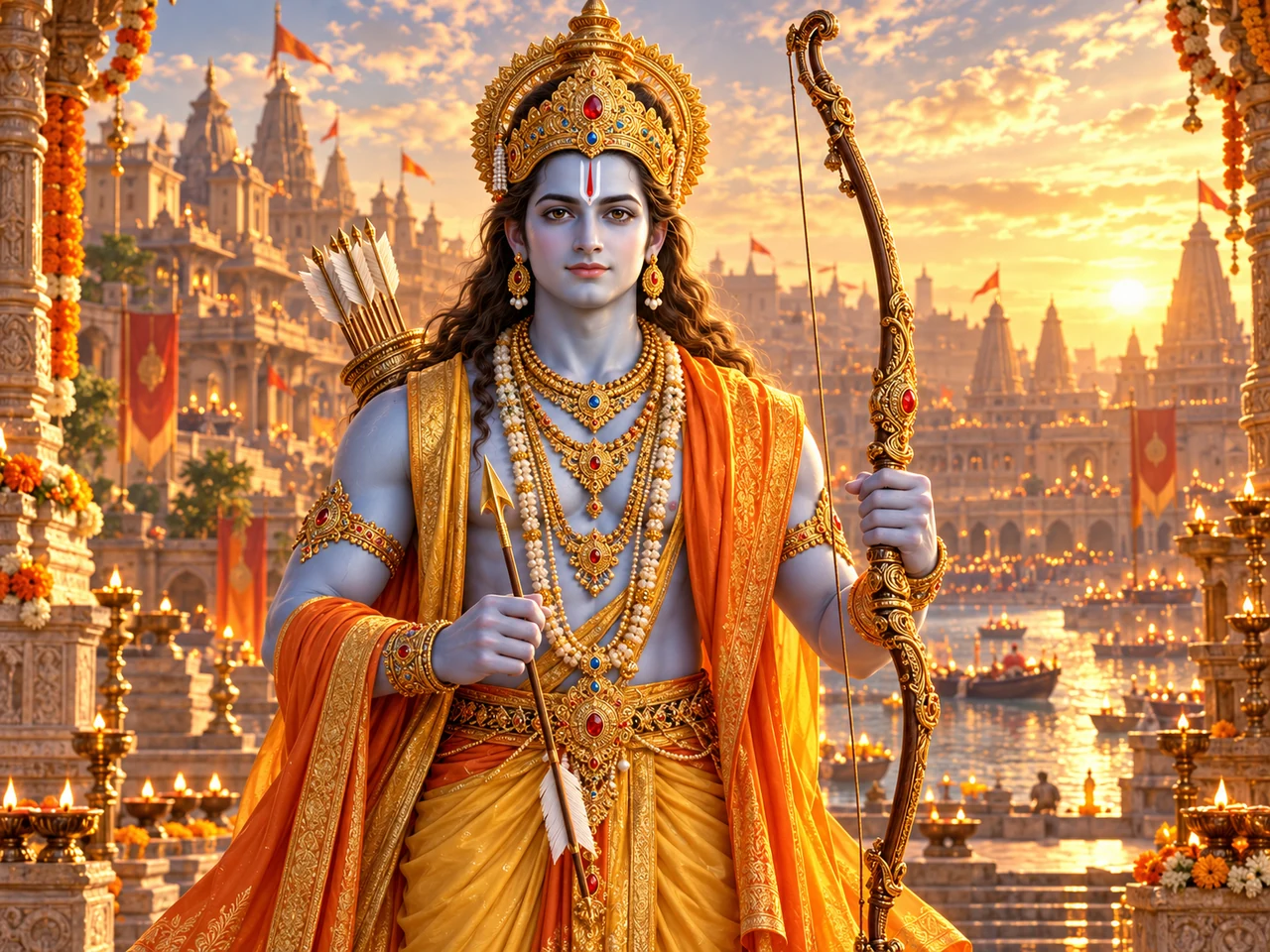
A common image shows Rama as a youthful king or prince with a bow and quiver; he may stand with Sītā, Lakṣmaṇa and Hanuman. The bow represents capacity and responsibility to protect; the arrow can be read as purposeful action. These are devotional interpretations of iconography, not a claim that one symbol has only one meaning. Blue or greenish-blue colouring, a crown, royal dress and forest clothing appear in different regional images. A common image shows Rāma as a youthful king or prince with a bow and quiver; he may stand with Sītā, Lakṣmaṇa and Hanumān. The bow represents capacity and responsibility to protect; the arrow can be read as purposeful action. These are devotional interpretations of iconography, not a claim that one symbol has only one meaning. Blue or greenish-blue colouring, a crown, royal dress and forest clothing appear in different regional images. 9 12
Images of Rama worshipping Shiva, especially in Rāmeśvaram tradition, are an important reminder that Hindu devotional geography often crosses modern sectarian boundaries. The Ramanathaswamy shrine is primarily a Shiva temple while also holding a powerful Rāmāyaṇa association. Images of Rāma worshipping Śiva, especially in Rāmeśvaram tradition, are an important reminder that Hindu devotional geography often crosses modern sectarian boundaries. The Ramanathaswamy shrine is primarily a Śiva temple while also holding a powerful Rāmāyaṇa association. 14
Temples and pilgrimage landscapes
- Ayodhyā, Uttar Pradesh: Rama's revered birth-city, with Shri Rām Janmabhūmi Mandir, Hanuman Garhi, Kanak Bhawan, Sarayū ghats and other sites. Exact historical identification of particular epic events must not be inferred from present-day architecture. Rāma's revered birth-city, with Śrī Rām Janmabhūmi Mandir, Hanumān Garhi, Kanak Bhawan, Sarayū ghats and other sites. Exact historical identification of particular epic events must not be inferred from present-day architecture. 11
- Chitrakoot, Uttar Pradesh–Madhya Pradesh: remembered for forest residence, the meeting of Bharata and Rama, Rāmghāṭ and Kamadgiri parikramā. remembered for forest residence, the meeting of Bharata and Rāma, Rāmghāṭ and Kamadgiri parikramā. 12
- Janakpur, Nepal: especially centred on Sītā/Jānakī and the marriage tradition; Janaki Mandir and Vivāha Pañcamī are major expressions of this relationship. 13
- Rāmeśvaram, Tamil Nadu: sacred to Shiva at Ramanathaswamy Temple and closely tied by tradition to Rama's Laṅkā journey and devotion to Shiva. sacred to Śiva at Ramanathaswamy Temple and closely tied by tradition to Rāma's Laṅkā journey and devotion to Śiva. 14
- Other living centres: numerous local Rama, Sītā-Rama and Hanuman shrines across India and the wider diaspora; a future directory should verify each address and hours individually. numerous local Rāma, Sītā-Rāma and Hanumān shrines across India and the wider diaspora; a future directory should verify each address and hours individually.
Festivals and observances
Rama NavamīRāma Navamī recalls Rama's birth, traditionally on Chaitra śukla navamī; it may coincide with the conclusion of Chaitra Navratri practices. recalls Rāma's birth, traditionally on Caitra śukla navamī; it may coincide with the conclusion of Caitra Navarātri practices. Dīpāvalī/Deepotsav is associated in prominent North Indian traditions with the joyful return to Ayodhyā, though Diwali has other important religious meanings elsewhere. Vijayadaśamī/Daśaharā often dramatizes Rāvaṇa's defeat, while Vivāha Pañcamī celebrates the Rama–Sītā wedding, especially in Mithilā. Some communities observe Rama-nāma celebrations and celebrates the Rāma–Sītā wedding, especially in Mithilā. Some communities observe Rāma-nāma celebrations and Rāmāyaṇa recitations on additional days. 11 13 15
No Gregorian date, location-specific tithi, fasting obligation or auspicious time is supplied here. These require the separately verified ShivGoraksh Calendar and the relevant local tradition.
Mantras, aarti, stotras and reading traditions
A widely used short devotional salutation is Shri RāmŚrī Rām or Jai Shri RāmJai Śrī Rām; these are common expressions of reverence, not a universal ritual requirement. Do not assume that merely listing a mantra confers initiation or authorizes specified counts. 17
The Rāmcharitmānas, Vālmīki's epic, Hanuman ChalisaHanumān Cālīsā (), Saṅkaṭamocana Hanuman AṣṭakSaṅkaṭamocana Hanumān Aṣṭak () and various Rama stotras belong to different textual genres, authorships and reuse conditions. () and various Rāma stotras belong to different textual genres, authorships and reuse conditions. Āditya Hṛdayam () occurs in the war setting of the Rāmāyaṇa; this does not make it a Rama-composed hymn.; this does not make it a Rāma-composed hymn.
Seven principal books and a textual caution
| Book | Broad narrative emphasis |
|---|---|
| Bāla | Birth, youth, Viśvāmitra, Sītā's marriage |
| Ayodhyā | Planned coronation, exile, Bharata and loyalty |
| Araṇya | Forest, encounters, Sītā's abduction |
| Kiṣkindhā | Sugrīva–Vāli, friendship, search begins |
| Sundara | Hanuman's journey and encounter with SītāHanumān's journey and encounter with Sītā |
| Yuddha | Laṅkā conflict, return, coronation |
| Uttara | Later-life episodes in recensions that include this book |
Some modern online presentations focus on the first six books; seven-book traditions circulate too. Scholarly critical editions and regional recensions differ in readings and sometimes in material included. This article uses checked episode locators from a named electronic witness, not a character-by-character collation of the Baroda Critical Edition. 1 8
Frequent questions
Is Rama Vishnu? Many Vaiṣṇava traditions affirm Rama as a Vishnu avatāra. Some Rama-centred traditions understand the relationship in a different theological hierarchy. Always name the tradition. Many Vaiṣṇava traditions affirm Rāma as a Viṣṇu avatāra. Some Rāma-centred traditions understand the relationship in a different theological hierarchy. Always name the tradition. 2 10
Is Rama the same as Paraśurāma?Is Rāma the same as Paraśurāma? No. They are distinct figures bearing the name Rama and appear in different narrative roles; do not merge their biographies. No. They are distinct figures bearing the name Rāma and appear in different narrative roles; do not merge their biographies.
Is the Rāmcharitmānas simply the Vālmīki Rāmāyaṇa in Hindi? No. It is a distinct Awadhi devotional composition with its own voice, structure and episodes. 9
Did all sources tell the Māyā Sītā story? No. It is prominent in the Adhyātma Rāmāyaṇa and related later devotional narrations; source-specific attribution is essential. 10
What about the killing of Vāli? Vāli's objection and Rama's justification are explicitly present in the Vāli's objection and Rāma's justification are explicitly present in the Kiṣkindhā Kāṇḍa. The episode invites serious study, not erasure. 6
What about Sītā's later exile? The event appears in Uttara Kāṇḍa traditions and later retellings, whose textual histories differ. It should not be silently inserted into the six-book electronic witness used for many of this article's locators. 1 8
Is Rama Rājya a proven historical system?Is Rāma Rājya a proven historical system? It is an influential religious-ethical image of exemplary kingship. Literary descriptions do not by themselves establish measurable historical conditions. 7
Do I need to perform an elaborate puja to learn about Rama?Do I need to perform an elaborate pūjā to learn about Rāma? No. This is a reading resource. Household customs, liturgy and any ritual rules should be drawn from a separately reviewed tradition-specific guide.
Is Rama worship only a North Indian tradition?Is Rāma worship only a North Indian tradition? No. The story and devotion have many South Asian and Southeast Asian forms, including temple, literary and performance traditions. 16
Glossary
Avatāra: divine descent or manifestation. Dharma: order, responsibility and right conduct, always interpreted in context. Bhakti: devotional love and service. Maryādā: appropriate limits and norms. Rama Rājya:Rāma Rājya: idealized Rama kingship. idealized Rāma kingship. Śaraṇāgati: taking refuge in the divine. Kāṇḍa: a major book of an epic. Tithi: lunar day; not equivalent to a fixed civil calendar date.