



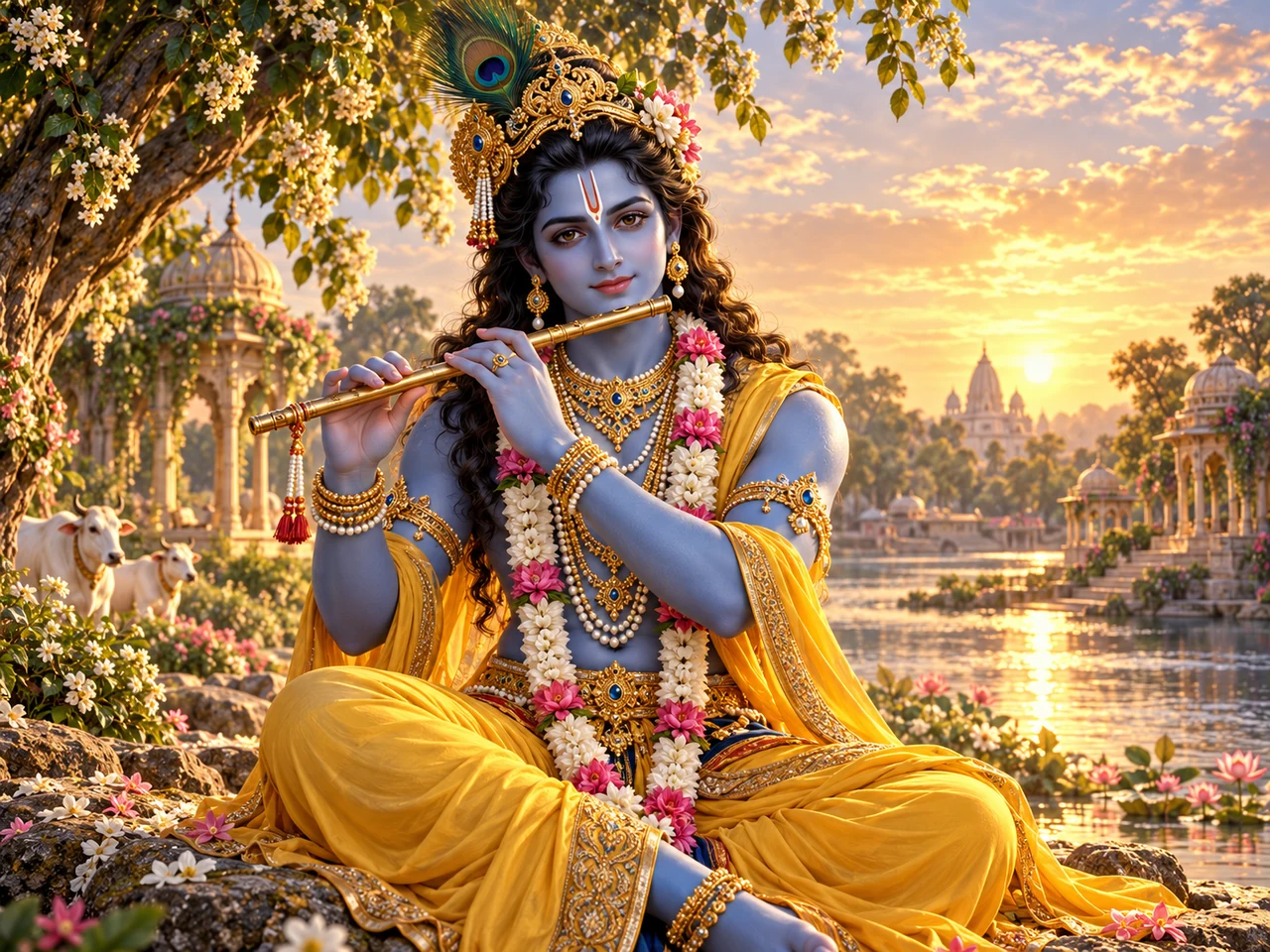
Edition notice: Provisional eight-verse text of the 1928 Puṣṭimārgīya Stotraratnākara, as reported in a print-linked transcription. The original scanned pages have not been independently collated in this preparation; substantive variant readings and rights require review. educational edition — not approved for publication. 1 2
Understanding the hymn
Madhura means sweet, pleasing or tenderly beloved. The refrain madhurādhipaterakhilaṃ madhuram says that everything belonging to the Lord of sweetness is sweet; in this poem the Lord is Krishna. Starting with his smile and gaze, the poet’s attention spreads to his speech, flute, friendship, river, cowherds and even the tensions of change. The eight stanzas are an affectionate devotional vision, not a claim about the chemical sweetness of objects or a guarantee of worldly success. 1 2
In the Puṣṭimārga context connected with Vallabhācārya, devotion often stresses Krishna’s grace, playful presence and loving sevā. This helps explain why small familiar details—dust, a staff, sleep, a garment—can carry great emotional weight. The stotra can be appreciated outside the formal practices of that tradition without representing it as a mandatory initiated rite. 6
A short guide to key terms
- Madhura: sweet, delightful or intimately beloved; emotional and aesthetic as well as sensory.
- Madhurādhipati: the Lord of sweetness, Krishna in the present hymn.
- Līlā: divine play; activity understood in a devotional relationship, not a simplistic claim that every event is pleasant.
- Sakhya: friendship; an affectionate way of relating to Krishna.
- Vraja and Yamunā: pastoral place-imagery linked to Krishna’s stories.
- Guñjā: brightly coloured seeds invoked as ornaments.
- Bhakta / bhukta: an especially important reported variant in verse 4; avoid replacing one with the other without an edition note.
Why some recitations sound different
The eight-verse boundary is broadly stable, but individual readings are not. The reported 1928 version has bhaktaṃ (verse 4), bhuktaṃ and iṣṭaṃ (verse 7), while Sanskrit Documents prints bhuktaṃ, muktaṃ, and dṛṣṭaṃ in those positions. A Wikisource text even substitutes a Rādhā-related line in verse 7; this is not inserted into the historical-print-based draft. Verse 5 also circulates with smaraṇaṃ instead of ramaṇaṃ (recorded in 7). These distinctions affect meaning and must remain visible. No ninth stanza, phalaśruti, nyāsa, or ritual instruction has been added. 2 3 4
Reader questions
Is Madhurāṣṭakam the same as a Krishna aarti? No. It is an eight-verse Sanskrit hymn of praise; aarti is a different liturgical genre. The ShivGoraksh Aarti Kunj Bihari Ki is another work, not an alternate chapter of this poem. Does the English page contain the original text? Yes. The opening block is Sanskrit transliterated into IAST, not an English paraphrase; the English meaning follows separately. Why does verse 4 say bhaktam rather than bhuktam? The reported 1928 print has bhaktam. Many popular versions use bhuktam. This important uncertainty is explicit until independent print collation and expert linguistic review are completed. Where is the ninth verse or the promise of benefits? The selected hymn is eight verses long; the printed colophon is not another verse. No extra benefit-claiming verse is included. Does every reader need to adopt Puṣṭimārga practice? No. The hymn’s literary and devotional interpretation can be read openly; initiation, ritual schedules and eligibility are separate questions and not instructed here. Is Vallabhācārya’s authorship certain? The traditional credit is documented, but attribution based on a closing line or catalogue record is not the same as conclusive historical authorship.
Additional passage commentary
Verse 1 — The face, smile and inner heart
Meaning: His lips are sweet; his face is sweet; his eyes and smile are sweet. His heart and way of moving are sweet. Everything belonging to the Lord of sweetness is sweet. Explanation: The poem begins with details that anyone can notice in a loved presence: lips, face, gaze and laughter. It then moves inward to hṛdayam, the heart or inward disposition, and outward again to gamanam, the manner of walking. The refrain is more than a list of pleasant physical traits: it declares that a devotee experiences Krishna’s entire being through affection. Madhura can mean sweet, pleasing or endearing; it is a relational, poetic judgment rather than a scientific quality. The verse does not insist that one particular depiction of Krishna is the only valid one.
Verse 2 — Speech, conduct and graceful movement
Meaning: His speech is sweet, his conduct or story is sweet, his clothing and graceful turns are sweet. His movement and roaming are sweet: everything of the Lord of sweetness is sweet. Explanation: The viewpoint broadens from appearance to action. Vacana concerns speech; carita can mean conduct or deeds and may also evoke the stories through which devotees remember Krishna. Vasana means clothing, while valita suggests bending, turning or a graceful bodily inflection. Calita and bhramita are related but not identical: movement and wandering do not need to be collapsed into one word. This repeated praise gives everyday gestures spiritual significance within bhakti. Some digital witnesses rearrange the first words of the verse; the draft follows the selected reported 1928 order. Edition note: वचनं ... चरितं ... वसनं ↔ वसनं ... चरितं ... वचनं. These are recorded as alternatives, not inserted into the selected Sanskrit.
Verse 3 — Flute music, dust, dance and friendship
Meaning: His flute is sweet, the dust associated with him is sweet; his hand and both feet are sweet. His dance and his friendship are sweet. Everything of the Lord of sweetness is sweet. Explanation: Veṇu is the flute, an especially recognisable emblem of Krishna in Vraja devotion. Reṇu, dust, evokes the earth of Vraja and the dust raised by footsteps; calling it sweet lifts an ordinary material into the realm of loving memory. The grammatical endings vary: madhuro with masculine nouns, madhurau with the dual pādau, and madhuraṃ with neuter nouns. Sakhyam is companionship or friendship, not merely an ornament of worship. This stanza’s final pairing says that joy in Krishna’s presence also includes a relationship in which closeness matters. The malformed veṇarmadhuro found in one online copy should not be silently adopted. Edition note: वेणुर्मधुरो ↔ वेणर्मधुरो. These are recorded as alternatives, not inserted into the selected Sanskrit.
Verse 4 — Song, food, repose, form and tilaka
Meaning: His song is sweet; what he drinks, or the “yellow” evoked by pītam, is sweet; the food described by bhaktam is sweet; his sleeping or repose is sweet. His form and tilaka mark are sweet: everything of the Lord of sweetness is sweet. Explanation: The reported 1928 reading has bhaktaṃ, not the familiar bhuktaṃ of many sung or digital versions. Bhakta may signify cooked food or rice in Sanskrit usage, though this particular compound’s intended sense deserves specialist review; bhuktam would instead suggest what has been enjoyed or eaten. The draft retains the reported printed word rather than correcting it toward a more common recital. Pītam likewise can mean “drunk” and can evoke yellow in a different construal; choosing one exclusively would be too confident. Suptam, sleep, is striking: even repose is dear to the affectionate beholder. This verse is a natural place to discuss Krishna’s domestic and intimate līlā without imposing a prescribed ritual. Edition note: भक्तं मधुरं ↔ भुक्तं मधुरं. These are recorded as alternatives, not inserted into the selected Sanskrit.
Verse 5 — Action, crossing, taking, delight and calming
Meaning: His doing is sweet and his carrying across is sweet; his taking away or stealing and his playful delight are sweet. Even what is expressed or cast forth and what is calmed or pacified are sweet. Everything of the Lord of sweetness is sweet. Explanation: This is among the most semantically difficult stanzas. Karaṇam, taraṇam, haraṇam, ramaṇam are verbal nouns, but their theological referents are not individually specified in the poem. Haraṇam can suggest Krishna’s playful stealing in remembered narratives, without establishing a particular incident here. The word vamitam ordinarily carries the sense of emitted, brought out or expelled; it must not be euphemistically changed into “blessings bestowed” as though that were its literal dictionary meaning. Śamitam points to what has been brought to rest. Some sources replace ramaṇam with smaraṇam (remembrance), changing the verse’s focus. Interpretations remain provisional and need a Sanskrit specialist, especially for vamitam. Edition note: रमणं ↔ स्मरणं. These are recorded as alternatives, not inserted into the selected Sanskrit.
Verse 6 — Guñjā garlands and the Yamunā landscape
Meaning: The guñjā berries are sweet and the garland is sweet; the Yamunā is sweet and her ripples are sweet. Her water and lotus flowers are sweet. Everything of the Lord of sweetness is sweet. Explanation: The first five stanzas mostly praise Krishna’s actions and appearance; now the surrounding world shares the same sweetness. Guñjā refers to small bright seeds used ornamentally in traditional imagery, while mālā can refer to a garland or necklace. Yamunā, vīci, salila and kamala build a river landscape: stream, wave, water and lotus. The reading vīcirmadhurā displays ordinary sandhi of vīciḥ madhurā, whereas some digital transcriptions leave vīcī madhurā; this distinction should be recorded as textual/orthographic, not inflated into a doctrinal disagreement. The religious vision includes place and ecology, without turning a sacred river into a claim that all physical water is safe to drink. Edition note: वीचिर्मधुरा ↔ वीची मधुरा. These are recorded as alternatives, not inserted into the selected Sanskrit.
Verse 7 — Gopīs, līlā, union, enjoyment and what is beloved
Meaning: The gopī is sweet and Krishna’s divine play is sweet; union or what is joined is sweet, and what is enjoyed is sweet. What is dear or chosen is sweet, as is what is refined or well ordered. Everything of the Lord of sweetness is sweet. Explanation: Verse 7 is the most conspicuous recension problem. The reported 1928 print has yuktaṃ / bhuktaṃ and iṣṭaṃ / śiṣṭaṃ. Sanskrit Documents instead reads yuktaṃ / muktaṃ and dṛṣṭaṃ / śiṣṭaṃ, while one editable Wikisource page introduces Rādhā madhurā milanaṃ madhuram. These are different lines and cannot all be represented as one authentic “original.” The draft preserves the single selected reading, then gives alternatives in the source ledger. Gopī is the female Vraja companion, līlā divine play; discussions of companionship and spiritual intimacy should avoid flattening all devotional relationships into romantic literalism. The precise nuance of iṣṭam/śiṣṭam remains to be independently reviewed. Edition note: युक्तं मधुरं भुक्तं मधुरम् ↔ युक्तं मधुरं मुक्तं मधुरम्; युक्तं मधुरं भुक्तं मधुरम् ↔ राधा मधुरा मिलनं मधुरम्; इष्टं मधुरं ↔ दृष्टं मधुरं. These are recorded as alternatives, not inserted into the selected Sanskrit.
Verse 8 — Cowherds, cattle, the staff and the fruit of action
Meaning: The cowherds and the cows are sweet; the herding staff and the creation are sweet. What is crushed or broken and what bears fruit are sweet in the poet’s praise. Everything of the Lord of sweetness is sweet. Explanation: The ending brings the hymn fully into Vraja’s pastoral world: gopā are cowherds, gāvaḥ cows, and yaṣṭi the stick carried by a herdsman. Sṛṣṭi, creation, allows the praise to widen beyond a single riverbank or village. The closing dalitaṃ / phalitaṃ pair juxtaposes what is broken or overcome with what ripens or results. It is an expression of devotional totality, not an ethical instruction that all injury is good. The repeated refrain binds the smallest material object and widest horizon into one poetic vision. No additional ninth verse or merit-promising phalaśruti appears in this selected eight-verse scope.
Colophon — Printed colophon (not a ninth verse)
Meaning: Thus concludes the Madhurāṣṭakam, attributed by the printed closing formula to Shri Vallabhācārya. Thus concludes the Madhurāṣṭakam, attributed by the printed closing formula to Śrī Vallabhācārya. Explanation: This is a colophon, not a ninth devotional stanza. It records the edition’s author credit and closure; a printed colophon establishes that a tradition attributes the text to Vallabhācārya, but does not independently prove autograph authorship. Sanskrit Documents closes with a different terminal word (sampūrṇam). Edition note: समाप्तम् ↔ सम्पूर्णम्. These are recorded as alternatives, not inserted into the selected Sanskrit.