Text, Meaning & Explanation
श्रीगुरु चरन सरोजरज निज मनु मुकुरु सुधारि। बरनउँ रघुबर बिमल जसु जो दायकु फल चारि॥
Roman HindiShri Guru charan saroj raj, nij manu mukuru sudhaari
Baranaun Raghubar bimal jasu, jo daayaku phal chaariShri Guru charan saroj raj, nij manu mukuru sudhaari
Baranaun Raghubar bimal jasu, jo daayaku phal chaari
Meaning
The poet cleans the mirror of his mind with the dust of the guru’s lotus feet and prepares to recount Rama’s stainless glory, which supports the four human aims.
Explanation
The mirror is an image of attention clarified by humility. The four fruits are conventionally understood as dharma, artha, kama and moksha; the verse is an invocation, not a promise of automatic worldly rewards.
बुद्धिहीन तनु जानिके सुमिरौं पवन-कुमार। बल बुद्धि बिद्या देहु मोहिं हरहु कलेस बिकार॥
Roman HindiBuddhiheen tanu jaanike, sumiraun Pavan-Kumaar
Bal buddhi bidya dehu mohin, harahu kales bikaarBuddhiheen tanu jaanike, sumiraun Pavan-Kumaar
Bal buddhi bidya dehu mohin, harahu kales bikaar
Meaning
Recognizing his limited understanding, the speaker remembers the son of the Wind and asks for strength, discernment, learning and freedom from inner distress and faults.
Explanation
Here devotion begins with a willingness to learn. The prayer joins courage with judgement: physical strength without wisdom is not its ideal.
जय हनुमान ज्ञान गुन सागर। जय कपीस तिहुँ लोक उजागर॥
Roman HindiJai Hanuman gyaan gun saagar
Jai Kapees tihun lok ujaagarJai Hanuman gyaan gun saagar
Jai Kapees tihun lok ujaagar
Meaning
Victory to Hanuman, ocean of knowledge and virtue, renowned through the three worlds as lord among vanaras.
Explanation
The first chaupai establishes the main theme: Hanuman is praised as much for intelligence and moral character as for heroic power. The three worlds are a traditional cosmological expression.
रामदूत अतुलित बल धामा। अंजनि-पुत्र पवनसुत नामा॥
Roman HindiRaamdoot atulit bal dhaama
Anjani-putra Pavansut naamaRaamdoot atulit bal dhaama
Anjani-putra Pavansut naama
Meaning
Hanuman is Rama’s messenger and the abode of immeasurable strength; he is called Anjani’s son and the Wind’s son.
Explanation
The two parentage titles express different strands of the Hanuman story. His strength is framed by his chosen role as a servant and messenger, not by domination.
महाबीर बिक्रम बजरंगी। कुमति निवार सुमति के संगी॥
Roman HindiMahaabeer bikram Bajrangi
Kumati nivaar sumati ke sangiMahaabeer bikram Bajrangi
Kumati nivaar sumati ke sangi
Meaning
Greatly brave and mighty Bajrangi, you remove misguided thinking and support wise understanding.
Explanation
Bajrangi evokes thunderbolt-like firmness. This prayer asks for an ethical change in the devotee’s decisions, not merely defeat of outside enemies.
कंचन बरन बिराज सुबेसा। कानन कुंडल कुंचित केसा॥
Roman HindiKanchan baran biraaj subesa
Kaanan kundal kunchit kesaKanchan baran biraaj subesa
Kaanan kundal kunchit kesa
Meaning
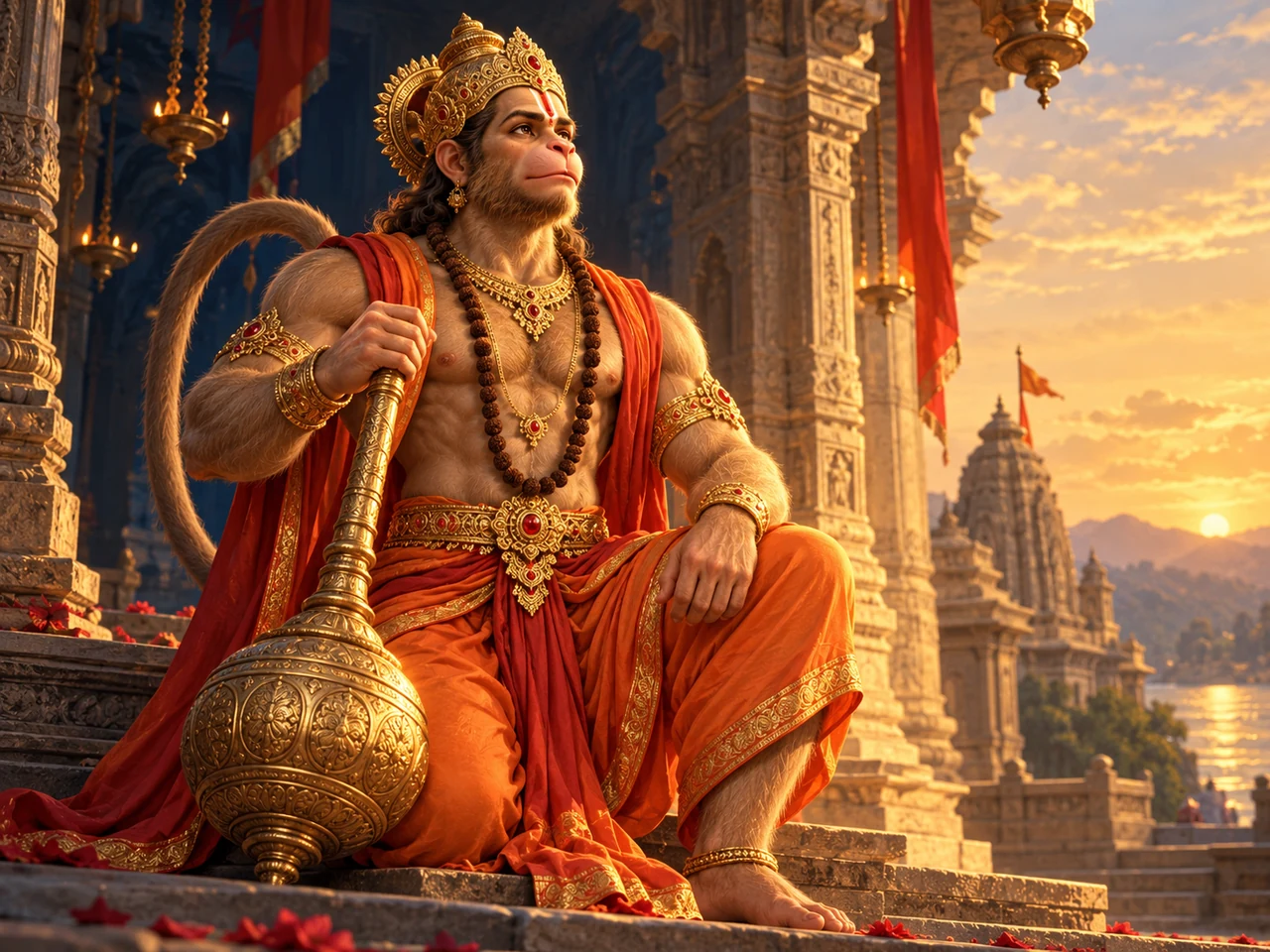
Your golden appearance and beautiful attire shine; earrings adorn your ears and your hair is curled.
Explanation
This is a poetic portrait rather than a fixed archaeological description. Devotional art translates such features into many regional images and materials.
हाथ बज्र और ध्वजा बिराजै। काँधे मूँज जनेऊ साजै॥
Roman HindiHaath bajra aur dhwaja biraajai
Kaandhe moonj janeu saajaiHaath bajra aur dhwaja biraajai
Kaandhe moonj janeu saajai
Meaning
A thunderbolt and banner are shown in your hand, and a sacred thread of munja grass adorns your shoulder.
Explanation
Witnesses and iconography differ in rendering the weapon as bajra or gada; this selected wording reads bajra. The flag suggests allegiance, while the thread evokes ritual and disciplined identity.
शंकर सुवन केसरी नंदन। तेज प्रताप महा जग बंदन॥
Roman HindiShankar suvan Kesari nandan
Tej prataap maha jag bandanShankar suvan Kesari nandan
Tej prataap maha jag bandan
Meaning
Son of Shankar and beloved son of Kesari, your radiance and renown are revered across the world.
Explanation
‘Shankar suvan’ gives the hymn a Shaiva association within an intensely Rama-devotional poem. Traditions explain this differently; it should not erase Hanuman’s equally important roles as Anjani’s and Kesari’s child.
विद्यावान गुनी अति चातुर। राम काज करिबे को आतुर॥
Roman HindiBidyavaan guni ati chaatur
Raam kaaj karibe ko aaturBidyavaan guni ati chaatur
Raam kaaj karibe ko aatur
Meaning
Learned, virtuous and resourceful, you are always eager to undertake Rama’s work.
Explanation
‘Chatur’ praises practical intelligence used in service. The ideal is not passive obedience; it is alert, thoughtful help at the right moment.
प्रभु चरित्र सुनिबे को रसिया। राम लखन सीता मन बसिया॥
Roman HindiPrabhu charitra sunibe ko rasiya
Raam Lakhan Seeta man basiyaPrabhu charitra sunibe ko rasiya
Raam Lakhan Seeta man basiya
Meaning
You delight in hearing the Lord’s deeds, and Rama, Lakshmana and Sita dwell in your heart.
Explanation
Listening itself becomes an act of devotion. The heart-language depicts unwavering remembrance and loving attachment to Rama’s household.
सूक्ष्म रूप धरि सियहिं दिखावा। बिकट रूप धरि लंक जरावा॥
Roman HindiSookshm roop dhari Siyahin dikhaava
Bikat roop dhari Lank jaraavaSookshm roop dhari Siyahin dikhaava
Bikat roop dhari Lank jaraava
Meaning
Taking a subtle form, you appeared to Sita; taking a formidable form, you set Lanka ablaze.
Explanation
The two contrasting forms show adaptability: gentleness in meeting the captive Sita and force in confronting hostile power. These are narrative episodes of the Ramayana tradition.
भीम रूप धरि असुर संहारे। रामचंद्र के काज सँवारे॥
Roman HindiBheem roop dhari asur sanhaare
Raamchandra ke kaaj sanwaareBheem roop dhari asur sanhaare
Raamchandra ke kaaj sanwaare
Meaning
In your formidable form you overcame adversaries and completed Rama’s undertakings.
Explanation
The chaupai continues the narrative praise of service. Devotional imagery of battle belongs to epic storytelling, not to permission for violence in everyday life.
लाय सजीवन लखन जियाये। श्रीरघुबीर हरषि उर लाये॥
Roman HindiLaay sajeevan Lakhan jiyaaye
Shri Raghubeer harashi ur laayeLaay sajeevan Lakhan jiyaaye
Shri Raghubeer harashi ur laaye
Meaning
You brought the life-restoring remedy for Lakshmana, and the joyful Rama drew you to his heart.
Explanation
The Sanjivani episode conveys urgent, selfless aid. Different retellings narrate the herb and mountain in their own way; this verse emphasizes the rescue and Rama’s gratitude.
रघुपति कीन्ही बहुत बड़ाई। तुम मम प्रिय भरतहि सम भाई॥
Roman HindiRaghupati keenhi bahut badaai
Tum mam priya Bharatahi sam bhaaiRaghupati keenhi bahut badaai
Tum mam priya Bharatahi sam bhaai
Meaning
Rama praised you greatly and said you are dear to him like his brother Bharata.
Explanation
Comparison with Bharata places Hanuman within Rama’s closest circle of affection. The praise honours loyalty rather than inherited rank.
सहस बदन तुम्हरो जस गावैं। अस कहि श्रीपति कंठ लगावैं॥
Roman HindiSahas badan tumharo jas gaavain
As kahi Shripati kanth lagaavainSahas badan tumharo jas gaavain
As kahi Shripati kanth lagaavain
Meaning
Countless mouths sing your fame; saying this, the Lord embraced you.
Explanation
‘Sahas badan’ may evoke Shesha’s thousand heads as well as an image of innumerable voices. The embrace repeats the hymn’s connection between devotion and affection.
सनकादिक ब्रह्मादि मुनीसा। नारद सारद सहित अहीसा॥
Roman HindiSanakaadik Brahmaadi muneesa
Naarad Saarad sahit aheesaSanakaadik Brahmaadi muneesa
Naarad Saarad sahit aheesa
Meaning
Sages such as Sanaka, Brahma and other seers, Narada, Saraswati and the serpent lord praise you.
Explanation
The list gathers knowledge-holders across mythic worlds. ‘Sarad’ is generally read as Saraswati and ‘Ahisa’ as Shesha; such identifications are interpretive glosses.
जम कुबेर दिगपाल जहाँ ते। कबि कोबिद कहि सके कहाँ ते॥
Roman HindiJam Kuber digpaal jahaan te
Kabi kobid kahi sake kahaan teJam Kuber digpaal jahaan te
Kabi kobid kahi sake kahaan te
Meaning
Even Yama, Kubera and the directional guardians cannot exhaust your praise; neither can learned poets.
Explanation
In devotional hyperbole, immeasurability conveys reverence rather than a historical survey of what named deities said.
तुम उपकार सुग्रीवहिं कीन्हा। राम मिलाय राज पद दीन्हा॥
Roman HindiTum upkaar Sugreevahin keenha
Raam milaay raaj pad deenhaTum upkaar Sugreevahin keenha
Raam milaay raaj pad deenha
Meaning
You helped Sugriva by bringing him to Rama, through which he regained kingship.
Explanation
Hanuman’s diplomacy and trust-building matter as much as battlefield strength. The verse is rooted in the Kishkindha narrative of Rama’s alliance.
तुम्हरो मंत्र विभीषन माना। लंकेश्वर भए सब जग जाना॥
Roman HindiTumharo mantra Vibheeshan maana
Lankeshwar bhae sab jag jaanaTumharo mantra Vibheeshan maana
Lankeshwar bhae sab jag jaana
Meaning
Vibhishana accepted your counsel and became ruler of Lanka, a story known widely.
Explanation
Some Ramayana traditions emphasize other agents in Vibhishana’s decision. The Chalisa poet compresses complex events into a direct tribute to Hanuman’s counsel.
जुग सहस्र जोजन पर भानू। लील्यो ताहि मधुर फल जानू॥
Roman HindiJug sahasra jojan par bhaanu
Leelyo taahi madhur phal jaanuJug sahasra jojan par bhaanu
Leelyo taahi madhur phal jaanu
Meaning
As a child, you mistook the far-off sun for a sweet fruit and leapt toward it.
Explanation
‘Jug sahasra jojan’ is part of mythic poetic description, not a verified astronomical calculation of the Sun–Earth distance. The story expresses limitless youthful energy.
प्रभु मुद्रिका मेलि मुख माहीं। जलधि लाँघि गये अचरज नाहीं॥
Roman HindiPrabhu mudrika meli mukh maahin
Jaladhi laanghi gaye acharaj naahinPrabhu mudrika meli mukh maahin
Jaladhi laanghi gaye acharaj naahin
Meaning
Keeping the Lord’s ring safely in your mouth, you crossed the ocean without astonishment.
Explanation
The ring functions as Sita’s recognition-token in the Sundara Kanda story. Hanuman’s remarkable leap is tied to a purpose: carrying reassurance to her.
दुर्गम काज जगत के जेते। सुगम अनुग्रह तुम्हरे तेते॥
Roman HindiDurgam kaaj jagat ke jete
Sugam anugrah tumhare teteDurgam kaaj jagat ke jete
Sugam anugrah tumhare tete
Meaning
By your grace, the most difficult tasks in the world become easier.
Explanation
The verse voices confidence in divine help. Responsible explanation does not imply every obstacle will vanish automatically or without human effort.
राम दुआरे तुम रखवारे। होत न आज्ञा बिनु पैसारे॥
Roman HindiRaam duaare tum rakhwaare
Hot na aagya binu paisaareRaam duaare tum rakhwaare
Hot na aagya binu paisaare
Meaning
You stand guard at Rama’s doorway; none enters without your permission.
Explanation
The doorway symbolizes a devotional relationship: closeness to Rama is approached through the virtues Hanuman models—faithfulness, humility and service. This is a theological image, not a literal access rule for worshippers.
सब सुख लहै तुम्हारी सरना। तुम रक्षक काहू को डर ना॥
Roman HindiSab sukh lahai tumhaari sarna
Tum rakshak kaahu ko dar naSab sukh lahai tumhaari sarna
Tum rakshak kaahu ko dar na
Meaning
Those who take refuge in you find happiness and feel protected from fear.
Explanation
The emphasis is on spiritual reassurance and reliance, not a guarantee of immunity from danger. Practical safety measures remain important.
आपन तेज सम्हारो आपै। तीनों लोक हाँक तें काँपै॥
Roman HindiAapan tej samhaaro aapai
Teenon lok haank ten kaanpaiAapan tej samhaaro aapai
Teenon lok haank ten kaanpai
Meaning
You alone restrain your extraordinary radiance; your mighty call shakes the three worlds.
Explanation
Great power is pictured together with self-restraint. That pairing is central: Hanuman’s immense force is mastered rather than uncontrolled.
भूत पिसाच निकट नहिं आवै। महाबीर जब नाम सुनावै॥
Roman HindiBhoot pisaach nikat nahin aavai
Mahaabeer jab naam sunaavaiBhoot pisaach nikat nahin aavai
Mahaabeer jab naam sunaavai
Meaning
Ghosts and troubling spirits are said not to approach when Mahavir’s name is uttered.
Explanation
The image has literal interpretations in some communities and a figurative reading as freedom from fear in others. The text is not evidence for paranormal causation.
नासै रोग हरै सब पीरा। जपत निरंतर हनुमत बीरा॥
Roman HindiNaasai rog harai sab peera
Japat nirantar Hanumat beeraNaasai rog harai sab peera
Japat nirantar Hanumat beera
Meaning
Illness and pain are prayed to depart through continual remembrance of brave Hanuman.
Explanation
This is a devotional claim of comfort and hoped-for relief, not a clinical treatment or medical guarantee. Worship should not replace diagnosis or appropriate care.
संकट तें हनुमान छुडावै। मन क्रम बचन ध्यान जो लावै॥
Roman HindiSankat ten Hanuman chhudaavai
Man kram bachan dhyaan jo laavaiSankat ten Hanuman chhudaavai
Man kram bachan dhyaan jo laavai
Meaning
Hanuman frees devotees from distress when they focus on him in thought, action and word.
Explanation
The triad of mind, conduct and speech emphasizes integrity: devotion involves how one behaves, not only what one recites.
सब पर राम तपस्वी राजा। तिन के काज सकल तुम साजा॥
Roman HindiSab par Raam tapasvi raaja
Tin ke kaaj sakal tum saajaSab par Raam tapasvi raaja
Tin ke kaaj sakal tum saaja
Meaning
Rama is the ascetic king above all, and you arranged all his tasks.
Explanation
This verse is openly Rama-centred. It should not be reinterpreted to make the poem a hidden hymn to some other deity simply because Hanuman has Shaiva associations.
और मनोरथ जो कोई लावै। सोइ अमित जीवन फल पावै॥
Roman HindiAur manorath jo koi laavai
Soi amit jeevan phal paavaiAur manorath jo koi laavai
Soi amit jeevan phal paavai
Meaning
Whoever brings a heartfelt aspiration to you receives abundant fruit in life, according to devotional faith.
Explanation
‘Amit phal’ is expansive praise. It can be read alongside ethical desire and service, not as an unconditional bargain guaranteeing a specific outcome.
चारों जुग परताप तुम्हारा। है परसिद्ध जगत उजियारा॥
Roman HindiChaaron jug parataap tumhaara
Hai parasiddh jagat ujiyaaraChaaron jug parataap tumhaara
Hai parasiddh jagat ujiyaara
Meaning
Your glory shines in all four cosmic ages and is famous in the world.
Explanation
The four yugas form a traditional cyclical view of time. The claim expresses enduring sacred significance, not a modern chronological measurement.
साधु-संत के तुम रखवारे। असुर निकंदन राम दुलारे॥
Roman HindiSaadhu-sant ke tum rakhwaare
Asur nikandan Raam dulaareSaadhu-sant ke tum rakhwaare
Asur nikandan Raam dulaare
Meaning
You protect holy people, defeat harmful forces and are dear to Rama.
Explanation
The hymn relates protection to care for communities of practice. Its adversarial language belongs to a religious-poetic framework, not a license to label living opponents as demons.
अष्ट सिद्धि नौ निधि के दाता। अस बर दीन जानकी माता॥
Roman HindiAsht siddhi nau nidhi ke daata
As bar deen Jaanki maataAsht siddhi nau nidhi ke daata
As bar deen Jaanki maata
Meaning
Sita, here called Janaki, is said to have blessed you with the ability to bestow eight siddhis and nine treasures.
Explanation
Siddhis and nidhis have varying lists across texts. The blessing belongs to devotional mythology and should not be turned into unverified claims of guaranteed occult powers.
राम रसायन तुम्हरे पासा। सदा रहो रघुपति के दासा॥
Roman HindiRaam rasaayan tumhare paasa
Sada raho Raghupati ke daasaRaam rasaayan tumhare paasa
Sada raho Raghupati ke daasa
Meaning
You possess the essence of Rama-devotion and remain forever Rama’s devoted servant.
Explanation
‘Rama rasayan’ evokes a transformative elixir; the image joins sweetness of devotion with steadfast service, not a chemical medicine.
तुम्हरे भजन राम को पावै। जनम-जनम के दुख बिसरावै॥
Roman HindiTumhare bhajan Raam ko paavai
Janam-janam ke dukh bisaraavaiTumhare bhajan Raam ko paavai
Janam-janam ke dukh bisaraavai
Meaning
Through devotion to you, one reaches Rama and leaves behind sorrows accumulated across lives.
Explanation
Hanuman is presented as a guide who directs attention beyond himself to Rama. Rebirth-language belongs to Hindu religious interpretation rather than an empirically demonstrated process.
अंत काल रघुबर पुर जाई। जहाँ जन्म हरि-भक्त कहाई॥
Roman HindiAnt kaal Raghubar pur jaai
Jahaan janm Hari-bhakt kahaaiAnt kaal Raghubar pur jaai
Jahaan janm Hari-bhakt kahaai
Meaning
At life’s end the devotee goes to Rama’s abode, or is born again as a devotee of Hari.
Explanation
The two images of post-death destiny differ in emphasis but share the wish that devotion continue. They should be presented as theological hopes, not established predictions.
और देवता चित्त न धरई। हनुमत सेई सर्ब सुख करई॥
Roman HindiAur devata chitt na dharai
Hanumat sei sarb sukh karaiAur devata chitt na dharai
Hanumat sei sarb sukh karai
Meaning
One need not fix the mind on other deities; serving Hanuman brings complete spiritual contentment, as the verse declares.
Explanation
This is the voice of exclusive devotion within this hymn, not a universal prohibition on other Hindu forms of worship.
संकट कटै मिटै सब पीरा। जो सुमिरै हनुमत बलबीरा॥
Roman HindiSankat katai mitai sab peera
Jo sumirai Hanumat balbeeraSankat katai mitai sab peera
Jo sumirai Hanumat balbeera
Meaning
Those who remember mighty Hanuman pray for crises and suffering to be eased.
Explanation
The repeated assurance supports courage in adversity. Repetition is a poetic feature of praise and should not be read as independent empirical evidence.
जय जय जय हनुमान गोसाईं। कृपा करहु गुरुदेव की नाईं॥
Roman HindiJai jai jai Hanuman Gosaain
Kripa karahu Gurudev ki naainJai jai jai Hanuman Gosaain
Kripa karahu Gurudev ki naain
Meaning
Victory again and again to Hanuman, the master; show compassion like a guru.
Explanation
Calling Hanuman ‘Gosain’ and comparing him to a guru places spiritual guidance beside heroic service. It does not mandate initiation for ordinary reading of the poem.
जो सत बार पाठ कर कोई। छूटहि बंदि महा सुख होई॥
Roman HindiJo sat baar paath kar koi
Chhootahi bandi maha sukh hoiJo sat baar paath kar koi
Chhootahi bandi maha sukh hoi
Meaning
The text says one who recites it a hundred times is released from bondage and finds great happiness.
Explanation
‘Sat baar’ is commonly read as a hundred recitations in this context, but counting and devotional customs differ. Treat this as a traditional phalashruti, never a guaranteed result or required practice regimen.
जो यह पढ़ै हनुमान चालीसा। होय सिद्धि साखी गौरीसा॥
Roman HindiJo yah padhai Hanuman Chaaleesa
Hoy siddhi saakhi GaureesaJo yah padhai Hanuman Chaaleesa
Hoy siddhi saakhi Gaureesa
Meaning
Whoever reads this Hanuman Chalisa attains success, with Gaurisha invoked as witness.
Explanation
Gaurisha is Shiva, the lord of Gauri, linking the hymn’s closing assurance to a Shaiva name. The word ‘siddhi’ here need not mean paranormal power; its meaning follows the devotional context.
तुलसीदास सदा हरि चेरा। कीजै नाथ हृदय महँ डेरा॥
Roman HindiTulsidas sada Hari chera
Keejai Naath hriday mahan deraTulsidas sada Hari chera
Keejai Naath hriday mahan dera
Meaning
Tulsidas calls himself Hari’s perpetual servant and asks the Lord to reside in his heart.
Explanation
The poet’s signature, or bhanita, names Tulsidas inside the hymn. Internal naming strongly supports traditional attribution but alone cannot establish a precise date or autograph authorship.
पवनतनय संकट हरन मंगल मूरति रूप। राम लखन सीता सहित हृदय बसहु सुर भूप॥
Roman HindiPavantanay sankat haran mangal moorati roop
Raam Lakhan Seeta sahit hriday basahu sur bhoopPavantanay sankat haran mangal moorati roop
Raam Lakhan Seeta sahit hriday basahu sur bhoop
Meaning
O son of the Wind, remover of distress and embodiment of auspiciousness, dwell in my heart with Rama, Lakshmana and Sita.
Explanation
The closing doha returns from outward praise to an inward request. Its culmination is the presence of Hanuman together with Rama’s family in the devotee’s heart.
Context & Usage
Edition notice: This is the complete 43-unit selected Awadhi reading (two opening dohas, forty chaupais, one closing doha), transcribed from the fixed-revision source 1. Roman Hindi reproduces the original words, not English translation. Meanings and explanations are original ShivGoraksh draft prose, not copied from a modern translation.
Opening doha 1 {#opening-doha-1-meaning}
Meaning: The poet cleans the mirror of his mind with the dust of the guru’s lotus feet and prepares to recount Rama’s stainless glory, which supports the four human aims. Explanation: The mirror is an image of attention clarified by humility. The four fruits are conventionally understood as dharma, artha, kama and moksha; the verse is an invocation, not a promise of automatic worldly rewards.
Opening doha 2 {#opening-doha-2-meaning}
Meaning: Recognizing his limited understanding, the speaker remembers the son of the Wind and asks for strength, discernment, learning and freedom from inner distress and faults. Explanation: Here devotion begins with a willingness to learn. The prayer joins courage with judgement: physical strength without wisdom is not its ideal.
Closing doha {#closing-doha-meaning}
Meaning: O son of the Wind, remover of distress and embodiment of auspiciousness, dwell in my heart with Rama, Lakshmana and Sita. Explanation: The closing doha returns from outward praise to an inward request. Its culmination is the presence of Hanuman together with Rama’s family in the devotee’s heart.
Understanding the Hanuman Chalisa
What sort of text is this? Chalisa comes from the Hindi word for forty. This is an Awadhi-language hymn with two introductory dohas, forty chaupais and a concluding doha. A doha is a rhymed couplet with its own metrical pattern. A chaupai in the North Indian devotional tradition typically uses paired half-lines with a different rhythm. Here the numbered forty are the main praise-verses, not the opening or concluding dohas. The devotional poem is traditionally credited to Goswami Tulsidas. Its final chaupai contains the name Tulsidas, but neither this self-reference nor later popularity proves an exact composition year or an autograph original 1 8.
How its narrative develops
Rather than provide a separate plot summary of the whole Ramayana, the Chalisa selects scenes that show Hanuman's devotion in action. Its first ten chaupais introduce his qualities, appearance and readiness to serve. The middle section remembers Sita, the ocean-crossing, the restoration of Lakshmana, Sugriva and Vibhishana. The later verses ask for protection, guidance and steady devotion. The closing doha invites Hanuman to remain within the heart together with Rama, Lakshmana and Sita. The moral centre is not unconstrained force but courage disciplined by wisdom and service.
Shiva and Rama are both present, but not interchangeable
Chaupai 6 says Shankar suvan and chaupai 39 invokes Gaurisha, names associated with Shiva. At the same time, Rama's glory, Rama's family and Rama's work dominate the hymn. In some traditions Hanuman is understood as a form or aspect of Shiva, while others emphasize his parentage and devotion to Rama. ShivGoraksh respects this plurality: the language of one tradition does not abolish another's account. The selected reading of chaupai 6 has suvan, not the alternate svayam 1 5.
Symbols that repay close reading
The ring in chaupai 19 is a sign of trust between Rama and Sita, not a talisman independently guaranteeing supernatural power. The ocean crossing is purposeful effort. The Sun-as-fruit story in chaupai 18 belongs to mythic time and cannot reasonably be converted into a modern astronomy formula. The eight siddhis and nine nidhis in chaupai 31 belong to religious narratives with differing lists; they do not promise measurable paranormal achievements to a reader. The phrases about ghosts, illness and fear (24–26) should be read as traditional devotional affirmations, not substitutes for emergency, mental-health or medical care.
What does the poem ask of the reader? The opening prayer joins strength with intelligence and education; the request for a pure mind precedes any praise of physical power. The poet consistently values loyal friendship, self-control, alert action and compassion. Its closing promise-verses are received as phalashruti—a traditional statement of devotional fruits. Families have different recitation customs, and this reader does not prescribe a mandatory count or promise any fixed outcome. Ordinary public reading is the candidate practice classification; specialised discipline requires independent review 1.
Textual witness and variant decisions
Pronunciation and reader notes
Roman Hindi here is meant to be spoken aloud as Awadhi/Hindi, not as English vocabulary. Aa suggests a long आ, ee a long ई and oo a long ऊ; spellings such as bikrām/bikram, gyaan/gyan and tihun are pedagogic approximations, not scholarly IAST. For phonetic precision use the Devanagari original. There is no single compulsory tempo. Headings and numbers support navigation but are not additional lyrics.
Key words
- Doha — a metrical couplet framing the poem.
- Chaupai — a North Indian verse-form; forty main units are numbered here.
- Pavansut — son of the Wind, a title of Hanuman.
- Sankat — distress, danger or difficulty.
- Seva — service motivated by devotion.
- Phalashruti — traditional statement about the merits or results of recitation.
- Siddhi / Nidhi — powers or treasures in various religious classifications; meanings vary by source.
Frequently asked questions
1. Is the Hanuman Chalisa Sanskrit? No. The composition is in Awadhi, a North Indian literary vernacular; Devanagari is its displayed script here. 2. Why are there 43 units if it is a Chalisa? The title refers to forty chaupais. Two opening dohas and a closing doha bring the reader's total to 43. 3. Does the English version translate the original verses? Its opening section is Roman-script Awadhi/Roman Hindi: the same words as the supplied article. English meanings follow in a separate section. 4. Was the hymn certainly written by Tulsidas? It is traditionally attributed to him and names Tulsidas near the end. Exact first composition date and an original manuscript were not established here. 5. Is “Shankar suvan” the selected wording? Yes, in chaupai 6. Variants and interpretations are kept in the source ledger rather than mixed into the original text. 6. Must it be recited one hundred times? The text contains a traditional count-based fruit verse. This guide does not turn it into a universal requirement or guarantee. 7. Can a beginner read it publicly? The text is available for general reading; this guide offers no secret ritual procedures. 8. Does chanting cure illness or protect against every danger? No medical or universal safety guarantee follows from the poem. These are expressions of religious confidence; seek appropriate care when needed. 9. Can the Hanuman Chalisa be linked to ShivGoraksh's Hanuman Aarti? Yes. The Hanuman Aarti is a related but distinct composition, not part of the Chalisa.
Sources, Credits & Licensing
Founder-authorized educational edition. Independent textual and specialist review remains incomplete; this reading does not confer initiation or ritual authorization.
MIT License
Copyright (c) 2024 Adiyogi Arts
Permission is hereby granted, free of charge, to any person obtaining a copy
of this software and associated documentation files (the "Software"), to deal
in the Software without restriction, including without limitation the rights
to use, copy, modify, merge, publish, distribute, sublicense, and/or sell
copies of the Software, and to permit persons to whom the Software is
furnished to do so, subject to the following conditions:
The above copyright notice and this permission notice shall be included in all
copies or substantial portions of the Software.
THE SOFTWARE IS PROVIDED "AS IS", WITHOUT WARRANTY OF ANY KIND, EXPRESS OR
IMPLIED, INCLUDING BUT NOT LIMITED TO THE WARRANTIES OF MERCHANTABILITY,
FITNESS FOR A PARTICULAR PURPOSE AND NONINFRINGEMENT. IN NO EVENT SHALL THE
AUTHORS OR COPYRIGHT HOLDERS BE LIABLE FOR ANY CLAIM, DAMAGES OR OTHER
LIABILITY, WHETHER IN AN ACTION OF CONTRACT, TORT OR OTHERWISE, ARISING FROM,
OUT OF OR IN CONNECTION WITH THE SOFTWARE OR THE USE OR OTHER DEALINGS IN THE
SOFTWARE.
Selected text from the linked source; Romanization and bilingual meanings newly prepared by ShivGoraksh. No source recordings or modern translations imported.
Text licence
Original Roman reading
The Roman reading recorded with this edition, retaining its spelling and word forms before the Easy Roman display conversion.
- Opening doha 1
Shri Guru charan saroj raj, nij manu mukuru sudhaari
Baranaun Raghubar bimal jasu, jo daayaku phal chaari
- Opening doha 2
Buddhiheen tanu jaanike, sumiraun Pavan-Kumaar
Bal buddhi bidya dehu mohin, harahu kales bikaar
- Chaupai 1
Jai Hanuman gyaan gun saagar
Jai Kapees tihun lok ujaagar
- Chaupai 2
Raamdoot atulit bal dhaama
Anjani-putra Pavansut naama
- Chaupai 3
Mahaabeer bikram Bajrangi
Kumati nivaar sumati ke sangi
- Chaupai 4
Kanchan baran biraaj subesa
Kaanan kundal kunchit kesa
- Chaupai 5
Haath bajra aur dhwaja biraajai
Kaandhe moonj janeu saajai
- Chaupai 6
Shankar suvan Kesari nandan
Tej prataap maha jag bandan
- Chaupai 7
Bidyavaan guni ati chaatur
Raam kaaj karibe ko aatur
- Chaupai 8
Prabhu charitra sunibe ko rasiya
Raam Lakhan Seeta man basiya
- Chaupai 9
Sookshm roop dhari Siyahin dikhaava
Bikat roop dhari Lank jaraava
- Chaupai 10
Bheem roop dhari asur sanhaare
Raamchandra ke kaaj sanwaare
- Chaupai 11
Laay sajeevan Lakhan jiyaaye
Shri Raghubeer harashi ur laaye
- Chaupai 12
Raghupati keenhi bahut badaai
Tum mam priya Bharatahi sam bhaai
- Chaupai 13
Sahas badan tumharo jas gaavain
As kahi Shripati kanth lagaavain
- Chaupai 14
Sanakaadik Brahmaadi muneesa
Naarad Saarad sahit aheesa
- Chaupai 15
Jam Kuber digpaal jahaan te
Kabi kobid kahi sake kahaan te
- Chaupai 16
Tum upkaar Sugreevahin keenha
Raam milaay raaj pad deenha
- Chaupai 17
Tumharo mantra Vibheeshan maana
Lankeshwar bhae sab jag jaana
- Chaupai 18
Jug sahasra jojan par bhaanu
Leelyo taahi madhur phal jaanu
- Chaupai 19
Prabhu mudrika meli mukh maahin
Jaladhi laanghi gaye acharaj naahin
- Chaupai 20
Durgam kaaj jagat ke jete
Sugam anugrah tumhare tete
- Chaupai 21
Raam duaare tum rakhwaare
Hot na aagya binu paisaare
- Chaupai 22
Sab sukh lahai tumhaari sarna
Tum rakshak kaahu ko dar na
- Chaupai 23
Aapan tej samhaaro aapai
Teenon lok haank ten kaanpai
- Chaupai 24
Bhoot pisaach nikat nahin aavai
Mahaabeer jab naam sunaavai
- Chaupai 25
Naasai rog harai sab peera
Japat nirantar Hanumat beera
- Chaupai 26
Sankat ten Hanuman chhudaavai
Man kram bachan dhyaan jo laavai
- Chaupai 27
Sab par Raam tapasvi raaja
Tin ke kaaj sakal tum saaja
- Chaupai 28
Aur manorath jo koi laavai
Soi amit jeevan phal paavai
- Chaupai 29
Chaaron jug parataap tumhaara
Hai parasiddh jagat ujiyaara
- Chaupai 30
Saadhu-sant ke tum rakhwaare
Asur nikandan Raam dulaare
- Chaupai 31
Asht siddhi nau nidhi ke daata
As bar deen Jaanki maata
- Chaupai 32
Raam rasaayan tumhare paasa
Sada raho Raghupati ke daasa
- Chaupai 33
Tumhare bhajan Raam ko paavai
Janam-janam ke dukh bisaraavai
- Chaupai 34
Ant kaal Raghubar pur jaai
Jahaan janm Hari-bhakt kahaai
- Chaupai 35
Aur devata chitt na dharai
Hanumat sei sarb sukh karai
- Chaupai 36
Sankat katai mitai sab peera
Jo sumirai Hanumat balbeera
- Chaupai 37
Jai jai jai Hanuman Gosaain
Kripa karahu Gurudev ki naain
- Chaupai 38
Jo sat baar paath kar koi
Chhootahi bandi maha sukh hoi
- Chaupai 39
Jo yah padhai Hanuman Chaaleesa
Hoy siddhi saakhi Gaureesa
- Chaupai 40
Tulsidas sada Hari chera
Keejai Naath hriday mahan dera
- Closing doha
Pavantanay sankat haran mangal moorati roop
Raam Lakhan Seeta sahit hriday basahu sur bhoop
Source references and textual notes
Primary selected text: fixed-revision AdiyogiArts data 1. Comparison and print-witness leads: Gita Press archives 2 3, Pujadeep 4, Nitya 5, KaalPanchang 6, MyArchana 7. Scholarly context for vernacular Tulsidas performance: Lutgendorf 8. Library language evidence: CiNii 9. Full citation and rights details live in the source list.
- Hanuman Chalisa JSON dataset, selected 43-unit Awadhi field · Open source
- GP0695 Shri Hanuman Chalisa (Small) · Open source
- Shri Hanuman Chalisha — Gita Press (Mumukshu Bhawan Varanasi collection) · Open source
- Hanuman Chalisa: Complete Text, Meaning and Dated Witness · Open source
- Hanuman Chalisa: Gita Press reading and source comparison · Open source
- Hanuman Chalisa full 40 chaupais with three framing dohas · Open source
- Hanuman Chalisa with PDF and printed comparison references · Open source
- The Life of a Text: Performing the Ramcaritmanas of Tulsidas · Open source
- Hanuman Chalisa of Tulsidasji with English translation and notes, 1st edition · Open source




Additional passage commentary
Chaupai 1 {#chaupai-01-meaning}
Meaning: Victory to Hanuman, ocean of knowledge and virtue, renowned through the three worlds as lord among vanaras. Explanation: The first chaupai establishes the main theme: Hanuman is praised as much for intelligence and moral character as for heroic power. The three worlds are a traditional cosmological expression.
Chaupai 2 {#chaupai-02-meaning}
Meaning: Hanuman is Rama’s messenger and the abode of immeasurable strength; he is called Anjani’s son and the Wind’s son. Explanation: The two parentage titles express different strands of the Hanuman story. His strength is framed by his chosen role as a servant and messenger, not by domination.
Chaupai 3 {#chaupai-03-meaning}
Meaning: Greatly brave and mighty Bajrangi, you remove misguided thinking and support wise understanding. Explanation: Bajrangi evokes thunderbolt-like firmness. This prayer asks for an ethical change in the devotee’s decisions, not merely defeat of outside enemies.
Chaupai 4 {#chaupai-04-meaning}
Meaning: Your golden appearance and beautiful attire shine; earrings adorn your ears and your hair is curled. Explanation: This is a poetic portrait rather than a fixed archaeological description. Devotional art translates such features into many regional images and materials.
Chaupai 5 {#chaupai-05-meaning}
Meaning: A thunderbolt and banner are shown in your hand, and a sacred thread of munja grass adorns your shoulder. Explanation: Witnesses and iconography differ in rendering the weapon as bajra or gada; this selected wording reads bajra. The flag suggests allegiance, while the thread evokes ritual and disciplined identity.
Chaupai 6 {#chaupai-06-meaning}
Meaning: Son of Shankar and beloved son of Kesari, your radiance and renown are revered across the world. Explanation: ‘Shankar suvan’ gives the hymn a Shaiva association within an intensely Rama-devotional poem. Traditions explain this differently; it should not erase Hanuman’s equally important roles as Anjani’s and Kesari’s child.
Chaupai 7 {#chaupai-07-meaning}
Meaning: Learned, virtuous and resourceful, you are always eager to undertake Rama’s work. Explanation: ‘Chatur’ praises practical intelligence used in service. The ideal is not passive obedience; it is alert, thoughtful help at the right moment.
Chaupai 8 {#chaupai-08-meaning}
Meaning: You delight in hearing the Lord’s deeds, and Rama, Lakshmana and Sita dwell in your heart. Explanation: Listening itself becomes an act of devotion. The heart-language depicts unwavering remembrance and loving attachment to Rama’s household.
Chaupai 9 {#chaupai-09-meaning}
Meaning: Taking a subtle form, you appeared to Sita; taking a formidable form, you set Lanka ablaze. Explanation: The two contrasting forms show adaptability: gentleness in meeting the captive Sita and force in confronting hostile power. These are narrative episodes of the Ramayana tradition.
Chaupai 10 {#chaupai-10-meaning}
Meaning: In your formidable form you overcame adversaries and completed Rama’s undertakings. Explanation: The chaupai continues the narrative praise of service. Devotional imagery of battle belongs to epic storytelling, not to permission for violence in everyday life.
Chaupai 11 {#chaupai-11-meaning}
Meaning: You brought the life-restoring remedy for Lakshmana, and the joyful Rama drew you to his heart. Explanation: The Sanjivani episode conveys urgent, selfless aid. Different retellings narrate the herb and mountain in their own way; this verse emphasizes the rescue and Rama’s gratitude.
Chaupai 12 {#chaupai-12-meaning}
Meaning: Rama praised you greatly and said you are dear to him like his brother Bharata. Explanation: Comparison with Bharata places Hanuman within Rama’s closest circle of affection. The praise honours loyalty rather than inherited rank.
Chaupai 13 {#chaupai-13-meaning}
Meaning: Countless mouths sing your fame; saying this, the Lord embraced you. Explanation: ‘Sahas badan’ may evoke Shesha’s thousand heads as well as an image of innumerable voices. The embrace repeats the hymn’s connection between devotion and affection.
Chaupai 14 {#chaupai-14-meaning}
Meaning: Sages such as Sanaka, Brahma and other seers, Narada, Saraswati and the serpent lord praise you. Explanation: The list gathers knowledge-holders across mythic worlds. ‘Sarad’ is generally read as Saraswati and ‘Ahisa’ as Shesha; such identifications are interpretive glosses.
Chaupai 15 {#chaupai-15-meaning}
Meaning: Even Yama, Kubera and the directional guardians cannot exhaust your praise; neither can learned poets. Explanation: In devotional hyperbole, immeasurability conveys reverence rather than a historical survey of what named deities said.
Chaupai 16 {#chaupai-16-meaning}
Meaning: You helped Sugriva by bringing him to Rama, through which he regained kingship. Explanation: Hanuman’s diplomacy and trust-building matter as much as battlefield strength. The verse is rooted in the Kishkindha narrative of Rama’s alliance.
Chaupai 17 {#chaupai-17-meaning}
Meaning: Vibhishana accepted your counsel and became ruler of Lanka, a story known widely. Explanation: Some Ramayana traditions emphasize other agents in Vibhishana’s decision. The Chalisa poet compresses complex events into a direct tribute to Hanuman’s counsel.
Chaupai 18 {#chaupai-18-meaning}
Meaning: As a child, you mistook the far-off sun for a sweet fruit and leapt toward it. Explanation: ‘Jug sahasra jojan’ is part of mythic poetic description, not a verified astronomical calculation of the Sun–Earth distance. The story expresses limitless youthful energy.
Chaupai 19 {#chaupai-19-meaning}
Meaning: Keeping the Lord’s ring safely in your mouth, you crossed the ocean without astonishment. Explanation: The ring functions as Sita’s recognition-token in the Sundara Kanda story. Hanuman’s remarkable leap is tied to a purpose: carrying reassurance to her.
Chaupai 20 {#chaupai-20-meaning}
Meaning: By your grace, the most difficult tasks in the world become easier. Explanation: The verse voices confidence in divine help. Responsible explanation does not imply every obstacle will vanish automatically or without human effort.
Chaupai 21 {#chaupai-21-meaning}
Meaning: You stand guard at Rama’s doorway; none enters without your permission. Explanation: The doorway symbolizes a devotional relationship: closeness to Rama is approached through the virtues Hanuman models—faithfulness, humility and service. This is a theological image, not a literal access rule for worshippers.
Chaupai 22 {#chaupai-22-meaning}
Meaning: Those who take refuge in you find happiness and feel protected from fear. Explanation: The emphasis is on spiritual reassurance and reliance, not a guarantee of immunity from danger. Practical safety measures remain important.
Chaupai 23 {#chaupai-23-meaning}
Meaning: You alone restrain your extraordinary radiance; your mighty call shakes the three worlds. Explanation: Great power is pictured together with self-restraint. That pairing is central: Hanuman’s immense force is mastered rather than uncontrolled.
Chaupai 24 {#chaupai-24-meaning}
Meaning: Ghosts and troubling spirits are said not to approach when Mahavir’s name is uttered. Explanation: The image has literal interpretations in some communities and a figurative reading as freedom from fear in others. The text is not evidence for paranormal causation.
Chaupai 25 {#chaupai-25-meaning}
Meaning: Illness and pain are prayed to depart through continual remembrance of brave Hanuman. Explanation: This is a devotional claim of comfort and hoped-for relief, not a clinical treatment or medical guarantee. Worship should not replace diagnosis or appropriate care.
Chaupai 26 {#chaupai-26-meaning}
Meaning: Hanuman frees devotees from distress when they focus on him in thought, action and word. Explanation: The triad of mind, conduct and speech emphasizes integrity: devotion involves how one behaves, not only what one recites.
Chaupai 27 {#chaupai-27-meaning}
Meaning: Rama is the ascetic king above all, and you arranged all his tasks. Explanation: This verse is openly Rama-centred. It should not be reinterpreted to make the poem a hidden hymn to some other deity simply because Hanuman has Shaiva associations.
Chaupai 28 {#chaupai-28-meaning}
Meaning: Whoever brings a heartfelt aspiration to you receives abundant fruit in life, according to devotional faith. Explanation: ‘Amit phal’ is expansive praise. It can be read alongside ethical desire and service, not as an unconditional bargain guaranteeing a specific outcome.
Chaupai 29 {#chaupai-29-meaning}
Meaning: Your glory shines in all four cosmic ages and is famous in the world. Explanation: The four yugas form a traditional cyclical view of time. The claim expresses enduring sacred significance, not a modern chronological measurement.
Chaupai 30 {#chaupai-30-meaning}
Meaning: You protect holy people, defeat harmful forces and are dear to Rama. Explanation: The hymn relates protection to care for communities of practice. Its adversarial language belongs to a religious-poetic framework, not a license to label living opponents as demons.
Chaupai 31 {#chaupai-31-meaning}
Meaning: Sita, here called Janaki, is said to have blessed you with the ability to bestow eight siddhis and nine treasures. Explanation: Siddhis and nidhis have varying lists across texts. The blessing belongs to devotional mythology and should not be turned into unverified claims of guaranteed occult powers.
Chaupai 32 {#chaupai-32-meaning}
Meaning: You possess the essence of Rama-devotion and remain forever Rama’s devoted servant. Explanation: ‘Rama rasayan’ evokes a transformative elixir; the image joins sweetness of devotion with steadfast service, not a chemical medicine.
Chaupai 33 {#chaupai-33-meaning}
Meaning: Through devotion to you, one reaches Rama and leaves behind sorrows accumulated across lives. Explanation: Hanuman is presented as a guide who directs attention beyond himself to Rama. Rebirth-language belongs to Hindu religious interpretation rather than an empirically demonstrated process.
Chaupai 34 {#chaupai-34-meaning}
Meaning: At life’s end the devotee goes to Rama’s abode, or is born again as a devotee of Hari. Explanation: The two images of post-death destiny differ in emphasis but share the wish that devotion continue. They should be presented as theological hopes, not established predictions.
Chaupai 35 {#chaupai-35-meaning}
Meaning: One need not fix the mind on other deities; serving Hanuman brings complete spiritual contentment, as the verse declares. Explanation: This is the voice of exclusive devotion within this hymn, not a universal prohibition on other Hindu forms of worship.
Chaupai 36 {#chaupai-36-meaning}
Meaning: Those who remember mighty Hanuman pray for crises and suffering to be eased. Explanation: The repeated assurance supports courage in adversity. Repetition is a poetic feature of praise and should not be read as independent empirical evidence.
Chaupai 37 {#chaupai-37-meaning}
Meaning: Victory again and again to Hanuman, the master; show compassion like a guru. Explanation: Calling Hanuman ‘Gosain’ and comparing him to a guru places spiritual guidance beside heroic service. It does not mandate initiation for ordinary reading of the poem.
Chaupai 38 {#chaupai-38-meaning}
Meaning: The text says one who recites it a hundred times is released from bondage and finds great happiness. Explanation: ‘Sat baar’ is commonly read as a hundred recitations in this context, but counting and devotional customs differ. Treat this as a traditional phalashruti, never a guaranteed result or required practice regimen.
Chaupai 39 {#chaupai-39-meaning}
Meaning: Whoever reads this Hanuman Chalisa attains success, with Gaurisha invoked as witness. Explanation: Gaurisha is Shiva, the lord of Gauri, linking the hymn’s closing assurance to a Shaiva name. The word ‘siddhi’ here need not mean paranormal power; its meaning follows the devotional context.
Chaupai 40 {#chaupai-40-meaning}
Meaning: Tulsidas calls himself Hari’s perpetual servant and asks the Lord to reside in his heart. Explanation: The poet’s signature, or bhanita, names Tulsidas inside the hymn. Internal naming strongly supports traditional attribution but alone cannot establish a precise date or autograph authorship.