



Selected reading: Gita Press, Arati Sangrah Part 2, printed pages 94–95; original Devanagari presented in readable Roman Hindi. Six reader units represent one refrain plus eleven succeeding couplets. Scanned page-image and reuse-rights approval remain pending. 1
What this Aarti is — and what it is not
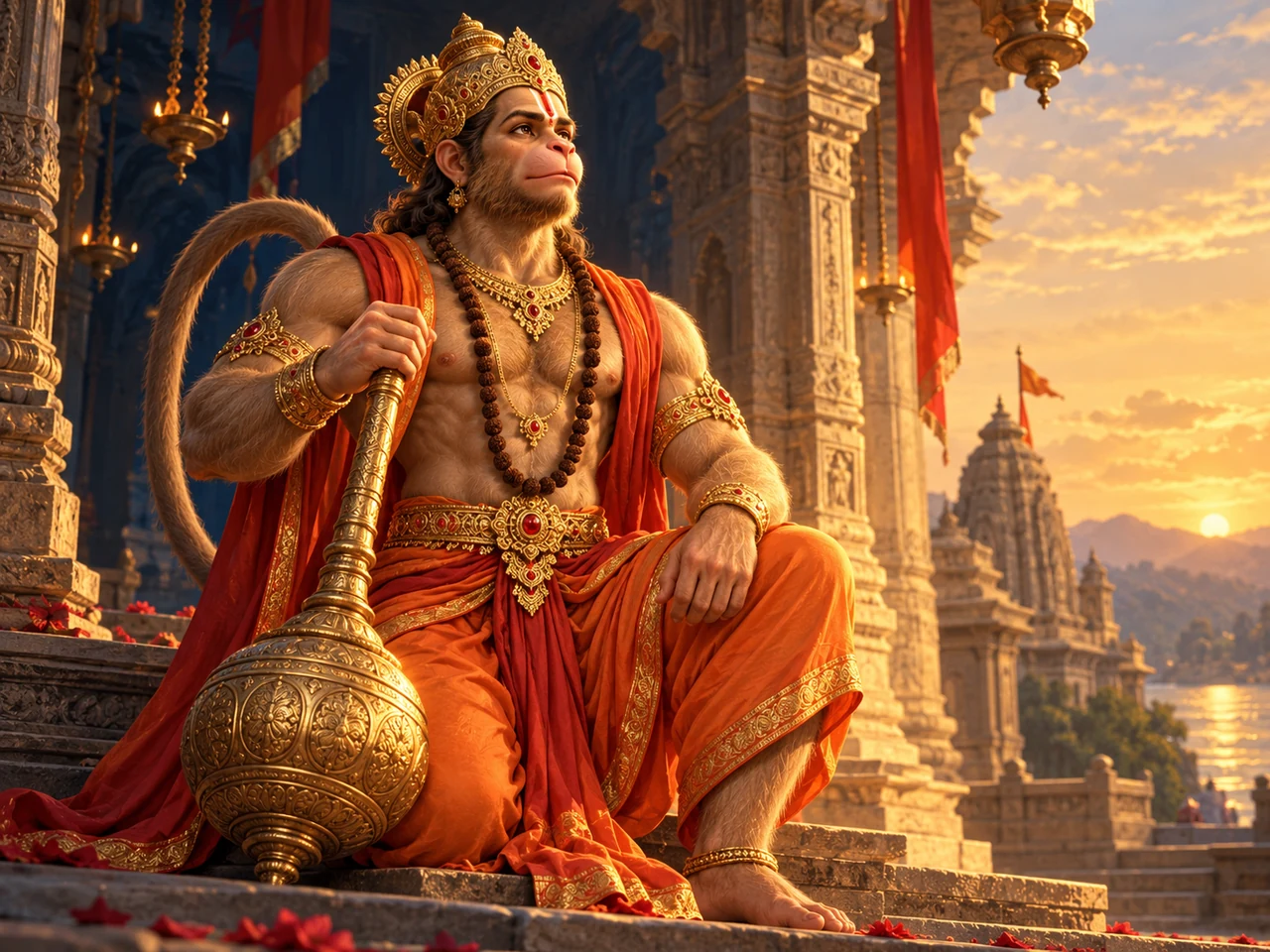
“Aarti Kije Hanuman Lala Ki” is a Hindi devotional song to Hanuman, not a Sanskrit Vedic mantra and not the Hanuman Chalisa itself. Its first address is affectionate: Hanuman Lala, beloved Hanuman. Its verses then recount service to Rama, the search for Sita, Lanka, the aid given to Lakshmana, and a later underworld tale. Its conclusion imagines a family scene in which mother Anjana offers the lamp. The work is thus simultaneously a song of praise, a compact narrative and a communal invitation to remember compassionate strength. 1 4
Hanuman is centrally known here as a servant and ally of Rama; ShivGoraksh's broader Shaiva/Shakti focus should not be used to rewrite this Rama-oriented, often Vaishnava devotional material as an exclusively Shaiva composition. Other Hindu traditions see Hanuman in different theological relationships; the words in this Aarti should first be understood in their own context.
The historical source and how the text was selected
The draft uses the Gita Press Arati Sangrah scan deposited in the Internet Archive. The OCR of printed pages 94–95 lists a refrain followed by eleven consecutive couplets. For reading convenience these couplets are arranged as the refrain plus five successive sections, in groups of 2, 2, 2, 2 and 3. The exact number of performance stanzas is therefore not universal. The OCR has suspect spellings in places; this editorial transcription regularises visible OCR faults and spaces provisionally using separate online transcriptions. Because the actual page images have not been visually collated, the text remains partially verified, despite being complete as a transcription of the available selected witness. 1 3 4
The accompanying Roman Hindi is new reader-friendly transliteration of these vernacular lines, not a translation and not an independent canonical witness. Sanskritised replacement wording has not been inserted. Repeat the opening refrain in performance if your family custom does so, but the reader does not silently count each repetition as a new source verse.
Rama's work, not Hanuman's self-promotion
A short repeated pattern governs the whole story: Hanuman acts with immense strength, but the objective is someone else's welfare. Rama sends him. He searches for Sita. He attends to Lakshmana. The final picture reunites him with Anjana. The hymn's emphasis on service and protection gives context to its military images; strength is neither celebrated merely as dominance nor separated from devotion. This is why the phrase Sita-Ram ji ke kaaj deserves attention rather than being lost in the retelling of battles. The episode of the life-saving mountain is a well-established subject of Indian visual devotion. The Metropolitan Museum of Art preserves an approximately 1800 Rajasthan depiction of Hanuman bringing the herb-bearing mountain, illustrating how the narrative continued through later painting traditions. This is evidence of historical devotional reception, not scientific evidence that the story happened as an ordinary medical event. 5
Ahiravana, Mahiravana and layers of the Ramayana
The selected hymn names Ahiravana in the stanza about entering the underworld (patal). This belongs to the rich world of later and regional Ramayana retellings; details are not uniform, and names such as Ahiravana and Mahiravana may differ between traditions. The British Library catalogues an illustrated item inscribed “Fight between Mahiravan and Hanuman,” independently documenting a strand of the visual tradition. This does not prove every narrated detail, nor should this stanza be cited as a direct passage from the critical Valmiki Ramayana. 6
Who composed the Aarti? A real attribution disagreement
Attribution is not resolved. In Hindi Sahitya Ka Itihas, Ramchandra Shukla quotes a noticeably different version among songs associated with Swami Ramananda. Some circulated Aarti variants add a final Tulsidas-naming couplet. The selected Gita Press witness does not contain that closing line. One author name in a later line, or a literary historian's attribution of a different recension, is not by itself proof that the widely sung arrangement was written by that person. The cautious description is a traditional composition with contested specific authorship. 1 2 3
Key words in the original language
Lala: affectionate address for a cherished child or young beloved person. Raghunath: a name of Rama. Kala: here interpreted by devotees as a power or expression belonging to Rama. Siya / Siy: Sita, in North Indian vernacular usage. Sudhi: news, remembrance or information; here the news of Sita's whereabouts. Pavansut: son of the wind deity. Sajivan / Sanjivani: life-restoring herb in the narrative; a theological/mythic motif, not a prescription. Kanchan thaar: golden tray. Param pad: supreme spiritual state in the hymn's devotional vision. Vernacular forms such as kijai, jaake, paithi, aane/aani and gaavai are part of the composition's sound and should not be replaced inside the original by modern standard Hindi or English paraphrase. The semantic details of beera, sakaare and jam-kaare need specialist dialect review, and the explanations above signal that uncertainty.
Where the reading changes between versions
The chosen version writes a form of “jhāmpai” for the line on affliction, where other sung versions use “jhānke.” Some versions read Siya/Siyaram where this witness prints Sita-Ram in the same narrative position. The Lakshmana line has a widely sung “pade dharani mein” variant in place of “pade sakaare.” A reported closing couplet naming Tulsidas is excluded from the Gita Press excerpt, and Shukla's Ramananda-associated version differs substantially in both order and wording. These are distinct witnesses, not spare couplets to attach to the selected text to make it sound more complete. 1 2 3
Devotional significance and responsible reading
In many households, Aarti is a closing expression of worship; the lamp and shared voice represent welcome, gratitude and collective attention. People often sing this composition on Tuesdays, Saturdays or Hanuman observances, but such customs vary. Reading the hymn does not require this educational reading to prescribe fire-handling methods, auspicious times, counted repetitions or ritual initiation. Any specialized practice belongs to separately reviewed Puja & Practice material. 4
Requests for protection from sickness, success or liberation are written in the language of devotional conviction and hope. They are not guarantees of safety, supernatural invulnerability or a substitute for health care. This distinction makes the text more intelligible rather than less meaningful: its lasting message is courage used for others.
Additional passage commentary
Refrain
Meaning: Let us offer the light of Aarti to beloved Hanuman, praised as a defender against wrongdoing and an embodiment or instrument of Raghunath’s power. Explanation: “Lala” is a tender way of addressing a beloved child, even when the devotee is praising enormous courage. “Kala” can suggest a power, manifestation or capacity associated with Raghunath (Rama); it does not establish a single compulsory theology. The song begins with a shared invitation to worship, not with a demand for a reward. The short refrain is the singing anchor; printed sources and family performances differ in how often it is repeated.
Verse 1
Meaning: Mountains seem to tremble before his strength; disease and misfortune are imagined as unable to approach him. Anjani’s son is praised as a source of courage and a constant helper of the saintly. Explanation: The opening image is poetic hyperbole: a trembling mountain makes invisible courage visible. The protective wording is a devotional belief, not evidence that worship prevents infections or cures disease. “Anjani-putra” remembers the mother through whose name Hanuman is also lovingly known. The last line turns physical power into an ethical quality: strength has value because it helps and protects others. A devotee may carry that lesson into everyday service.
Verse 2
Meaning: Raghunath sends his brave servant on a mission. Hanuman crosses the sea, finds news of Sita and, in the epic narrative, sets Lanka ablaze. The fortress and surrounding sea cannot delay the son of the wind. Explanation: The expression “de beera” occurs in older vernacular readings; it may evoke the ritual giving of a betel-leaf pledge (bira) or a heroic charge. Because its precise local usage is not secure, it should not be translated as a modern military order. “Siya sudhi” means news of Sita, and this is the heart of Hanuman’s embassy: finding someone who had been taken away and restoring hope. The sea and fortress enlarge the scale of that service. This is an episode of Rama narrative tradition, not a modern historical travel report.
Verse 3
Meaning: Hanuman defeats foes and advances the work of Sita and Rama. When Lakshmana lies unconscious, he brings the life-restoring herb in the Rama story and saves his life. Explanation: The stanza compresses separate episodes into four quick lines. The idea of “kaaj sanvaare” is not personal glory; it is completing another’s righteous task. “Sakaare” is an old reading whose nuance—often understood as dawn or early light—should remain flagged for dialect review. Hanuman bringing healing herbs became an important subject of later devotional art; the Metropolitan Museum describes visual renderings of the mountain-carrying episode. The hymn voices rescue as sacred narrative, not a claim that an available herb or this Aarti can replace medical care.
Verse 4
Meaning: He enters the netherworld, breaks dreadful bonds and overcomes Ahiravana. The imagery of his left and right arms joins overcoming threatening forces with rescuing the devoted. Explanation: Ahiravana (often related to Mahiravana in regional tellings) belongs to expanded Ramayana storytelling and should not be silently attributed to the core Valmiki text. “Jam-kaare” is textually and semantically difficult; a broad phrase such as “fearful bonds linked with Yama/death” is safer than claiming a particular event absent a critically identified recension. Left and right arms create a striking ethical contrast—power to oppose harm alongside power to rescue. Devotees may read this as courage restrained by care, without treating every narrative detail as common to every Ramayana.
Verse 5
Meaning: Gods, humans and sages honour Hanuman with the Aarti. A camphor flame lights a golden tray; his mother Anjana offers the light. The concluding verse praises the supreme spiritual destiny traditionally associated with singing in devotion. Explanation: The scene ends not on a battlefield but at a circle of light. Mother Anjana’s appearance gives the heroic figure a familial tenderness; the worshipper imagines even the gods and sages joining a shared act. “Baikunth” is a Vaishnava devotional image of the divine abode, consistent with this Aarti’s Rama-centred vocabulary. “Param pad” is an ultimate spiritual state in the song’s theological voice—not a scientifically provable outcome earned mechanically by reciting a fixed number of verses. The selected printed witness ends here; some other renditions add a Tulsidas-naming couplet, which is not included.