



About these reading aids

Easy Roman is a Devanagari-based Sanskrit reading aid. IAST preserves scholarly distinctions. Where no Roman text was supplied, IAST is derived automatically from the Devanagari; this is not a certified pronunciation guide. Vernacular songs retain their supplied word forms and spoken endings. Easy Roman simplifies unambiguous diacritics; their scholarly view retains the supplied Roman form rather than inventing Sanskrit pronunciation. Selected bija spellings are kept where unambiguous.

Aarti

Jai Saraswati Mata — Saraswati Aarti

Read a seven-stanza Saraswati Aarti in Roman Hindi with line-aligned meanings and carefully disclosed textual variants.

Reading settings

Settings are saved in this page’s URL and carried to adjacent chapters. Bookmark the URL to keep them. Devanagari keeps its dedicated reading font.

Reset settings

Text, Meaning & Explanation

1

जय सरस्वती माता, मैया जय सरस्वती माता। सद्गुण, वैभवशाली, त्रिभुवन विख्याता॥ जय सरस्वती माता॥

Roman Hindi

Jai Saraswati Mata, Maiya Jai Saraswati Mata. Sadgun, Vaibhavshali, Tribhuvan Vikhyata. Jai Saraswati Mata.Jai Saraswati Mata, Maiya Jai Saraswati Mata. Sadgun, Vaibhavshali, Tribhuvan Vikhyata. Jai Saraswati Mata.

Meaning

Hail Mother Saraswati, lovingly addressed as Maiya. The singer praises her virtues and glory, imagining her fame extending throughout the three worlds.

Explanation

“Maiya” brings tenderness to the formal praise. “Sadgun” points to fine qualities or virtues, while “tribhuvan” invokes a traditional threefold cosmic world, not three astronomical planets. This witness reads “sadgun, vaibhavshali,” a phrase different from the often sung “sadgun vaibhav shalini.” The repeated salutation holds the song together for a gathering; its presence does not establish a mandatory number of recitations.

2

चन्द्रवदनि, पद्मासिनी घुति मंगलकारी। सोहे हंस-सवारी, अतुल तेजधारी॥ जय सरस्वती माता॥

Roman Hindi

Chandravdani, Padmasini Ghuti Mangalakari. Sohe Hans-Savari, Atul Tejdhari. Jai Saraswati Mata.Chandravdani, Padmasini Ghuti Mangalakari. Sohe Hans-Savari, Atul Tejdhari. Jai Saraswati Mata.

Meaning

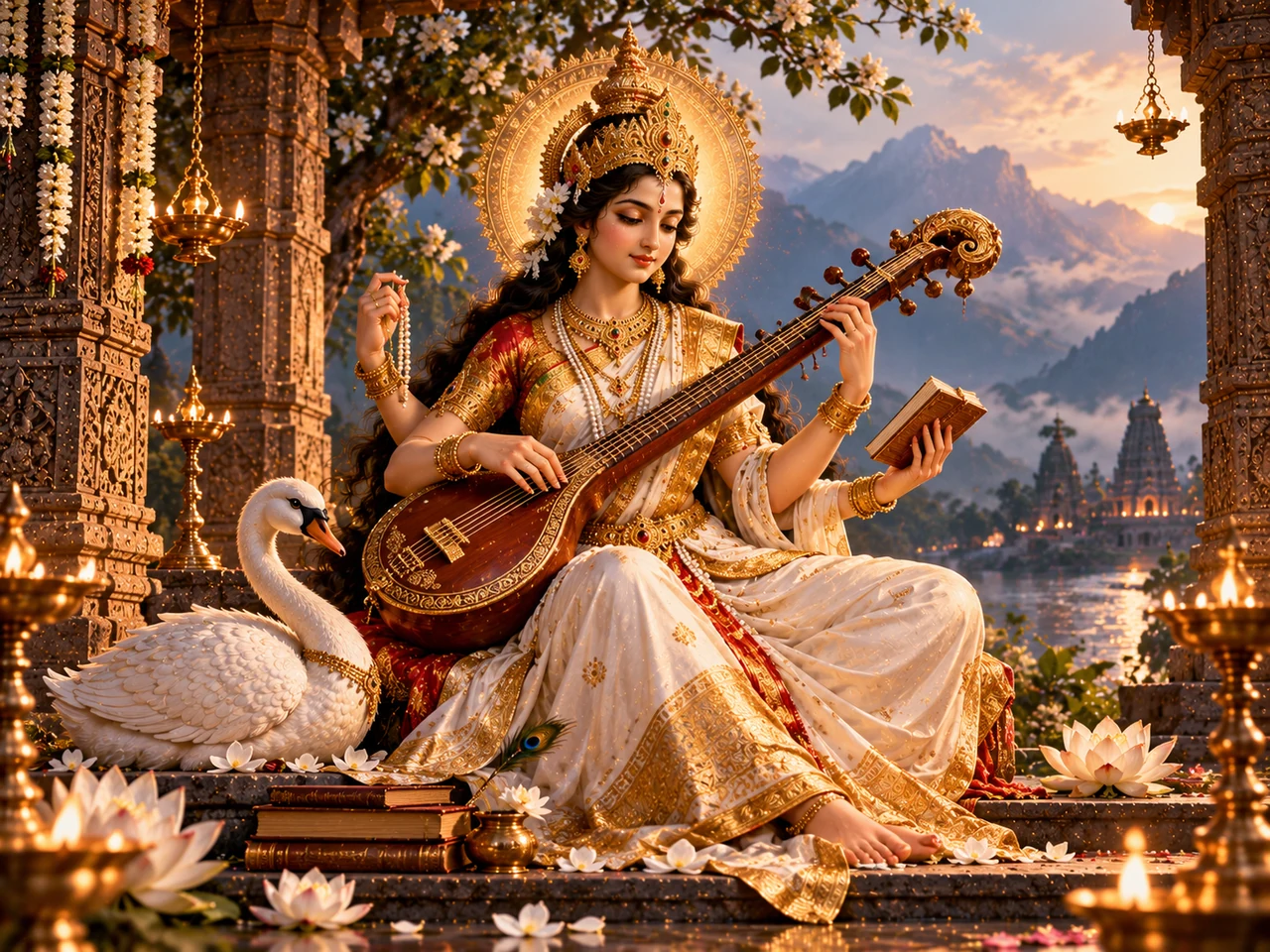
The hymn pictures the goddess with a moonlike face, on a lotus seat, radiant and auspicious, accompanied by a hamsa (often shown as a swan).

Explanation

The moon and lotus are poetic images of tranquillity and beauty; the bird is part of established Saraswati iconography. The base transcription reads the unusual “घुति,” while independently available versions read “द्युति,” meaning radiance. We preserve the base word rather than silently invent a Sanskrit etymology for it. The Metropolitan Museum documents both hamsa and peacock associations in different iconographies 56.

3

बायें कर में वीणा, दूजे कर माला। शीश मुकुट-मणि सोहे, गले मोतियन माला॥ जय सरस्वती माता॥

Roman Hindi

Bayen Kar Mein Veena, Dooje Kar Mala. Sheesh Mukut-Mani Sohe, Gale Motiyan Mala. Jai Saraswati Mata.Bayen Kar Mein Veena, Dooje Kar Mala. Sheesh Mukut-Mani Sohe, Gale Motiyan Mala. Jai Saraswati Mata.

Meaning

Saraswati is pictured holding a veena and a rosary, with a jewelled crown on her head and pearls around her neck.

Explanation

The musical instrument evokes sound, disciplined artistry and study; the rosary evokes recollection and focused attention. The fixed repository witness prints “वाणी” at this point, literally speech or voice, whereas Drik Panchang and the comparison PDF print “वीणा,” fitting “in the hand” and iconography. This edition reads “वीणा”; the repository reading remains recorded in the source list and the edition notes. “Dooje” means “the other/second,” not necessarily “the right” hand.

4

देव शरण में आये, उनका उद्धार किया। पैठी मंथरा दासी, असुर संघार किया॥ जय सरस्वती माता॥

Roman Hindi

Dev Sharan Mein Aaye, Unka Uddhar Kiya. Paithi Manthara Dasi, Asur Sanghar Kiya. Jai Saraswati Mata.Dev Sharan Mein Aaye, Unka Uddhar Kiya. Paithi Manthara Dasi, Asur Sanghar Kiya. Jai Saraswati Mata.

Meaning

The song says divine beings seek Saraswati’s shelter and are aided. Its second line alludes to Manthara, a maidservant of the Ramayana tradition, and the defeat of asuras.

Explanation

“Paithi” suggests entering or influencing, but this line does not supply a full story. A different, popular witness instead names Ravana’s destruction 34. Neither version proves that the episode is found verbatim in Valmiki’s Ramayana or that all Saraswati traditions teach the same causal role. “Sanghar” is retained as printed rather than silently converted to a standardized spelling. Treat the episode as a devotional narrative allusion, not historical documentation.

5

वेद-ज्ञान प्रदायिनी, बुद्धि-प्रकाश करो। मोहज्ञान तिमिर का सत्वर नाश करो॥ जय सरस्वती माता॥

Roman Hindi

Ved-Gyan Pradayini, Buddhi-Prakash Karo. Mohgyan Timir Ka Satvar Nash Karo. Jai Saraswati Mata.Ved-Gyan Pradayini, Buddhi-Prakash Karo. Mohgyan Timir Ka Satvar Nash Karo. Jai Saraswati Mata.

Meaning

The singer asks the giver of Vedic knowledge to illuminate understanding and quickly dispel the darkness associated with delusion.

Explanation

“Pradayini” means giver, and “satvar” means quickly. “Mohgyan” is an unusual fused reading; it does not suggest that knowledge itself is harmful. Other texts say “moh ajnan aur timir,” with a clearer opposition of ignorance and light 3. This is an interpretation of metaphor and ethical reflection, not a guaranteed route to examination marks or supernatural intellectual ability.

6

धूप-दीप-फल-मेवा-पूजा स्वीकार करो। ज्ञान-चक्षु दे माता, सब गुण-ज्ञान भरो॥ जय सरस्वती माता॥

Roman Hindi

Dhoop-Deep-Phal-Meva-Pooja Sveekar Karo. Gyan-Chakshu De Mata, Sab Gun-Gyan Bharo. Jai Saraswati Mata.Dhoop-Deep-Phal-Meva-Pooja Sveekar Karo. Gyan-Chakshu De Mata, Sab Gun-Gyan Bharo. Jai Saraswati Mata.

Meaning

Mother is asked to accept offerings such as incense, a lamp, fruit and nuts, and to grant the eye of insight and fill the devotee with knowledge and good qualities.

Explanation

The offering imagery belongs to an Aarti setting, but the verse is not an enforceable purchase list or an instruction that a flame must be lit. “Gyan-chakshu,” the eye of knowledge, metaphorically asks for discernment. Compared witnesses shorten the first line and read “jag nistar karo” instead of “sab gun-gyan bharo” 3. This difference changes the prayer’s emphasis; the readings have not been combined.

माँ सरस्वती की आरती, जो कोई जन गावे। हितकारी, सुखकारी ज्ञान-भक्ति पावे॥ जय सरस्वती माता॥

Roman Hindi

Maa Saraswati Ki Aarti, Jo Koi Jan Gaave. Hitkari, Sukhkari Gyan-Bhakti Paave. Jai Saraswati Mata.Maa Saraswati Ki Aarti, Jo Koi Jan Gaave. Hitkari, Sukhkari Gyan-Bhakti Paave. Jai Saraswati Mata.

Meaning

The conclusion expresses the singer’s hope that those who sing Saraswati’s Aarti receive helpful, joyful knowledge and devotion.

Explanation

The stanza promises spiritual benefit in the language of praise. It does not establish that everyone who sings must obtain an examination result, an admission or a scholarship. Read “knowledge and devotion” together: to learn, to act with humility and to acknowledge other people’s efforts. Some printed witnesses emphasize “Maa Saraswati ji ki aarti,” showing ordinary transmission differences.

Context & Usage

Selected source: seven complete stanzas, HanuDroid PostId 29 1. Roman Hindi below preserves the Hindi words; it is not an English translation. One openly declared correction (वाणी → वीणा) appears in stanza 3. Original lyric reuse approval remains pending.

A first reading: learning as a sacred responsibility

Jai Saraswati Mata is a Hindi Aarti addressed to Saraswati, revered in many Hindu traditions as the goddess of knowledge, articulate speech, music and artistic skill. It is a song to be read or sung, not a Sanskrit Vedic mantra and not a quotation from a single named Purana. The affectionate word Maiya invites readers into a devotional relationship; the repeated appeal for insight turns attention from merely possessing information toward understanding and character. This edition uses the seven-stanza Saraswati text in HanuDroid's AartiSangrah, fixed at a specified Git commit, default_data.xml, PostData ID 29 1. The displayed third stanza openly corrects its apparent instrument-word error from वाणी to वीणा using an independent parallel reading 34. Uncertain words elsewhere are retained. This complete selected reading is not a claim to the oldest or only canonical Aarti. Underlying lyric rights and scholarly collation have not been fully cleared.

Saraswati's images: what the Aarti actually says

A moonlike face, lotus, hamsa, veena, mala and luminous ornamentation are familiar devotional images. The hamsa (often visualized as a swan) can invite reflection on thoughtful discrimination; the veena invites disciplined listening and creativity; the mala reminds the reader of attention. These symbolic readings are ShivGoraksh explanatory prose, not hidden translations of extra lines of the hymn. Museum records show that Saraswati iconography is not unchanging: a nineteenth-century print may show a peacock instead of the more usual swan, while veena, manuscripts and rosary remain recognizable attributes 56. None of those museum images is being reused in this handoff.

Why the Manthara stanza calls for care

The line about Manthara is especially open to misunderstanding. The selected witness speaks of gods seeking refuge, a servant Manthara and the destruction of asuras. Another widespread sung reading names Ravana instead 34. The Aarti does not identify a precise passage in the Valmiki Ramayana, and the text alone cannot resolve how this mythic episode entered the song. It would be inaccurate to claim that every Hindu tradition assigns Saraswati the same role in Rama's narrative. Read the episode as part of the hymn's devotional imagination and transmitted storytelling. Readers should not infer a historical event, universal theological doctrine or a license to demonize real people.

Aarti in daily life and festivals

Saraswati is especially honoured by many communities during Vasant Panchami, and her worship also appears in other regional festival settings. Schools, music teachers, learners and artists may sing Saraswati prayers before work or study. These are customary settings, not requirements for everyone. The Hindu American Foundation discusses the association with education and the arts 7. Dates vary by local calendar and should come from ShivGoraksh's separately reviewed Calendar tools, never from a hardcoded article. Devotion and practical effort complement each other: respectful learning involves study, revising one's errors, listening carefully and making room for teachers and fellow students. The Aarti can focus intention but it does not confer guaranteed grades, employment, wealth or supernatural knowledge.

Key words and concepts

  • Maiya: loving address for mother.
  • Tribhuvan: three worlds in traditional cosmological poetry.
  • Padmasini: one seated upon a lotus.
  • Hamsa: a swan/goose-like bird prominent in goddess imagery.
  • Veena: a string instrument emblematic of music and trained skill.
  • Gyan-chakshu: the figurative “eye of knowledge” or insight.
  • Satvar: speedily; a plea for quick removal of inner darkness, not a guaranteed result.

Frequently asked questions

Is this the complete Jai Saraswati Mata Aarti? It is all seven stanzas of the specifically identified HanuDroid online witness, each with its refrain. Other popular renditions include a further reprise or alternate verses; a universal canonical length is not established.

Why is “Om” absent from the selected opening? The selected source opens “Jai Saraswati Mata”. Some independent versions add “Om”; this difference is recorded but not inserted into the base.

Why has “Veena” been used instead of “Vani”? The pinned source reads वाणी, while independently checked versions read वीणा and the hand-held instrument matches iconographic evidence. The single correction is disclosed and requires specialist review.

Is this from the Vedas or the Valmiki Ramayana? No verified edition or verse reference places this complete Hindi Aarti in either. It is a devotional song with an epic allusion that needs careful interpretation.

Can students sing it before studying? Yes, as an optional devotional practice where welcome and appropriate. Learning, preparation and respect for individual beliefs remain important.

Must incense, a lamp and nuts be purchased? No. The stanza uses offering imagery; the article does not require purchases, flame handling or a particular ritual method.

Will singing guarantee exam success? No. Descriptions of knowledge and blessing express religious hope, not an evidence-backed promise of results.

Sources, Credits & Licensing

Founder-authorized educational edition. Independent textual and specialist review remains incomplete; this reading does not confer initiation or ritual authorization.

MIT License Copyright (c) 2021 HanuDroid Permission is hereby granted, free of charge, to any person obtaining a copy of this software and associated documentation files (the "Software"), to deal in the Software without restriction, including without limitation the rights to use, copy, modify, merge, publish, distribute, sublicense, and/or sell copies of the Software, and to permit persons to whom the Software is furnished to do so, subject to the following conditions: The above copyright notice and this permission notice shall be included in all copies or substantial portions of the Software. THE SOFTWARE IS PROVIDED "AS IS", WITHOUT WARRANTY OF ANY KIND, EXPRESS OR IMPLIED, INCLUDING BUT NOT LIMITED TO THE WARRANTIES OF MERCHANTABILITY, FITNESS FOR A PARTICULAR PURPOSE AND NONINFRINGEMENT. IN NO EVENT SHALL THE AUTHORS OR COPYRIGHT HOLDERS BE LIABLE FOR ANY CLAIM, DAMAGES OR OTHER LIABILITY, WHETHER IN AN ACTION OF CONTRACT, TORT OR OTHERWISE, ARISING FROM, OUT OF OR IN CONNECTION WITH THE SOFTWARE OR THE USE OR OTHER DEALINGS IN THE SOFTWARE. Selected text from the linked source; Romanization and bilingual meanings newly prepared by ShivGoraksh. No source recordings or modern translations imported.

Text licence

Original Roman reading

The Roman reading recorded with this edition, retaining its spelling and word forms before the Easy Roman display conversion.

  1. 1

    Jai Saraswati Mata, Maiya Jai Saraswati Mata. Sadgun, Vaibhavshali, Tribhuvan Vikhyata. Jai Saraswati Mata.

  2. 2

    Chandravdani, Padmasini Ghuti Mangalakari. Sohe Hans-Savari, Atul Tejdhari. Jai Saraswati Mata.

  3. 3

    Bayen Kar Mein Veena, Dooje Kar Mala. Sheesh Mukut-Mani Sohe, Gale Motiyan Mala. Jai Saraswati Mata.

  4. 4

    Dev Sharan Mein Aaye, Unka Uddhar Kiya. Paithi Manthara Dasi, Asur Sanghar Kiya. Jai Saraswati Mata.

  5. 5

    Ved-Gyan Pradayini, Buddhi-Prakash Karo. Mohgyan Timir Ka Satvar Nash Karo. Jai Saraswati Mata.

  6. 6

    Dhoop-Deep-Phal-Meva-Pooja Sveekar Karo. Gyan-Chakshu De Mata, Sab Gun-Gyan Bharo. Jai Saraswati Mata.

  7. 7

    Maa Saraswati Ki Aarti, Jo Koi Jan Gaave. Hitkari, Sukhkari Gyan-Bhakti Paave. Jai Saraswati Mata.

Source history and variant boundaries

The identified online repository includes seven complete stanzas, each ending in a refrain 1. The Drik Panchang page adds a sung closing reprise and includes different lexical choices 3. The comparison PDF similarly prints an Om opening and other differences 4. We have not merged these versions. Punctuation and word spacing are editorially organized for comfortable reading; the one substantive correction is disclosed above and itemized in the source list. The repository's own MIT licence 2 does not by itself prove ownership of any pre-existing lyrics it may contain. The lyricist is unknown in the consulted material. An app's author/uploader field is not evidence of who composed a traditional Aarti. No historical year or fictitious attribution is supplied.

Sources and editorial notice

  • 1 HanuDroid / AartiSangrah — default_data.xml, PostId 29: माँ सरस्वती की आरती: https://github.com/HanuDroid/AartiSangrah/blob/ee77c52057e3bb4b5c04544114dceacda091ffb7/app/src/main/assets/default_data.xml
  • 2 HanuDroid / AartiSangrah — MIT License at pinned commit: https://github.com/HanuDroid/AartiSangrah/blob/ee77c52057e3bb4b5c04544114dceacda091ffb7/LICENSE
  • 3 Drik Panchang — Saraswati Mata Aarti: https://www.drikpanchang.com/lyrics/aarti/saraswati-mata/saraswati-mata-aarti.html
  • 4 Thakur Bhim Singh — Jai Saraswati Mata (Aarti), PDF: https://thakurbhimsingh.com/wp-content/uploads/2018/09/Om-Jai-Saraswati-mata.pdf
  • 5 The Metropolitan Museum of Art — Saraswati, goddess of learning (object 2013.11): https://www.metmuseum.org/art/collection/search/78265
  • 6 The Metropolitan Museum of Art — Goddess Sarasvati (object 849503): https://www.metmuseum.org/art/collection/search/849503
  • 7 Hindu American Foundation — Vasant Panchami: https://www.hinduamerican.org/vasant-panchami
  • 8 Valkala — Saraswati Aarti source/variant check: https://www.valkala.com/saraswati-aarti
Additional passage commentary

Stanza 1 — Invocation: virtues and the three worlds

Meaning: Hail Mother Saraswati, lovingly addressed as Maiya. The singer praises her virtues and glory, imagining her fame extending throughout the three worlds. Explanation: “Maiya” brings tenderness to the formal praise. “Sadgun” points to fine qualities or virtues, while “tribhuvan” invokes a traditional threefold cosmic world, not three astronomical planets. This witness reads “sadgun, vaibhavshali,” a phrase different from the often sung “sadgun vaibhav shalini.” The repeated salutation holds the song together for a gathering; its presence does not establish a mandatory number of recitations.

Stanza 2 — Moonlike face, lotus seat and hamsa

Meaning: The hymn pictures the goddess with a moonlike face, on a lotus seat, radiant and auspicious, accompanied by a hamsa (often shown as a swan). Explanation: The moon and lotus are poetic images of tranquillity and beauty; the bird is part of established Saraswati iconography. The base transcription reads the unusual “घुति,” while independently available versions read “द्युति,” meaning radiance. We preserve the base word rather than silently invent a Sanskrit etymology for it. The Metropolitan Museum documents both hamsa and peacock associations in different iconographies 56.

Stanza 3 — Veena, rosary and adornments

Meaning: Saraswati is pictured holding a veena and a rosary, with a jewelled crown on her head and pearls around her neck. Explanation: The musical instrument evokes sound, disciplined artistry and study; the rosary evokes recollection and focused attention. The fixed repository witness prints “वाणी” at this point, literally speech or voice, whereas Drik Panchang and the comparison PDF print “वीणा,” fitting “in the hand” and iconography. This edition reads “वीणा”; the repository reading remains recorded in the source list and the edition notes. “Dooje” means “the other/second,” not necessarily “the right” hand.

Stanza 4 — Refuge and a disputed epic allusion

Meaning: The song says divine beings seek Saraswati’s shelter and are aided. Its second line alludes to Manthara, a maidservant of the Ramayana tradition, and the defeat of asuras. Explanation: “Paithi” suggests entering or influencing, but this line does not supply a full story. A different, popular witness instead names Ravana’s destruction 34. Neither version proves that the episode is found verbatim in Valmiki’s Ramayana or that all Saraswati traditions teach the same causal role. “Sanghar” is retained as printed rather than silently converted to a standardized spelling. Treat the episode as a devotional narrative allusion, not historical documentation.

Stanza 5 — Light of understanding

Meaning: The singer asks the giver of Vedic knowledge to illuminate understanding and quickly dispel the darkness associated with delusion. Explanation: “Pradayini” means giver, and “satvar” means quickly. “Mohgyan” is an unusual fused reading; it does not suggest that knowledge itself is harmful. Other texts say “moh ajnan aur timir,” with a clearer opposition of ignorance and light 3. This is an interpretation of metaphor and ethical reflection, not a guaranteed route to examination marks or supernatural intellectual ability.

Stanza 6 — Simple offerings, insight and good qualities

Meaning: Mother is asked to accept offerings such as incense, a lamp, fruit and nuts, and to grant the eye of insight and fill the devotee with knowledge and good qualities. Explanation: The offering imagery belongs to an Aarti setting, but the verse is not an enforceable purchase list or an instruction that a flame must be lit. “Gyan-chakshu,” the eye of knowledge, metaphorically asks for discernment. Compared witnesses shorten the first line and read “jag nistar karo” instead of “sab gun-gyan bharo” 3. This difference changes the prayer’s emphasis; the readings have not been combined.

Stanza 7 — Closing: learning joined with devotion

Meaning: The conclusion expresses the singer’s hope that those who sing Saraswati’s Aarti receive helpful, joyful knowledge and devotion. Explanation: The stanza promises spiritual benefit in the language of praise. It does not establish that everyone who sings must obtain an examination result, an admission or a scholarship. Read “knowledge and devotion” together: to learn, to act with humility and to acknowledge other people’s efforts. Some printed witnesses emphasize “Maa Saraswati ji ki aarti,” showing ordinary transmission differences.

  1. HanuDroid / AartiSangrah — default_data.xml, PostId 29: माँ सरस्वती की आरती · Open source
  2. HanuDroid / AartiSangrah — MIT License at pinned commit · Open source
  3. Drik Panchang — Saraswati Mata Aarti · Open source
  4. Thakur Bhim Singh — Jai Saraswati Mata (Aarti), PDF · Open source
  5. The Metropolitan Museum of Art — Saraswati, goddess of learning (object 2013.11) · Open source
  6. The Metropolitan Museum of Art — Goddess Sarasvati (object 849503) · Open source
  7. Hindu American Foundation — Vasant Panchami · Open source
  8. Valkala — Saraswati Aarti source/variant check · Open source