



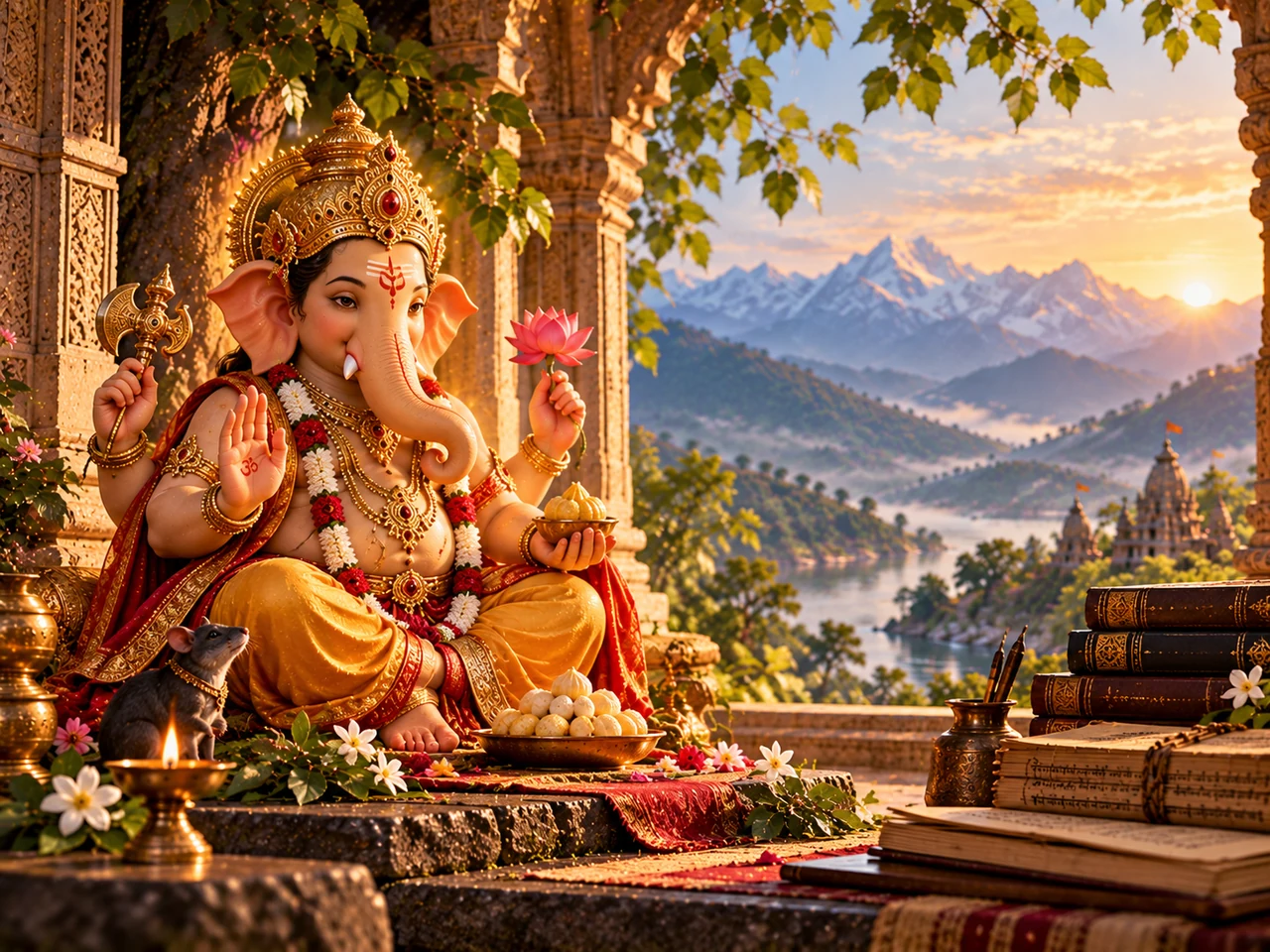
Selected reading: the familiar standalone four-pāda Ganesha invocation, cross-checked against an accessible Sanskrit Documents reading and other digital witnesses. It is a complete reading of this single prayer, not a claim that an entire historical puja manual has been reproduced. Earlier dated witnesses have been identified, but their original scan pages have , not a claim that an entire historical pūjā manual has been reproduced. Earlier dated witnesses have been identified, but their original scan pages have not been independently collated here. The composer, earliest textual locus and reuse permissions remain unresolved; this is an educational edition, not an authenticated Purāṇic quotation. 1 2 3 4
Meaning of each of the four pādas
1. vakratuṇḍa mahākāya — O curved-trunked, great-bodied one. The compound vakra means bent or curved and tuṇḍa denotes a projecting snout or beak; in this invocation the established Ganesha image supplies the sense trunk. Mahākāya combines mahā (great, large) and kāya (body or embodied form). Both are forms of direct address to the deity. A useful interpretive reading is that the striking elephant form focuses the devotee’s attention rather than functioning as an anatomical or historical description. “Curved” is not an omen of something wrong: it is a recognisable feature of the honoured form. 2. sūryakoṭisamaprabha — One whose radiance is like a crore suns. Here sūrya is the sun, koṭi a crore (ten million in the standard modern Indian numbering sense), sama comparable or equal, and prabhā radiance or splendour. The combined vocative -prabha describes the addressed deity as radiant. In devotional language, this deliberately immense comparison conveys brilliance, awareness and auspicious presence. It is not a physical measurement and should not be translated as a claim that a particular luminosity was observed. Some printings divide the compound typographically as sūryakoṭi samaprabha without changing the idea. 3. nirvighnaṃ kuru me deva — O divine one, make [it] free of obstruction for me. Vighna is an obstacle or hindrance; nir-vighna means without one. Kuru is the imperative “make/do,” me means “for me” or “my,” and deva is a vocative “O deity.” The Sanskrit does not specifically promise wealth, grades, recovery from illness or effortless victory. In context, the object of “make unobstructed” is supplied by the undertakings mentioned in the next pāda. That link matters: the prayer seeks help with what the supplicant must still undertake. 4. sarvakāryeṣu sarvadā — In all undertakings, at all times. Sarva means all; kārya denotes a task, matter to be done or undertaking; -eṣu is the locative plural ending, “in/with respect to”; sarvadā means always. The line does not name one privileged task. It can be read as an inclusive request for steadiness across ordinary responsibilities as well as solemn occasions. An early catalogue prints sarvakāryāṇi (“all undertakings,” accusative plural) instead; that is a genuine grammatical variation in its reported manuscript text, not an alternate spelling of -eṣu. 4
A brief Sanskrit reading guide
| Selected word | Grammatical role | Plain meaning |
|---|---|---|
| vakratuṇḍa | vocative epithet | O one with a curved trunk |
| mahākāya | vocative epithet | O great-bodied one |
| sūryakoṭisamaprabha | vocative compound | O one radiant as a crore suns |
| nirvighnaṃ | predicative adjective/adverbial expression | free from obstacles |
| kuru | imperative of √kṛ | make, bring about |
| me | enclitic pronoun | for me / my |
| deva | vocative | O divine one |
| sarvakāryeṣu | locative plural | in every undertaking |
| sarvadā | indeclinable | always |
Transliteration note. The Roman text uses IAST: ā is a long vowel; ṭ and ṇ mark retroflex sounds; ṣ and ś represent distinct Sanskrit sibilants; ṃ marks an anusvāra. Compound joining and two-line layout are declared editorial presentation choices, not proof of an ancient manuscript’s punctuation. This is a non-Vedic devotional verse in the selected reading; no Vedic pitch accents or certified recitation rules are asserted.
What kind of prayer is Vakratunda Mahakaya? This composition is a prārthanā, a direct request following a compact description of Ganesha. In daily speech it is often called a “Ganesh mantra,” but its visible literary form is one Sanskrit śloka. It is shorter than the , a direct request following a compact description of Gaṇeśa. In daily speech it is often called a “Ganesh mantra,” but its visible literary form is one Sanskrit śloka. It is shorter than the Ganesha PañcaratnamGaṇeśa Pañcaratnam and is not a stanza from the Ganesha ChalisaGaṇeśa Cālīsā or an introductory substitute for the full Ganesha KavacamGaṇeśa Kavacam. These works have different identities and should remain separate in the collection. The prayer is encountered in contexts of maṅgalācaraṇa, an auspicious invocation at the beginning of study, worship, an event or a task. It is also printed inside longer ritual outlines and verse collections. Appearing at the start of one such collection does not make this isolated śloka the whole of that collection, and placing it before an undertaking does not prove that it was composed for that undertaking. A digitally published Siddhivināyaka Ṣoḍaśopacāra Pūjāstutiḥ has the selected words as its opening verse; a distinct Vighneśvara Pūjāvidhānam prints both avighnaṃ and nirvighnaṃ within its broader ritual text. 1 6
The spiritual themes without a guarantee of results
Ganesha is widely honoured as Gaṇeśa is widely honoured as Vighneśvara, lord in relation to obstacles, and Vighnahartā, remover of obstacles. In this prayer those familiar devotional names help explain why a request for nirvighnatā feels natural. In practice, a challenge can be external (a delay, a difficult decision, a missing resource) or internal (haste, distraction, arrogance or fear). The text does not explicitly enumerate these examples; they are a contemporary reflection offered by ShivGoraksh, not additional lines of the original. A student may find the prayer a reminder to begin carefully, a family may use it to express hope before a shared event, and a devotee may hear the description of sunlight as a metaphor for clarity. None of those applications is compulsory, and no set count, auspicious time or technical ritual performance is prescribed in this educational article. The link between sincere prayer and responsible action is interpretive, not a promise that every undertaking will succeed.
Textual history, printed witnesses and responsible attribution
The author is unknown. The verse is transmitted as a traditional Ganesha invocation; no trustworthy specific Veda, Upaniṣad, Purāṇa chapter or named ancient poet has been established for its origin in the evidence examined for this edition. In particular, seeing the same words in a modern liturgy or composite stotra does not establish that that larger title was their place of first composition. 1 3 4 5
A dated 1913 manuscript catalogue, A Descriptive Catalogue of the Sanskrit Manuscripts of the Government Oriental Manuscripts Library, Madras, volume 16, reports the line under Vināyakavratakalpa, item 8521, at the end of the manuscript text. The catalogue’s web OCR is marked not proofread. It reports अविघ्नं and सर्वकार्याणि rather than our selected निर्विघ्नं and सर्वकार्येषु; its report is valuable evidence of transmission but not a visual inspection of the manuscript or the original printed catalogue page. 4
The Internet Archive catalogues L. R. Pangarkar’s Bhaktimārga Pradīpa, published in 1910, item in.ernet.dli.2015.366206. A third-party editorial collation says its scan leaf 9, printed page 1, contains the prayer with वक्रतुंड, सूर्यकोटिसमप्रभ and निर्विघ्नं. this edition has checked the Archive catalogue and the independent report, not the leaf image itself. The report therefore supports a lead and provisional variant map, not a falsely claimed primary-scan verification. 2 3
An advertised “1916 Ahnika Sutravali” comparison in that report needs particular caution: the linked Archive item in.ernet.dli.2015.405955 currently carries 1883 as its catalogue date. We have not proved whether it is a differently dated impression or a link/edition mismatch; neither “1916 edition” nor its reported page reading should be treated as independently verified by this edition. 2 7
Witness readings are not blended
| Reading issue | This reader | Separately attested or reported form | What changes? |
|---|---|---|---|
| Opening epithet | वक्रतुण्ड | वक्रतुंड in the reported 1910 print | Nasal spelling; no deliberate change in meaning |
| Sun compound | सूर्यकोटिसमप्रभ | कोटिसूर्यसमप्रभ in a common-shloka collection | Reordered compound, similar poetic image |
| Obstacle phrase | निर्विघ्नं | अविघ्नं in the 1913 catalogue and some puja readings in the 1913 catalogue and some pūjā readings | Two different negative prefixes, both seek absence of obstacles |
| Undertakings | सर्वकार्येषु | सर्वकार्याणि in the 1913 catalogue | A meaningful grammatical change: locative versus accusative |
| Invocation | No initial oṃ | ॐ prefixed in some recitation manuals | Liturgical framing, not part of this selected standalone wording |
| Compound spacing | सूर्यकोटिसमप्रभ | सूर्यकोटि समप्रभ | Usually a typographic word-division choice |
The variants above are not evidence for six formally dated manuscript recensions. Modern webpages, a published manuscript description, reported historical-print collations and liturgical additions have differing evidentiary value. Textual relationships, exact dates of individual manuscript exemplars and any genealogical stemma remain open. 2 4 5 6
Additional passage commentary
Prayer 1
Complete meaning. O Lord of the curved trunk and vast form, whose splendour rivals that of a crore suns: please make all my undertakings free from obstacles, always. The first half is an address to Ganesha; the second is an appeal. It does not say that the speaker will never encounter difficulty, nor that chanting replaces preparation, discernment or work. It asks for a favourable, unobstructed course of action while recognising a source of help beyond the individual. The measured shift from praise to request gives this very short prayer its emotional shape. O Lord of the curved trunk and vast form, whose splendour rivals that of a crore suns: please make all my undertakings free from obstacles, always. The first half is an address to Gaṇeśa; the second is an appeal. It does not say that the speaker will never encounter difficulty, nor that chanting replaces preparation, discernment or work. It asks for a favourable, unobstructed course of action while recognising a source of help beyond the individual. The measured shift from praise to request gives this very short prayer its emotional shape. 1 2