



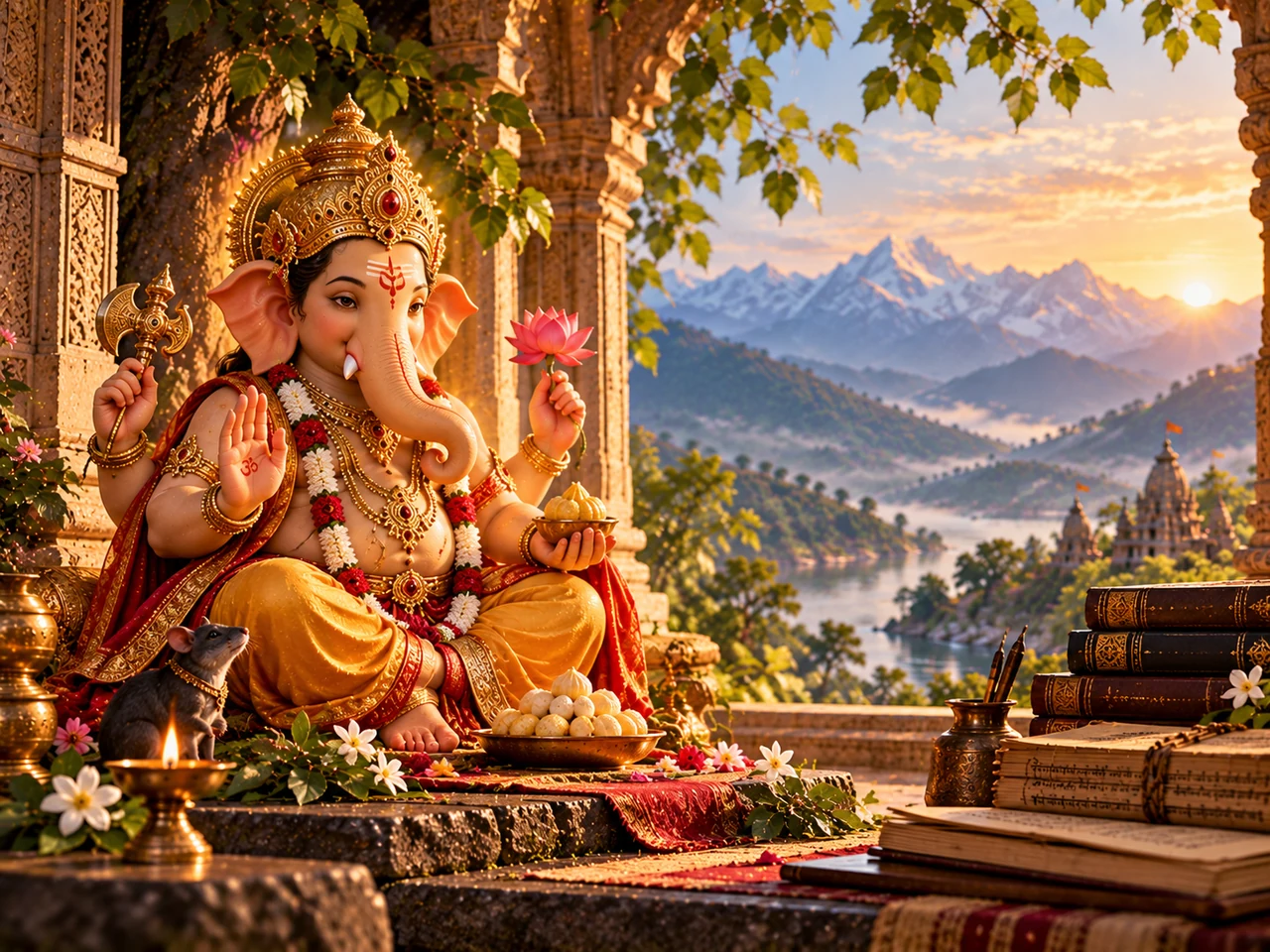
Edition note. Below is the entire selected one-formula mantra, first in Roman IAST rather than English translation. Its location is the mantra passage of the Gaṇapatyatharvaśīrṣa (numbered 7 in the selected digital witnesses). This is a provisional unaccented educational reading. With the seed syllable gaṃ, reverent salutations to Ganapati, the Lord of the gaṇas. . With the seed syllable gaṃ, reverent salutations to Gaṇapati, the Lord of the gaṇas. Explanation. The line combines oṃ, the sacred syllable used in the selected Gaṇapatyatharvaśīrṣa passage, with gaṃ, the seed sound associated with Ganapati. , the seed sound associated with Gaṇapati. Gaṇapataye is the dative form “to Gaṇapati”; namaḥ is a respectful salutation or bow. The immediately preceding prose of the source describes how the ga-sound is articulated as a seed using ga, a, the nasal element and its sound-symbols. That account belongs to the text’s ritual theology and is not a modern scientific explanation of how sounds work. As a devotional reflection, the formula can evoke humility at the start of learning or an undertaking; it does not guarantee a particular result. The exact practice context is tradition-dependent and remains outside this reading entry. 1 2 4
Word-by-word understanding
Oṃ (ॐ). This revered sacred syllable opens the formula as recorded in the selected passage. Its presence here should not be taken to prove that every Ganesha name or Vedic invocation historically begins with This revered sacred syllable opens the formula as recorded in the selected passage. Its presence here should not be taken to prove that every Gaṇeśa name or Vedic invocation historically begins with oṃ. This page does not prescribe a pronunciation or a specialised rite. 1
Gaṃ (गं). The short seed syllable—bijabīja—associated with Ganapati. The original passage describes a compositional symbolism involving —associated with Gaṇapati. The original passage describes a compositional symbolism involving ga, a, a nasal element and the signs of bindu and nāda. The spelling गं in this reading represents a nasalised/ṃ-marked seed sound. This should not be translated literally as an independent dictionary word meaning “obstacle-remover”. 1 2
Gaṇapataye (गणपतये). “To Gaṇapati”: gaṇa may mean a group, host or company; pati is lord or master. Here the dative ending -aye marks the recipient of the salutation. Ganapati is identified with Ganesha in this text's devotional setting. Do not assume that every instance of the word marks the recipient of the salutation. Gaṇapati is identified with Gaṇeśa in this text's devotional setting. Do not assume that every instance of the word ganapatigaṇapati in older Vedic literature is automatically a direct reference to the later familiar elephant-headed iconography. 1 5
Namaḥ (नमः). “Reverence, homage, salutation.” This is an act of addressing and honouring, not a statement that a god is obliged to deliver a requested result. 1
Where does this exact mantra appear? The short formula appears near the end of the passage customarily titled Ganesha MantraGaṇeśa Mantra in the Gaṇapatyatharvaśīrṣa, also called the Ganapati UpaniṣadGaṇapati Upaniṣad. In the Sanskrit Wikisource and Sanskrit Documents displays consulted, it is numbered 7. The preceding sentences introduce the syllabic form—gakāra, akāra, anusvāra, bindu, nāda—before the formula is stated. Other printed recensions divide the surrounding Upaniṣad differently: the number “7” is a source-specific locator, not a universally fixed mantra number. 1 2 4
This Devotion entry is only the mantra. It is not a transcription of the whole Gaṇapatyatharvaśīrṣa, its prayer of peace, its Ganesha-gāyatrī, visualisation, or its phalaśruti. Those passages must be separately source-verified if the site later creates a full Upaniṣad reader. The selected text is therefore complete as a . It is not a transcription of the whole Gaṇapatyatharvaśīrṣa, its prayer of peace, its Gaṇeśa-gāyatrī, visualisation, or its phalaśruti. Those passages must be separately source-verified if the site later creates a full Upaniṣad reader. The selected text is therefore complete as a one-mantra work, not as the entire parent composition. 1 2
Why does it include a bija syllable? A Why does it include a bīja syllable? A bijabīja (“seed”) in mantra traditions is a compact, symbolically charged syllable. The Gaṇapatyatharvaśīrṣa itself explains the elements of the Ganesha seed; this is stronger evidence for the formula's identity than merely calling it a popular “success chant”. It is important to distinguish an itself explains the elements of the Gaṇeśa seed; this is stronger evidence for the formula's identity than merely calling it a popular “success chant”. It is important to distinguish an emic explanation—what a religious text says about sacred sound—from a claim that the syllable mechanically changes external events. A reflective reading may link the opening sound to bringing care and steadiness to action, but that is original editorial interpretation. 1 2
There are practices in which bijabīja mantras appear alongside dikshadīkṣā, nyāsa, mudrā, prescribed counts or other ritual methods. Their requirements vary across lineages. A public explanation of the mantra's words is not an authorisation or prohibition for every formal ritual context. Specialist review is required before ShivGoraksh supplies such instructions. 4
Is Ganapati the same as the Ganesha of popular worship? Within the selected Is Gaṇapati the same as the Gaṇeśa of popular worship? Within the selected Gaṇapatyatharvaśīrṣa, yes: it is a devotional and philosophical address to Ganesha as Ganapati. The composition even elevates him to ultimate reality, : it is a devotional and philosophical address to Gaṇeśa as Gaṇapati. The composition even elevates him to ultimate reality, brahman, in its theology. This is not identical to claiming the same theological usage in every text and century. The older word ganapatigaṇapati has its own linguistic and textual history. 1 3 5
History, manuscript evidence and attribution
The Gaṇapatyatharvaśīrṣa is a later, sectarian Upaniṣadic composition associated by tradition with the Atharvaveda. It should not be misrepresented as a mantra directly located in the oldest Ṛgvedic Saṃhitā. A University of Pennsylvania manuscript, catalogued as Ms. Coll. 390, Item 14, carries a manuscript date corresponding to 1865 and is recorded as a complete text. That catalogue establishes a historical manuscript witness for the larger work, not yet the exact folio reading of this mantra, because its page images have not been collated for this edition. Another catalogue record, Item 79, supplies additional manuscript context. These records do not determine the composition's original date. 3 6
The text is transmitted anonymously; the word Gaṇaka in its mantra section identifies a traditional ṛṣi of the mantra, which should not be treated without evidence as a modern-style signature proving the author of the entire Upaniṣad. Some scholarship places the text relatively late; precise date and textual history should remain qualified. 1 5
Textual variants and editorial choices
- बिन्दु and anusvāra spelling. The selected formula uses गं (gaṃ). Other recitation aids may render its nasal sign differently, or write गम् as a pronunciation aid. These graphic conventions should not be merged into a new source reading or pronounced from this page as formal instruction. 1 4
- Beginning with Oṃ. The selected formula does begin with oṃ, unlike other Vedic mantras in which it may be a later prefatory addition. Never transfer the rule from a different mantra to this one. 1 2
- Gaṇapataye / gaṇapataye namaḥ alone. Shorter salutations to Ganapati circulate, but omitting Shorter salutations to Gaṇapati circulate, but omitting oṃ gaṃ makes a different bounded formula rather than the identical source-selected mantra. 1
- Section numbering. The locator “7” belongs to the checked web transcriptions; some editions label the same passage differently. Do not assign an unverified manuscript folio or universal verse number. 1 3
- Vedic accent. Some recitation files and manuscripts contain svara signs. They are not reproduced here, and this entry must not be described as an accent-approved chant guide. 2 6
Meaning in a reader's life
Ganesha is widely honoured when undertaking study, writing or new work. The language of this mantra is strikingly economical: it does not list tasks to be accomplished or promise wealth; it names the deity and offers reverence. A modern reader may draw from that economy a call to begin with a less hurried mind, accept limits, and act thoughtfully. Such an interpretation is deliberately presented as Gaṇeśa is widely honoured when undertaking study, writing or new work. The language of this mantra is strikingly economical: it does not list tasks to be accomplished or promise wealth; it names the deity and offers reverence. A modern reader may draw from that economy a call to begin with a less hurried mind, accept limits, and act thoughtfully. Such an interpretation is deliberately presented as ShivGoraksh commentary, not as a hidden extra verse or as a guaranteed psychological effect. 1 4
Pronunciation and ritual boundaries
The spelling oṃ gaṃ gaṇapataye namaḥ uses IAST: ṇ is a retroflex nasal and ṃ is the transliteration sign for the nasal element. This notation is for understanding the text. It does not replace a qualified teacher's recitation guidance, nor does it provide the source's full accent system. No japa count, initiation requirement, ritual time, breathing procedure, homa or nyāsa is prescribed. The devotional tradition may associate the mantra with removal of obstacles, but that is a religious understanding, not a promised measurable outcome. 1 4
Frequently asked questions
Is the complete original mantra included? Yes. The selected work is the short formula oṃ gaṃ gaṇapataye namaḥ ||. The whole surrounding Upaniṣad is a separate, longer text. 1
Does “gaṃ” literally mean Ganesha?Does “gaṃ” literally mean Gaṇeśa? No. It is a bijabīja, explained symbolically and liturgically in the preceding source text; it is not an ordinary lexical synonym for “Gaṇeśa”. 1
Is this the same as Ganesha Gāyatrī?Is this the same as Gaṇeśa Gāyatrī? No. The source presents a Ganesha-gāyatrīGaṇeśa-gāyatrī in the following section. The two should not be joined as if they formed one mantra. 1
Is the mantra from Rigveda 2.23.1?Is the mantra from Ṛgveda 2.23.1? No. That is a different and older ganapatigaṇapati invocation, not the textual location of this exact oṃ gaṃ gaṇapataye namaḥ formula. 1 5
Can the article teach ritual japa or promise obstacle removal? No. This is an educational Devotion reader. Formal practice rules, claims of guaranteed benefits and source-specific recitation require separate review. 4