



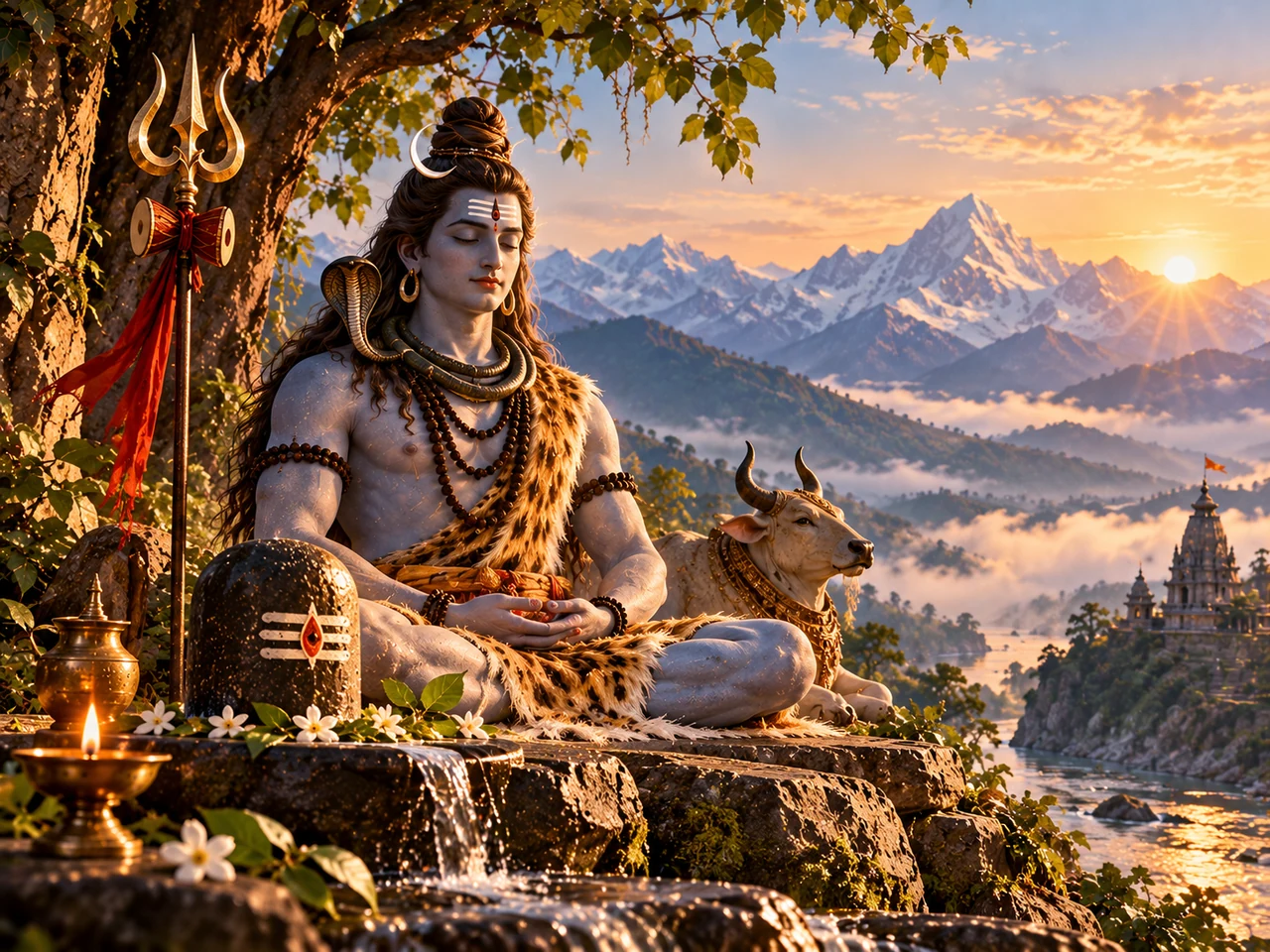
Edition notice: Eight Sanskrit praise verses embedded in the Uttara Kāṇḍa of the Rāmacaritamānasa, plus the separate closing phalaśruti. Sixteen half-verses in the fixed Wikisource witness are paired into eight shlokas; sandhi/spelling is editorially normalized. Final visual collation against the historical print remains pending. 1 2 3
Phalaśruti
Meaning: A Brahmin spoke this Rudrāṣṭakam to please Hara. According to the closing benediction, Śambhu is gracious toward people who recite it with devotion. Explanation: The closing verse is separate from the eight metrical praise-verses and changes the narrative viewpoint. In the Uttara Kāṇḍa story, the Brahmin is the guru who seeks grace after his disciple insults him in a Shiva temple. “Śambhu is pleased” is a literary devotional promise; the text does not authorize guaranteed cures or compulsory recitation counts. related reading · 1 3
What is Rudrashtakam? Rudrāṣṭakam is an eight-verse Sanskrit hymn to Shiva embedded in the is an eight-verse Sanskrit hymn to Śiva embedded in the Uttara Kāṇḍa of Goswami Tulsidas’s Rāmacaritamānasa, a larger work mostly in Awadhi. Within the narrative of Kakabhushundi’s former life, a disciple fails to honor his Brahmin teacher in a Shiva temple, a curse follows, and the teacher invokes Shiva’s compassion. The stotra therefore belongs to a story about pride, respect, mercy and the responsibilities of a guru—not merely to a free-floating collection of prayers. 2 3 5
The eight primary verses are composed in the bhujaṅgaprayāta rhythm, whose recurring pattern can sound flowing or serpentine. They are followed by an anuṣṭubh closing verse, the phalaśruti. It comments on the hymn and its devotional fruit; it is deliberately not labelled a ninth verse of the aṣṭakam. 1 3 4
How the hymn unfolds: from the formless to intimate surrender
The first two verses introduce the Shiva whom ordinary categories cannot capture: all-pervading consciousness, beyond form, described through nirguṇa, turīya and the ground of Oṃkāra. In verses three and four the poet shifts sharply into a recognizable sacred portrait: snow, Gaṅgā, a new moon, serpents, a blue throat, hide and skull garland. Verses five and six bring cosmic might beside tenderness, naming Bhavānī and asking for grace. The seventh associates devotion with peace, and the eighth relinquishes any claim to mastery of yoga, japa or elaborate worship. This emotional progression makes the hymn understandable even to readers meeting Sanskrit poetry for the first time.
Shiva within a poem centered on Rama
A striking feature is its location in the Rāmacaritamānasa, a foundational Rama-devotional narrative. Shiva and Rama devotion are not treated as rivals by this passage. That does not establish that every Shaiva, Vaiṣṇava, Smārta, Shakta or Nāth community holds the same theology; the hymn is a literary witness to a particular devotional synthesis rather than a universal doctrinal charter., a foundational Rama-devotional narrative. Shiva and Rama devotion are not treated as rivals by this passage. That does not establish that every Śaiva, Vaiṣṇava, Smārta, Śākta or Nāth community holds the same theology; the hymn is a literary witness to a particular devotional synthesis rather than a universal doctrinal charter.
Key words at a glance
| Term | Accessible meaning |
|---|---|
| Nirvāṇarūpa | Of the nature of liberation |
| Cidākāśa | The expansive “space” of consciousness |
| Turīya | A philosophical “fourth,” beyond ordinary waking, dreaming and deep sleep |
| Nīlakaṇṭha | Blue-throated Shiva of the poison-bearing narrative |
| Bhavānīpati | Shiva as the consort of Bhavānī (Parvati)Shiva as the consort of Bhavānī (Pārvatī) |
| Trayaḥśūla | Often glossed as three forms of suffering |
| Manmathārī | The foe of Kāma, invoking a Shiva myth |
| Phalaśruti | A closing verse describing the devotional merit or fruit of recitation |
Textual sources and what varies
The complete eight-verse core and the closing phalaśruti are attested across the reviewed sources. A fixed Sanskrit Wikisource page numbers sixteen half-verses, while other readers pair them into eight full stanzas. Spellings and sandhi vary around words such as girā jnana gotītagirā jñāna gotīta, bhrū sunetra, kalpāntakārī and duḥkhaugha. The scanned historical Rāmacaritamānasa page transcriptions are especially useful for locating the hymn, but include obvious transcription/OCR difficulties. A single historical source has not been fully visually collated in this edition. 1 2 3 4 This edition makes its stanza grouping and editorial Sanskrit normalization explicit and does not borrow another site’s translations. A final Sanskrit reader must confirm the readings against page images before the site treats the text as source-verified. Rights clearance of the specific transcription, including attribution and ShareAlike obligations, is also a separate gate.
Reading, devotion and practice
Rudrāṣṭakam is offered here as a publicly readable devotional hymn, not as an initiation manual. The phalaśruti speaks of Shiva’s gracious response to devotion: a meaningful claim within the religious tradition, not a guarantee of health, money, employment or a particular outcome. No prescribed recitation count, special ritual procedure, fasting rule, or medical advice is derived from this text.
Additional passage commentary
Verse 1
Meaning: I bow to Shiva, the Lord of lords, whose nature is liberation: powerful, all-pervading, identified with Brahman and the Vedas. I worship the self-abiding one beyond attributes, conceptual divisions and selfish desire, the vastness of consciousness, whose dwelling is likened to space. I bow to Śiva, the Lord of lords, whose nature is liberation: powerful, all-pervading, identified with Brahman and the Vedas. I worship the self-abiding one beyond attributes, conceptual divisions and selfish desire, the vastness of consciousness, whose dwelling is likened to space. Explanation: The hymn begins without a physical portrait. “Nirguṇa” describes the ultimate beyond limiting qualities, not a denial of the compassionate figure praised later. “Cidākāśa” is an image for the openness of awareness; “ākāśavāsa” also evokes the unfettered ascetic. This is devotional theology, not a scientific claim that a person literally occupies all physical space. related reading · 1 2
Verse 2
Meaning: I salute the formless source of Oṃkāra, the transcendent “fourth,” beyond ordinary speech, knowing and the senses; the mountain Lord who is awe-inspiring, who outlasts even Time, yet is compassionate, a treasury of excellence beyond worldly entanglement. Explanation: “Turīya,” the fourth, invites a comparison with the Māṇḍūkya Upaniṣad, but this stanza does not quote that Upaniṣad verbatim. The contrast between “karāla” (terrible or awe-inspiring) and “kṛpāla” (merciful) matters: Shiva transcends time without being reduced to a figure of fear. Forms such as “girā-jñāna-go-atīta” have competing word divisions in printed witnesses. related reading · 1 2
Verse 3
Meaning: Shiva is deep and radiant like the snow-covered Himalaya, with a beauty surpassing innumerable love-gods; charming Gaṅgā flows among his locks, the young moon gleams at his forehead, and serpents adorn his neck. Śiva is deep and radiant like the snow-covered Himalaya, with a beauty surpassing innumerable love-gods; charming Gaṅgā flows among his locks, the young moon gleams at his forehead, and serpents adorn his neck. Explanation: After the formless opening, the hymn turns to the visible sacred image. Snow suggests purity and stillness; the river is movement and life; the crescent carries the rhythm of waxing time, while the serpent expresses ascetic mastery and the proximity of death. The “ten million love-gods” comparison is poetic hyperbole, not a numerical proposition. related reading · 1 2
Verse 4
Meaning: I worship beloved Shankara, the Lord of all: his earrings sway, his brow and broad eyes are striking, his face is gracious, his throat is blue, and he wears a great beast’s hide and a garland of skulls. I worship beloved Śaṅkara, the Lord of all: his earrings sway, his brow and broad eyes are striking, his face is gracious, his throat is blue, and he wears a great beast’s hide and a garland of skulls. Explanation: Nīlakaṇṭha recalls the myth of poison at the ocean-churning, in which Shiva bears danger rather than passing it to others. The beast-hide and skull garland evoke renunciation and impermanence, not literal instructions to imitate the iconography. “Mṛgādhīśa” can be understood as a lion or king of beasts; do not force a universally fixed tiger interpretation. “Bhrūsunetra” is one of the textual difficulties for specialist review. related reading · 1 2
Verse 5
Meaning: I worship Bhavānī’s Lord, powerful, exalted, fearless and supreme, undivided and unborn, shining like countless suns; trident in hand, he uproots the three kinds of suffering and may be approached through sincere devotion. Explanation: “Trayaḥ-śūla” is traditionally interpreted as the three sufferings—those arising from oneself, other beings and larger conditions—though its exact compound deserves philological review. “Bhāva-gamya” shifts the emphasis from technical achievement to heartfelt approach. The line praises Shiva as Bhavānī’s partner; Shakti is integral, not an optional ornament. related reading · 1 2
Verse 6
Meaning: Beyond temporal divisions, auspicious, bringer of the end of a cosmic age, benefactor of the virtuous, destroyer of the three cities, treasury of conscious bliss and remover of delusion—O conqueror of Kāma, be gracious to me. Explanation: “Purārī” evokes the story of Tripura; “Manmathārī” recalls the burning of Kāma by Shiva’s third eye. These are distinct mythic allusions joined by the theme of freedom from domination by desire. The repeated “prasīda” is not magical leverage but an intimate petition: the grand cosmic praise becomes a plea for grace. related reading · 1 3
Verse 7
Meaning: Until people cherish the lotus feet of Umā’s Lord, says the speaker, abiding peace and relief from distress remain elusive in this world and beyond. O Lord who dwells in all beings, grant your grace. Explanation: This is a devotional claim within the poem, not a verdict that people from other religions or ways of life cannot be peaceful. “Lotus feet” symbolizes refuge, humility and committed remembrance. The closing address “dwelling in all beings” broadens compassion beyond the worshipper’s own community. related reading · 1 3
Verse 8
Meaning: I do not know yoga, repetition of sacred formulas or elaborate worship; I bow to you always, Śambhu. Afflicted by old age, birth and a flood of sorrows, I come to you in distress: O Lord, protect me. Explanation: The climax is disarming: after elaborate philosophical and visual praise the speaker admits to having no special ritual accomplishments. This does not condemn yoga, japa or puja; it elevates surrender beyond spiritual pride. The plea for protection is a devotional request, not a promised intervention or substitute for practical care. Some editions print different sandhi at “āpannamāmīśa”. related reading · 1 3