Text, Meaning & Explanation
महिम्नः पारं ते परमविदुषो यद्यसदृशी
स्तुतिर्ब्रह्मादीनामपि तदवसन्नास्त्वयि गिरः ।
अथावाच्यः सर्वः स्वमतिपरिणामावधि गृणन्
ममाप्येष स्तोत्रे हर निरपवादः परिकरः ॥ 1 ॥
Roman Transliterationmahimnah paaram te paramavidusho yadyasadrishee
stutirbrahmaadeenaamapi tadavasannaastvayi girah |
athaavaachyah sarvah svamatiparinaamaavadhi grinan
mamaapyesha stotre hara nirapavaadah parikarah || 1 ||mahimnaḥ pāraṃ te paramaviduṣo yadyasadṛśī
stutirbrahmādīnāmapi tadavasannāstvayi giraḥ .
athāvācyaḥ sarvaḥ svamatipariṇāmāvadhi gṛṇan
mamāpyeṣa stotre hara nirapavādaḥ parikaraḥ || 1 ||
Meaning
Even the loftiest beings cannot measure Shiva’s greatness; praise is an honest offering limited by the speaker’s understanding.
Explanation
The opening rejects the pretence that any hymn can exhaust the divine.
अतीतः पन्थानं तव च महिमा वाङ्मनसयो-
रतद्व्यावृत्त्या यं चकितमभिधत्ते श्रुतिरपि ।
स कस्य स्तोतव्यः कतिविधगुणः कस्य विषयः
पदे त्वर्वाचीने पतति न मनः कस्य न वचः ॥ 2 ॥
Roman Transliterationateetah panthaanam tava cha mahimaa vaanmanasayo-
ratadvyaavrittyaa yam chakitamabhidhatte shrutirapi |
sa kasya stotavyah katividhagunah kasya vishayah
pade tvarvaacheene patati na manah kasya na vachah || 2 ||atītaḥ panthānaṃ tava ca mahimā vāṅmanasayo-
ratadvyāvṛttyā yaṃ cakitamabhidhatte śrutirapi .
sa kasya stotavyaḥ katividhaguṇaḥ kasya viṣayaḥ
pade tvarvācīne patati na manaḥ kasya na vacaḥ || 2 ||
Meaning
Shiva exceeds language and thought, while the mind still seeks a form in which to adore him.
Explanation
This holds the apophatic and personal dimensions of devotion together.
मधुस्फीता वाचः परमममृतं निर्मितवत-
स्तव ब्रह्मन्किं वागपि सुरगुरोर्विस्मयपदम् ।
मम त्वेतां वाणीं गुणकथनपुण्येन भवतः
पुनामीत्यर्थेऽस्मिन् पुरमथन बुद्धिर्व्यवसिता ॥ 3 ॥
Roman Transliterationmadhuspheetaa vaachah paramamamritam nirmitavata-
stava brahmankim vaagapi suragurorvismayapadam |
mama tvetaam vaaneem gunakathanapunyena bhavatah
punaameetyarthe’smin puramathana buddhirvyavasitaa || 3 ||madhusphītā vācaḥ paramamamṛtaṃ nirmitavata-
stava brahmankiṃ vāgapi suragurorvismayapadam .
mama tvetāṃ vāṇīṃ guṇakathanapuṇyena bhavataḥ
punāmītyarthe’smin puramathana buddhirvyavasitā || 3 ||
Meaning
The poet does not imagine instructing Shiva; speaking of Shiva purifies the speaker’s own words.
Explanation
Praise becomes an exercise in humility, not a performance before an ignorant deity.
तवैश्वर्यं यत्तज्जगदुदयरक्षाप्रलयकृ-
त्त्रयीवस्तु व्यस्तं तिसृषु गुणभिन्नासु तनुषु ।
अभव्यानामस्मिन्वरद रमणीयामरमणीं
विहन्तुं व्याक्रोशीं विदधत इहैके जडधियः ॥ 4 ॥
Roman Transliterationtavaishvaryam yattajjagadudayarakshaapralayakri-
ttrayeevastu vyastam tisrishu gunabhinnaasu tanushu |
abhavyaanaamasminvarada ramaneeyaamaramaneem
vihantum vyaakrosheem vidadhata ihaike jadadhiyah || 4 ||tavaiśvaryaṃ yattajjagadudayarakṣāpralayakṛ-
ttrayīvastu vyastaṃ tisṛṣu guṇabhinnāsu tanuṣu .
abhavyānāmasminvarada ramaṇīyāmaramaṇīṃ
vihantuṃ vyākrośīṃ vidadhata ihaike jaḍadhiyaḥ || 4 ||
Meaning
Creation, preservation and dissolution express one divine sovereignty through differentiated forms.
Explanation
The stanza uses a Shaiva theological reading of the divine triad; traditions interpret it differently.
किमीहः किंकायः स खलु किमुपायस्त्रिभुवनं
किमाधारो धाता सृजति किमुपादान इति च ।
अतर्क्यैश्वर्ये त्वय्यनवसरदुःस्थो हतधियः
कुतर्कोऽयं कांश्चिन्मुखरयति मोहाय जगतः ॥ 5 ॥
Roman Transliterationkimeehah kimkaayah sa khalu kimupaayastribhuvanam
kimaadhaaro dhaataa srijati kimupaadaana iti cha |
atarkyaishvarye tvayyanavasaraduhstho hatadhiyah
kutarko’yam kaamshchinmukharayati mohaaya jagatah || 5 ||kimīhaḥ kiṃkāyaḥ sa khalu kimupāyastribhuvanaṃ
kimādhāro dhātā sṛjati kimupādāna iti ca .
atarkyaiśvarye tvayyanavasaraduḥstho hatadhiyaḥ
kutarko’yaṃ kāṃścinmukharayati mohāya jagataḥ || 5 ||
Meaning
The hymn responds to questions about how the universe could arise and what cause supports it.
Explanation
Its answer is a devotional claim about the limits of speculative reasoning, not a scientific cosmology.
अजन्मानो लोकाः किमवयववन्तोऽपि जगता-
मधिष्ठातारं किं भवविधिरनादृत्य भवति ।
अनीशो वा कुर्याद्भुवनजनने कः परिकरो
यतो मन्दाः स्वां प्रत्यमरवर संशेरत इमे ॥ 6 ॥
Roman Transliterationajanmaano lokaah kimavayavavanto’pi jagataa-
madhishthaataaram kim bhavavidhiranaadritya bhavati |
aneesho vaa kuryaadbhuvanajanane kah parikaro
yato mandaah svaam pratyamaravara samsherata ime || 6 ||ajanmāno lokāḥ kimavayavavanto’pi jagatā-
madhiṣṭhātāraṃ kiṃ bhavavidhiranādṛtya bhavati .
anīśo vā kuryādbhuvanajanane kaḥ parikaro
yato mandāḥ svāṃ pratyamaravara saṃśerata ime || 6 ||
Meaning
The poet asks whether a world of dependent things could dispense with a governing ground.
Explanation
This argument is part of the hymn’s philosophical rhetoric; it is not a universal consensus.
त्रयी सांख्यं योगः पशुपतिमतं वैष्णवमिति
प्रभिन्ने प्रस्थाने परमिदमदः पथ्यमिति च ।
रुचीनां वैचित्र्यादृजुकुटिलनानापथजुषां
नृणामेको गम्यस्त्वमसि पयसामर्णव इव ॥ 7 ॥
Roman Transliterationtrayee saamkhyam yogah pashupatimatam vaishnavamiti
prabhinne prasthaane paramidamadah pathyamiti cha |
rucheenaam vaichitryaadrijukutilanaanaapathajushaam
nrinaameko gamyastvamasi payasaamarnava iva || 7 ||trayī sāṃkhyaṃ yogaḥ paśupatimataṃ vaiṣṇavamiti
prabhinne prasthāne paramidamadaḥ pathyamiti ca .
rucīnāṃ vaicitryādṛjukuṭilanānāpathajuṣāṃ
nṛṇāmeko gamyastvamasi payasāmarṇava iva || 7 ||
Meaning
Different religious and philosophical paths may be directed toward a single divine end, like rivers toward the sea.
Explanation
The verse is generous in tone but speaks from a specifically Shaiva viewpoint.
महोक्षः खट्वाङ्गं परशुरजिनं भस्म फणिनः
कपालं चेतीयत्तव वरद तन्त्रोपकरणम् ।
सुरास्तां तामृद्धिं दधति तु भवद्भ्रूप्रणिहितां
न हि स्वात्मारामं विषयमृगतृष्णा भ्रमयति ॥ 8 ॥
Roman Transliterationmahokshah khatvaangam parashurajinam bhasma phaninah
kapaalam cheteeyattava varada tantropakaranam |
suraastaam taamriddhim dadhati tu bhavadbhroopranihitaam
na hi svaatmaaraamam vishayamrigatrishnaa bhramayati || 8 ||mahokṣaḥ khaṭvāṅgaṃ paraśurajinaṃ bhasma phaṇinaḥ
kapālaṃ cetīyattava varada tantropakaraṇam .
surāstāṃ tāmṛddhiṃ dadhati tu bhavadbhrūpraṇihitāṃ
na hi svātmārāmaṃ viṣayamṛgatṛṣṇā bhramayati || 8 ||
Meaning
Shiva’s ascetic possessions seem poor beside the gods’ riches, yet he lacks nothing.
Explanation
Inner sufficiency makes outward display unnecessary.
ध्रुवं कश्चित्सर्वं सकलमपरस्त्वध्रुवमिदं
परो ध्रौव्याध्रौव्ये जगति गदति व्यस्तविषये ।
समस्तेऽप्येतस्मिन्पुरमथन तैर्विस्मित इव
स्तुवञ्जिह्रेमि त्वां न खलु ननु धृष्टा मुखरता ॥ 9 ॥
Roman Transliterationdhruvam kashchitsarvam sakalamaparastvadhruvamidam
paro dhrauvyaadhrauvye jagati gadati vyastavishaye |
samaste’pyetasminpuramathana tairvismita iva
stuvanjihremi tvaam na khalu nanu dhrishtaa mukharataa || 9 ||dhruvaṃ kaścitsarvaṃ sakalamaparastvadhruvamidaṃ
paro dhrauvyādhrauvye jagati gadati vyastaviṣaye .
samaste’pyetasminpuramathana tairvismita iva
stuvañjihremi tvāṃ na khalu nanu dhṛṣṭā mukharatā || 9 ||
Meaning
Philosophers disagree over what endures; the poet admits the limits of speech amid these disputes.
Explanation
The passage should not be flattened into a single systematic doctrine.
तवैश्वर्यं यत्नाद्यदुपरि विरिञ्चो हरिरधः
परिच्छेत्तुं यातावनलमनलस्कन्धवपुषः ।
ततो भक्तिश्रद्धाभरगुरुगृणद्भ्यां गिरिश यत्
स्वयं तस्थे ताभ्यां तव किमनुवृत्तिर्न फलति ॥ 10 ॥
Roman Transliterationtavaishvaryam yatnaadyadupari virincho hariradhah
parichchhettum yaataavanalamanalaskandhavapushah |
tato bhaktishraddhaabharagurugrinadbhyaam girisha yat
svayam tasthe taabhyaam tava kimanuvrittirna phalati || 10 ||tavaiśvaryaṃ yatnādyadupari viriñco hariradhaḥ
paricchettuṃ yātāvanalamanalaskandhavapuṣaḥ .
tato bhaktiśraddhābharagurugṛṇadbhyāṃ giriśa yat
svayaṃ tasthe tābhyāṃ tava kimanuvṛttirna phalati || 10 ||
Meaning
Brahma and Vishnu cannot find the bounds of Shiva’s fiery manifestation, but devotion becomes a means of approach.
Explanation
This is the well-known liṅgodbhava narrative, told in theological mythic language.
अयत्नादापाद्य त्रिभुवनमवैरव्यतिकरं
दशास्यो यद्बाहूनभृत रणकण्डूपरवशान् ।
शिरःपद्मश्रेणीरचितचरणाम्भोरुहबलैः
स्थिरायास्त्वद्भक्तेस्त्रिपुरहर विस्फूर्जितमिदम् ॥ 11 ॥
Roman Transliterationayatnaadaapaadya tribhuvanamavairavyatikaram
dashaasyo yadbaahoonabhrita ranakandooparavashaan |
shirahpadmashreneerachitacharanaambhoruhabalaih
sthiraayaastvadbhaktestripurahara visphoorjitamidam || 11 ||ayatnādāpādya tribhuvanamavairavyatikaraṃ
daśāsyo yadbāhūnabhṛta raṇakaṇḍūparavaśān .
śiraḥpadmaśreṇīracitacaraṇāmbhoruhabalaiḥ
sthirāyāstvadbhaktestripurahara visphūrjitamidam || 11 ||
Meaning
Ravana’s power is described as having been strengthened through strenuous devotion to Shiva.
Explanation
The story prepares the contrast between devotion and pride in the next verse.
अमुष्य त्वत्सेवासमधिगतसारं भुजवनं
बलात्कैलासेऽपि त्वदधिवसतौ विक्रमयतः ।
अलभ्या पातालेऽप्यलसचलिताङ्गुष्ठशिरसि
प्रतिष्ठा त्वय्यासीद्ध्रुवमुपचितो मुह्यति खलः ॥ 12 ॥
Roman Transliterationamushya tvatsevaasamadhigatasaaram bhujavanam
balaatkailaase’pi tvadadhivasatau vikramayatah |
alabhyaa paataale’pyalasachalitaangushthashirasi
pratishthaa tvayyaaseeddhruvamupachito muhyati khalah || 12 ||amuṣya tvatsevāsamadhigatasāraṃ bhujavanaṃ
balātkailāse’pi tvadadhivasatau vikramayataḥ .
alabhyā pātāle’pyalasacalitāṅguṣṭhaśirasi
pratiṣṭhā tvayyāsīddhruvamupacito muhyati khalaḥ || 12 ||
Meaning
Ravana’s attempt to shake Kailasa ends when Shiva checks him with scarcely an effort.
Explanation
Power without humility loses its bearing.
यदृद्धिं सुत्राम्णो वरद परमोच्चैरपि सती-
मधश्चक्रे बाणः परिजनविधेयत्रिभुवनः ।
न तच्चित्रं तस्मिन्वरिवसितरि त्वच्चरणयो-
र्न कस्याप्युन्नत्यै भवति शिरसस्त्वय्यवनतिः ॥ 13 ॥
Roman Transliterationyadriddhim sutraamno varada paramochchairapi satee-
madhashchakre baanah parijanavidheyatribhuvanah |
na tachchitram tasminvarivasitari tvachcharanayo-
rna kasyaapyunnatyai bhavati shirasastvayyavanatih || 13 ||yadṛddhiṃ sutrāmṇo varada paramoccairapi satī-
madhaścakre bāṇaḥ parijanavidheyatribhuvanaḥ .
na taccitraṃ tasminvarivasitari tvaccaraṇayo-
rna kasyāpyunnatyai bhavati śirasastvayyavanatiḥ || 13 ||
Meaning
Banasura’s greatness is likewise described in relation to reverence at Shiva’s feet.
Explanation
Bowing is a literary image for the paradox of rising through humility.
अकाण्डब्रह्माण्डक्षयचकितदेवासुरकृपा-
विधेयस्यासीद्यस्त्रिनयन विषं संहृतवतः ।
स कल्माषः कण्ठे तव न कुरुते न श्रियमहो
विकारोऽपि श्लाघ्यो भुवनभयभङ्गव्यसनिनः ॥ 14 ॥
Roman Transliterationakaandabrahmaandakshayachakitadevaasurakripaa-
vidheyasyaaseedyastrinayana visham samhritavatah |
sa kalmaashah kanthe tava na kurute na shriyamaho
vikaaro’pi shlaaghyo bhuvanabhayabhangavyasaninah || 14 ||akāṇḍabrahmāṇḍakṣayacakitadevāsurakṛpā-
vidheyasyāsīdyastrinayana viṣaṃ saṃhṛtavataḥ .
sa kalmāṣaḥ kaṇṭhe tava na kurute na śriyamaho
vikāro’pi ślāghyo bhuvanabhayabhaṅgavyasaninaḥ || 14 ||
Meaning
Shiva holds the world-threatening poison; the dark mark on his throat becomes a sign of protection.
Explanation
This invokes the ocean-churning myth, not advice about handling poison.
असिद्धार्था नैव क्वचिदपि सदेवासुरनरे
निवर्तन्ते नित्यं जगति जयिनो यस्य विशिखाः ।
स पश्यन्नीश त्वामितरसुरसाधारणमभूत्
स्मरः स्मर्तव्यात्मा न हि वशिषु पथ्यः परिभवः ॥ 15 ॥
Roman Transliterationasiddhaarthaa naiva kvachidapi sadevaasuranare
nivartante nityam jagati jayino yasya vishikhaah |
sa pashyanneesha tvaamitarasurasaadhaaranamabhoot
smarah smartavyaatmaa na hi vashishu pathyah paribhavah || 15 ||asiddhārthā naiva kvacidapi sadevāsuranare
nivartante nityaṃ jagati jayino yasya viśikhāḥ .
sa paśyannīśa tvāmitarasurasādhāraṇamabhūt
smaraḥ smartavyātmā na hi vaśiṣu pathyaḥ paribhavaḥ || 15 ||
Meaning
The god of desire, who prevails over others, is overcome when he challenges self-mastered Shiva.
Explanation
The focus is restraint over compulsive desire, not contempt for all human affection.
मही पादाघाताद्व्रजति सहसा संशयपदं
पदं विष्णोर्भ्राम्यद्भुजपरिघरुग्णग्रहगणम् ।
मुहुर्द्यौर्दौस्थ्यं यात्यनिभृतजटाताडिततटा
जगद्रक्षायै त्वं नटसि ननु वामैव विभुता ॥ 16 ॥
Roman Transliterationmahee paadaaghaataadvrajati sahasaa samshayapadam
padam vishnorbhraamyadbhujaparigharugnagrahaganam |
muhurdyaurdausthyam yaatyanibhritajataataaditatataa
jagadrakshaayai tvam natasi nanu vaamaiva vibhutaa || 16 ||mahī pādāghātādvrajati sahasā saṃśayapadaṃ
padaṃ viṣṇorbhrāmyadbhujaparigharugṇagrahagaṇam .
muhurdyaurdausthyaṃ yātyanibhṛtajaṭātāḍitataṭā
jagadrakṣāyai tvaṃ naṭasi nanu vāmaiva vibhutā || 16 ||
Meaning
Shiva’s immense dance shakes the cosmos yet is undertaken for the world’s protection.
Explanation
The paradox dramatizes cosmic power under compassionate purpose.
वियद्व्यापी तारागणगुणितफेनोपमरुचिः
प्रवाहो वारां यः पृषतलघुदृष्टः शिरसि ते ।
जगद्द्वीपाकारं जलधिवलयं तेन कृतमि-
त्यनेनैवोन्नेयं धृतमहिम दिव्यं तव वपुः ॥ 17 ॥
Roman Transliterationviyadvyaapee taaraaganagunitaphenopamaruchih
pravaaho vaaraam yah prishatalaghudrishtah shirasi te |
jagaddveepaakaaram jaladhivalayam tena kritami-
tyanenaivonneyam dhritamahima divyam tava vapuh || 17 ||viyadvyāpī tārāgaṇaguṇitaphenopamaruciḥ
pravāho vārāṃ yaḥ pṛṣatalaghudṛṣṭaḥ śirasi te .
jagaddvīpākāraṃ jaladhivalayaṃ tena kṛtami-
tyanenaivonneyaṃ dhṛtamahima divyaṃ tava vapuḥ || 17 ||
Meaning
The vast Ganga looks like a mere drop amid Shiva’s matted locks.
Explanation
Scale is poetic: what appears enormous to us is small within the divine.
रथः क्षोणी यन्ता शतधृतिरगेन्द्रो धनुरथो
रथाङ्गे चन्द्रार्कौ रथचरणपाणिः शर इति ।
दिधक्षोस्ते कोऽयं त्रिपुरतृणमाडम्बरविधि-
र्विधेयैः क्रीडन्त्यो न खलु परतन्त्राः प्रभुधियः ॥ 18 ॥
Roman Transliterationrathah kshonee yantaa shatadhritiragendro dhanuratho
rathaange chandraarkau rathacharanapaanih shara iti |
didhakshoste ko’yam tripuratrinamaadambaravidhi-
rvidheyaih kreedantyo na khalu paratantraah prabhudhiyah || 18 ||rathaḥ kṣoṇī yantā śatadhṛtiragendro dhanuratho
rathāṅge candrārkau rathacaraṇapāṇiḥ śara iti .
didhakṣoste ko’yaṃ tripuratṛṇamāḍambaravidhi-
rvidheyaiḥ krīḍantyo na khalu paratantrāḥ prabhudhiyaḥ || 18 ||
Meaning
The whole universe becomes Shiva’s chariot and weapon in the destruction of Tripura.
Explanation
The lavish cosmic equipment is portrayed as play for one already sovereign.
हरिस्ते साहस्रं कमलबलिमाधाय पदयो-
र्यदेकोने तस्मिन्निजमुदहरन्नेत्रकमलम् ।
गतो भक्त्युद्रेकः परिणतिमसौ चक्रवपुषा
त्रयाणां रक्षायै त्रिपुरहर जागर्ति जगताम् ॥ 19 ॥
Roman Transliterationhariste saahasram kamalabalimaadhaaya padayo-
ryadekone tasminnijamudaharannetrakamalam |
gato bhaktyudrekah parinatimasau chakravapushaa
trayaanaam rakshaayai tripurahara jaagarti jagataam || 19 ||hariste sāhasraṃ kamalabalimādhāya padayo-
ryadekone tasminnijamudaharannetrakamalam .
gato bhaktyudrekaḥ pariṇatimasau cakravapuṣā
trayāṇāṃ rakṣāyai tripurahara jāgarti jagatām || 19 ||
Meaning
Vishnu’s devotion is depicted by his offering an eye when one lotus is missing.
Explanation
This is a traditional iconographic narrative of unreserved bhakti, not an instruction for self-harm.
क्रतौ सुप्ते जाग्रत्त्वमसि फलयोगे क्रतुमतां
क्व कर्म प्रध्वस्तं फलति पुरुषाराधनमृते ।
अतस्त्वां सम्प्रेक्ष्य क्रतुषु फलदानप्रतिभुवं
श्रुतौ श्रद्धां बद्ध्वा दृढपरिकरः कर्मसु जनः ॥ 20 ॥
Roman Transliterationkratau supte jaagrattvamasi phalayoge kratumataam
kva karma pradhvastam phalati purushaaraadhanamrite |
atastvaam samprekshya kratushu phaladaanapratibhuvam
shrutau shraddhaam baddhvaa dridhaparikarah karmasu janah || 20 ||kratau supte jāgrattvamasi phalayoge kratumatāṃ
kva karma pradhvastaṃ phalati puruṣārādhanamṛte .
atastvāṃ samprekṣya kratuṣu phaladānapratibhuvaṃ
śrutau śraddhāṃ baddhvā dṛḍhaparikaraḥ karmasu janaḥ || 20 ||
Meaning
Sacrifice is meaningful only when offered to the divine; external actions alone cannot guarantee their fruits.
Explanation
The hymn critiques mechanical ritualism without rejecting all ritual.
क्रियादक्षो दक्षः क्रतुपतिरधीशस्तनुभृता-
मृषीणामार्त्विज्यं शरणद सदस्याः सुरगणाः ।
क्रतुभ्रंशस्त्वत्तः क्रतुफलविधानव्यसनिनो
ध्रुवं कर्तुः श्रद्धाविधुरमभिचाराय हि मखाः ॥ 21 ॥
Roman Transliterationkriyaadaksho dakshah kratupatiradheeshastanubhritaa-
mrisheenaamaartvijyam sharanada sadasyaah suraganaah |
kratubhramshastvattah kratuphalavidhaanavyasanino
dhruvam kartuh shraddhaavidhuramabhichaaraaya hi makhaah || 21 ||kriyādakṣo dakṣaḥ kratupatiradhīśastanubhṛtā-
mṛṣīṇāmārtvijyaṃ śaraṇada sadasyāḥ suragaṇāḥ .
kratubhraṃśastvattaḥ kratuphalavidhānavyasanino
dhruvaṃ kartuḥ śraddhāvidhuramabhicārāya hi makhāḥ || 21 ||
Meaning
Even Daksha’s grand rite collapses when its inner attitude lacks reverence.
Explanation
The critique concerns moral intention alongside ceremonial expertise.
प्रजानाथं नाथ प्रसभमभिकं स्वां दुहितरं
गतां रोहिद्भूतां रिरमयिषुमृष्यस्य वपुषा ।
धनुःपाणेर्यातं दिवमपि सपत्राकृतममुं
त्रसन्तं तेऽद्यापि त्यजति न मृगव्याधरभसः ॥ 22 ॥
Roman Transliterationprajaanaatham Nath prasabhamabhikam svaam duhitaram
gataam rohidbhootaam riramayishumrishyasya vapushaa |
dhanuhpaaneryaatam divamapi sapatraakritamamum
trasantam te’dyaapi tyajati na mrigavyaadharabhasah || 22 ||prajānāthaṃ nātha prasabhamabhikaṃ svāṃ duhitaraṃ
gatāṃ rohidbhūtāṃ riramayiṣumṛṣyasya vapuṣā .
dhanuḥpāṇeryātaṃ divamapi sapatrākṛtamamuṃ
trasantaṃ te’dyāpi tyajati na mṛgavyādharabhasaḥ || 22 ||
Meaning
Shiva’s intervention in the story of a creator pursuing his daughter expresses moral restraint.
Explanation
The passage alludes to an old myth that requires careful, non-literal historical handling.
स्वलावण्याशंसा धृतधनुषमह्नाय तृणव-
त्पुरः प्लुष्टं दृष्ट्वा पुरमथन पुष्पायुधमपि ।
यदि स्त्रैणं देवी यमनिरतदेहार्धघटना-
दवैति त्वामद्धा बत वरद मुग्धा युवतयः ॥ 23 ॥
Roman Transliterationsvalaavanyaashamsaa dhritadhanushamahnaaya trinava-
tpurah plushtam drishtvaa puramathana pushpaayudhamapi |
yadi strainam devee yamaniratadehaardhaghatanaa-
davaiti tvaamaddhaa bata varada mugdhaa yuvatayah || 23 ||svalāvaṇyāśaṃsā dhṛtadhanuṣamahnāya tṛṇava-
tpuraḥ pluṣṭaṃ dṛṣṭvā puramathana puṣpāyudhamapi .
yadi straiṇaṃ devī yamaniratadehārdhaghaṭanā-
davaiti tvāmaddhā bata varada mugdhā yuvatayaḥ || 23 ||
Meaning
Shiva burns the god of love, yet shares one body with the Goddess; divine life transcends simplistic labels.
Explanation
The paradox questions crude assumptions about renunciation and companionship.
श्मशानेष्वाक्रीडा स्मरहर पिशाचाः सहचरा-
श्चिताभस्मालेपः स्रगपि नृकरोटीपरिकरः ।
अमङ्गल्यं शीलं तव भवतु नामैवमखिलं
तथापि स्मर्तॄणां वरद परमं मङ्गलमसि ॥ 24 ॥
Roman Transliterationshmashaaneshvaakreedaa smarahara pishaachaah sahacharaa-
shchitaabhasmaalepah sragapi nrikaroteeparikarah |
amangalyam sheelam tava bhavatu naamaivamakhilam
tathaapi smartreenaam varada paramam mangalamasi || 24 ||śmaśāneṣvākrīḍā smarahara piśācāḥ sahacarā-
ścitābhasmālepaḥ sragapi nṛkaroṭīparikaraḥ .
amaṅgalyaṃ śīlaṃ tava bhavatu nāmaivamakhilaṃ
tathāpi smartṝṇāṃ varada paramaṃ maṅgalamasi || 24 ||
Meaning
Ash, cremation grounds and skulls look inauspicious, yet Shiva becomes the highest auspiciousness for devotees.
Explanation
The verse reverses ordinary cultural judgements of purity and impurity.
मनः प्रत्यक्चित्ते सविधमवधायात्तमरुतः
प्रहृष्यद्रोमाणः प्रमदसलिलोत्साहितदृशः ।
यदालोक्याह्लादं ह्रद इव निमज्ज्यामृतमये
दधत्यन्तस्तत्त्वं किमपि यमिनस्तत्किल भवान् ॥ 25 ॥
Roman Transliterationmanah pratyakchitte savidhamavadhaayaattamarutah
prahrishyadromaanah pramadasalilotsaahitadrishah |
yadaalokyaahlaadam hrada iva nimajjyaamritamaye
dadhatyantastattvam kimapi yaminastatkila bhavaan || 25 ||manaḥ pratyakcitte savidhamavadhāyāttamarutaḥ
prahṛṣyadromāṇaḥ pramadasalilotsāhitadṛśaḥ .
yadālokyāhlādaṃ hrada iva nimajjyāmṛtamaye
dadhatyantastattvaṃ kimapi yaminastatkila bhavān || 25 ||
Meaning
Yogins turn awareness inward and describe an ineffable bliss that they identify with Shiva.
Explanation
The text reports contemplative religious experience, not a guaranteed result or prescribed advanced technique.
त्वमर्कस्त्वं सोमस्त्वमसि पवनस्त्वं हुतवह-
स्त्वमापस्त्वं व्योम त्वमु धरणिरात्मा त्वमिति च ।
परिच्छिन्नामेवं त्वयि परिणता बिभ्रति गिरं
न विद्मस्तत्तत्त्वं वयमिह तु यत्त्वं न भवसि ॥ 26 ॥
Roman Transliterationtvamarkastvam somastvamasi pavanastvam hutavaha-
stvamaapastvam vyoma tvamu dharaniraatmaa tvamiti cha |
parichchhinnaamevam tvayi parinataa bibhrati giram
na vidmastattattvam vayamiha tu yattvam na bhavasi || 26 ||tvamarkastvaṃ somastvamasi pavanastvaṃ hutavaha-
stvamāpastvaṃ vyoma tvamu dharaṇirātmā tvamiti ca .
paricchinnāmevaṃ tvayi pariṇatā bibhrati giraṃ
na vidmastattattvaṃ vayamiha tu yattvaṃ na bhavasi || 26 ||
Meaning
The sun, moon, wind, fire, water, sky, earth and self are spoken of as Shiva’s forms.
Explanation
This expresses theological immanence without limiting Shiva to eight objects.
त्रयीं तिस्रो वृत्तीस्त्रिभुवनमथो त्रीनपि सुरा-
नकाराद्यैर्वर्णैस्त्रिभिरभिदधत्तीर्णविकृति ।
तुरीयं ते धाम ध्वनिभिरवरुन्धानमणुभिः
समस्तव्यस्तं त्वां शरणद गृणात्योमिति पदम् ॥ 27 ॥
Roman Transliterationtrayeem tisro vritteestribhuvanamatho treenapi suraa-
nakaaraadyairvarnaistribhirabhidadhatteernavikriti |
tureeyam te dhaama dhvanibhiravarundhaanamanubhih
samastavyastam tvaam sharanada grinaatyomiti padam || 27 ||trayīṃ tisro vṛttīstribhuvanamatho trīnapi surā-
nakārādyairvarṇaistribhirabhidadhattīrṇavikṛti .
turīyaṃ te dhāma dhvanibhiravarundhānamaṇubhiḥ
samastavyastaṃ tvāṃ śaraṇada gṛṇātyomiti padam || 27 ||
Meaning
The sound Om encompasses triads and points beyond them to a fourth, transcendent state.
Explanation
The fourth (turīya) is a philosophical term also discussed in the Mandukya Upanishad.
भवः शर्वो रुद्रः पशुपतिरथोग्रः सह महां-
स्तथा भीमेशानाविति यदभिधानाष्टकमिदम् ।
अमुष्मिन्प्रत्येकं प्रविचरति देव श्रुतिरपि
प्रियायास्मै धात्रे प्रविहितनमस्योऽस्मि भवते ॥ 28 ॥
Roman Transliterationbhavah sharvo rudrah pashupatirathograh saha mahaam-
stathaa bheemeshaanaaviti yadabhidhaanaashtakamidam |
amushminpratyekam pravicharati deva shrutirapi
priyaayaasmai dhaatre pravihitanamasyo’smi bhavate || 28 ||bhavaḥ śarvo rudraḥ paśupatirathograḥ saha mahāṃ-
stathā bhīmeśānāviti yadabhidhānāṣṭakamidam .
amuṣminpratyekaṃ pravicarati deva śrutirapi
priyāyāsmai dhātre pravihitanamasyo’smi bhavate || 28 ||
Meaning
Eight sacred names—Bhava, Sharva, Rudra, Pashupati, Ugra, Mahadeva, Bhima and Ishana—honour Shiva’s manifold aspects.
Explanation
The list is a devotional name-cluster, not a claim that there are eight separate gods.
नमो नेदिष्ठाय प्रियदव दविष्ठाय च नमो
नमः क्षोदिष्ठाय स्मरहर महिष्ठाय च नमः ।
नमो वर्षिष्ठाय त्रिनयन यविष्ठाय च नमो
नमः सर्वस्मै ते तदिदमिति शर्वाय च नमः ॥ 29 ॥
Roman Transliterationnamo nedishthaaya priyadava davishthaaya cha namo
namah kshodishthaaya smarahara mahishthaaya cha namah |
namo varshishthaaya trinayana yavishthaaya cha namo
namah sarvasmai te tadidamiti sharvaaya cha namah || 29 ||namo nediṣṭhāya priyadava daviṣṭhāya ca namo
namaḥ kṣodiṣṭhāya smarahara mahiṣṭhāya ca namaḥ .
namo varṣiṣṭhāya trinayana yaviṣṭhāya ca namo
namaḥ sarvasmai te tadidamiti śarvāya ca namaḥ || 29 ||
Meaning
Shiva is saluted as both nearest and farthest, smallest and greatest, oldest and newest.
Explanation
The paired opposites convey a reality beyond ordinary categories.
बहुलरजसे विश्वोत्पत्तौ भवाय नमो नमः
प्रबलतमसे तत्संहारे हराय नमो नमः ।
जनसुखकृते सत्त्वोद्रिक्तौ मृडाय नमो नमः
प्रमहसि पदे निस्त्रैगुण्ये शिवाय नमो नमः ॥ 30 ॥
Roman Transliterationbahularajase vishvotpattau bhavaaya namo namah
prabalatamase tatsamhaare haraaya namo namah |
janasukhakrite sattvodriktau mridaaya namo namah
pramahasi pade nistraigunye Shivaya namo namah || 30 ||bahularajase viśvotpattau bhavāya namo namaḥ
prabalatamase tatsaṃhāre harāya namo namaḥ .
janasukhakṛte sattvodriktau mṛḍāya namo namaḥ
pramahasi pade nistraiguṇye śivāya namo namaḥ || 30 ||
Meaning
The hymn reveres Shiva amid the activities associated with the gunas and beyond all three.
Explanation
This is a theological use of guna categories, not empirical psychology.
कृशपरिणति चेतः क्लेशवश्यं क्व चेदं
क्व च तव गुणसीमोल्लङ्घिनी शश्वदृद्धिः ।
इति चकितममन्दीकृत्य मां भक्तिराधा-
द्वरद चरणयोस्ते वाक्यपुष्पोपहारम् ॥ 31 ॥
Roman Transliterationkrishaparinati chetah kleshavashyam kva chedam
kva cha tava gunaseemollanghinee shashvadriddhih |
iti chakitamamandeekritya maam bhaktiraadhaa-
dvarada charanayoste vaakyapushpopahaaram || 31 ||kṛśapariṇati cetaḥ kleśavaśyaṃ kva cedaṃ
kva ca tava guṇasīmollaṅghinī śaśvadṛddhiḥ .
iti cakitamamandīkṛtya māṃ bhaktirādhā-
dvarada caraṇayoste vākyapuṣpopahāram || 31 ||
Meaning
The poet’s small mind cannot encompass Shiva’s infinite qualities; devotion nonetheless offers flowers made of words.
Explanation
The poem returns to its opening insistence on humble speech.
असितगिरिसमं स्यात्कज्जलं सिन्धुपात्रे
सुरतरुवरशाखा लेखनी पत्रमुर्वी ।
लिखति यदि गृहीत्वा शारदा सर्वकालं
तदपि तव गुणानामीश पारं न याति ॥ 32 ॥
Roman Transliterationasitagirisamam syaatkajjalam sindhupaatre
surataruvarashaakhaa lekhanee patramurvee |
likhati yadi griheetvaa shaaradaa sarvakaalam
tadapi tava gunaanaameesha paaram na yaati || 32 ||asitagirisamaṃ syātkajjalaṃ sindhupātre
surataruvaraśākhā lekhanī patramurvī .
likhati yadi gṛhītvā śāradā sarvakālaṃ
tadapi tava guṇānāmīśa pāraṃ na yāti || 32 ||
Meaning
Even if mountains were ink, the ocean an inkpot, earth a page and Saraswati wrote forever, Shiva’s virtues would remain unexhausted.
Explanation
This famous hyperbole expresses the inexhaustibility of the sacred.
असुरसुरमुनीन्द्रैरर्चितस्येन्दुमौले-
र्ग्रथितगुणमहिम्नो निर्गुणस्येश्वरस्य ।
सकलगुणवरिष्ठः पुष्पदन्ताभिधानो
रुचिरमलघुवृत्तः स्तोत्रमेतच्चकार ॥ 33 ॥
Roman Transliterationasurasuramuneendrairarchitasyendumaule-
rgrathitagunamahimno nirgunasyeshvarasya |
sakalagunavarishthah pushpadantaabhidhaano
ruchiramalaghuvrittah stotrametachchakaara || 33 ||asurasuramunīndrairarcitasyendumaule-
rgrathitaguṇamahimno nirguṇasyeśvarasya .
sakalaguṇavariṣṭhaḥ puṣpadantābhidhāno
ruciramalaghuvṛttaḥ stotrametaccakāra || 33 ||
Meaning
A closing verse names Pushpadanta as composer of this beautifully metered hymn to the moon-crested Lord.
Explanation
An internal signature is evidence of traditional attribution, not a dated autograph.
अहरहरनवद्यं धूर्जटेः स्तोत्रमेतत्
पठति परमभक्त्या शुद्धचित्तः पुमान्यः ।
स भवति शिवलोके रुद्रतुल्यस्तथात्र
प्रचुरतरधनायुःपुत्रवान्कीर्तिमांश्च ॥ 34 ॥
Roman Transliterationaharaharanavadyam dhoorjateh stotrametat
pathati paramabhaktyaa shuddhachittah pumaanyah |
sa bhavati shivaloke rudratulyastathaatra
prachurataradhanaayuhputravaankeertimaamshcha || 34 ||aharaharanavadyaṃ dhūrjaṭeḥ stotrametat
paṭhati paramabhaktyā śuddhacittaḥ pumānyaḥ .
sa bhavati śivaloke rudratulyastathātra
pracurataradhanāyuḥputravānkīrtimāṃśca || 34 ||
Meaning
The text promises merit, long life and honour to a devoted reader.
Explanation
Such phalaśruti claims are expressions of religious hope, not measurable guarantees.
महेशान्नापरो देवो महिम्नो नापरा स्तुतिः ।
अघोरान्नापरो मन्त्रो नास्ति तत्त्वं गुरोः परम् ॥ 35 ॥
Roman Transliterationmaheshaannaaparo devo mahimno naaparaa stutih |
aghoraannaaparo mantro naasti tattvam guroh param || 35 ||maheśānnāparo devo mahimno nāparā stutiḥ .
aghorānnāparo mantro nāsti tattvaṃ guroḥ param || 35 ||
Meaning
The hymn praises Mahesha, Mahimna-stuti, Aghora and the guru as supreme within its devotional voice.
Explanation
This is a sectarian praise formula; it need not be read as disrespect for other paths.
दीक्षादानं तपस्तीर्थं ज्ञानं यागादिकाः क्रियाः ।
महिम्नस्तवपाठस्य कलां नार्हन्ति षोडशीम् ॥ 36 ॥
Roman Transliterationdeekshaadaanam tapasteertham jnaanam yaagaadikaah kriyaah |
mahimnastavapaathasya kalaam naarhanti shodasheem || 36 ||dīkṣādānaṃ tapastīrthaṃ jñānaṃ yāgādikāḥ kriyāḥ .
mahimnastavapāṭhasya kalāṃ nārhanti ṣoḍaśīm || 36 ||
Meaning
The recitation is extolled above many customary forms of religious merit-making.
Explanation
This is rhetorical devotional elevation, not a mandate to abandon ethical action.
कुसुमदशननामा सर्वगन्धर्वराजः
शशिधरवरमौलेर्देवदेवस्य दासः ।
स खलु निजमहिम्नो भ्रष्ट एवास्य रोषात्
स्तवनमिदमकार्षीद्दिव्यदिव्यं महिम्नः ॥ 37 ॥
Roman Transliterationkusumadashananaamaa sarvagandharvaraajah
shashidharavaramaulerdevadevasya daasah |
sa khalu nijamahimno bhrashta evaasya roshaat
stavanamidamakaarsheeddivyadivyam mahimnah || 37 ||kusumadaśananāmā sarvagandharvarājaḥ
śaśidharavaramaulerdevadevasya dāsaḥ .
sa khalu nijamahimno bhraṣṭa evāsya roṣāt
stavanamidamakārṣīddivyadivyaṃ mahimnaḥ || 37 ||
Meaning
The singer Kusumadashana, identified with Pushpadanta, is said to have composed the hymn after losing divine favour.
Explanation
Treat the account as a traditional composition legend, not established biography.
सुरवरमुनिपूज्यं स्वर्गमोक्षैकहेतुं
पठति यदि मनुष्यः प्राञ्जलिर्नान्यचेताः ।
व्रजति शिवसमीपं किन्नरैः स्तूयमानः
स्तवनमिदममोघं पुष्पदन्तप्रणीतम् ॥ 38 ॥
Roman Transliterationsuravaramunipoojyam svargamokshaikahetum
pathati yadi manushyah praanjalirnaanyachetaah |
vrajati shivasameepam kinnaraih stooyamaanah
stavanamidamamogham pushpadantapraneetam || 38 ||suravaramunipūjyaṃ svargamokṣaikahetuṃ
paṭhati yadi manuṣyaḥ prāñjalirnānyacetāḥ .
vrajati śivasamīpaṃ kinnaraiḥ stūyamānaḥ
stavanamidamamoghaṃ puṣpadantapraṇītam || 38 ||
Meaning
Devout recitation is associated with attaining closeness to Shiva after death.
Explanation
The claimed afterlife reward is a matter of religious faith.
श्रीपुष्पदन्तमुखपङ्कजनिर्गतेन
स्तोत्रेण किल्बिषहरेण हरप्रियेण ।
कण्ठस्थितेन पठितेन समाहितेन
सुप्रीणितो भवति भूतपतिर्महेशः ॥ 39 ॥
Roman Transliterationshreepushpadantamukhapankajanirgatena
stotrena kilbishaharena harapriyena |
kanthasthitena pathitena samaahitena
supreenito bhavati bhootapatirmaheshah || 39 ||śrīpuṣpadantamukhapaṅkajanirgatena
stotreṇa kilbiṣahareṇa harapriyeṇa .
kaṇṭhasthitena paṭhitena samāhitena
suprīṇito bhavati bhūtapatirmaheśaḥ || 39 ||
Meaning
Remembering the hymn associated with Pushpadanta is said to please Mahesha.
Explanation
This additional concluding verse belongs to the selected forty-verse edition; other recensions number appendices differently.
इत्येषा वाङ्मयी पूजा श्रीमच्छङ्करपादयोः ।
अर्पिता तेन देवेशः प्रीयतां मे सदाशिवः ॥ 40 ॥
Roman Transliterationityeshaa vaanmayee Puja shreemachchhankarapaadayoh |
arpitaa tena deveshah preeyataam me sadaashivah || 40 ||ityeṣā vāṅmayī pūjā śrīmacchaṅkarapādayoḥ .
arpitā tena deveśaḥ prīyatāṃ me sadāśivaḥ || 40 ||
Meaning
The poem closes by offering words themselves as worship at Shankara’s feet.
Explanation
Its central message is that truthful praise can itself be a devotional offering.
Context & Usage
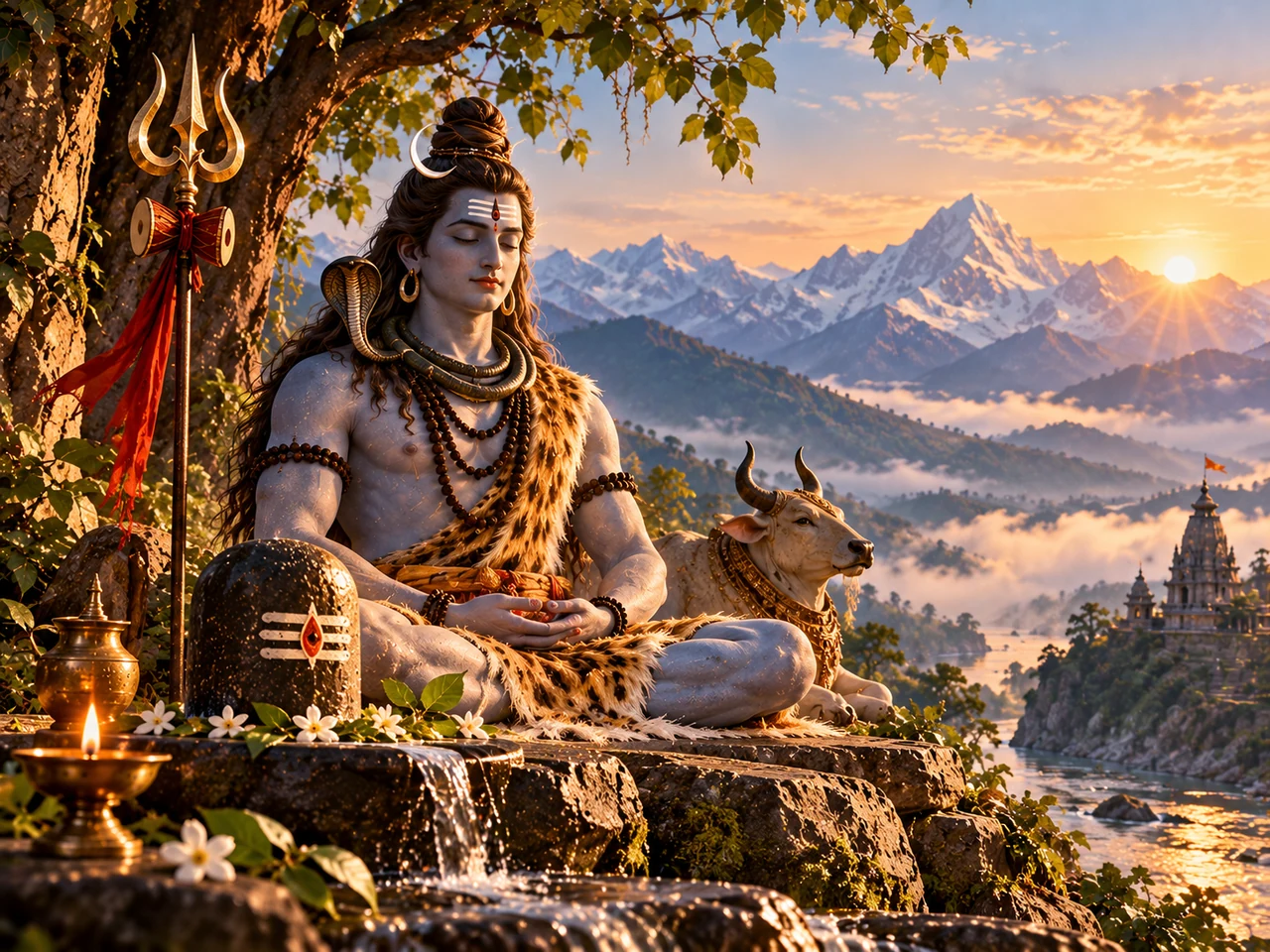
What is Shiva Mahimna Stotram? Shiva Mahimna StotramŚiva Mahimna Stotram (“hymn to Shiva’s greatness”) is a Sanskrit work that begins by saying even the finest speech cannot reach the limit of the divine. Instead of promising to describe Shiva exhaustively, the speaker offers whatever truthful praise a finite mind can manage. This combination of philosophical humility, vivid narratives and devotion explains why the hymn remains a compelling literary work. 1 3
The poem shifts between Shiva beyond speech, his manifestations in the cosmos, and stories of his compassion and power. Its celebrated river-to-ocean simile (verse 7) recognises multiple paths, though articulated from the poem’s own Shaiva perspective; it need not be flattened into a historical claim that all schools have identical teachings.
The chosen edition: forty, not forty-three
This handoff follows the forty numbered units of the Bṛhatstotraratnākara family. The Sanskrit Wikisource transcription of the 1953 printing was the practical reading base, compared at representative readings with the 1912 scanned printing and other reference presentations. The full scanned 1912 edition has not been exhaustively verified at every syllable, so the source-text gate stays partial. 1 2
Another widely recited electronic edition has 43 numbered verses. Sanskrit Documents further discusses a Shiva-rahasya parallel and additional stanzas; this materially changes the boundaries and numbering. The extra verses are . Sanskrit Documents further discusses a Śiva-rahasya parallel and additional stanzas; this materially changes the boundaries and numbering. The extra verses are not spliced into the forty-verse selection. In this edition the earlier narrative/praise verses transition into author-signature and benefits passages after verse 32. These are still included because they belong to the selected printed sequence. 3
The literary and philosophical arc
Verses 1–3 — limits of speech. The hymn announces that words cannot encompass Shiva; the very act of praise becomes a humble self-discipline. This is not a philosophical proof that reason has no value. Verses 4–9 — reality and routes to it. Creation, rival philosophical claims, various religious paths, and Shiva’s ascetic equipment are presented in a specifically Shaiva poetic voice. Verse 7’s river image is inclusive while not eliminating real doctrinal disagreement. Verses 10–24 — divine narratives. The luminous pillar, Ravana’s devotion and pride, Banasura, the poison held in the throat, Kamadeva, the cosmic dance, Ganga, Tripura, Vishnu’s offering and Daksha’s sacrifice bring familiar Shiva traditions into one literary sequence. They are sacred narratives, not independently established historical events. Verses 25–32 — inner experience and universality. Shiva is contemplated as the inwardly realised principle, as pervasive through elements and consciousness, as related to the syllable Om and the idea of turīya, and as the subject of a deliberately unfinishable praise. Verses 33–40 — signature and devotional fruits. The poem invokes Pushpadanta, associates listening and recitation with spiritual benefits and concludes by offering words themselves as worship. Claims of guaranteed wealth, cures or afterlife outcomes are not asserted as scientific findings.
Key concepts and symbols
Mahimā: greatness not reducible to inventory or measurement. Hara: Shiva as the remover. Pashupati: Lord of beings; a name connected with Shaiva traditions, not interchangeable with every later school. Tripura: the three cities, an important mythic symbol. Nīlakaṇṭha: the dark-throated figure whose act of holding poison stands for protection. Turīya: the “fourth” term used for consciousness beyond familiar divisions. Phalaśruti: verses describing traditional religious fruits of recitation, not a controlled prediction of physical outcomes.
Authorship, history and textual variations
The hymn explicitly names Puṣpadanta in its concluding portion, and later tradition tells a Gandharva story around its composition. This establishes a traditional attribution, not a verified autograph, birth date or historical biography. Edition identity matters more than selecting a single legendary date. 1 3 4
Outstanding line readings include verse 5 (kimupādāna), verse 14 (bhuvanabhayabhaṅga), verse 16 (jagad-rakṣāyai), verse 17 (jagad-dvīpākāram), verse 26 (na vidmas tattattvam) and verse 29 (śarvāya). These readings are disclosed as editorial choices against divergent digital/print witnesses and require final image collation before certification. Some older transcriptions show damaged or erroneous text, especially across line breaks. 2 3
Reading, worship and practice scope
This edition is intended for ordinary public reading of a literary Sanskrit stotra. A general reader can appreciate its philosophy and narratives without receiving ritual instructions. Traditions may associate it with personal devotion and temple worship, but no universal counting rule, initiation claim, special breath technique or guaranteed result is supplied here. Festival and Panchang timing should be resolved only by the separate approved calendar system.
Frequently asked questions
1. Is the Shiva Mahimna Stotram in Sanskrit? Yes. The source text is Sanskrit; the Roman letters above represent its original words using IAST, not an English translation. 2. Who composed it? It is traditionally attributed to Pushpadanta. The poem itself names him, but that does not establish a modern historical biography. 3. Does it have 40 or 43 verses? Both numbered families circulate. this edition preserves one complete 40-verse printed tradition and documents the longer version rather than mixing them. 4. Why does the poem say there are different spiritual paths? Verse 7 likens varied paths to rivers entering the sea, from the hymn’s own Shaiva theological perspective. 5. Does Shiva appear as a pillar of fire? Verse 10 recalls a sacred narrative about Brahma and Vishnu seeking its ends; it is not offered as independently verified history. 6. What does Om mean in the hymn? Verse 27 connects Om with triads and the fourth (turīya), a concept discussed also in the Māṇḍūkya Upaniṣad. 7. Will chanting guarantee money, healing or liberation? No such guarantee can be established. Traditional fruits in the hymn express devotional hopes and beliefs. 8. Can I read this text without initiation? Ordinary educational reading is public; any lineage-specific ritual practice should be reviewed separately with qualified teachers.




Additional passage commentary
Shloka 1 — Meaning
Even the loftiest beings cannot measure Shiva’s greatness; praise is an honest offering limited by the speaker’s understanding. Explanation: The opening rejects the pretence that any hymn can exhaust the divine.
Shloka 2 — Meaning
Shiva exceeds language and thought, while the mind still seeks a form in which to adore him. Explanation: This holds the apophatic and personal dimensions of devotion together.
Shloka 3 — Meaning
The poet does not imagine instructing Shiva; speaking of Shiva purifies the speaker’s own words. Explanation: Praise becomes an exercise in humility, not a performance before an ignorant deity.
Shloka 4 — Meaning
Creation, preservation and dissolution express one divine sovereignty through differentiated forms. Explanation: The stanza uses a Shaiva theological reading of the divine triad; traditions interpret it differently.
Shloka 5 — Meaning
The hymn responds to questions about how the universe could arise and what cause supports it. Explanation: Its answer is a devotional claim about the limits of speculative reasoning, not a scientific cosmology.
Shloka 6 — Meaning
The poet asks whether a world of dependent things could dispense with a governing ground. Explanation: This argument is part of the hymn’s philosophical rhetoric; it is not a universal consensus.
Shloka 7 — Meaning
Different religious and philosophical paths may be directed toward a single divine end, like rivers toward the sea. Explanation: The verse is generous in tone but speaks from a specifically Shaiva viewpoint.
Shloka 8 — Meaning
Shiva’s ascetic possessions seem poor beside the gods’ riches, yet he lacks nothing. Explanation: Inner sufficiency makes outward display unnecessary.
Shloka 9 — Meaning
Philosophers disagree over what endures; the poet admits the limits of speech amid these disputes. Explanation: The passage should not be flattened into a single systematic doctrine.
Shloka 10 — Meaning
Brahma and Vishnu cannot find the bounds of Shiva’s fiery manifestation, but devotion becomes a means of approach. Explanation: This is the well-known liṅgodbhava narrative, told in theological mythic language.
Shloka 11 — Meaning
Ravana’s power is described as having been strengthened through strenuous devotion to Shiva. Explanation: The story prepares the contrast between devotion and pride in the next verse.
Shloka 12 — Meaning
Ravana’s attempt to shake Kailasa ends when Shiva checks him with scarcely an effort. Explanation: Power without humility loses its bearing.
Shloka 13 — Meaning
Banasura’s greatness is likewise described in relation to reverence at Shiva’s feet. Explanation: Bowing is a literary image for the paradox of rising through humility.
Shloka 14 — Meaning
Shiva holds the world-threatening poison; the dark mark on his throat becomes a sign of protection. Explanation: This invokes the ocean-churning myth, not advice about handling poison.
Shloka 15 — Meaning
The god of desire, who prevails over others, is overcome when he challenges self-mastered Shiva. Explanation: The focus is restraint over compulsive desire, not contempt for all human affection.
Shloka 16 — Meaning
Shiva’s immense dance shakes the cosmos yet is undertaken for the world’s protection. Explanation: The paradox dramatizes cosmic power under compassionate purpose.
Shloka 17 — Meaning
The vast Ganga looks like a mere drop amid Shiva’s matted locks. Explanation: Scale is poetic: what appears enormous to us is small within the divine.
Shloka 18 — Meaning
The whole universe becomes Shiva’s chariot and weapon in the destruction of Tripura. Explanation: The lavish cosmic equipment is portrayed as play for one already sovereign.
Shloka 19 — Meaning
Vishnu’s devotion is depicted by his offering an eye when one lotus is missing. Explanation: This is a traditional iconographic narrative of unreserved bhakti, not an instruction for self-harm.
Shloka 20 — Meaning
Sacrifice is meaningful only when offered to the divine; external actions alone cannot guarantee their fruits. Explanation: The hymn critiques mechanical ritualism without rejecting all ritual.
Shloka 21 — Meaning
Even Daksha’s grand rite collapses when its inner attitude lacks reverence. Explanation: The critique concerns moral intention alongside ceremonial expertise.
Shloka 22 — Meaning
Shiva’s intervention in the story of a creator pursuing his daughter expresses moral restraint. Explanation: The passage alludes to an old myth that requires careful, non-literal historical handling.
Shloka 23 — Meaning
Shiva burns the god of love, yet shares one body with the Goddess; divine life transcends simplistic labels. Explanation: The paradox questions crude assumptions about renunciation and companionship.
Shloka 24 — Meaning
Ash, cremation grounds and skulls look inauspicious, yet Shiva becomes the highest auspiciousness for devotees. Explanation: The verse reverses ordinary cultural judgements of purity and impurity.
Shloka 25 — Meaning
Yogins turn awareness inward and describe an ineffable bliss that they identify with Shiva. Explanation: The text reports contemplative religious experience, not a guaranteed result or prescribed advanced technique.
Shloka 26 — Meaning
The sun, moon, wind, fire, water, sky, earth and self are spoken of as Shiva’s forms. Explanation: This expresses theological immanence without limiting Shiva to eight objects.
Shloka 27 — Meaning
The sound Om encompasses triads and points beyond them to a fourth, transcendent state. Explanation: The fourth (turīya) is a philosophical term also discussed in the Mandukya Upanishad.
Shloka 28 — Meaning
Eight sacred names—Bhava, Sharva, Rudra, Pashupati, Ugra, Mahadeva, Bhima and Ishana—honour Shiva’s manifold aspects. Explanation: The list is a devotional name-cluster, not a claim that there are eight separate gods.
Shloka 29 — Meaning
Shiva is saluted as both nearest and farthest, smallest and greatest, oldest and newest. Explanation: The paired opposites convey a reality beyond ordinary categories.
Shloka 30 — Meaning
The hymn reveres Shiva amid the activities associated with the gunas and beyond all three. Explanation: This is a theological use of guna categories, not empirical psychology.
Shloka 31 — Meaning
The poet’s small mind cannot encompass Shiva’s infinite qualities; devotion nonetheless offers flowers made of words. Explanation: The poem returns to its opening insistence on humble speech.
Shloka 32 — Meaning
Even if mountains were ink, the ocean an inkpot, earth a page and Saraswati wrote forever, Shiva’s virtues would remain unexhausted. Explanation: This famous hyperbole expresses the inexhaustibility of the sacred.
Shloka 33 — Meaning
A closing verse names Pushpadanta as composer of this beautifully metered hymn to the moon-crested Lord. Explanation: An internal signature is evidence of traditional attribution, not a dated autograph.
Shloka 34 — Meaning
The text promises merit, long life and honour to a devoted reader. Explanation: Such phalaśruti claims are expressions of religious hope, not measurable guarantees.
Shloka 35 — Meaning
The hymn praises Mahesha, Mahimna-stuti, Aghora and the guru as supreme within its devotional voice. Explanation: This is a sectarian praise formula; it need not be read as disrespect for other paths.
Shloka 36 — Meaning
The recitation is extolled above many customary forms of religious merit-making. Explanation: This is rhetorical devotional elevation, not a mandate to abandon ethical action.
Shloka 37 — Meaning
The singer Kusumadashana, identified with Pushpadanta, is said to have composed the hymn after losing divine favour. Explanation: Treat the account as a traditional composition legend, not established biography.
Shloka 38 — Meaning
Devout recitation is associated with attaining closeness to Shiva after death. Explanation: The claimed afterlife reward is a matter of religious faith.
Shloka 39 — Meaning
Remembering the hymn associated with Pushpadanta is said to please Mahesha. Explanation: This additional concluding verse belongs to the selected forty-verse edition; other recensions number appendices differently.
Shloka 40 — Meaning
The poem closes by offering words themselves as worship at Shankara’s feet. Explanation: Its central message is that truthful praise can itself be a devotional offering.