



About these reading aids

Easy Roman is a Devanagari-based Sanskrit reading aid. IAST preserves scholarly distinctions. Where no Roman text was supplied, IAST is derived automatically from the Devanagari; this is not a certified pronunciation guide. Vernacular songs retain their supplied word forms and spoken endings. Easy Roman simplifies unambiguous diacritics; their scholarly view retains the supplied Roman form rather than inventing Sanskrit pronunciation. Selected bija spellings are kept where unambiguous.

Stotra

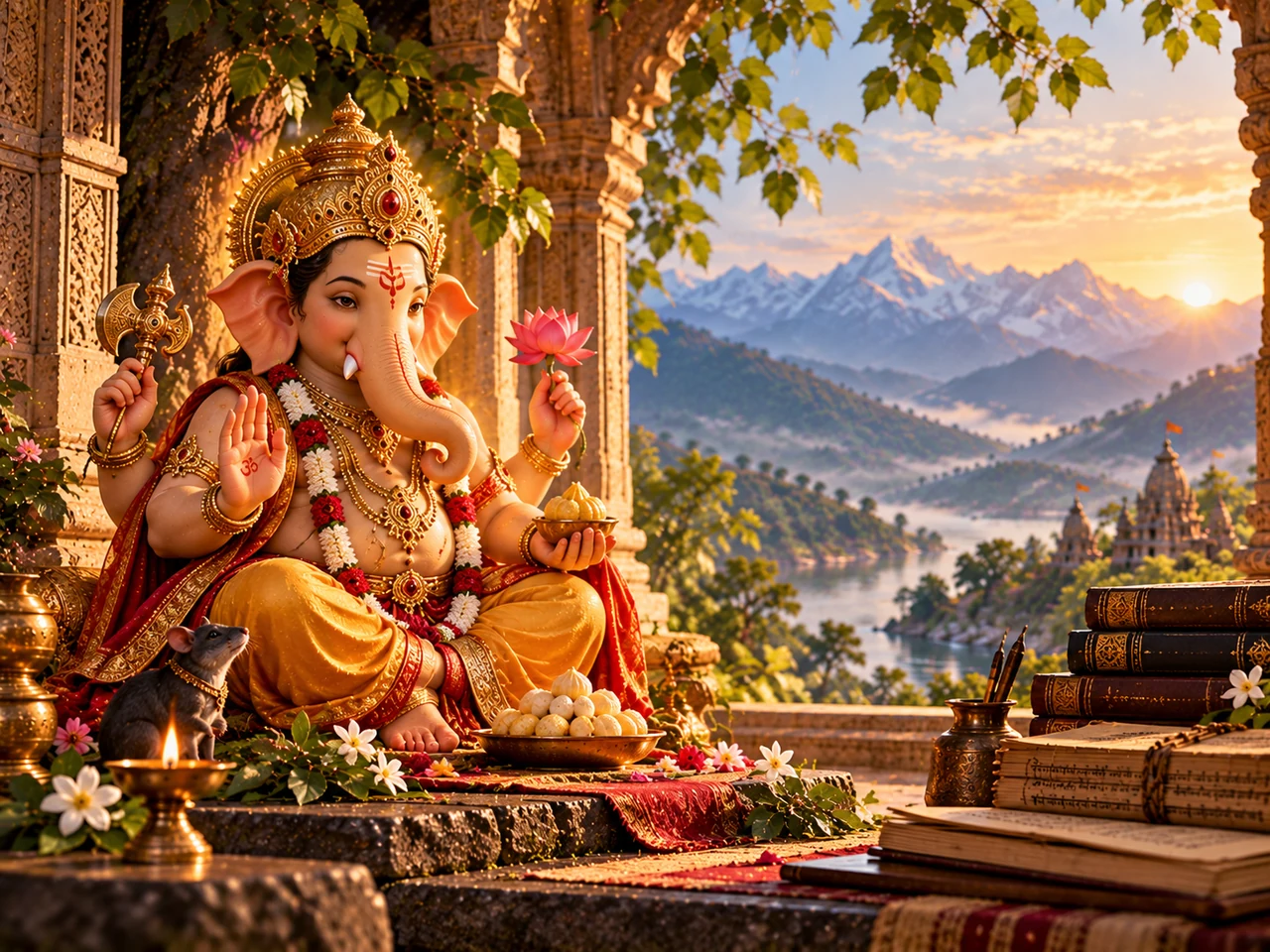
Ganesha Pancharatnam: Complete Sanskrit, IAST and Meaning

Five densely musical verses praising Ganesha as a joyful guide, compassionate protector and inward presence, followed by a distinct phalaśruti.

Reading settings

Settings are saved in this page’s URL and carried to adjacent chapters. Bookmark the URL to keep them. Devanagari keeps its dedicated reading font.

Reset settings

Text, Meaning & Explanation

1

मुदा करात्तमोदकं सदा विमुक्तिसाधकं कलाधरावतंसकं विलासिलोकरक्षकम् । अनायकैकनायकं विनाशितेभदैत्यकं नताशुभाशुनाशकं नमामि तं विनायकम् ॥ १ ॥

Roman Transliteration

mudaa karaattamodakam sadaa vimuktisaadhakam kalaadharaavatamsakam vilaasilokarakshakam | anaayakaikanaayakam vinaashitebhadaityakam nataashubhaashunaashakam namaami tam vinaayakam || 1 ||mudā karāttamodakaṃ sadā vimuktisādhakaṃ kalādharāvataṃsakaṃ vilāsilokarakṣakam | anāyakaikanāyakaṃ vināśitebhadaityakaṃ natāśubhāśunāśakaṃ namāmi taṃ vināyakam || 1 ||

Meaning

I bow to Vināyaka: he holds a modaka with delight, is praised as aiding liberation, wears a crescent-shaped ornament, protects the world in his playful activity, is the unique guide of those without a guide, overcomes the elephant-like demon, and swiftly dispels misfortune for those who bow.

Explanation

The opening mudā karātta-modakam links delight (mudā) with the sweet modaka held in the hand; the name of the sweet is not itself a moral demand to make offerings. Vimukti reaches beyond relief from a daily obstacle toward spiritual release. Kalādhara can evoke the moon-bearing association within the Shaiva family; one should not insist on a single iconographic form from this verse alone. The compound concerning the defeated elephant/demon is condensed and should not be presented as a settled, literal history. Anāyakaika-nāyaka is a striking contrast: the guide to those who lack a guide. Read the prayer as praise and an invitation to steadiness, not a promise of instant risk-free success.The opening mudā karātta-modakam links delight (mudā) with the sweet modaka held in the hand; the name of the sweet is not itself a moral demand to make offerings. Vimukti reaches beyond relief from a daily obstacle toward spiritual release. Kalādhara can evoke the moon-bearing association within the Shaiva family; one should not insist on a single iconographic form from this verse alone. The compound concerning the defeated elephant/demon is condensed and should not be presented as a settled, literal history. can evoke the moon-bearing association within the Śaiva family; one should not insist on a single iconographic form from this verse alone. The compound concerning the defeated elephant/demon is condensed and should not be presented as a settled, literal history. Anāyakaika-nāyaka is a striking contrast: the guide to those who lack a guide. Read the prayer as praise and an invitation to steadiness, not a promise of instant risk-free success.

2

नतेतरातिभीकरं नवोदितार्कभास्वरं नमत्सुरारिनिर्जरं नताधिकापदुद्धरम् । सुरेश्वरं निधीश्वरं गजेश्वरं गणेश्वरं महेश्वरं तमाश्रये परात्परं निरन्तरम् ॥ २ ॥

Roman Transliteration

natetaraatibheekaram navoditaarkabhaasvaram namatsuraarinirjaram nataadhikaapaduddharam | sureshvaram nidheeshvaram gajeshvaram ganeshvaram maheshvaram tamaashraye paraatparam nirantaram || 2 ||natetarātibhīkaraṃ navoditārkabhāsvaraṃ namatsurārinirjaraṃ natādhikāpaduddharam | sureśvaraṃ nidhīśvaraṃ gajeśvaraṃ gaṇeśvaraṃ maheśvaraṃ tamāśraye parātparaṃ nirantaram || 2 ||

Meaning

I continually seek refuge in that supreme one who is fearsome to those who refuse to bow, shines like the newly risen sun, is honoured by gods who overcome hostile powers, lifts up those burdened by great adversity, and is hailed as lord of gods, treasures, elephants and the gaṇas—Maheshvara, beyond the beyond.

Explanation

The stanza accelerates through a series of titles—Sureśvara, Nidhīśvara, Gajeśvara, Gaṇeśvara—before the language of parātpara (beyond what is highest). The early sun is a radiant image rather than an astronomical prescription. The contrast between what terrifies the unbowed and what sustains the bowed is a devotional depiction of ego and trust; it does not license cruelty to nonbelievers. Maheshvara here praises Ganesha as supreme in this hymn; it need not imply a rigid sectarian hierarchy over Shiva, with whom the epithet is also closely associated.The stanza accelerates through a series of titles—Sureśvara, Nidhīśvara, Gajeśvara, Gaṇeśvara—before the language of parātpara (beyond what is highest). The early sun is a radiant image rather than an astronomical prescription. The contrast between what terrifies the unbowed and what sustains the bowed is a devotional depiction of ego and trust; it does not license cruelty to nonbelievers. Maheshvara here praises Ganesha as supreme in this hymn; it need not imply a rigid sectarian hierarchy over Shiva, with whom the epithet is also closely associated. here praises Gaṇeśa as supreme in this hymn; it need not imply a rigid sectarian hierarchy over Śiva, with whom the epithet is also closely associated.

3

समस्तलोकशंकरं निरस्तदैत्यकुञ्जरं दरेतरोदरं वरं वरेभवक्त्रमक्षरम् । कृपाकरं क्षमाकरं मुदाकरं यशस्करं मनस्करं नमस्कृतां नमस्करोमि भास्वरम् ॥ ३ ॥

Roman Transliteration

samastalokashamkaram nirastadaityakunjaram daretarodaram varam varebhavaktramaksharam | kripaakaram kshamaakaram mudaakaram yashaskaram manaskaram namaskritaam namaskaromi bhaasvaram || 3 ||samastalokaśaṃkaraṃ nirastadaityakuñjaraṃ daretarodaraṃ varaṃ varebhavaktramakṣaram | kṛpākaraṃ kṣamākaraṃ mudākaraṃ yaśaskaraṃ manaskaraṃ namaskṛtāṃ namaskaromi bhāsvaram || 3 ||

Meaning

I bow to the radiant one who brings well-being to all worlds, drives away the elephant-like demon, is revered in an auspicious elephant-faced form, is imperishable, and is a source of grace, forgiveness, delight, renown and thoughtful guidance for those who offer respect.

Explanation

The balanced compounds—kṛpākara, kṣamākara, mudākara, yaśaskara—move from compassion and forgiveness to joy and reputation. The selected 1910 line ends manaskaraṃ namaskṛtāṃ; some other published/recited texts show namaskaraṃ namaskṛtāṃ. That one-consonant difference shifts the possible meaning; this commentary treats manaskara cautiously as mind-supporting or thought-awakening rather than asserting a precise doctrinal definition. Akṣara can suggest the imperishable, while elephant imagery is devotional and mythic, not a zoological claim.

4

अकिंचनार्तिमार्जनं चिरंतनोक्तिभाजनं पुरारिपूर्वनन्दनं सुरारिगर्वचर्वणम् । प्रपञ्चनाशभीषणं धनंजयादिभूषणं कपोलदानवारणं भजे पुराणवारणम् ॥ ४ ॥

Roman Transliteration

akimchanaartimaarjanam chiramtanoktibhaajanam puraaripoorvanandanam suraarigarvacharvanam | prapanchanaashabheeshanam dhanamjayaadibhooshanam kapoladaanavaaranam bhaje puraanavaaranam || 4 ||akiṃcanārtimārjanaṃ cirantanoktibhājanaṃ purāripūrvanandanaṃ surārigarvacarvaṇam | prapañcanāśabhīṣaṇaṃ dhanaṃjayādibhūṣaṇaṃ kapoladānavāraṇaṃ bhaje purāṇavāraṇam || 4 ||

Meaning

I worship the ancient elephant-faced one who wipes away the suffering of those with no possessions, is celebrated in long-standing praise, is Shiva’s first son in the hymn’s imagery, grinds down the pride of hostile forces, is formidable to the deluding world-process, bears Dhanañjaya and other ornaments, and has the majestic cheeks of a rutting elephant.I worship the ancient elephant-faced one who wipes away the suffering of those with no possessions, is celebrated in long-standing praise, is Shiva’s first son in the hymn’s imagery, grinds down the pride of hostile forces, is formidable to the deluding world-process, bears Dhanañjaya and other ornaments, and has the majestic cheeks of a rutting elephant.I worship the ancient elephant-faced one who wipes away the suffering of those with no possessions, is celebrated in long-standing praise, is Śiva’s first son in the hymn’s imagery, grinds down the pride of hostile forces, is formidable to the deluding world-process, bears Dhanañjaya and other ornaments, and has the majestic cheeks of a rutting elephant.

Explanation

Akiṃcana means one without possessions or support: the stanza pays special attention to those who lack resources. Purāri is a name of Shiva as destroyer of the three cities, so purāri-pūrvanandana places Ganesha in that familial theology; the expression is not a secure historical chronological proof of which child was born first. The fierce compounds turn the theme toward pride and the world’s bewilderment. Kapola-dāna-vāraṇa evokes an elephant with fragrant rut-fluid on its cheeks; the image belongs to older poetic idiom and should not be confused with a direction about handling animals. Dhanañjaya-ādi is a dense compound whose precise referents require specialist confirmation.Akiṃcana means one without possessions or support: the stanza pays special attention to those who lack resources. Purāri is a name of Shiva as destroyer of the three cities, so is a name of Śiva as destroyer of the three cities, so purāri-pūrvanandana places Ganesha in that familial theology; the expression is not a secure historical chronological proof of which child was born first. The fierce compounds turn the theme toward pride and the world’s bewilderment. places Gaṇeśa in that familial theology; the expression is not a secure historical chronological proof of which child was born first. The fierce compounds turn the theme toward pride and the world’s bewilderment. Kapola-dāna-vāraṇa evokes an elephant with fragrant rut-fluid on its cheeks; the image belongs to older poetic idiom and should not be confused with a direction about handling animals. Dhanañjaya-ādi is a dense compound whose precise referents require specialist confirmation.

5

नितान्तकान्तदन्तकान्तिमन्तकान्तकात्मजम् अचिन्त्यरूपमन्तहीनमन्तरायकृन्तनम् । हृदन्तरे निरन्तरं वसन्तमेव योगिनां तमेकदन्तमेव तं विचिन्तयामि संततम् ॥ ५ ॥

Roman Transliteration

nitaantakaantadantakaantimantakaantakaatmajam achintyaroopamantaheenamantaraayakrintanam | hridantare nirantaram vasantameva yoginaam tamekadantameva tam vichintayaami samtatam || 5 ||nitāntakāntadantakāntimantakāntakātmajam acintyarūpamantahīnamantarāyakṛntanam | hṛdantare nirantaraṃ vasantameva yogināṃ tamekadantameva taṃ vicintayāmi saṃtatam || 5 ||

Meaning

I constantly contemplate that one-tusked Lord, child of Shiva, praised as the one who overcomes Death, whose attractive tusk shines, whose form is beyond conception, whose greatness has no boundary, who cuts through obstructions and who dwells continually in the hearts of yogins.I constantly contemplate that one-tusked Lord, child of Shiva, praised as the one who overcomes Death, whose attractive tusk shines, whose form is beyond conception, whose greatness has no boundary, who cuts through obstructions and who dwells continually in the hearts of yogins.I constantly contemplate that one-tusked Lord, child of Śiva, praised as the one who overcomes Death, whose attractive tusk shines, whose form is beyond conception, whose greatness has no boundary, who cuts through obstructions and who dwells continually in the hearts of yogins.

Explanation

This verse layers linked kānta / danta / kānti sounds; the beauty of its Sanskrit is partly sonic and cannot be exhausted by a one-line translation. The dense kāntakātmajam may be unpacked through kāntaka / antaka depending on sandhi and local exegetical tradition; this edition follows the conventional Shaiva-family interpretation cautiously rather than claiming a unique grammatical solution. Antarāya-kṛntana is the cutting of hindrances, while hṛdantare locates the deepest encounter inwardly—in contemplative awareness rather than in a guaranteed external event. The single tusk (ekadanta) is the stanza’s memorable closing epithet.This verse layers linked kānta / danta / kānti sounds; the beauty of its Sanskrit is partly sonic and cannot be exhausted by a one-line translation. The dense kāntakātmajam may be unpacked through kāntaka / antaka depending on sandhi and local exegetical tradition; this edition follows the conventional Shaiva-family interpretation cautiously rather than claiming a unique grammatical solution. depending on sandhi and local exegetical tradition; this edition follows the conventional Śaiva-family interpretation cautiously rather than claiming a unique grammatical solution. Antarāya-kṛntana is the cutting of hindrances, while hṛdantare locates the deepest encounter inwardly—in contemplative awareness rather than in a guaranteed external event. The single tusk (ekadanta) is the stanza’s memorable closing epithet.

महागणेशपञ्चरत्नमादरेण योऽन्वहं प्रजल्पति प्रभातके हृदि स्मरन्गणेश्वरम् । अरोगतामदोषतां सुसाहितीं सुपुत्रतां समाहितायुरष्टभूतिमभ्युपैति सोऽचिरात् ॥ ६ ॥

Roman Transliteration

mahaaganeshapancharatnamaadarena yo’nvaham prajalpati prabhaatake hridi smaranganeshvaram | arogataamadoshataam susaahiteem suputrataam samaahitaayurashtabhootimabhyupaiti so’chiraat || 6 ||mahāgaṇeśapañcaratnamādareṇa yo'nvahaṃ prajalpati prabhātake hṛdi smarangaṇeśvaram | arogatāmadoṣatāṃ susāhitīṃ suputratāṃ samāhitāyuraṣṭabhūtimabhyupaiti so'cirāt || 6 ||

Meaning

The concluding verse says that one who respectfully recites these five jewels each day, remembering Gaṇeśvara in the heart at daybreak, soon attains freedom from illness and faults, eloquence or cultivated expression, good children, a collected or enduring life, and eight forms of well-being.

Explanation

This is the phalaśruti, the hymn’s devotional statement of fruit, not a sixth “jewel” in the five-verse body. It speaks in the traditional idiom of arogatā (health), adoṣatā (freedom from defects), susāhitī (good literary/expressive capacity, interpretive), suputratā (good offspring), and aṣṭa-bhūti (eightfold prosperity, enumeration unspecified here). The 1910 print reads prajalpati and samāhitāyur; alternative recitations include pragāyati and different life/prosperity compounds. A person’s health, fertility or wealth cannot be guaranteed by recitation, and no ritual obligations are being prescribed.

Context & Usage

Edition notice: Five principal Sanskrit verses plus a distinct sixth phalaśruti, following the visually inspected 1910 Shri Vani Vilas print (pp. 1–2), crosschecked with Ambuda CC0. Five principal Sanskrit verses plus a distinct sixth phalaśruti, following the visually inspected 1910 Sri Vani Vilas print (pp. 1–2), crosschecked with Ambuda CC0. 1 2

What is Ganesha Pañcaratnam? The title means What is Gaṇeśa Pañcaratnam? The title means “Five Jewels in praise of Gaṇeśa.” It is a compact Sanskrit hymn whose musical chains of compounds bring the listener from the modaka in Ganesha’s hand to the idea of his presence within the contemplative heart. Each of the first five verses is a “jewel.” The printed text also includes a It is a compact Sanskrit hymn whose musical chains of compounds bring the listener from the modaka in Gaṇeśa’s hand to the idea of his presence within the contemplative heart. Each of the first five verses is a “jewel.” The printed text also includes a sixth numbered phalaśruti, a closing description of hoped-for benefits; that is not an additional jewel. 1 2

This reader uses the 1910 Shri Vani Vilas Press volume _Śaṅkarācāryaviracitāni Stotrāṇi, Part I_1910 Sri Vani Vilas Press volume _Śaṅkarācāryaviracitāni Stotrāṇi, Part I_, pp. 1–2, a historical print directly inspected as page images. The freely licensed Ambuda reading based on the same volume provides a second textual check; there is no silent replacement of historical wording with modern recitation preferences. Traditional attribution to Ādi Śaṅkarācārya is not independently established authorship. 1 2 8

The sound of the hymn matters: successive -kara, -īśvara and -kānta patterns develop its argument through rhythm as well as meaning. There is a devotional, philosophical movement: outward symbols of joy and protection (verses 1–2), inner qualities of mercy and forgiveness (verse 3), care for the vulnerable (verse 4), and sustained inward contemplation (verse 5). The phalaśruti connects that praise to well-being in the convention of devotional poetry. This does not constitute an evidence-based medical or financial undertaking.

How this reading is arranged

The complete original appears above before any translation. The section below gives a fresh English explanation for each of the six printed units. Individual anchors #shloka-001 through #shloka-006 can later be used by a separate approved reader UI.

Imagery, historical setting and careful interpretation

Modaka and gladness. The first line portrays sweetness as something held with joy. A physical offering may be meaningful in many households, but the poem’s grammar is not a compulsory recipe for gaining favour. The guide for the unguided. The compound anāyakaika-nāyaka allows a reader to see guidance as a moral or spiritual relationship, not as a promise that practical problems will disappear without effort. Family language. Ganesha is linked to Gaṇeśa is linked to Purāri—Shiva, destroyer of the triple cities—in verse 4; the divine family image is one part of the hymn’s Shaiva context. At the same time Ganesha is praised as —Śiva, destroyer of the triple cities—in verse 4; the divine family image is one part of the hymn’s Śaiva context. At the same time Gaṇeśa is praised as parātpara in verse 2. Such superlatives are common devotional speech and need not create an exclusive hierarchy among Hindu traditions. The elephant image. The prose meaning of vāraṇa and poetic rut imagery do not exhaust the rich family of stories about Ganesha’s head or tusk. Those stories vary by source and should not be presented here as if established by these six verses. and poetic rut imagery do not exhaust the rich family of stories about Gaṇeśa’s head or tusk. Those stories vary by source and should not be presented here as if established by these six verses. The inward culmination. Verse 5 moves from external epithets to the heart (hṛdantara) of the yogin. This is a particularly useful interpretive bridge between devotional iconography and contemplative language. It is an editorial explanation of the poetry rather than a new spiritual practice prescription. What the source does not establish. A 1910 printed anthology demonstrates that a text and its traditional attribution circulated by that date; it does not establish an eighth-century author or the date of composition. The hymn is also not the same composition as a Ganesha chalisa, the same composition as a Gaṇeśa cālīsā, Jai Ganesh Deva ārati or Vakratunda Mahākāya. 1 8

Textual variants and edition decisions

  1. Verse 1, “vilāsilokarakṣakam.” The 1910 scan and Ambuda give the protector-of-the-world phrase. Another Wikisource text reads vilāsalokarakṣakam, and SanskritDocuments separately proposes vilāsilokarañjakam (“delighter of the world”). They are not merged. 1 2 3 4
  2. Verse 3, “manaskaraṃ.” This historical witness reads manaskaraṃ namaskṛtāṃ; a Gita Press reading, reported by Ved Path (not independently inspected from the Gita Press page), reads namaskaraṃ. These yield subtly different senses. 1 5
  3. Verse 6, “prajalpati.” The scanned 1910 phalaśruti has prajalpati prabhātake; some readers have pragāyati prabhātake. Both are documented without treating the second as a typo. 1 4 5
  4. Verse 6, “samāhitāyur.” The 1910 print and Ambuda retain this form. Some later digital recitation comparisons report samīhitāyu. That is not substituted without independent witness collation. 1 2 6
  5. Orthographic forms: the early print and different digital editors use anusvāra, conjuncts and compound spacing differently (śaṃkara/śaṅkara; akiṃcana/akiñcana). This draft normalises layout only and records matters of potential lexical consequence in the source list.

Attribution, rights and editorial boundaries

The historical source is an anthology attributed to Śaṅkarācārya; the precise author is traditionally attributed, not independently proved. The photographed 1910 print is marked Public Domain Mark 1.0 by Wikimedia Commons, and Ambuda explicitly places its separate electronic transcription under CC0. These are meaningful evidence but do not amount to a website-specific legal clearance in every jurisdiction. SanskritDocuments carries a no-reposting-for-promotion/commercial-use notice for its volunteer file; it is cited for variant comparison only. Meanings and commentary here are newly written. 1 2 4 7

The reading is public devotional literature, not a new mantra initiation, miracle guarantee or health guidance. The optional cultural association with Ganesha Caturthī implies The reading is public devotional literature, not a new mantra initiation, miracle guarantee or health guidance. The optional cultural association with Gaṇeśa Caturthī implies no festival date or muhurta; those require a separately approved calendar occurrence.

Frequently asked questions

How many verses does Ganesha Pañcaratnam have? Five principal “jewels” followed by a separately identified sixth numbered phalaśruti in the chosen 1910 printed edition.How many verses does Gaṇeśa Pañcaratnam have? Five principal “jewels” followed by a separately identified sixth numbered phalaśruti in the chosen 1910 printed edition.

Who composed it? It is traditionally attributed to Ādi Śaṅkarācārya. The 1910 publication and other modern headings record that tradition but do not independently prove the historical author.

Is “mudā karātta modakam” the opening? Yes. The first verse begins by describing the modaka held joyfully in the hand; spacing differs among print and digital editions.

Which wording is used here for verse 3? The selected historical source reads manaskaraṃ namaskṛtāṃ. The namaskaraṃ alternative is recorded as a reported variant rather than silently mixed into the verse.

Does the text guarantee health or prosperity? No. Verse 6 is a traditional devotional phalaśruti. Its hoped-for fruits are not medical, reproductive, or financial guarantees.

Can I use the Roman text as English translation? No. The first block is IAST transliteration of the original Sanskrit words; English meanings begin in the subsequent section.

Sources, Credits & Licensing

Founder-authorized educational edition. Independent textual and specialist review remains incomplete; this reading does not confer initiation or ritual authorization.

Inherited traditional wording; selected witness cited below. Romanization, meanings and explanations prepared for ShivGoraksh. No modern source translation, page layout or recording reproduced.

Original Roman reading

The Roman reading recorded with this edition, retaining its spelling and word forms before the Easy Roman display conversion.

  1. 1

    mudā karāttamodakaṃ sadā vimuktisādhakaṃ kalādharāvataṃsakaṃ vilāsilokarakṣakam | anāyakaikanāyakaṃ vināśitebhadaityakaṃ natāśubhāśunāśakaṃ namāmi taṃ vināyakam || 1 ||

  2. 2

    natetarātibhīkaraṃ navoditārkabhāsvaraṃ namatsurārinirjaraṃ natādhikāpaduddharam | sureśvaraṃ nidhīśvaraṃ gajeśvaraṃ gaṇeśvaraṃ maheśvaraṃ tamāśraye parātparaṃ nirantaram || 2 ||

  3. 3

    samastalokaśaṃkaraṃ nirastadaityakuñjaraṃ daretarodaraṃ varaṃ varebhavaktramakṣaram | kṛpākaraṃ kṣamākaraṃ mudākaraṃ yaśaskaraṃ manaskaraṃ namaskṛtāṃ namaskaromi bhāsvaram || 3 ||

  4. 4

    akiṃcanārtimārjanaṃ cirantanoktibhājanaṃ purāripūrvanandanaṃ surārigarvacarvaṇam | prapañcanāśabhīṣaṇaṃ dhanaṃjayādibhūṣaṇaṃ kapoladānavāraṇaṃ bhaje purāṇavāraṇam || 4 ||

  5. 5

    nitāntakāntadantakāntimantakāntakātmajam acintyarūpamantahīnamantarāyakṛntanam | hṛdantare nirantaraṃ vasantameva yogināṃ tamekadantameva taṃ vicintayāmi saṃtatam || 5 ||

  6. 6

    mahāgaṇeśapañcaratnamādareṇa yo'nvahaṃ prajalpati prabhātake hṛdi smarangaṇeśvaram | arogatāmadoṣatāṃ susāhitīṃ suputratāṃ samāhitāyuraṣṭabhūtimabhyupaiti so'cirāt || 6 ||

Sources and editorial status

  • 1 Śaṅkarācāryaviracitāni Stotrāṇi, Part I (Sri Vani Vilas Press, 1910), original pp. 1–2 / PDF pages 9–10. Historical text controlling this reader.
  • 2 Ambuda’s CC0 transcription of the same historical printed edition.
  • 3 Alternate Sanskrit Wikisource reading (comparison only).
  • 4 SanskritDocuments ganesha5.itx / HTML (variants only; separate volunteer reuse restrictions).
  • 5 Ved Path’s reported Gita Press variants (Gita Press source not independently scanned for this edition).
  • 6 Secondary Telugu recitation comparison of reported variant.
  • 7 Commons media rights metadata for scan.
  • 8 India Office catalogue: bibliographic context only. Verification: Six out of six selected printed units represented, including verse 6 as phalaśruti. Editorial status partial, not certified source/rights complete.
Additional passage commentary

Verse 1 — Joy in the hand, refuge for the bowed

Meaning. I bow to Vināyaka: he holds a modaka with delight, is praised as aiding liberation, wears a crescent-shaped ornament, protects the world in his playful activity, is the unique guide of those without a guide, overcomes the elephant-like demon, and swiftly dispels misfortune for those who bow. Explanation. The opening mudā karātta-modakam links delight (mudā) with the sweet modaka held in the hand; the name of the sweet is not itself a moral demand to make offerings. Vimukti reaches beyond relief from a daily obstacle toward spiritual release. Kalādhara can evoke the moon-bearing association within the Shaiva family; one should not insist on a single iconographic form from this verse alone. The compound concerning the defeated elephant/demon is condensed and should not be presented as a settled, literal history. can evoke the moon-bearing association within the Śaiva family; one should not insist on a single iconographic form from this verse alone. The compound concerning the defeated elephant/demon is condensed and should not be presented as a settled, literal history. Anāyakaika-nāyaka is a striking contrast: the guide to those who lack a guide. Read the prayer as praise and an invitation to steadiness, not a promise of instant risk-free success.

Verse 2 — Power beyond pride and fear

Meaning. I continually seek refuge in that supreme one who is fearsome to those who refuse to bow, shines like the newly risen sun, is honoured by gods who overcome hostile powers, lifts up those burdened by great adversity, and is hailed as lord of gods, treasures, elephants and the gaṇas—Maheshvara, beyond the beyond. Explanation. The stanza accelerates through a series of titles—Sureśvara, Nidhīśvara, Gajeśvara, Gaṇeśvara—before the language of parātpara (beyond what is highest). The early sun is a radiant image rather than an astronomical prescription. The contrast between what terrifies the unbowed and what sustains the bowed is a devotional depiction of ego and trust; it does not license cruelty to nonbelievers. Maheshvara here praises Ganesha as supreme in this hymn; it need not imply a rigid sectarian hierarchy over Shiva, with whom the epithet is also closely associated. here praises Gaṇeśa as supreme in this hymn; it need not imply a rigid sectarian hierarchy over Śiva, with whom the epithet is also closely associated.

Verse 3 — Compassion, forgiveness and luminous understanding

Meaning. I bow to the radiant one who brings well-being to all worlds, drives away the elephant-like demon, is revered in an auspicious elephant-faced form, is imperishable, and is a source of grace, forgiveness, delight, renown and thoughtful guidance for those who offer respect. Explanation. The balanced compounds—kṛpākara, kṣamākara, mudākara, yaśaskara—move from compassion and forgiveness to joy and reputation. The selected 1910 line ends manaskaraṃ namaskṛtāṃ; some other published/recited texts show namaskaraṃ namaskṛtāṃ. That one-consonant difference shifts the possible meaning; this commentary treats manaskara cautiously as mind-supporting or thought-awakening rather than asserting a precise doctrinal definition. Akṣara can suggest the imperishable, while elephant imagery is devotional and mythic, not a zoological claim.

Verse 4 — Care for the vulnerable, mastery of pride

Meaning. I worship the ancient elephant-faced one who wipes away the suffering of those with no possessions, is celebrated in long-standing praise, is Shiva’s first son in the hymn’s imagery, grinds down the pride of hostile forces, is formidable to the deluding world-process, bears Dhanañjaya and other ornaments, and has the majestic cheeks of a rutting elephant. I worship the ancient elephant-faced one who wipes away the suffering of those with no possessions, is celebrated in long-standing praise, is Śiva’s first son in the hymn’s imagery, grinds down the pride of hostile forces, is formidable to the deluding world-process, bears Dhanañjaya and other ornaments, and has the majestic cheeks of a rutting elephant. Explanation. Akiṃcana means one without possessions or support: the stanza pays special attention to those who lack resources. Purāri is a name of Shiva as destroyer of the three cities, so is a name of Śiva as destroyer of the three cities, so purāri-pūrvanandana places Ganesha in that familial theology; the expression is not a secure historical chronological proof of which child was born first. The fierce compounds turn the theme toward pride and the world’s bewilderment. places Gaṇeśa in that familial theology; the expression is not a secure historical chronological proof of which child was born first. The fierce compounds turn the theme toward pride and the world’s bewilderment. Kapola-dāna-vāraṇa evokes an elephant with fragrant rut-fluid on its cheeks; the image belongs to older poetic idiom and should not be confused with a direction about handling animals. Dhanañjaya-ādi is a dense compound whose precise referents require specialist confirmation.

Verse 5 — The one-tusked presence in the heart

Meaning. I constantly contemplate that one-tusked Lord, child of Shiva, praised as the one who overcomes Death, whose attractive tusk shines, whose form is beyond conception, whose greatness has no boundary, who cuts through obstructions and who dwells continually in the hearts of yogins. I constantly contemplate that one-tusked Lord, child of Śiva, praised as the one who overcomes Death, whose attractive tusk shines, whose form is beyond conception, whose greatness has no boundary, who cuts through obstructions and who dwells continually in the hearts of yogins. Explanation. This verse layers linked kānta / danta / kānti sounds; the beauty of its Sanskrit is partly sonic and cannot be exhausted by a one-line translation. The dense kāntakātmajam may be unpacked through kāntaka / antaka depending on sandhi and local exegetical tradition; this edition follows the conventional Shaiva-family interpretation cautiously rather than claiming a unique grammatical solution. depending on sandhi and local exegetical tradition; this edition follows the conventional Śaiva-family interpretation cautiously rather than claiming a unique grammatical solution. Antarāya-kṛntana is the cutting of hindrances, while hṛdantare locates the deepest encounter inwardly—in contemplative awareness rather than in a guaranteed external event. The single tusk (ekadanta) is the stanza’s memorable closing epithet.

Phalaśruti 6 — Phalaśruti: what the hymn itself promises

Meaning. The concluding verse says that one who respectfully recites these five jewels each day, remembering Gaṇeśvara in the heart at daybreak, soon attains freedom from illness and faults, eloquence or cultivated expression, good children, a collected or enduring life, and eight forms of well-being. Explanation. This is the phalaśruti, the hymn’s devotional statement of fruit, not a sixth “jewel” in the five-verse body. It speaks in the traditional idiom of arogatā (health), adoṣatā (freedom from defects), susāhitī (good literary/expressive capacity, interpretive), suputratā (good offspring), and aṣṭa-bhūti (eightfold prosperity, enumeration unspecified here). The 1910 print reads prajalpati and samāhitāyur; alternative recitations include pragāyati and different life/prosperity compounds. A person’s health, fertility or wealth cannot be guaranteed by recitation, and no ritual obligations are being prescribed.

  1. Śaṅkarācāryaviracitāni Stotrāṇi, Prathamaḥ Bhāgaḥ (The Works of Sri Sankaracharya, Vol. 17, Stotras Part I) · Open source
  2. Gaṇeśapañcaratnam | Ambuda electronic Sanskrit transcription · Open source
  3. Gaṇeśapañcaratnam | Sanskrit Wikisource (alternate reading) · Open source
  4. Śrī Gaṇeśapañcaratna Stotram (ganesha5.itx / HTML) · Open source
  5. Gaṇeśapañcaratnam—Ved Path with claimed Gita Press print collation · Open source
  6. Ganesha Pancharatnam Telugu recitation comparison notes · Open source
  7. Wikimedia Commons media-description and copyright tags for 1910 Stotrāṇi volume · Open source
  8. Catalogue of the India Office Library, part I: Stotras by Śamkara Ācārya · Open source