



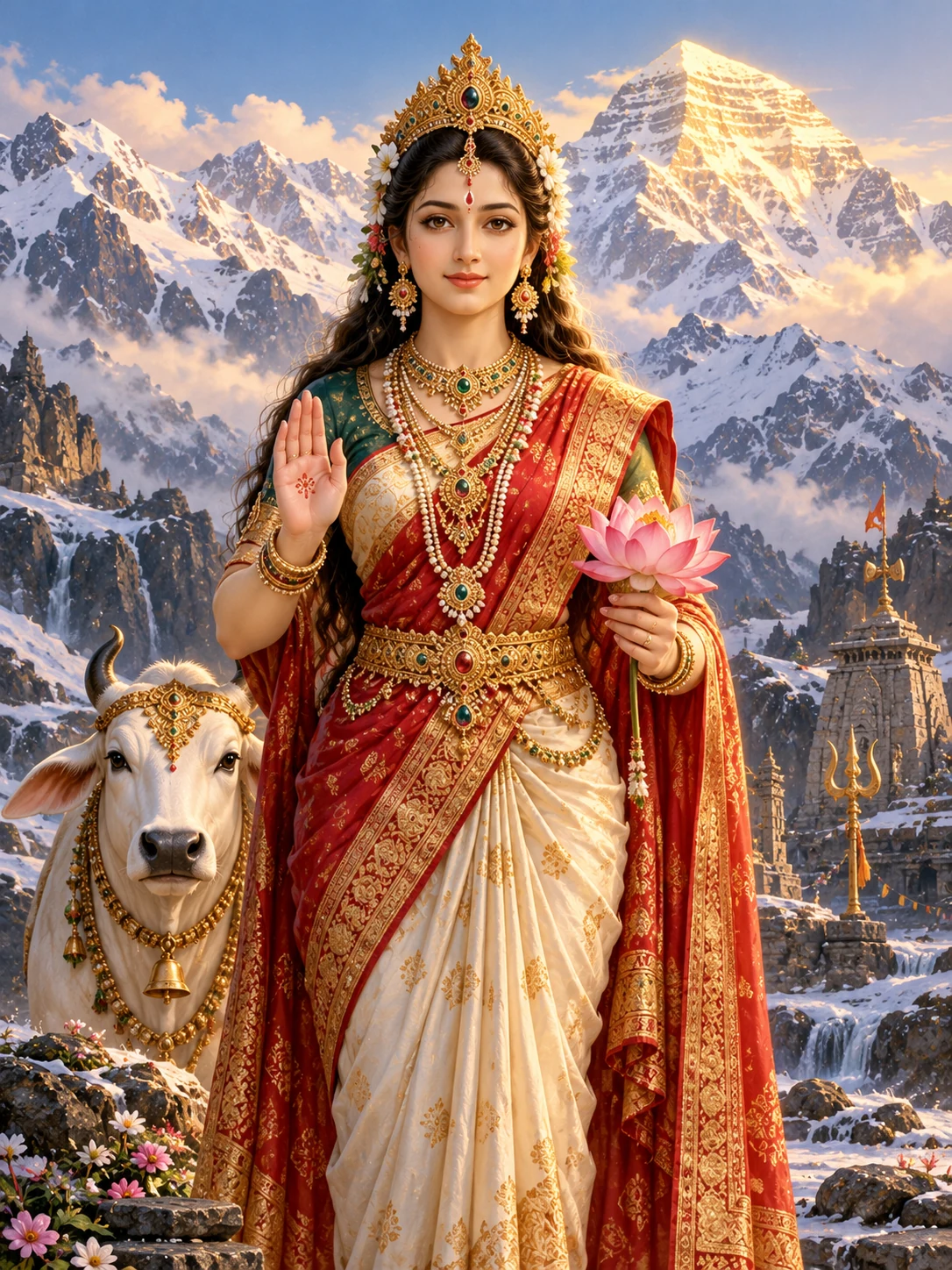
Source and rights notice: These eight units (refrain + seven stanzas) reproduce Nitya’s explicitly public-domain-labelled bare-text dataset 1, with the same Hindi words in Roman letters on this page. Source-author/date proof and final legal clearance remain pending, so this is an unpublished educational edition. No third-party modern translation has been copied.
Protector and world-mother
Meaning: Hail the Mother who removes hostile obstacles and protects her devotees; she is the mother of the world, whose greatness is praised in the language of Hari and Hara. Explanation: “Ari-kul” denotes a hostile group; “kantak” means thorn. The chosen reading is a metaphor of relief from threat and distress rather than advice to treat other people as literal enemies. “Jagjanani/Jagadamba” elevates Parvati beyond a domestic portrait into an encompassing divine-mother ideal. “Harihar gun gata” is syntactically compressed: singers may hear Hari and Hara praising the Goddess, or a poetic gathering of Vaishnava and Shaiva names in her praise. Its grammar deserves specialist review. BhaktiBharat and Drik give notably different first-half readings 23.
The lion, ornaments and celestial praise
Meaning: The Goddess is envisioned upon a lion, wearing earrings, while divine women sing her praise and dance. Explanation: The lion is strongly associated with the martial goddess Durga in many visual traditions, whereas many Uma–Maheshvara sculptures present Parvati seated beside Shiva without a lion. A devotee can therefore hear this as a Shakta identification of Parvati with Durga, not as an inventory of every Parvati image 67. “Tatha” at line end sounds like an old or locally transmitted rhythmic expression and should not be overtranslated as a precise instrument or dance step. This is poetic celestial imagery, not a report of an observed ceremony.
Sati and the Himalayan daughter
Meaning: The hymn remembers the Goddess under the name Sati and then as the daughter born in the Himalayan household, spending joyful time with companions. Explanation: In widely told Puranic narratives, Sati is Daksha’s daughter and Parvati is born to Himavan and Mena after Sati’s death. The verse compresses the two biographies into one devotional continuity. “Satyug” is the poem’s sacred-time language; it cannot date the composition itself. “Hemanchal” points to the Himalaya, and “sakhiyan” to companions and an intimate household setting. This is not a line-by-line quotation from the Shiva Purana. The separate Himalayan-Gauri identity is independently recognized in museum cataloguing 6.
Shumbha, Nishumbha and the many-armed Devi
Meaning: The Mother is praised as conqueror of Shumbha and Nishumbha; the verse magnifies her power through a thousand-armed form and a discus. Explanation: The conflict with the two asuras is narrated in the Devi Mahatmyam (Durga Saptashati), especially its ninth and tenth chapters 8. That text foregrounds forms of the Goddess often called Durga or Chandika. This Aarti worshipfully joins that victory to Parvati’s identity as Mahadevi; the identification is meaningful within several Shakta and Shaiva traditions, but authors and iconographic schools vary. “Sahasra bhuja” is an expansive image of innumerable capacities, not necessarily an exact illustration prescription. Compare the multi-armed Durga painting described by the Met 7.
The universe, Shiva, Nandi and Bhringi
Meaning: The Mother is praised as the form of creation, delighted in Shiva’s company; Nandi and Bhringi appear amid music and the world is pictured as joyfully absorbed. Explanation: “Srishti roop” need not mean that an Aarti supplies a complete metaphysical system; it is a devotional affirmation of the Goddess’s presence throughout life. “Shiv sang” recalls the Uma–Maheshvara pair, historically visible in sculptures across the Himalayan region 5. Nandi is widely known as Shiva’s bull and devoted attendant; Bhringi appears as a distinct Shaiva attendant in later stories. “Been lahi” is a difficult vernacular reading: it plausibly describes taking up an instrument, but should not be used to claim a specific historical musical performance. The closing expression evokes participatory joy.
The devotee’s personal petition
Meaning: As the gods petition the Mother, the singer also turns attention to her feet and asks that her grace keep the mind from wandering. Explanation: After public cosmic imagery, the Aarti becomes personal. “Charan dhyan” is a poetic way to hold the worshipped deity in memory; it is not an instruction in specialized breath control or initiation. The selected publicly shared dataset reads “charan dhyan” and “teri kripa ... man nahin bharmata” 1; Drik Panchang instead reads a communal clapping-and-singing couplet 2. They are two attested endings for this place, not interchangeable words to fuse into a fabricated original.
Closing blessing and the limits of promise
Meaning: The closing verse expresses a devotee’s hope that singing the Mother’s Aarti with love brings happiness and well-being. Explanation: Such closing assurance belongs to the genre of devotional praise and blessing (a phalashruti-like ending). It is not evidence that performing this hymn produces a guaranteed financial, medical, or psychological outcome. The selected witness uses an anonymous “Maiya ji ki Aarti” closing 1. The Drik Panchang ending begins “Shri Pratap Aarti Maiya Ki” 2, a potentially meaningful signature or conventional epithet whose attribution cannot be settled merely by guessing that “Pratap” is the poet’s name. Independent print research is still required.
What is Jai Parvati Mata? Jai Parvati Mata is a North Indian Hindi Aarti devoted to Parvati, revered in many traditions as Gauri, Uma, the spouse of Shiva, and mother of Ganesha. An Aarti is a song of praise associated with offering light and devotional attention. Its words may be recited or sung; this page is a reader and explanation, not a ritual manual. In the selected witness, the opening two-line refrain is followed by seven short stanzas. Each stanza returns to the refrain. The reader can encounter the full lyrical movement without needing to switch back and forth between interpretation and sacred words 14. The poem’s movement is unusually broad for such a short Aarti: the first call to the eternal Mother becomes a plea for protection, then a vision of ornaments and divine song, a memory of Sati and the Himalayan daughter, the martial Devi’s victory, loving companionship with Shiva, and finally a private prayer for a settled mind. It ends by wishing well-being upon the singer. These are devotional images and hopes, not independently measurable promises.
Parvati, Uma, Sati, Gauri and Durga: one name or many? Parvati is closely associated with Shiva in Shaiva traditions. The Uma–Maheshvara form, where both are shown together, occurs in Indian and Nepalese sculpture; the Met identifies an early Almora work and records a distinct Parvati-Gauri figure in a Himalayan shrine 56. In stories of the goddess, Sati is often understood as her previous birth. The hymn does not narrate that story in full; it signals it with two names and an evocation of the Himalayan home. Lion riding and defeat of Shumbha and Nishumbha, on the other hand, strongly evoke Durga or Chandika in the Devi Mahatmyam (Durga Saptashati). The text’s chapters 9–10 concern the defeat of the two asuras 78. Devotees who regard Parvati, Durga and the Great Goddess as related manifestations can praise these qualities together. Yet particular Shaiva, Shakta and regional traditions differ in their theology, and art historians distinguish object types. It would be misleading to claim the same costume, vehicle, or doctrinal interpretation for every image of Parvati.
How the Aarti is shaped
The structure here is one two-line refrain plus seven paired-line stanzas, not eight different stanzas without a refrain. The repeat is a feature of performance: the singer returns to “Jai Parvati Mata” after each episode. The selected romanization is the same Hindi/Braj-influenced vocabulary printed in Latin letters; it is intentionally not an English translation. English meanings occupy a separate layer beneath the entire Aarti. Readers can search by line, segment ID or topic; numbered segment identifiers correspond to the edition notes. The language is not classical Sanskrit. Words such as jas (praise), sakhiyan (companions), araj (petition), and rangrata (absorbed or steeped in delight) carry North Indian vernacular poetic colour. Where a compressed phrase cannot be parsed with confidence, this guide keeps the reading and explains the uncertainty rather than inventing elegant but unsupported Sanskrit grammar.
What the major images invite us to contemplate
Mother and protector. The name Jagadamba makes the speaker’s relationship personal: the vast goddess is approached as someone to whom distress may be voiced. The thorn image turns hostility into a metaphor for impediments. It should foster courage and compassion, not hostility toward real people. The lion and many arms. Such imagery evokes courage and the Goddess’s capacity to face threats. The exact number of arms is not a factual count of all representations, and the Aarti is not a museum catalogue. A lion-mounted Durga is described in the Met's Devi Mahatmyam (Durga Saptashati) painting 7. The home of the Himalaya. The mountains and companions shift the atmosphere from cosmic battle to affectionate memory. The Goddess is not reduced to a weapon-bearing figure; the poem allows intimacy, family and joy to coexist with power. Shiva and musical attendants. The pairing of Parvati with Shiva is a familiar form of Shaiva worship; Nandi and Bhringi evoke a mythic assembly. An uncertain expression such as been lahi should be understood cautiously, not used to reconstruct an ancient musical instrument or rite. Grace and the restless mind. In the selected sixth stanza, the devotee seeks undistracted attention. Its prayer is accessible regardless of whether one sings publicly in a temple or reads quietly. It does not command a particular posture, number of repetitions, or initiatory technique.
Textual witnesses, editorial decisions and authorship
The chosen digital witness is Nitya’s separately published Devanagari and Roman JSON data, whose text alone is described by the publisher as traditional public-domain material, with unrestricted source-JSON reuse 1. That attribution is reproduced in the source list. Nitya separately licenses its own modern meanings and notes under a non-commercial ShareAlike licence; none of those translations or explanations have been copied. this edition’s meanings are new. The Nitya page says its poem was checked against popular Aarti booklets and comparison sites, but it does not name a dated scan or shelfmark 4. Drik Panchang prints a different first verse wording (“padma vinashini”), a different sixth stanza about joyful clapping, and a different closing stanza invoking “Shri Pratap” 2. BhaktiBharat varies “Brahma/Brahmaa”, “kantak/nasani” and “nij sevak” 3. These are substantive textual alternatives, so they are recorded in the source list and not combined with the selected eight parts. The date and author remain unknown. The phrase “Shri Pratap” cannot alone identify an historical writer. Rights and authenticity are separate questions. The selected web data is complete as an eight-unit witness; an independently dated historical edition, underlying lyric ownership and a qualified Hindi philological review are still missing. The public-domain assertion is useful evidence, not final legal clearance.
Frequently asked questions
1. Is “Jai Parvati Mata” a Sanskrit Aarti? No. The attested source is Hindi with older vernacular poetic forms; Sanskrit divine names appear within it. 2. Why is the original in Roman letters on the English page? The Roman text is phonetic Hindi/Roman Hindi for readers who cannot easily read Devanagari. The meanings below are in English, separately. 3. Is Parvati identical to Durga in every tradition? Some Shakta and Shaiva traditions understand them as manifestations of the same divine power; theological and artistic treatments differ. The Aarti intentionally blends their imagery. 4. Who wrote this Aarti? We have not verified an author or first date. One variant has “Shri Pratap,” but that is not enough to identify a lyricist. 5. Why does another website have different last verses? Different witnesses transmit different devotional readings. this edition preserves one identified eight-part sequence and lists other words as variants. 6. Must the refrain be repeated? The selected reading displays the complete refrain first and repeats it after every stanza, as a reader convention. Local singing arrangements can vary. 7. Is initiation required to read it? Ordinary public devotional singing is generally accessible; specialized family or temple worship protocols should be learned from the relevant tradition. this edition provides no restricted ritual techniques. 8. Does singing guarantee wealth or health? No guarantee can be made. The final verse expresses a prayer and hope for auspicious well-being, not a verified outcome.
Additional passage commentary
Refrain — The eternal Mother
Meaning: Praise to Mother Parvati, the eternally revered goddess, approached as a giver of auspicious blessings. Explanation: The refrain addresses Parvati directly, not an abstract idea of a goddess. “Brahma sanatan” has several plausible devotional shades: timeless spiritual reality, divinity beyond change, or language for supreme power. It does not by itself establish an author’s commitment to one philosophical school, nor should it automatically be translated as a claim about the four-faced creator Brahma. “Shubh phal” names hoped-for auspiciousness in prayer, not a guaranteed transaction. In the selected witness this entire two-line refrain returns after each descriptive stanza 1.