



Selected text: eight displayed parts from Drik Panchang. The original words below are in Roman Hindi, not an English translation. Online transcription complete; historical print, rights and specialist verification pending. 1 2
1. Invocation and refrain
Meaning Victory and reverence to Mother Lakshmi. The song says she is honoured night and day by the divine, expressed in its compressed and textually variable line naming Hari, Vishnu and Vidhata. Explanation “Maiya” is an affectionate address; “nishidin” means day and night and “sevat” means serves or honours. The witness prints “Hari Vishnu Vidhata,” a phrase that is not grammatically transparent as a fixed list of three gods. Other readings have “Har Vishnu Dhata,” often explained as Shiva, Vishnu and Brahma. This reader keeps the printed online reading and does not silently rewrite it. The refrain unites the gathered singers.
2. Uma, Rama and Brahmani
Meaning The singer praises Lakshmi through the names Uma, Rama and Brahmani and addresses her as Mother of the world. Sun and moon contemplate her, while sage Narada sings. Explanation The stanza uses a broad devotional idiom that gathers multiple goddess-names into one maternal vision. “Rama” here denotes Rama, a name of Lakshmi, not the male deity Rama. Traditions that distinguish Lakshmi, Parvati and Saraswati need not treat this poetic identification as a universal doctrinal equation. Narada is the mythic sage renowned for song and devotion, not a historically documented contributor to this Aarti. The stanza uses a broad devotional idiom that gathers multiple goddess-names into one maternal vision. “Rama” here denotes Ramā, a name of Lakshmi, not the male deity Rama. Traditions that distinguish Lakshmi, Parvati and Sarasvati need not treat this poetic identification as a universal doctrinal equation. Narada is the mythic sage renowned for song and devotion, not a historically documented contributor to this Aarti.
3. Durga and auspicious abundance
Meaning She is invoked as the stainless divine power in Durga’s form, giver of happiness and prosperity. The hymn voices the devotee’s hope for flourishing, accomplishment and resources through remembrance. Explanation “Niranjani” conveys unstained or untainted. “Riddhi” suggests flourishing, “siddhi” fulfilment or accomplishment, and “dhan” wealth. This is a religious expression of trust, not a financial return formula. The pairing of Lakshmi and Durga is meaningful in inclusive Shakta devotional readings, but the individual deities retain distinct histories and worship traditions.
4. Refuge across all realms
Meaning The goddess is described as present even in the nether regions and as the source of auspiciousness, revealing the effects of action and offering protection amid the ocean of worldly existence. Explanation “Patal” evokes an underworld realm in Hindu cosmological imagery, not a scientifically mapped location. “Karma-prabhava-prakashini” is poetic and admits interpretive nuances: illuminating the consequences or influence of action. “Bhavanidhi” is a metaphor for the vast ocean of becoming and struggle; “trata” is rescuer. Some witnesses read “data” (giver) instead of “trata,” materially changing the second half-line.
5. Virtue in the home
Meaning Where Lakshmi is welcomed, the home becomes a place of good qualities, possibility and steadiness of mind. Explanation The text links prosperity with character—“sadgun,” good qualities—rather than cash alone. “All becomes possible” is devotional encouragement, not proof that obstacles vanish. It can be read as a call to cultivate care, trust, responsible livelihood and generosity at home. Material deprivation is not evidence of divine rejection, nor is wealth proof of moral superiority.
6. Nourishment and shared wellbeing
Meaning The stanza acknowledges the material conditions of life—offerings, clothing, food and hospitality—as manifestations of Lakshmi’s generosity. Explanation “Yajna” here refers to sacrificial or offering-centered religious activity; the stanza says that such acts depend on sustaining resources. “Vastra” is clothing. The verse is best heard as gratitude for the conditions that make family and community life possible, coupled with an ethical responsibility to share them. A compared modern printed witness reportedly has “barat” where this reading has “vastra”; do not silently replace it without direct image collation.
7. Ocean-born Lakshmi and the fourteen treasures
Meaning Lakshmi is praised as a beautiful abode of auspicious qualities, emerging from the Ocean of Milk; the mythical fourteen treasures of the churning are associated with her abundance. Explanation “Kshirodadhi” is the Ocean of Milk, and “jata” means born or arisen. The Samudra-manthana narrative is a sacred mythic setting, not the source from which this entire Hindi Aarti can be claimed to come. Lists of the “fourteen treasures” vary across retellings: the verse does not enumerate them, so a fixed fabricated list is unnecessary. This literary allusion should not be mistaken for evidence that the Aarti occurs in a particular Purana.
8. The closing blessing of song
Meaning The closing verse says that singing Mahalakshmi’s Aarti fills the heart with joy and expresses the hope of moral and spiritual cleansing. Explanation “Ur” is heart or inner being. “Paap utar jata” is not a licence to harm others or evade accountability; in a reflective reading it encourages remorse, moral reform and compassionate conduct. Whether sung in a home or temple, the repeated refrain closes the collective praise. This is not an empirically measurable absolution mechanism.
What is Om Jai Lakshmi Mata?
“Om Jai Lakshmi Mata” is a vernacular Hindi Aarti—a song of praise associated with reverence to goddess Lakshmi. This is not a Sanskrit Vedic hymn and not a chapter of the Shri SuktaSri Sukta. Its short refrain invites collective singing; its succeeding stanzas speak of the goddess as Mother, the source of goodness, the power of nourishment and an assurance of courage amid uncertainty. The text is offered here as an identified reading from one accessible online witness, not as the only authentic form used by every household. 1 2
Aarti can refer to a ritual offering of light and also to the hymn sung during that offering. The present page is a reader and interpretation, not a do-it-yourself liturgical checklist. Actual customs vary by tradition, location and family. It supplies neither an obligatory time nor promised wealth after a prescribed number of repetitions.
Why Lakshmi matters beyond monetary wealth
Lakshmi is widely honoured as a goddess of good fortune, auspiciousness and abundance. In Vaishnava settings she is closely associated with Vishnu, but historical religious art also depicts Lakshmi as a significant deity in her own right. A seventh-century brass sculpture at the Metropolitan Museum illustrates her early independent presence; an eastern Indian image depicts Vishnu accompanied by Lakshmi and Saraswati. These are historical art references, Lakshmi is widely honoured as a goddess of good fortune, auspiciousness and abundance. In Vaishnava settings she is closely associated with Vishnu, but historical religious art also depicts Lakshmi as a significant deity in her own right. A seventh-century brass sculpture at the Metropolitan Museum illustrates her early independent presence; an eastern Indian image depicts Vishnu accompanied by Lakshmi and Sarasvati. These are historical art references, not proof of this song's date or authorship. 5 6
The Aarti's interests extend from sukh (well-being) and sampatti (resources) to sadgun (good qualities), food, clothing, courage and relief from distress. This broad language helps readers understand abundance as the capacity to sustain life and relationships. It does not imply that those suffering poverty have failed spiritually or that prosperity makes a person virtuous.
How the hymn speaks across goddess traditions
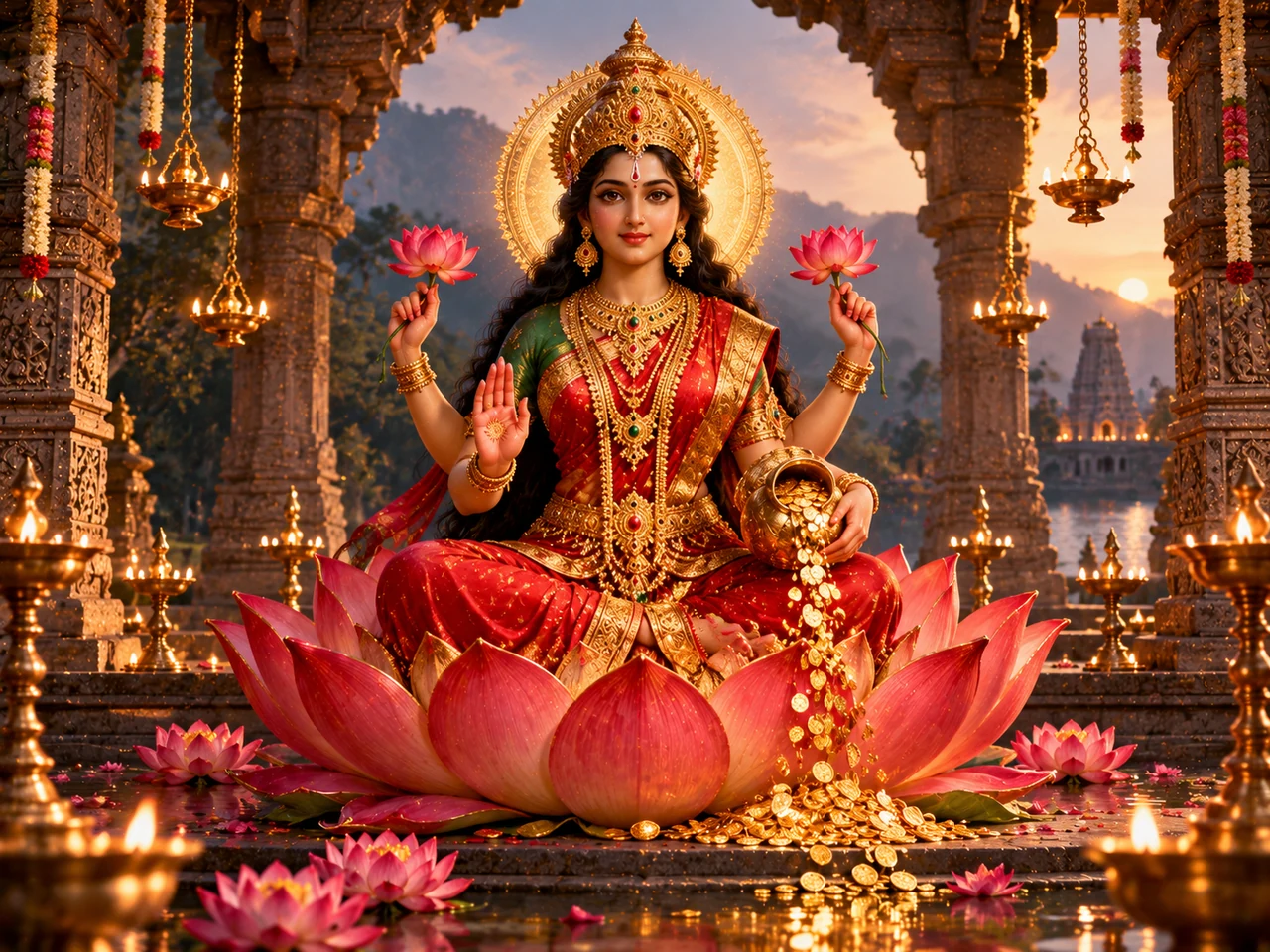
The second stanza uses Uma, Rama and Brahmani and the third adds a Durga association. In some inclusive Shakta readings this gathers feminine divinity under an overarching Mother; many Vaishnava families address Lakshmi primarily as Vishnu's consort. These are related but not interchangeable interpretive contexts. The Aarti does not authorize treating all schools' doctrines as identical. Distinguish the poetic language of a vernacular song from the philosophical claims of a particular school. Lakshmi is frequently shown with lotus flowers, and Gaja-Lakshmi iconography includes elephants in reverential relation to her. These visual traditions appear in museum holdings. The selected Aarti does not literally describe every familiar visual attribute, so the lotus/elephant imagery is background context rather than a missing verse to be added. 7
The Ocean of Milk and fourteen treasures
In stanza seven Lakshmi is named Kshirodadhi-jata, arisen from the Ocean of Milk. This invokes the broad myth of the ocean churning (samudra-manthana) without narrating it. The “fourteen treasures” signal a traditional enumeration of wonders linked with that myth. Retellings vary in how the items are listed; it would misrepresent the Aarti to insert a single detailed list as though the stanza provided it. Its fundamental idea is that prosperity participates in a cosmic story about sustaining and renewing life. The existence of this allusion does not authenticate the Aarti as a quotation from any particular Purana. Its present language is Hindi devotional verse, while the classical myth also occurs in earlier Sanskrit narrative literature.
A text with real variants: which reading did we choose? The selected reading is the eight displayed units under Drik Panchang's “Lakshmi Mata Aarti”: one opening stanza and seven further stanzas, with a short return to “Om Jai Lakshmi Mata” after each subsequent unit. Its original Hindi words and order govern this draft. 1
Important differences should remain visible: the opening can read Hari Vishnu Vidhata or Har Vishnu Dhata; witnesses expand the sung “Maiya” echo; bhavanidhi ki trata appears elsewhere as data; and the stanza on clothing has differences in print-witness reports. The sources are not blended to manufacture a single supposed ancient original. The comparison with the Sanskrit Documents entry provides a second independently viewable vernacular presentation. The reported Hari Darshan and Agarwal scans are leads, not independently checked image evidence in this edition. 2 3 4
The author and exact date of composition are not established. Although a related Vishnu Aarti, “Om Jai Jagdish Hare”, is often linked to the nineteenth-century poet Shraddha Ram Phillauri, this fact must not be automatically borrowed as the authorship of the Lakshmi hymn.
How to read the Aarti responsibly
A reader can approach it as a poetic expression of gratitude: a household needs food, clothing, trust, effort and kindness. The stanza on sadgun offers a particularly strong bridge between devotion and ethical action. Likewise, the closing line on release from wrongdoing is an aspiration to moral renewal, not a substitute for accountability, restitution or social responsibility. The hymn's hopes for prosperity, protection and an uplifted heart are devotional statements, not experimentally verified guarantees of money, health or legal outcomes. Its significance is not reduced by declining to turn these hopes into predictions.
When is it sung? Households and temples sing Lakshmi Aartis in ordinary worship as well as occasions associated with the goddess, including Lakshmi Puja during Diwali and, in some families, Friday observances. Practices differ regionally. No exact lunar date, festival timing, fast-breaking time or muhurta is asserted here; these require the approved ShivGoraksh Calendar and its locally resolved data, not an evergreen article or AI-estimated calculation. 1 4
Pronunciation and reader notes
The Roman Hindi block above preserves Hindi words rather than replacing them with English poetry. For example, nishidin means “night and day,” shubhdaata “giver of auspiciousness,” and ur “heart.” Roman Hindi is a reading aid; it does not reproduce every Devanagari sound perfectly. A reader seeking strict scholarly transliteration should not treat this practical Roman display as an IAST edition of a Sanskrit poem. The Sanskrit-derived words within this Hindi song are part of vernacular speech. The repeated short refrain is a performance cue, not eight additional authored stanzas. In the edition notes the eight numbered reader units remain separate, with each later unit pointing back to the opening refrain.
Connections for further learning
Glossary
| Term | Plain explanation |
|---|---|
| Aarti | Song of praise and/or rite of offering light; formats vary |
| Maiya | Affectionate address to the Divine Mother |
| Nishidin | Day and night |
| Riddhi–siddhi | Flourishing and accomplishment; meanings depend on context |
| Sadgun | Good qualities or virtues |
| Bhavanidhi | The metaphorical ocean of worldly becoming |
| Kshirodadhi | Ocean of Milk in sacred narrative |
| Ur | Heart, the inward seat of feeling |
Frequently asked questions
1. Is the entire Aarti included? Yes, all eight parts of the chosen online witness are present, including the refrain cues. Independent historical-edition comparison and republication rights are still pending. 2. Why is the text in Roman Hindi on an English page? The site's policy is to preserve the same devotional words across languages; English meanings follow separately. 3. Is it a Sanskrit mantra or Vedic passage? No. This is a Hindi Aarti. The Shri SuktaSri Sukta is a distinct textual work. 4. Does the Aarti promise guaranteed wealth? No. Its language expresses devotional hope; the guide does not promise financial or medical outcomes. 5. Why are Uma and Durga named in a Lakshmi Aarti? Inclusive goddess-devotion frequently gathers forms of the divine feminine; traditions may still distinguish the deities. 6. Are all sung versions the same? No. Echoes, spellings, stanza lines and alternate readings vary. this edition fixes one witness and records differences. 7. Who wrote the Aarti? A reliably authenticated author and composition date have not been established by this source review. 8. Can the text be published immediately? No. This is a draft; reproduction rights, source collation and expert review require separate approval.