



About these reading aids

Easy Roman is a Devanagari-based Sanskrit reading aid. IAST preserves scholarly distinctions. Where no Roman text was supplied, IAST is derived automatically from the Devanagari; this is not a certified pronunciation guide. Vernacular songs retain their supplied word forms and spoken endings. Easy Roman simplifies unambiguous diacritics; their scholarly view retains the supplied Roman form rather than inventing Sanskrit pronunciation. Selected bija spellings are kept where unambiguous.

Stotra

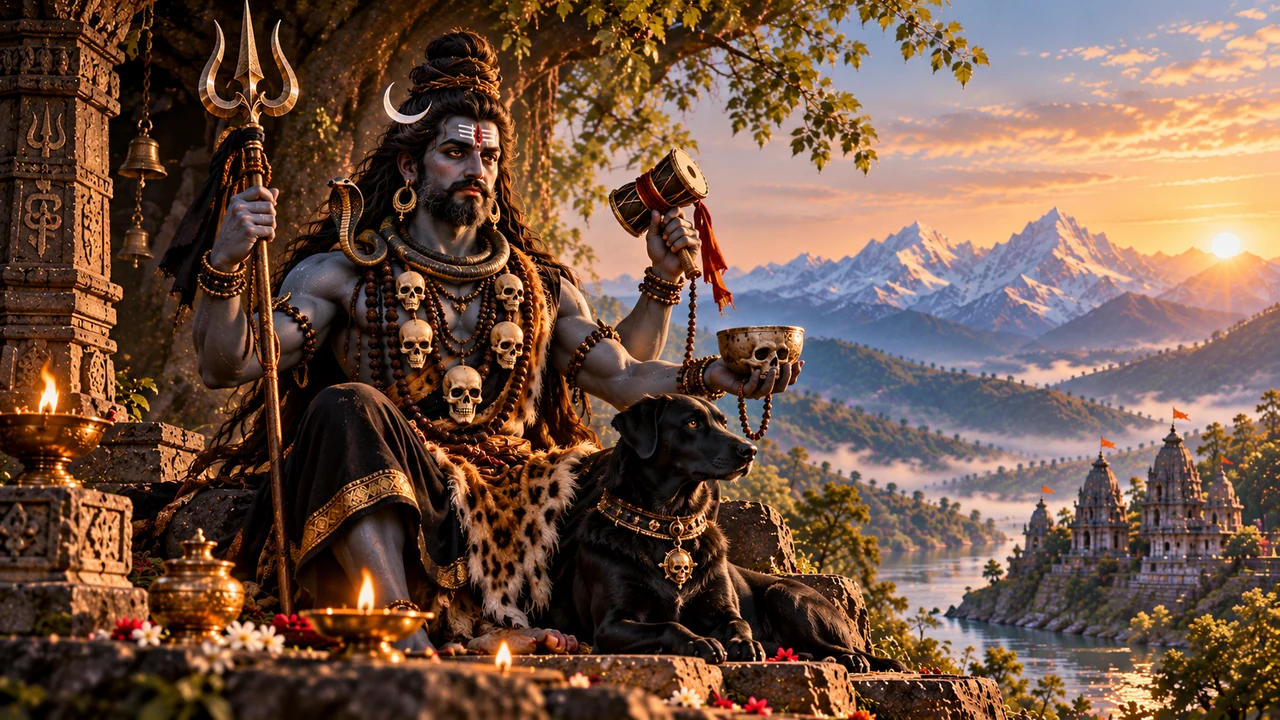
Kālabhairavāṣṭakam (Kalabhairava Ashtakam)

An eight-verse praise of Kālabhairava as lord of Kāśī; this edition separates the printed phalaśruti and records variant readings.

Reading settings

Settings are saved in this page’s URL and carried to adjacent chapters. Bookmark the URL to keep them. Devanagari keeps its dedicated reading font.

Reset settings

Text, Meaning & Explanation

1

श्रीगणेशाय नमः ॥

Roman Transliteration

shreeganeshaaya namah ||śrīgaṇeśāya namaḥ ||

Meaning

A respectful opening salutation to Ganesha.A respectful opening salutation to Ganesha.A respectful opening salutation to Gaṇeśa.

Explanation

This invocation precedes the numbered hymn in the selected printed book. It is paratext, not a ninth hymn verse; its presence in this edition does not establish that it appeared in the earliest form of the composition.

1

देवराजसेव्यमानपावनाङ्घ्रिपङ्कजं व्यालयज्ञसूत्रमिन्दुशेखरं कृपाकरम् । नारदादियोगिवृन्दवन्दितं दिगम्बरं काशिकापुराधिनाथकालभैरवं भजे ॥ १ ॥

Roman Transliteration

devaraajasevyamaanapaavanaanghripankajam vyaalayajnasootramindushekharam kripaakaram | naaradaadiyogivrindavanditam digambaram kaashikaapuraadhinaathakaalabhairavam bhaje || 1 ||devarājasevyamānapāvanāṅghripaṅkajaṃ vyālayajñasūtraminduśekharaṃ kṛpākaram | nāradādiyogivṛndavanditaṃ digambaraṃ kāśikāpurādhināthakālabhairavaṃ bhaje || 1 ||

Meaning

I worship Kālabhairava, sovereign of Kāśī: his holy lotus-like feet are revered even by the king of gods; a serpent is his sacred thread, the moon crowns him, and compassion is his nature. Nārada and other yogis bow to him, who is described as clad in the directions.

Explanation

The opening verse juxtaposes an awe-inspiring appearance with compassion: the serpent is an emblem of his unusual ascetic iconography, not a practical costume instruction. “Digambara” literally evokes the directions as clothing, expressing freedom from ordinary social adornment. Kāśī is Varanasi, and the same closing invocation recurs after every core verse.

2

भानुकोटिभास्वरं भवाब्धितारकं परं नीलकण्ठमीप्सितार्थदायकं त्रिलोचनम् । कालकालमम्बुजाक्षमक्षशूलमक्षरं काशिकापुराधिनाथकालभैरवं भजे ॥ २ ॥

Roman Transliteration

bhaanukotibhaasvaram bhavaabdhitaarakam param neelakanthameepsitaarthadaayakam trilochanam | kaalakaalamambujaakshamakshashoolamaksharam kaashikaapuraadhinaathakaalabhairavam bhaje || 2 ||bhānukoṭibhāsvaraṃ bhavābdhitārakaṃ paraṃ nīlakaṇṭhamīpsitārthadāyakaṃ trilocanam | kālakālamambujākṣamakṣaśūlamakṣaraṃ kāśikāpurādhināthakālabhairavaṃ bhaje || 2 ||

Meaning

I worship Kālabhairava, lord of Kāśī, shining like countless suns, the supreme guide across the ocean of becoming, blue-throated, three-eyed, and giver of sought-for aims; death even to Time, lotus-eyed, associated here with the compound akṣaśūla, and imperishable.

Explanation

“Bhavābdhi” is the ocean of repeated becoming; crossing it signifies release from bondage. Calling Bhairava “Kāla-kāla” makes time itself subject to him. The difficult compound akṣaśūla is retained rather than resolved with unwarranted certainty: the immediate context suggests a weapon image, but its precise grammatical analysis warrants Sanskrit specialist review.

3

शूलटङ्कपाशदण्डपाणिमादिकारणं श्यामकायमादिदेवमक्षरं निरामयम् । भीमविक्रमं प्रभुं विचित्रताण्डवप्रियं काशिकापुराधिनाथकालभैरवं भजे ॥ ३ ॥

Roman Transliteration

shoolatankapaashadandapaanimaadikaaranam shyaamakaayamaadidevamaksharam niraamayam | bheemavikramam prabhum vichitrataandavapriyam kaashikaapuraadhinaathakaalabhairavam bhaje || 3 ||śūlaṭaṅkapāśadaṇḍapāṇimādikāraṇaṃ śyāmakāyamādidevamakṣaraṃ nirāmayam | bhīmavikramaṃ prabhuṃ vicitratāṇḍavapriyaṃ kāśikāpurādhināthakālabhairavaṃ bhaje || 3 ||

Meaning

I honour Kālabhairava, lord of Kāśī: the primal cause who bears trident, axe-like ṭaṅka, noose and staff; dark in form, the primordial deity, unperishing and free from affliction, of formidable power and fond of the wondrous tāṇḍava.

Explanation

The weapons are mythic signs of force, restraint and discipline; the poem does not tell a reader to handle them. “Ādikāraṇa” moves the praise from physical imagery to metaphysics: the fierce deity is also envisaged as first cause. Tāṇḍava signals dynamic divine activity rather than ordinary violence.

4

भुक्तिमुक्तिदायकं प्रशस्तचारुविग्रहं भक्तवत्सलं स्थितं समस्तलोकविग्रहम् । विनिक्वणन्मनोज्ञहेमकिङ्किणीलसत्कटिं काशिकापुराधिनाथकालभैरवं भजे ॥ ४ ॥

Roman Transliteration

bhuktimuktidaayakam prashastachaaruvigraham bhaktavatsalam sthitam samastalokavigraham | vinikvananmanojnahemakinkineelasatkatim kaashikaapuraadhinaathakaalabhairavam bhaje || 4 ||bhuktimuktidāyakaṃ praśastacāruvigrahaṃ bhaktavatsalaṃ sthitaṃ samastalokavigraham | vinikvaṇanmanojñahemakiṅkiṇīlasatkaṭiṃ kāśikāpurādhināthakālabhairavaṃ bhaje || 4 ||

Meaning

I praise Kālabhairava, lord of Kāśī, celebrated for granting both enjoyment and release, beautiful in form, loving to devotees, steadfast, whose body is imagined as encompassing all worlds, and whose waist shines with pleasantly jingling golden bells.

Explanation

“Bhukti” and “mukti” are placed together: the hymn does not require a simple opposition between worldly flourishing and spiritual freedom. The edition reads sthitaṃ (“established/steady”), not sthiraṃ in some comparisons. The printed vinikvaṇan is kept even though a shorter nikvaṇan is common and is metrically more regular; readers should not silently substitute the latter in the source layer.

5

धर्मसेतुपालकं त्वधर्ममार्गनाशकं कर्मपाशमोचकं सुशर्मदायकं विभुम् । स्वर्णवर्णशेषपाशशोभिताङ्गमण्डलं काशिकापुराधिनाथकालभैरवं भजे ॥ ५ ॥

Roman Transliteration

dharmasetupaalakam tvadharmamaarganaashakam karmapaashamochakam susharmadaayakam vibhum | svarnavarnasheshapaashashobhitaangamandalam kaashikaapuraadhinaathakaalabhairavam bhaje || 5 ||dharmasetupālakaṃ tvadharmamārganāśakaṃ karmapāśamocakaṃ suśarmadāyakaṃ vibhum | svarṇavarṇaśeṣapāśaśobhitāṅgamaṇḍalaṃ kāśikāpurādhināthakālabhairavaṃ bhaje || 5 ||

Meaning

I worship Kālabhairava, lord of Kāśī, protector of the bridge of dharma and destroyer of the path of its opposite; liberator from the bonds of deeds, giver of well-being, all-pervading, his body adorned with the golden-hued coil or noose of Śeṣa.

Explanation

The “bridge of dharma” is an ethical metaphor, not a geographical structure. “Karma-pāśa” presents binding action as a noose: the praise asks readers to consider responsibility and liberation. The selected 1912 text has śeṣapāśa (a serpentine adornment); the circulating keśapāśa (“locks of hair”) is a different reading and changes the image.

6

रत्नपादुकाप्रभाभिरामपादयुग्मकं नित्यमद्वितीयमिष्टदैवतं निरञ्जनम् । मृत्युदर्पनाशनं करालदंष्ट्रमोक्षणं काशिकापुराधिनाथकालभैरवं भजे ॥ ६ ॥

Roman Transliteration

ratnapaadukaaprabhaabhiraamapaadayugmakam nityamadviteeyamishtadaivatam niranjanam | mrityudarpanaashanam karaaladamshtramokshanam kaashikaapuraadhinaathakaalabhairavam bhaje || 6 ||ratnapādukāprabhābhirāmapādayugmakaṃ nityamadvitīyamiṣṭadaivataṃ nirañjanam | mṛtyudarpanāśanaṃ karāladaṃṣṭramokṣaṇaṃ kāśikāpurādhināthakālabhairavaṃ bhaje || 6 ||

Meaning

I revere Kālabhairava, lord of Kāśī, whose feet are lovely in the radiance of jewelled sandals; eternal, without a second, beloved as the chosen deity and unstained; destroyer of Death’s arrogance, described by the challenging compound karāladaṃṣṭramokṣaṇaṃ involving fearsome fangs and release.

Explanation

The poem mixes royal splendour (jewelled footwear), nondual-sounding praise (“advitīya”) and the frightening image of fangs. The exact force of karāladaṃṣṭramokṣaṇaṃ in the printed reading is debated; do not substitute the smoother popular karāladaṃṣṭrabhūṣaṇaṃ and imply that the 1912 witness says it.

7

अट्टहासभिन्नपद्मजाण्डकोशसन्ततिं दृष्टिपातनष्टपापजालमुग्रशासनम् । अष्टसिद्धिदायकं कपालमालिकन्धरं काशिकापुराधिनाथकालभैरवं भजे ॥ ७ ॥

Roman Transliteration

attahaasabhinnapadmajaandakoshasantatim drishtipaatanashtapaapajaalamugrashaasanam | ashtasiddhidaayakam kapaalamaalikandharam kaashikaapuraadhinaathakaalabhairavam bhaje || 7 ||aṭṭahāsabhinnapadmajāṇḍakośasantatiṃ dṛṣṭipātanaṣṭapāpajālamugraśāsanam | aṣṭasiddhidāyakaṃ kapālamālikandharaṃ kāśikāpurādhināthakālabhairavaṃ bhaje || 7 ||

Meaning

I worship Kālabhairava, lord of Kāśī, whose mighty laughter breaks the succession of cosmic shells linked with the lotus-born creator; whose glance destroys a web of wrongdoing, whose discipline is fierce, who is praised as giver of eight siddhis, and whose neck bears a garland of skulls.

Explanation

The startling cosmic laughter expresses a power beyond a created universe; it is poetic cosmology, not an astronomical assertion. “Eight siddhis” is a traditional claim in the hymn and is not a promise of abilities from recitation. The selected print reads kapālamālikandharaṃ (skull-garland at the neck); other readings use kapālamālikādharaṃ.

8

भूतसङ्घनायकं विशालकीर्तिदायकं काशिवासलोकपुण्यपापशोधकं विभुम् । नीतिमार्गकोविदं पुरातनं जगत्पतिं काशिकापुराधिनाथकालभैरवं भजे ॥ ८ ॥

Roman Transliteration

bhootasanghanaayakam vishaalakeertidaayakam kaashivaasalokapunyapaapashodhakam vibhum | neetimaargakovidam puraatanam jagatpatim kaashikaapuraadhinaathakaalabhairavam bhaje || 8 ||bhūtasaṅghanāyakaṃ viśālakīrtidāyakaṃ kāśivāsalokapuṇyapāpaśodhakaṃ vibhum | nītimārgakovidaṃ purātanaṃ jagatpatiṃ kāśikāpurādhināthakālabhairavaṃ bhaje || 8 ||

Meaning

I praise Kālabhairava, ruler of Kāśī and lord of the world, leader of the hosts of beings, giver of broad renown, said to discern or purify the good and bad deeds of Kāśī’s residents, all-pervading, wise in right conduct and primeval.

Explanation

“Bhūta” here may denote Shiva’s attendant hosts, not simply ghosts in a modern horror sense. Kāśī is both a real sacred city and the poem’s spiritual setting. The verse emphasizes ethical discernment (“nīti-mārga”) alongside supernatural imagery; the judgment of deeds is presented as a religious picture, not an empirical claim.“Bhūta” here may denote Shiva’s attendant hosts, not simply ghosts in a modern horror sense. Kāśī is both a real sacred city and the poem’s spiritual setting. The verse emphasizes ethical discernment (“nīti-mārga”) alongside supernatural imagery; the judgment of deeds is presented as a religious picture, not an empirical claim.“Bhūta” here may denote Śiva’s attendant hosts, not simply ghosts in a modern horror sense. Kāśī is both a real sacred city and the poem’s spiritual setting. The verse emphasizes ethical discernment (“nīti-mārga”) alongside supernatural imagery; the judgment of deeds is presented as a religious picture, not an empirical claim.

कालभैरवाष्टकं पठन्ति ये मनोहरं ज्ञानमुक्तिसाधनं विचित्रपुण्यवर्धनम् । शोकमोहदैन्यलोभकोपतापनाशनं ते प्रयान्ति कालभैरवाङ्घ्रिसन्निधिं ध्रुवम् ॥ ९ ॥

Roman Transliteration

kaalabhairavaashtakam pathanti ye manoharam jnaanamuktisaadhanam vichitrapunyavardhanam | shokamohadainyalobhakopataapanaashanam te prayaanti kaalabhairavaanghrisannidhim dhruvam || 9 ||kālabhairavāṣṭakaṃ paṭhanti ye manoharaṃ jñānamuktisādhanaṃ vicitrapuṇyavardhanam | śokamohadainyalobhakopatāpanāśanaṃ te prayānti kālabhairavāṅghrisannidhiṃ dhruvam || 9 ||

Meaning

The closing fruit-of-recitation verse says that people who recite this pleasing Kālabhairavāṣṭakam, characterized as fostering knowledge, liberation and merit, and dispelling grief, confusion, deprivation, greed, anger and distress, are said to come surely into the nearness of Kālabhairava’s feet.

Explanation

This is a phalaśruti, an account of spiritual benefit within the literary and devotional tradition, not an independently proven effect or a prescription of repetition counts. In this witness it is printed as verse nine, but is not a ninth verse of the aṣṭaka proper; it belongs after the eight praise stanzas.

इति श्रीमच्छङ्कराचार्यविरचितं कालभैरवाष्टकं सम्पूर्णम् ॥

Roman Transliteration

iti shreemachchhankaraachaaryavirachitam kaalabhairavaashtakam sampoornam ||iti śrīmacchaṅkarācāryaviracitaṃ kālabhairavāṣṭakaṃ sampūrṇam ||

Meaning

Thus concludes the Kālabhairavāṣṭakam, named in this printed colophon as composed by the revered Śaṅkarācārya.

Explanation

This is a printed attribution formula, not independent biographical proof that the historical Shankara composed the text. A different redaction occurs in Śivarahasya and must not be merged with this printed recital.This is a printed attribution formula, not independent biographical proof that the historical Shankara composed the text. A different redaction occurs in Śivarahasya and must not be merged with this printed recital.This is a printed attribution formula, not independent biographical proof that the historical Śaṅkara composed the text. A different redaction occurs in Śivarahasya and must not be merged with this printed recital.

Context & Usage

Edition notice: Eight main verses from the 1912 Bṛhatstotraratnākara (printed pp. 127–128; scan frames 135–136), plus its printed opening invocation, separately numbered phalaśruti, and colophon. Orthography is standardized and abbreviated refrains are expanded using the attested first refrain. Source collation is substantial but specialist and publication clearance remain pending. 1 7

Phalaśruti — printed verse 9 · phalashruti-001

Meaning. The closing fruit-of-recitation verse says that people who recite this pleasing Kālabhairavāṣṭakam, characterized as fostering knowledge, liberation and merit, and dispelling grief, confusion, deprivation, greed, anger and distress, are said to come surely into the nearness of Kālabhairava’s feet. Explanation. This is a phalaśruti, an account of spiritual benefit within the literary and devotional tradition, not an independently proven effect or a prescription of repetition counts. In this witness it is printed as verse nine, but is not a ninth verse of the aṣṭaka proper; it belongs after the eight praise stanzas.

What is the Kālabhairavāṣṭakam? An aṣṭakam is a hymn built around eight principal stanzas. This one addresses Kālabhairava—Bhairava in his association with time, death, discipline and the sacred city of Kāśī (Varanasi). Rather than beginning with a command, the eight verses repeat a first-person gesture of reverence: “Kāśikāpurādhināthakālabhairavaṃ bhaje”, “I worship Kālabhairava, lord of the city of Kāśī.” The repetition makes the intricate descriptions easier to follow: each new image returns to the same devotional centre. 1

Kāśī, time and the names of Bhairava

Kāla can evoke time and death; Kālakāla in verse 2 calls Bhairava “the death of death” or the one beyond Time’s power. It is a religious image of transcendence, not a prediction that believers will physically escape mortality. Kāśī anchors the hymn in a particular cultural landscape, even as the stanzas portray Bhairava as pervading all worlds. His Shaiva identity is clear from the moon, blue throat, three eyes and tāṇḍava; the poem also cultivates his distinct Bhairava personality rather than reducing him to an interchangeable name. The final stanzas move from personal adoration toward cosmic scale. “The shell of the Brahmā-born world” is a poetic image of a created cosmos, while karma as a pāśa (“noose”) in verse 5 makes bondage imaginable. Such images invite ethical self-scrutiny; no instruction for tantra, initiation, weapon handling or an individual protection rite follows from them.

Which text is printed here? Why do versions differ? The controlling witness is item 57 on two scanned pages of a seventh-reprint 1912 Nirṇaya Sāgara *Bṛhatstotraratnākara. The historical print gives the full refrain in verse 1 but abbreviates it as काशिका० later. This reader expands the identical refrain after verses 2–8 for ease of reading; it is an explicit expansion, not a claim that every repetition was spelled out in the old layout. Standard spellings such as अङ्घ्रि for old अं‍घ्रि** likewise represent a Unicode orthographic layer, not a new source. 1

Several printed and recited families differ. The 1910 comparison transcription has बिन्दु where this print has इन्दु in the opening line; it prefers स्थिरं over स्थितं, निक्वणन् over विनिक्वणन्, and केशपाश rather than शेषपाश. There are also meaningful differences around the frightening fangs and the neck's skull garland. Here the chosen printed readings are retained even where another reading might scan or parse more smoothly; individual variants are documented in the source list. The alternate electronic Śivarahasya recension, placed at Mahādevākhya 11.34.53–61, reorders and alters major verses and the closing prayer, so it is a separate textual witness—not a set of corrections to import indiscriminately. 1 3 5

Who wrote the hymn? The selected historical book closes with a formula calling the text Śaṅkarācārya-viracita, “composed by Śaṅkarācārya.” This supports a traditional attribution; it does not by itself establish the identity or lifetime of the historical composer. The 1910 comparison also ascribes the hymn to a Shankara. Conversely the Śivarahasya presents a closely related but divergent hymn embedded in a Shiva–Parvati dialogue. It would be misleading to claim those are exactly the same edition or that the dialogue settles historical authorship. ; it does not by itself establish the identity or lifetime of the historical composer. The 1910 comparison also ascribes the hymn to a Śaṅkara. Conversely the Śivarahasya presents a closely related but divergent hymn embedded in a Śiva–Pārvatī dialogue. It would be misleading to claim those are exactly the same edition or that the dialogue settles historical authorship. 1 3 5

What about Kālāṣṭamī or recitation results? Some traditions associate Bhairava worship with Kālāṣṭamī, and the Śivarahasya passage is set in an aṣṭamī context. This page does not calculate observance dates, recommend timing, prescribe repetition counts, teach restricted rites or promise material, medical or supernatural results. The phalaśruti is translated as a historical devotional claim. A user interested in a local temple's observance should rely on a separately reviewed calendar and that tradition's qualified guidance. 5

Frequently asked questions

Does an aṣṭakam have eight or nine verses here? The praise consists of eight stanzas. The book then prints a ninth numbered phalaśruti (statement of benefits), plus an unnumbered colophon and a preceding invocation. This edition represents 11 reader units, not eleven main verses. Is the Roman text an English translation? No. It is IAST transliteration of the same Sanskrit words on the Hindi page. Read the meaning blocks below the complete hymn for English interpretation. Why retain difficult readings instead of using the most common version? This is an edition-aware reader. A familiar word cannot silently replace a different word in the controlling witness; unresolved compounds and metrical irregularities are identified for expert review. Is the fierce imagery a practical ritual guide? No. This draft provides the original hymn and literary/theological interpretation only; it does not authorize personal ritual performance.

Sources, Credits & Licensing

Founder-authorized educational edition. Independent textual and specialist review remains incomplete; this reading does not confer initiation or ritual authorization.

Inherited traditional wording; selected witness cited below. Romanization, meanings and explanations prepared for ShivGoraksh. No modern source translation, page layout or recording reproduced.

Original Roman reading

The Roman reading recorded with this edition, retaining its spelling and word forms before the Easy Roman display conversion.

  1. 1

    śrīgaṇeśāya namaḥ ||

  2. 1

    devarājasevyamānapāvanāṅghripaṅkajaṃ vyālayajñasūtraminduśekharaṃ kṛpākaram | nāradādiyogivṛndavanditaṃ digambaraṃ kāśikāpurādhināthakālabhairavaṃ bhaje || 1 ||

  3. 2

    bhānukoṭibhāsvaraṃ bhavābdhitārakaṃ paraṃ nīlakaṇṭhamīpsitārthadāyakaṃ trilocanam | kālakālamambujākṣamakṣaśūlamakṣaraṃ kāśikāpurādhināthakālabhairavaṃ bhaje || 2 ||

  4. 3

    śūlaṭaṅkapāśadaṇḍapāṇimādikāraṇaṃ śyāmakāyamādidevamakṣaraṃ nirāmayam | bhīmavikramaṃ prabhuṃ vicitratāṇḍavapriyaṃ kāśikāpurādhināthakālabhairavaṃ bhaje || 3 ||

  5. 4

    bhuktimuktidāyakaṃ praśastacāruvigrahaṃ bhaktavatsalaṃ sthitaṃ samastalokavigraham | vinikvaṇanmanojñahemakiṅkiṇīlasatkaṭiṃ kāśikāpurādhināthakālabhairavaṃ bhaje || 4 ||

  6. 5

    dharmasetupālakaṃ tvadharmamārganāśakaṃ karmapāśamocakaṃ suśarmadāyakaṃ vibhum | svarṇavarṇaśeṣapāśaśobhitāṅgamaṇḍalaṃ kāśikāpurādhināthakālabhairavaṃ bhaje || 5 ||

  7. 6

    ratnapādukāprabhābhirāmapādayugmakaṃ nityamadvitīyamiṣṭadaivataṃ nirañjanam | mṛtyudarpanāśanaṃ karāladaṃṣṭramokṣaṇaṃ kāśikāpurādhināthakālabhairavaṃ bhaje || 6 ||

  8. 7

    aṭṭahāsabhinnapadmajāṇḍakośasantatiṃ dṛṣṭipātanaṣṭapāpajālamugraśāsanam | aṣṭasiddhidāyakaṃ kapālamālikandharaṃ kāśikāpurādhināthakālabhairavaṃ bhaje || 7 ||

  9. 8

    bhūtasaṅghanāyakaṃ viśālakīrtidāyakaṃ kāśivāsalokapuṇyapāpaśodhakaṃ vibhum | nītimārgakovidaṃ purātanaṃ jagatpatiṃ kāśikāpurādhināthakālabhairavaṃ bhaje || 8 ||

  10. 9

    kālabhairavāṣṭakaṃ paṭhanti ye manoharaṃ jñānamuktisādhanaṃ vicitrapuṇyavardhanam | śokamohadainyalobhakopatāpanāśanaṃ te prayānti kālabhairavāṅghrisannidhiṃ dhruvam || 9 ||

  11. 11

    iti śrīmacchaṅkarācāryaviracitaṃ kālabhairavāṣṭakaṃ sampūrṇam ||

Sources and editorial status

  • 1 Historical controlling witness: Bṛhatstotraratnākara (1912), item 57, printed pp. 127–128, scanned pages 135–136. https://commons.wikimedia.org/wiki/File:Brihat_Stotra_Ratnakara_1912.djvu
  • 3 1910 comparison-family transcription (not controlling): https://sa.wikisource.org/w/index.php?oldid=288253
  • 5 Related but different Śivarahasya recension (11.34.53–61): https://sanskritdocuments.org/doc_shiva/kAlabhairavAShTakam1.html
  • 7 Wikimedia Commons scan-file rights and bibliographic statement: https://commons.wikimedia.org/w/index.php?oldid=1026446559&title=File:Brihat_Stotra_Ratnakara_1912.djvu
Additional passage commentary

Opening invocation

Meaning. A respectful opening salutation to Ganesha. A respectful opening salutation to Gaṇeśa. Explanation. This invocation precedes the numbered hymn in the selected printed book. It is paratext, not a ninth hymn verse; its presence in this edition does not establish that it appeared in the earliest form of the composition.

Verse 1 · shloka-001

Meaning. I worship Kālabhairava, sovereign of Kāśī: his holy lotus-like feet are revered even by the king of gods; a serpent is his sacred thread, the moon crowns him, and compassion is his nature. Nārada and other yogis bow to him, who is described as clad in the directions. Explanation. The opening verse juxtaposes an awe-inspiring appearance with compassion: the serpent is an emblem of his unusual ascetic iconography, not a practical costume instruction. “Digambara” literally evokes the directions as clothing, expressing freedom from ordinary social adornment. Kāśī is Varanasi, and the same closing invocation recurs after every core verse.

Verse 2 · shloka-002

Meaning. I worship Kālabhairava, lord of Kāśī, shining like countless suns, the supreme guide across the ocean of becoming, blue-throated, three-eyed, and giver of sought-for aims; death even to Time, lotus-eyed, associated here with the compound akṣaśūla, and imperishable. Explanation. “Bhavābdhi” is the ocean of repeated becoming; crossing it signifies release from bondage. Calling Bhairava “Kāla-kāla” makes time itself subject to him. The difficult compound akṣaśūla is retained rather than resolved with unwarranted certainty: the immediate context suggests a weapon image, but its precise grammatical analysis warrants Sanskrit specialist review.

Verse 3 · shloka-003

Meaning. I honour Kālabhairava, lord of Kāśī: the primal cause who bears trident, axe-like ṭaṅka, noose and staff; dark in form, the primordial deity, unperishing and free from affliction, of formidable power and fond of the wondrous tāṇḍava. Explanation. The weapons are mythic signs of force, restraint and discipline; the poem does not tell a reader to handle them. “Ādikāraṇa” moves the praise from physical imagery to metaphysics: the fierce deity is also envisaged as first cause. Tāṇḍava signals dynamic divine activity rather than ordinary violence.

Verse 4 · shloka-004

Meaning. I praise Kālabhairava, lord of Kāśī, celebrated for granting both enjoyment and release, beautiful in form, loving to devotees, steadfast, whose body is imagined as encompassing all worlds, and whose waist shines with pleasantly jingling golden bells. Explanation. “Bhukti” and “mukti” are placed together: the hymn does not require a simple opposition between worldly flourishing and spiritual freedom. The edition reads sthitaṃ (“established/steady”), not sthiraṃ in some comparisons. The printed vinikvaṇan is kept even though a shorter nikvaṇan is common and is metrically more regular; readers should not silently substitute the latter in the source layer.

Verse 5 · shloka-005

Meaning. I worship Kālabhairava, lord of Kāśī, protector of the bridge of dharma and destroyer of the path of its opposite; liberator from the bonds of deeds, giver of well-being, all-pervading, his body adorned with the golden-hued coil or noose of Śeṣa. Explanation. The “bridge of dharma” is an ethical metaphor, not a geographical structure. “Karma-pāśa” presents binding action as a noose: the praise asks readers to consider responsibility and liberation. The selected 1912 text has śeṣapāśa (a serpentine adornment); the circulating keśapāśa (“locks of hair”) is a different reading and changes the image.

Verse 6 · shloka-006

Meaning. I revere Kālabhairava, lord of Kāśī, whose feet are lovely in the radiance of jewelled sandals; eternal, without a second, beloved as the chosen deity and unstained; destroyer of Death’s arrogance, described by the challenging compound karāladaṃṣṭramokṣaṇaṃ involving fearsome fangs and release. Explanation. The poem mixes royal splendour (jewelled footwear), nondual-sounding praise (“advitīya”) and the frightening image of fangs. The exact force of karāladaṃṣṭramokṣaṇaṃ in the printed reading is debated; do not substitute the smoother popular karāladaṃṣṭrabhūṣaṇaṃ and imply that the 1912 witness says it.

Verse 7 · shloka-007

Meaning. I worship Kālabhairava, lord of Kāśī, whose mighty laughter breaks the succession of cosmic shells linked with the lotus-born creator; whose glance destroys a web of wrongdoing, whose discipline is fierce, who is praised as giver of eight siddhis, and whose neck bears a garland of skulls. Explanation. The startling cosmic laughter expresses a power beyond a created universe; it is poetic cosmology, not an astronomical assertion. “Eight siddhis” is a traditional claim in the hymn and is not a promise of abilities from recitation. The selected print reads kapālamālikandharaṃ (skull-garland at the neck); other readings use kapālamālikādharaṃ.

Verse 8 · shloka-008

Meaning. I praise Kālabhairava, ruler of Kāśī and lord of the world, leader of the hosts of beings, giver of broad renown, said to discern or purify the good and bad deeds of Kāśī’s residents, all-pervading, wise in right conduct and primeval. Explanation. “Bhūta” here may denote Shiva’s attendant hosts, not simply ghosts in a modern horror sense. Kāśī is both a real sacred city and the poem’s spiritual setting. The verse emphasizes ethical discernment (“nīti-mārga”) alongside supernatural imagery; the judgment of deeds is presented as a religious picture, not an empirical claim. “Bhūta” here may denote Śiva’s attendant hosts, not simply ghosts in a modern horror sense. Kāśī is both a real sacred city and the poem’s spiritual setting. The verse emphasizes ethical discernment (“nīti-mārga”) alongside supernatural imagery; the judgment of deeds is presented as a religious picture, not an empirical claim.

Printed colophon

Meaning. Thus concludes the Kālabhairavāṣṭakam, named in this printed colophon as composed by the revered Śaṅkarācārya. Explanation. This is a printed attribution formula, not independent biographical proof that the historical Shankara composed the text. A different redaction occurs in Śivarahasya and must not be merged with this printed recital. This is a printed attribution formula, not independent biographical proof that the historical Śaṅkara composed the text. A different redaction occurs in Śivarahasya and must not be merged with this printed recital.

  1. Bṛhatstotraratnākara (बृहत्स्तोत्ररत्नाकर), seventh reprint, 1912 · Open source
  2. Sanskrit Wikisource page for 1912 book, frames 135–136 · Open source
  3. Kālabhairavāṣṭakam (mūlasahitam), Sanskrit Wikisource, fixed revision · Open source
  4. Śrī Kālabhairavāṣṭakam 1-0 (sanskritdocuments.org) · Open source
  5. Kālabhairavāṣṭakam 1-1 (Śrīśivarahasya, Mahādevākhya 11, chapter 34, verses 53–61) · Open source
  6. Kālabhairavāṣṭakam, Bṛhatstotraratnākara Sanskrit Wikisource excerpt labelled 1953 · Open source
  7. Wikimedia Commons file description and licensing for Brihat Stotra Ratnakara 1912 · Open source
  8. Kalabhairava Ashtakam, Stotra Nidhi contemporary digital recital · Open source