



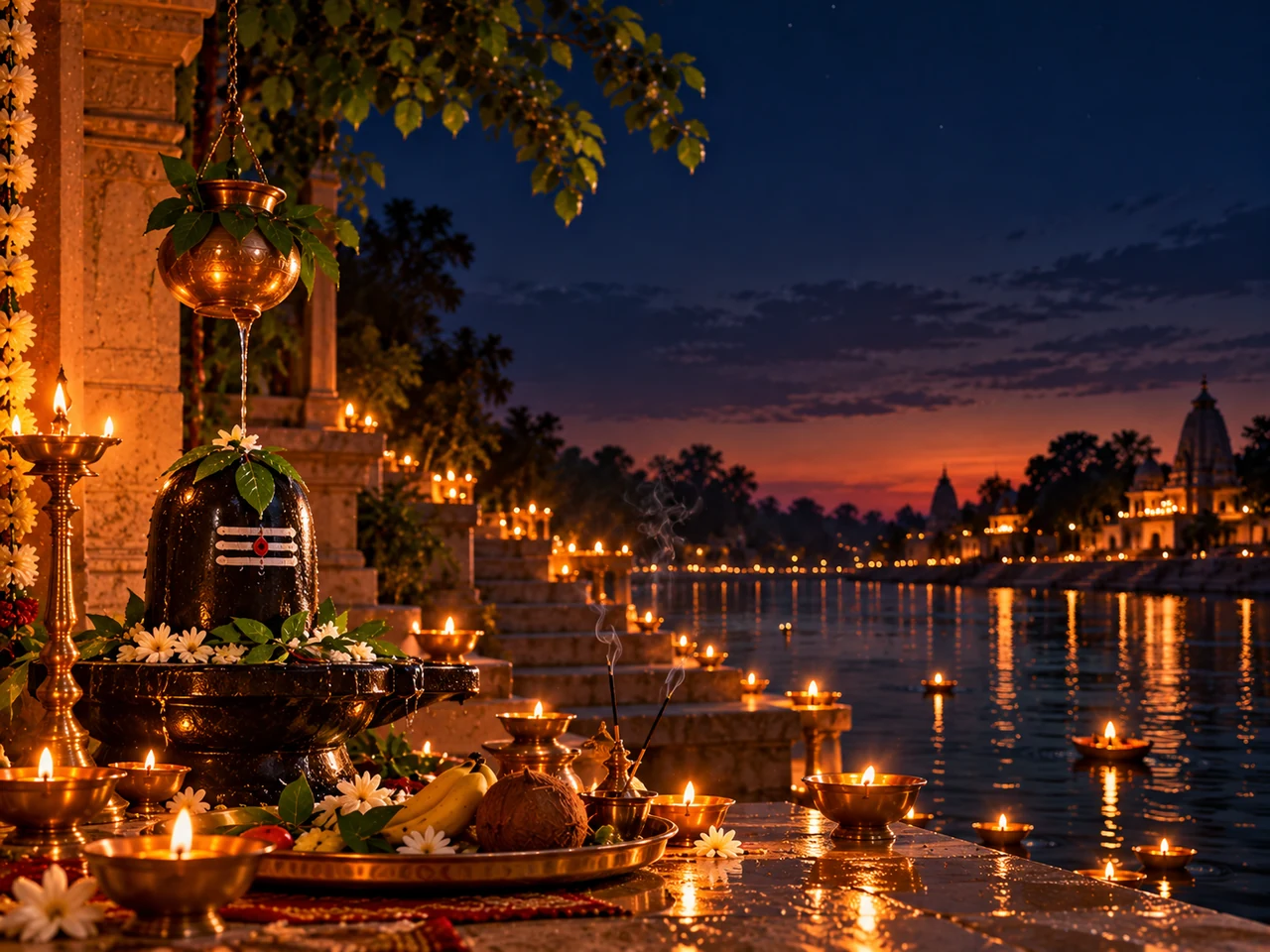
Some observances are marked by what appears in the sky; Amavasya asks us to notice what is not visible. On a clear full-moon night the Moon attracts attention. Around the astronomical new moon, its bright face is turned away from Earth. In Hindu homes, however, this quieter point of the lunar cycle may be filled with remembrance, prayer, an act of generosity or a visit to a sacred river. The meaning depends on the family, region and particular Amavasya. 1, 2
Amavasya is the final tithi of Krishna Paksha, the waning fortnight. It returns in every lunar cycle; it is not the name of one festival held only once a year. Many families associate it with pitṛ-smaraṇa—remembering departed elders—and, where inherited practice calls for it, tarpana and śrāddha. Others observe a Monday Amavasya, a special seasonal Amavasya or an Amavasya connected with a deity or local pilgrimage. These are overlapping traditions, not a universal set of obligations. 2, 3
What does Amavasya mean?
The Sanskrit name AmavasyaAmāvāsyā is conventionally rendered “new moon” in Hindu calendrical usage. It identifies a tithi: a lunar day calculated from the changing angular relationship between the Sun and Moon. Unlike a civil day, a tithi may start or finish between two sunrises. For readers, the essential distinction is that Amavasya tithi, an astronomical moment of new moon, and an assigned festival date are three different pieces of information. 1, 2
The term Krishna Paksha means the darker or waning half of a lunar month, ending with Amavasya. Shukla Paksha begins thereafter with the waxing fortnight. In an Amanta calendar, the lunar month concludes at Amavasya; a Purnimanta calendar places its month boundary at Purnima. Thus the same Amavasya can have different month names in different regional calendars without being a different phase of the Moon. This is especially important when looking up a named Amavasya across India. 2
Why is there no visible new moon?
NASA explains that at new moon the sunlit side faces mainly away from an observer on Earth, so the Moon is not ordinarily visible. New moon is not a narrow illuminated crescent and is not a lunar eclipse. An eclipse needs an additional orbital alignment and does not accompany every Amavasya. Descriptions of a crescent, full moon and dark new moon must not be mixed when explaining the cycle or choosing illustration art. 1
This is a scientific description of lunar illumination. It does not, by itself, determine which civil day should be selected for an ancestor rite or a regional festival.
Why is Amavasya important in Hindu life?
For many Hindu families, Amavasya creates a recurring opportunity to remember people who came before them. A name recalled, food shared, a prayer, or service to someone in need can express continuity between generations. In households observing formal ancestral rites, the day may be associated with offerings made with water or food, according to family paramparā (transmitted practice). 3, 4
The key idea is gratitude, rather than fear of a dark sky. Devotional teaching may speak of the ancestors’ blessings or spiritual satisfaction; those are religious beliefs, not laboratory-established consequences of a rite. Likewise, popular warnings that every new moon is “inauspicious” flatten traditions that also regard some Amavasyas as significant for worship, pilgrimage, charity and new beginnings.
Amavasya is not owned by one single deity. Some communities emphasize ancestor-related observances; others worship Shiva, a regional goddess, Vishnu, Shani or a family deity. A deity’s association with one particular Amavasya should not be represented as the meaning of every monthly Amavasya. 5, 7
Ancestor remembrance: tarpan, shraddha and pind daan
Three words often appear together, but they are not interchangeable:
- Tarpana (तर्पण): a traditional liquid offering, often associated with water and remembrance of ancestors; precise recitations and eligibility vary by lineage.
- Śrāddha (श्राद्ध): a wider set of ancestral remembrance or memorial observances performed according to family and ritual tradition.
- Piṇḍa-dāna (पिण्डदान): ritual offering of food portions in particular ancestral-rite systems; it is not automatically a requirement for every family on every new moon.
The Ministry of Tourism’s descriptions of Mahalaya and the calendar-reference material on Amavasya Shraddha document the association between the new-moon tithi and ancestral observances. They do not establish a universal one-page ritual recipe. Formal observances can be sensitive to bereavement practices, family lineage and officiant guidance. This article therefore explains terms without prescribing private mantras, an initiation-dependent ceremony or an obligatory procedure. 3, 4, 8
A meaningful practice need not look identical in every home
One household may invite a priest to conduct a rite. Another may prepare a meal in memory of an elder; someone living far from home may quietly reflect, make a charitable contribution, or call an older family member. These everyday gestures should not be advertised as technically identical to a formal śrāddha, but neither should a person be told that the only possible expression of remembrance is a complex ceremony. Local customs and family guidance determine the relevant choice.
If a family is grieving, religious customs surrounding the immediate period after death may be different from ordinary monthly Amavasya practices. A general educational article cannot replace that family-specific guidance.
Is every Amavasya the same as Sarva Pitru Amavasya?
No. Monthly Amavasya recurs throughout the lunar year; Sarva Pitru Amavasya, also called Mahalaya Amavasya, is a particular annual observance at the conclusion of Pitru Paksha in many North Indian and related calendars. It is especially associated with remembrance when a relative’s individual death tithi is unknown or when a family completes its annual ancestral rites. The religious claims around those actions are attributed to tradition. 3, 4
Mahalaya is also culturally significant in West Bengal, where ancestor-related tarpan is associated with the threshold of the Durga Puja season. Government event descriptions document this dual context of remembering forebears and welcoming the Goddess; a Bengali Mahalaya observance must not be assumed to be a rule for each monthly new moon or an exact description of all Durga Puja calendars. 8
This distinction matters on the website. The monthly Amavasya knowledge article should link to Pitru Paksha/Mahalaya as a named observance, if and when a verified dedicated article exists, rather than copying its once-yearly rites into all twelve or thirteen monthly entries.
Somvati and Shani Amavasya: weekday-associated names
When a selected new-moon observance falls on a Monday, it is commonly called Somvati Amavasya; on a Saturday, Shani Amavasya. These are special names associated with a weekday relationship, not two new lunar tithis. The precise weekday-selection rule still needs to be approved before a calendar engine can label a date automatically. 2
Northern pilgrimage traditions give Somvati Amavasya considerable importance. Kurukshetra’s district government names the occasion among its important pilgrim bathing days; Haridwar tourism descriptions also include it among the city’s major bathing observances. Bathing, vows, gifts and worship may be important to devotees, but no article should promise guaranteed relief from misfortune or attribute medically measurable benefits to a ritual. 6
In Maharashtra, the Maharashtra tourism department documents Khandoba Jatra at Jejuri in association with Somvati Amavasya. Khandoba is identified in that living regional tradition with Shiva, and the celebration includes distinctive temple, procession and turmeric practices. This is a meaningful Shiva-related link for ShivGoraksh—but the Jejuri rite is a regional event, not the standard format of Amavasya everywhere. 5
North India: rivers, remembrance and Mauni Amavasya
At places such as Kurukshetra and Haridwar, certain Amavasyas are associated with pilgrimage bathing and prayers. Mauni Amavasya, connected with the Magha sacred-bathing season, has particular importance at Prayagraj and Chitrakoot. The official Chitrakoot festival description links Mauni Amavasya with bathing in the Mandakini and pilgrimage around Kamadgiri/Kamtanath. These are named seasonal traditions, not obligations for every Amavasya. 6, 9
Mauna means silence. Some devotees associate Mauni Amavasya with a vow of quiet reflection, but its form, duration and suitability depend on their own tradition. Silence is best understood here as a devotional practice, not a mandated medical or psychological treatment.
Rajasthan: Hariyali Amavasya
In the Udaipur region, Hariyali Amavasya has a community character shaped by the monsoon: fairs, swings, handicrafts, local food and a celebration of greenery. An official India Tourism festival entry identifies the public fair at Fateh Sagar and Saheliyon ki Bari and connects contemporary celebration with tree planting and environmental themes. It is an excellent example of an Amavasya that is not reducible to ancestor rites. 10
West Bengal: Mahalaya and the coming of Durga
Bengali Mahalaya brings ancestral remembrance into conversation with the emotional approach to Durga Puja. The familiar cultural soundscape of devotional recitation belongs to a local public memory as well as family ritual. The government festival listing specifically records tarpan and invocation of the Goddess; it does not prove that a single ancient verse contains every modern broadcast or ceremony. 8
Tamil Nadu: Amavasai and the remembrance of forebears
The Tamil form Amavasai is widely used in discussions of ancestor-related rites. Seasonal names such as Aadi Amavasai, Thai Amavasai and Mahalaya Amavasai are heard in Tamil communities. An official Indian festival record for Mahalaya Ammavasai Tharpanam in Tiruchirappalli documents the ancestral-remembrance context. The details of Aadi or Thai ceremonies at an individual temple or pilgrimage site need separate source verification before precise local instructions can be written. 7
The Tamil solar-month names Aadi and Thai should not be silently translated into a North Indian Purnimanta lunar-month label. They belong to a distinct regional calendrical context.
Nepal: Kushe Aunsi and honouring fathers
Nepal’s Tourism Board describes Kushe Aunsi / Gokarna Aunsi as a day to honour fathers, when families visit living fathers and some people undertake remembrance rites for deceased fathers at Gokarna. It also records a Shiva shrine at Gokarna as part of the observance. This is not simply another name for every Indian monthly Amavasya: it is a named Nepali lunar occasion with its own cultural content and date-selection questions. 11
Amavasya and Diwali: why the festival’s darkness matters
The familiar Diwali lights are often understood against the new-moon night. In widely observed North Indian traditions, the central Lakshmi Puja of Diwali is associated with the Kartika Amavasya period, though the corresponding lunar-month name can differ in Amanta regional practice. The evening worship rule, its local sunset interval and its applicable tradition must be reviewed separately from a monthly Amavasya/Shraddha calendar. Being an Amavasya does not itself make a day Diwali. 2
Likewise, some Shakta communities have a distinct Kali Puja on the Diwali-period new moon. It is one of the clearest reminders that a single tithi can host several related yet nonidentical ritual traditions. Shiva and Shakti devotees should encounter these connections without any claim that all Hindus perform the same night worship.
What happens in a household on an ordinary Amavasya?
There is no universal checklist. Some families rise early, bathe, tidy a worship place, remember ancestors, offer a simple prayer, cook traditional food or set aside a contribution for people in need. Others visit a temple, perform a family-established rite, or continue ordinary life without a special formal observance. What is significant in one household may not be required in another. 2, 3
If you participate in a temple or riverbank ceremony, follow the temple’s legitimate local guidance, do not litter or leave offerings that pollute water, and choose safe bathing conditions. When describing fasting, it is enough to say that some households observe dietary restrictions while others do not. Anyone for whom fasting would be unsafe can participate through prayer or remembrance without pressure to adopt another person’s dietary practice.
What should be offered—and what should not be invented?
Food, water, flowers, lamps or charitable meals can be meaningful in many traditions. Their exact form is custom-dependent. A public information page should not prescribe a single tarpana mantra, number of offerings, directional posture or rule of ritual eligibility without a sourced tradition and expert review. Nor should it imply that a lamp or donation guarantees freedom from illness, debt, bad luck or ancestral displeasure.
A thoughtful approach is to distinguish public learning from ritual authority. The first can explain why something matters; the second may require a family elder, qualified practitioner or temple specialist. ShivGoraksh’s intended knowledge article serves the first purpose.
Does Amavasya mean an unlucky day?
Not universally. In certain household decision-making systems, people avoid particular beginnings on a new-moon day; in other settings the very same tithi is welcomed for a deity’s worship, pilgrimage, remembrance or charity. Even the idea of an “auspicious day” is better presented as a tradition-specific judgment, not a prediction of outcomes. A dark Moon is a normal astronomical phase, not evidence of danger. 1, 5
Amavasya and Purnima also have distinct emotional associations. Purnima can evoke fullness and public celebration; Amavasya may invite inward attention or ancestral memory. But there is no rule that one is spiritually “better” or that every family must divide its religious life in this way.
When is the next Amavasya?
Amavasya returns every synodic lunar cycle, roughly once in each lunar month. The exact local civil date and the beginning/end of its tithi require reviewed astronomical inputs, a named calendar convention and the selected city/timezone. NASA’s instant of astronomical new moon is useful scientific context, but it is not a validated Hindu observance date. 1, 2
A trustworthy calendar should distinguish the tithi interval from the selected date of monthly Amavasya, Darsha or ancestor rites, Somvati Amavasya, Mahalaya Shraddha and Diwali Lakshmi Puja. Sources such as Drik Panchang show that even their Darsha and named Amavasya labels need not always occupy the same displayed civil date. No fixed fasting, worship or śrāddha time can be assumed for every region. 2, 3
ShivGoraksh calendar notice: Date/timing not yet verified for this city/year. A reviewed occurrence will be shown separately when available.
Understanding the calendar without confusion
| Question | Careful answer |
|---|---|
| Is Amavasya one day every year? | No. It is a recurring lunar tithi, usually associated with each lunar month. |
| Is the astronomical new moon the same as an Amavasya fasting date? | No. A phase instant and a ritual-selected local civil day are different fields. |
| Is every Amavasya Mahalaya? | No. Mahalaya/Sarva Pitru Amavasya is a named annual observance. |
| Are all Amavasya rites for ancestors? | No. Worship of deities, pilgrimages and seasonal community festivals also occur. |
| Is Monday Amavasya always the same festival as Diwali? | No. Somvati is a weekday association; Diwali has separate annual rules. |
| Do all regions use the same month name? | No. Amanta, Purnimanta and regional solar-month conventions can differ. |