Text, Meaning & Explanation
जनक जननि पद कमल रज, निज मस्तक पर धारि।
बन्दौं मातु सरस्वती, बुद्धि बल दे दातारि॥
Roman Hindijanaka janani pada kamala raja, nija mastaka para dhaari|
bandaum maatu saraswati, buddhi bala de daataari||janaka janani pada kamala raja, nija mastaka para dhāri|
bandauṃ mātu sarasvatī, buddhi bala de dātāri||
Meaning
I bow with reverence and ask Mother Saraswati, giver of intelligence and strength, for her blessing.
Explanation
Calling for wisdom after saluting one’s parents expresses gratitude as the ground of learning; it does not prescribe a compulsory rite.
पूर्ण जगत में व्याप्त तव, महिमा अमित अनंतु।
रामसागर के पाप को, मातु तुही अब हन्तु॥
Roman Hindipoorna jagata mem vyaapta tava, mahimaa amita anamtu|
raamasaagara ke paapa ko, maatu tuhee aba hantu||pūrṇa jagata meṃ vyāpta tava, mahimā amita anaṃtu|
rāmasāgara ke pāpa ko, mātu tuhī aba hantu||
Meaning
Your greatness fills the world; the speaker asks you to remove the moral darkness associated with Ram Sagar.
Explanation
“Ram Sagar” appears in this reading and again at the end, but a name inside a poem alone cannot confirm the author’s identity or date.
जय श्री सकल बुद्धि बलरासी।
जय सर्वज्ञ अमर अविनासी॥
Roman Hindijaya shree sakala buddhi balaraasee|
jaya sarvajna amara avinaasee||jaya śrī sakala buddhi balarāsī|
jaya sarvajña amara avināsī||
Meaning
Victory to the inexhaustible source of wisdom and strength, all-knowing and imperishable.
Explanation
Wisdom here includes discernment and responsible action, not merely remembering facts.
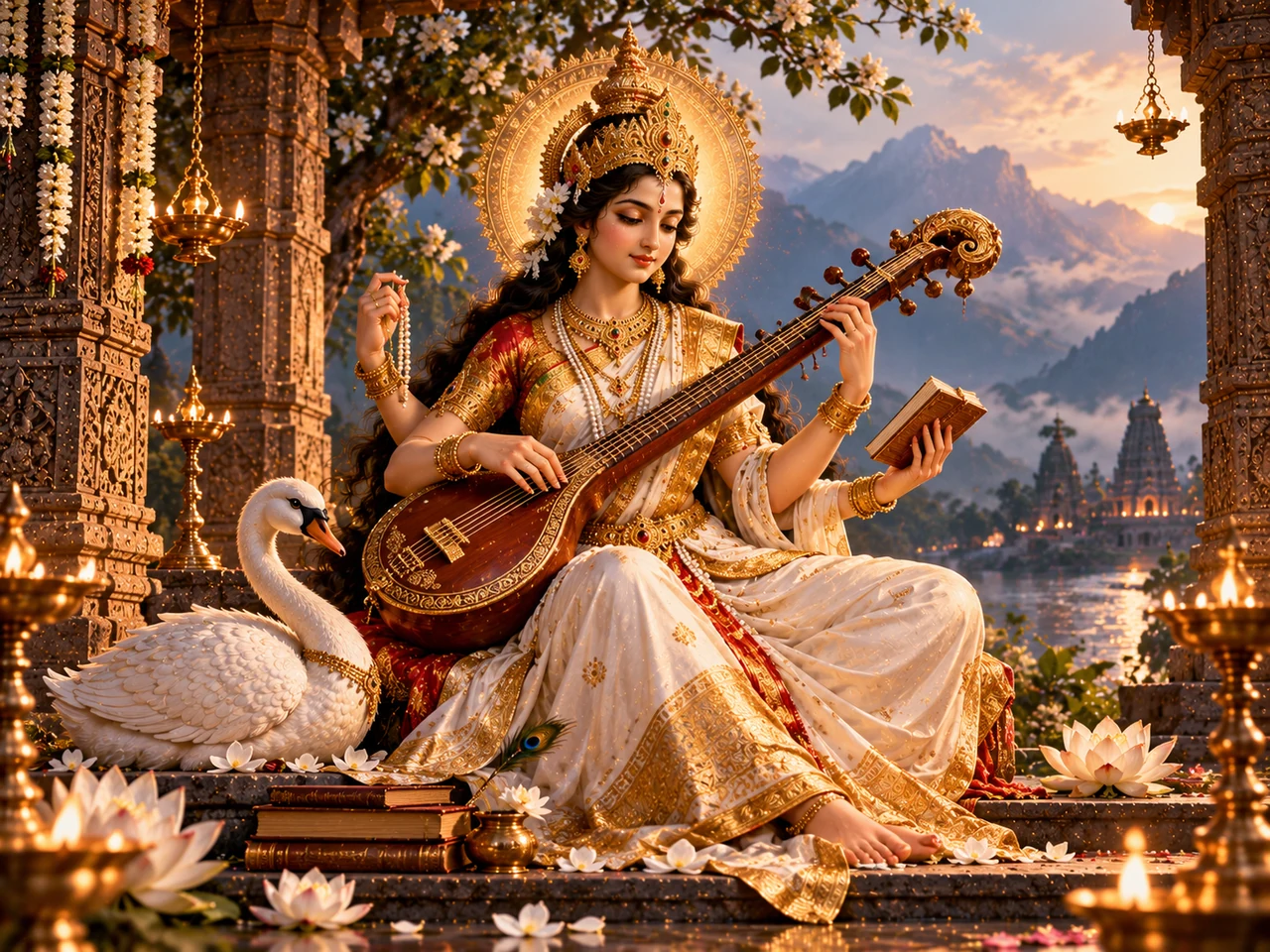
जय जय जय वीणाकर धारी।
करती सदा सुहंस सवारी॥
Roman Hindijaya jaya jaya veenaakara dhaaree|
karatee sadaa suhamsa savaaree||jaya jaya jaya vīṇākara dhārī|
karatī sadā suhaṃsa savārī||
Meaning
Praise to the goddess who holds the veena and rides the graceful swan.
Explanation
The veena is a traditional sign of music and measured expression; the hamsa is often read as discrimination between what helps and harms.
रूप चतुर्भुजधारी माता।
सकल विश्व अन्दर विख्याता॥
Roman Hindiroopa chaturbhujadhaaree maataa|
sakala vishva andara vikhyaataa||rūpa caturbhujadhārī mātā|
sakala viśva andara vikhyātā||
Meaning
Mother appears in a four-armed form renowned throughout the world.
Explanation
Four arms belong to one prominent iconographic convention, though Saraswati images vary by region and period.
जग में पाप बुद्धि जब होती।
जबहि धर्म की फीकी ज्योती॥
Roman Hindijaga mem paapa buddhi jaba hotee|
jabahi dharma kee pheekee jyotee||jaga meṃ pāpa buddhi jaba hotī|
jabahi dharma kī phīkī jyotī||
Meaning
When harmful thinking spreads, the light of dharma grows faint.
Explanation
Rather than assigning blame to any group, this couplet invites reflection on ethical confusion and weakened judgment.
तबहि मातु ले निज अवतारा।
पाप हीन करती महि तारा॥
Roman Hinditabahi maatu le nija avataaraa|
paapa heena karatee mahi taaraa||tabahi mātu le nija avatārā|
pāpa hīna karatī mahi tārā||
Meaning
The Mother manifests to relieve the world of wrongdoing.
Explanation
Such manifestations belong to the poem’s devotional universe; they are not dated historical reports.
बाल्मीकि जी थे हत्यारा।
तव प्रसाद जानै संसारा॥
Roman Hindibaalmeeki jee the hatyaaraa|
tava prasaada jaanai samsaaraa||bālmīki jī the hatyārā|
tava prasāda jānai saṃsārā||
Meaning
The hymn describes Valmiki as formerly a killer, then celebrates the grace through which he became known to the world.
Explanation
This is the wording of the licensed witness, not the earlier great-scholar reading. It evokes the devotional story of Valmiki’s transformation; it is not independent historical evidence.
रामायण जो रचे बनाई।
आदि कवि की पदवी पाई॥
Roman Hindiraamaayana jo rache banaaee|
aadi kavi kee padavee paaee||rāmāyaṇa jo race banāī|
ādi kavi kī padavī pāī||
Meaning
Valmiki creates the Ramayana and is celebrated as the first poet.
Explanation
The title Adikavi traditionally honours Valmiki; the Ramayana’s textual history is a separate scholarly question.
कालिदास जो भये विख्याता।
तेरी कृपा दृष्टि से माता॥
Roman Hindikaalidaasa jo bhaye vikhyaataa|
teree kripaa drishti se maataa||kālidāsa jo bhaye vikhyātā|
terī kṛpā dṛṣṭi se mātā||
Meaning
Kalidasa, the celebrated poet, is also understood as a beneficiary of her grace.
Explanation
Kalidasa’s talent is being celebrated devotionally. The composition supplies no historical evidence of his personal worship.
तुलसी सूर आदि विद्वाना।
भये और जो ज्ञानी नाना॥
Roman Hinditulasee soora aadi vidvaanaa|
bhaye aura jo jnaanee naanaa||tulasī sūra ādi vidvānā|
bhaye aura jo jñānī nānā||
Meaning
Poets such as Tulsidas and Surdas, and many other learned persons, are remembered.
Explanation
Tulsidas and Surdas exemplify literary devotion, not a single documented line of initiation.
तिन्हहिं न और रहेउ अवलम्बा।
केवल कृपा आपकी अम्बा॥
Roman Hinditinhahim na aura raheu avalambaa|
kevala kripaa aapakee ambaa||tinhahiṃ na aura raheu avalambā|
kevala kṛpā āpakī ambā||
Meaning
The poet says that these seekers relied on the Mother’s compassion.
Explanation
The central theme is dependence on grace combined with human effort and study.
करहु कृपा सोइ मातु भवानी।
दुखित दीन निज दासहि जानी॥
Roman Hindikarahu kripaa soi maatu bhavaanee|
dukhita deena nija daasahi jaanee||karahu kṛpā soi mātu bhavānī|
dukhita dīna nija dāsahi jānī||
Meaning
Mother Bhavani is asked to recognize her afflicted devotee and show compassion.
Explanation
The name Bhavani links Saraswati devotion with a broader Shakta vision without erasing distinctions between goddesses.
पुत्र करै अपराध बहूता।
तेहि न धरइ चित सुन्दर माता॥
Roman Hindiputra karai aparaadha bahootaa|
tehi na dharai chita sundara maataa||putra karai aparādha bahūtā|
tehi na dharai cita sundara mātā||
Meaning
Just as a loving mother forgives a child, the goddess is asked not to dwell upon faults.
Explanation
The mother–child analogy supports honest self-correction and compassion, not avoidance of accountability.
राखु लाज जननी अब मेरी।
विनय करूं बहु भाँति घनेरी॥
Roman Hindiraakhu laaja jananee aba meree|
vinaya karoom bahu bhaam̐ti ghaneree||rākhu lāja jananī aba merī|
vinaya karūṃ bahu bhām̐ti ghanerī||
Meaning
The devotee repeatedly pleads for the Mother to protect their dignity.
Explanation
“Keeping honour” means preserving dignity through learning from mistakes and asking for help.
मैं अनाथ तेरी अवलंबा।
कृपा करउ जय जय जगदंबा॥
Roman Hindimaim anaatha teree avalambaa|
kripaa karau jaya jaya jagadambaa||maiṃ anātha terī avalaṃbā|
kṛpā karau jaya jaya jagadaṃbā||
Meaning
Feeling unsupported, the speaker takes refuge in Jagadamba.
Explanation
Refuge imagery expresses spiritual belonging at a time of vulnerability.
मधु कैटभ जो अति बलवाना।
बाहुयुद्ध विष्णु ते ठाना॥
Roman Hindimadhu kaitabha jo ati balavaanaa|
baahuyuddha vishnu te thaanaa||madhu kaiṭabha jo ati balavānā|
bāhuyuddha viṣṇu te ṭhānā||
Meaning
The mighty Madhu and Kaitabha challenged Vishnu in battle.
Explanation
The Madhu–Kaitabha story belongs to the wider Devi–Vishnu mythic cycle; see the Devi Mahatmyam (Durga Saptashati) rather than treating this as verbatim scripture.
समर हजार पांच में घोरा।
फिर भी मुख उनसे नहिं मोरा॥
Roman Hindisamara hajaara paamcha mem ghoraa|
phira bhee mukha unase nahim moraa||samara hajāra pāṃca meṃ ghorā|
phira bhī mukha unase nahiṃ morā||
Meaning
The battle is described as lasting a mythically immense span without yielding.
Explanation
Numerical duration here is a feature of sacred narrative and cannot be used to date a historical battle.
मातु सहाय भई तेहि काला।
बुद्धि विपरीत करी खलहाला॥
Roman Hindimaatu sahaaya bhaee tehi kaalaa|
buddhi vipareeta karee khalahaalaa||mātu sahāya bhaī tehi kālā|
buddhi viparīta karī khalahālā||
Meaning
At that moment the goddess intervenes and confounds the adversaries’ judgment.
Explanation
Devi’s power is presented as influencing circumstances and discernment; different texts narrate the episode in different ways.
तेहि ते मृत्यु भई खल केरी।
पुरवहु मातु मनोरथ मेरी॥
Roman Hinditehi te mrityu bhaee khala keree|
puravahu maatu manoratha meree||tehi te mṛtyu bhaī khala kerī|
puravahu mātu manoratha merī||
Meaning
The adversaries are defeated; the poet renews a humble personal petition.
Explanation
The hymn returns from cosmic narrative to intimate prayer, illustrating the movement from praise to supplication.
चंड मुण्ड जो थे विख्याता।
छण महुं संहारेउ तेहि माता॥
Roman Hindichamda munda jo the vikhyaataa|
chhana mahum samhaareu tehi maataa||caṃḍa muṇḍa jo the vikhyātā|
chaṇa mahuṃ saṃhāreu tehi mātā||
Meaning
The goddess is praised for defeating Chanda and Munda.
Explanation
Chanda and Munda are central to Shakta victory narratives, where the goddess protects cosmic order.
रक्तबीज से समरथ पापी।
सुर-मुनि हृदय धरा सब कांपी॥
Roman Hindiraktabeeja se samaratha paapee|
sura-muni hridaya dharaa saba kaampee||raktabīja se samaratha pāpī|
sura-muni hṛdaya dharā saba kāṃpī||
Meaning
Raktabija terrifies gods and sages through his destructive power.
Explanation
Raktabija’s multiplying blood is a mythic image of troubles that become more difficult when met unskillfully.
काटेउ सिर जिम कदली खम्बा।
बार बार बिनवउं जगदंबा॥
Roman Hindikaateu sira jima kadalee khambaa|
baara baara binavaum jagadambaa||kāṭeu sira jima kadalī khambā|
bāra bāra binavauṃ jagadaṃbā||
Meaning
The goddess overcomes the demon as easily as felling a plantain trunk; the devotee bows repeatedly.
Explanation
The banana-trunk simile portrays decisiveness; it should not be generalized into advice about violence.
जग प्रसिद्ध जो शुंभ निशुंभा।
छिन में बधे ताहि तू अम्बा॥
Roman Hindijaga prasiddha jo shumbha nishumbhaa|
chhina mem badhe taahi too ambaa||jaga prasiddha jo śuṃbha niśuṃbhā|
china meṃ badhe tāhi tū ambā||
Meaning
The goddess swiftly defeats Shumbha and Nishumbha in the hymn’s retelling.
Explanation
The composition gathers several Devi Mahatmyam (Durga Saptashati) figures within one praise hymn; keep that source distinct.
भरत-मातु बुधि फेरेउ जाई।
रामचन्द्र बनवास कराई॥
Roman Hindibharata-maatu budhi phereu jaaee|
raamachandra banavaasa karaaee||bharata-mātu budhi phereu jāī|
rāmacandra banavāsa karāī||
Meaning
The poem credits the Mother’s cosmic power with the turning of Kaikeyi’s mind and Rama’s exile.
Explanation
Assigning Kaikeyi’s choice to divine agency is one devotional reading, not a universally accepted causal interpretation of the Ramayana.
एहि विधि रावन वध तुम कीन्हा।
सुर नर मुनि सब कहुं सुख दीन्हा॥
Roman Hindiehi vidhi raavana vadha tuma keenhaa|
sura nara muni saba kahum sukha deenhaa||ehi vidhi rāvana vadha tuma kīnhā|
sura nara muni saba kahuṃ sukha dīnhā||
Meaning
The story then credits that providential chain with Ravana’s defeat and general relief.
Explanation
The poet reads the difficult exile as part of a larger providential story; human moral responsibility remains a separate question.
को समरथ तव यश गुन गाना।
निगम अनादि अनंत बखाना॥
Roman Hindiko samaratha tava yasha guna gaanaa|
nigama anaadi anamta bakhaanaa||ko samaratha tava yaśa guna gānā|
nigama anādi anaṃta bakhānā||
Meaning
No one can fully recount her glory; even scriptures speak of boundless praise.
Explanation
The imagery resists the idea that any one short hymn can exhaust the divine.
विष्णु रूद्र अज सकहिं न मारी।
जिनकी हो तुम रक्षाकारी॥
Roman Hindivishnu roodra aja sakahim na maaree|
jinakee ho tuma rakshaakaaree||viṣṇu rūdra aja sakahiṃ na mārī|
jinakī ho tuma rakṣākārī||
Meaning
Those protected by the goddess are beyond the reach of hostile powers, the poet declares.
Explanation
This describes the devotee’s trust and should not be stated as a testable guarantee of physical safety.
रक्त दन्तिका और शताक्षी।
नाम अपार है दानव भक्षी॥
Roman Hindirakta dantikaa aura shataakshee|
naama apaara hai daanava bhakshee||rakta dantikā aura śatākṣī|
nāma apāra hai dānava bhakṣī||
Meaning
The names Raktadantika and Shatakshi indicate fierce and compassionate manifestations.
Explanation
Shatakshi is “hundred-eyed” and Raktadantika “red-toothed”; the Devi Mahatmyam (Durga Saptashati)’s later chapters explain associated forms.
दुर्गम काज धरा पर कीन्हा।
दुर्गा नाम सकल जग लीन्हा॥
Roman Hindidurgama kaaja dharaa para keenhaa|
durga naama sakala jaga leenhaa||durgama kāja dharā para kīnhā|
durgā nāma sakala jaga līnhā||
Meaning
The goddess completes the difficult task involving Durgama, celebrated through the name Durga.
Explanation
The Durgama episode is associated with the Devi’s nourishing and protective manifestations in Shakta literature.
दुर्ग आदि हरनी तू माता।
कृपा करहु जब जब सुखदाता॥
Roman Hindidurga aadi haranee too maataa|
kripaa karahu jaba jaba sukhadaataa||durga ādi haranī tū mātā|
kṛpā karahu jaba jaba sukhadātā||
Meaning
Mother removes difficulties and is asked repeatedly to grant kindness.
Explanation
“Durga” resonates with crossing difficulties, though the exact etymology must not be reduced to one folk derivation.
नृप कोपित जो मारन चाहै।
कानन में घेरे मृग नाहै॥
Roman Hindinripa kopita jo maarana chaahai|
kaanana mem ghere mriga naahai||nṛpa kopita jo mārana cāhai|
kānana meṃ ghere mṛga nāhai||
Meaning
The devotee seeks refuge even when threatened by a ruler or wild animals.
Explanation
These are examples of fear that make the prayer relatable; practical steps still matter when facing threats.
सागर मध्य पोत के भंगे।
अति तूफान नहिं कोऊ संगे॥
Roman Hindisaagara madhya pota ke bhamge|
ati toophaana nahim kooo samge||sāgara madhya pota ke bhaṃge|
ati tūphāna nahiṃ koū saṃge||
Meaning
The devotee seeks safety in the image of a broken boat amid a stormy sea.
Explanation
The storm-tossed boat represents fragility and uncertainty; metaphor is distinct from a promise against maritime danger.
भूत प्रेत बाधा या दुःख में।
हो दरिद्र अथवा संकट में॥
Roman Hindibhoota preta baadhaa yaa duhkha mem|
ho daridra athavaa samkata mem||bhūta preta bādhā yā duḥkha meṃ|
ho daridra athavā saṃkaṭa meṃ||
Meaning
The hymn addresses fear, misfortune, poverty and unseen affliction.
Explanation
The poem’s spiritual vocabulary should not be used to diagnose mental illness or replace medical assistance.
नाम जपे मंगल सब होई।
संशय इसमें करइ न कोई॥
Roman Hindinaama jape mamgala saba hoee|
samshaya isamem karai na koee||nāma jape maṃgala saba hoī|
saṃśaya isameṃ karai na koī||
Meaning
The poet expresses confidence that remembrance of the Mother brings auspiciousness.
Explanation
Confidence and repetition can comfort devotees, but outcomes cannot be promised as inevitable.
पुत्रहीन जो आतुर भाई।
सबै छांड़ि पूजें एहि माई॥
Roman Hindiputraheena jo aatura bhaaee|
sabai chaamrii poojem ehi maaee||putrahīna jo ātura bhāī|
sabai chāṃṛi pūjeṃ ehi māī||
Meaning
The text invites a person distressed by childlessness to turn to the Mother.
Explanation
Childlessness can be deeply painful; the verse should be read without blaming people who cannot or do not have children.
करै पाठ नित यह चालीसा।
होय पुत्र सुन्दर गुण ईसा॥
Roman Hindikarai paatha nita yaha chaaleesaa|
hoya putra sundara guna eesaa||karai pāṭha nita yaha cālīsā|
hoya putra sundara guṇa īsā||
Meaning
It promises a virtuous child to the person who recites this Chalisa faithfully.
Explanation
A devotional blessing is not a fertility treatment or guaranteed prediction.
धूपादिक नैवेद्य चढावै।
संकट रहित अवश्य हो जावै॥
Roman Hindidhoopaadika naivedya chadhaavai|
samkata rahita avashya ho jaavai||dhūpādika naivedya caḍhāvai|
saṃkaṭa rahita avaśya ho jāvai||
Meaning
Offerings and remembrance are poetically linked to relief from distress.
Explanation
Offerings can symbolize gratitude, but the text does not oblige readers to perform any specialized procedure.
भक्ति मातु की करै हमेशा।
निकट न आवै ताहि कलेशा॥
Roman Hindibhakti maatu kee karai hameshaa|
nikata na aavai taahi kaleshaa||bhakti mātu kī karai hameśā|
nikaṭa na āvai tāhi kaleśā||
Meaning
Continual devotion to the Mother is described as a refuge from suffering.
Explanation
The verse describes a relationship of trust rather than a mechanism producing guaranteed results.
बंदी पाठ करें शत बारा।
बंदी पाश दूर हो सारा॥
Roman Hindibamdee paatha karem shata baaraa|
bamdee paasha doora ho saaraa||baṃdī pāṭha kareṃ śata bārā|
baṃdī pāśa dūra ho sārā||
Meaning
Repeated recitation is said to loosen the bonds of captivity.
Explanation
Bondage might be understood literally in the poetry or spiritually as restriction and suffering; do not promise legal release.
करहु कृपा भवमुक्ति भवानी।
मो कहं दास सदा निज जानी॥
Roman Hindikarahu kripaa bhavamukti bhavaanee|
mo kaham daasa sadaa nija jaanee||karahu kṛpā bhavamukti bhavānī|
mo kahaṃ dāsa sadā nija jānī||
Meaning
The speaker asks Bhavani to grant freedom from worldly bondage and accept the devotee.
Explanation
Moksha is the spiritual liberation sought here; traditions differ on its philosophical understanding.
माता सूरज कान्ति तव, अंधकार मम रूप।
डूबन ते रक्षा करहु, परूं न मैं भव-कूप॥
Roman Hindimaataa sooraja kaanti tava, amdhakaara mama roopa|
doobana te rakshaa karahu, paroom na maim bhava-koopa||mātā sūraja kānti tava, aṃdhakāra mama rūpa|
ḍūbana te rakṣā karahu, parūṃ na maiṃ bhava-kūpa||
Meaning
Your radiance is like the sun, Mother, while I feel surrounded by darkness; save me from drowning in worldly existence.
Explanation
The contrast between solar light and inner darkness symbolizes knowledge dispelling confusion.
बल बुद्धि विद्या देहुं मोहि, सुनहु सरस्वति मातु।
अधम रामसागरहिं तुम, आश्रय देउ पुनातु॥
Roman Hindibala buddhi vidyaa dehum mohi, sunahu sarasvati maatu|
adhama raamasaagarahim tuma, aashraya deu punaatu||bala buddhi vidyā dehuṃ mohi, sunahu sarasvati mātu|
adhama rāmasāgarahiṃ tuma, āśraya deu punātu||
Meaning
Ram Sagar, identifying himself humbly, asks for strength, intelligence, learning and refuge.
Explanation
The closing signature is textual evidence for the name “Ram Sagar,” not proof of a dated literary biography.
Context & Usage
Context and edition
This is a separately versioned traditional-text presentation based on hindu-devotional-texts 0.8.0 under MIT. It is not identical to the earlier manuscript edition. It preserves the selected edition’s actual 43 reading units. Roman text is an orthographic IAST rendering of the supplied Devanagari, retaining written inherent vowels; spoken Hindi schwa deletion may differ. Independent linguistic and prosody review remains incomplete.
Usage notes
Read as devotional poetry. No initiation, ritual qualification, guaranteed health, wealth or prescribed fire practice is conferred. For the traditional witnesses, names, narrative imagery and recitation claims remain the voice of that particular hymn.
Sources, Credits & Licensing
Founder-authorized educational edition. Independent textual and specialist review remains incomplete; this reading does not confer initiation or ritual authorization.
MIT License
Copyright (c) 2026 Ishank Gupta and contributors to hindu-devotional-texts
Permission is hereby granted, free of charge, to any person obtaining a copy
of this software and associated documentation files (the "Software"), to deal
in the Software without restriction, including without limitation the rights
to use, copy, modify, merge, publish, distribute, sublicense, and/or sell
copies of the Software, and to permit persons to whom the Software is
furnished to do so, subject to the following conditions:
The above copyright notice and this permission notice shall be included in all
copies or substantial portions of the Software.
THE SOFTWARE IS PROVIDED "AS IS", WITHOUT WARRANTY OF ANY KIND, EXPRESS OR
IMPLIED, INCLUDING BUT NOT LIMITED TO THE WARRANTIES OF MERCHANTABILITY,
FITNESS FOR A PARTICULAR PURPOSE AND NONINFRINGEMENT. IN NO EVENT SHALL THE
AUTHORS OR COPYRIGHT HOLDERS BE LIABLE FOR ANY CLAIM, DAMAGES OR OTHER
LIABILITY, WHETHER IN AN ACTION OF CONTRACT, TORT OR OTHERWISE, ARISING FROM,
OUT OF OR IN CONNECTION WITH THE SOFTWARE OR THE USE OR OTHER DEALINGS IN THE
SOFTWARE.
Separate MIT-licensed reading from hindu-devotional-texts 0.8.0; a separate edition from the earlier manuscript. Orthographic Roman rendering and bilingual meanings/explanations prepared by ShivGoraksh, with AI assistance. Spoken Hindi, prosody and independent scholarly review remain pending.
Text licence
Original Roman reading
The Roman reading recorded with this edition, retaining its spelling and word forms before the Easy Roman display conversion.
- Opening 1
janaka janani pada kamala raja, nija mastaka para dhāri|
bandauṃ mātu sarasvatī, buddhi bala de dātāri||
- Opening 2
pūrṇa jagata meṃ vyāpta tava, mahimā amita anaṃtu|
rāmasāgara ke pāpa ko, mātu tuhī aba hantu||
- Chaupai 1
jaya śrī sakala buddhi balarāsī|
jaya sarvajña amara avināsī||
- Chaupai 2
jaya jaya jaya vīṇākara dhārī|
karatī sadā suhaṃsa savārī||
- Chaupai 3
rūpa caturbhujadhārī mātā|
sakala viśva andara vikhyātā||
- Chaupai 4
jaga meṃ pāpa buddhi jaba hotī|
jabahi dharma kī phīkī jyotī||
- Chaupai 5
tabahi mātu le nija avatārā|
pāpa hīna karatī mahi tārā||
- Chaupai 6
bālmīki jī the hatyārā|
tava prasāda jānai saṃsārā||
- Chaupai 7
rāmāyaṇa jo race banāī|
ādi kavi kī padavī pāī||
- Chaupai 8
kālidāsa jo bhaye vikhyātā|
terī kṛpā dṛṣṭi se mātā||
- Chaupai 9
tulasī sūra ādi vidvānā|
bhaye aura jo jñānī nānā||
- Chaupai 10
tinhahiṃ na aura raheu avalambā|
kevala kṛpā āpakī ambā||
- Chaupai 11
karahu kṛpā soi mātu bhavānī|
dukhita dīna nija dāsahi jānī||
- Chaupai 12
putra karai aparādha bahūtā|
tehi na dharai cita sundara mātā||
- Chaupai 13
rākhu lāja jananī aba merī|
vinaya karūṃ bahu bhām̐ti ghanerī||
- Chaupai 14
maiṃ anātha terī avalaṃbā|
kṛpā karau jaya jaya jagadaṃbā||
- Chaupai 15
madhu kaiṭabha jo ati balavānā|
bāhuyuddha viṣṇu te ṭhānā||
- Chaupai 16
samara hajāra pāṃca meṃ ghorā|
phira bhī mukha unase nahiṃ morā||
- Chaupai 17
mātu sahāya bhaī tehi kālā|
buddhi viparīta karī khalahālā||
- Chaupai 18
tehi te mṛtyu bhaī khala kerī|
puravahu mātu manoratha merī||
- Chaupai 19
caṃḍa muṇḍa jo the vikhyātā|
chaṇa mahuṃ saṃhāreu tehi mātā||
- Chaupai 20
raktabīja se samaratha pāpī|
sura-muni hṛdaya dharā saba kāṃpī||
- Chaupai 21
kāṭeu sira jima kadalī khambā|
bāra bāra binavauṃ jagadaṃbā||
- Chaupai 22
jaga prasiddha jo śuṃbha niśuṃbhā|
china meṃ badhe tāhi tū ambā||
- Chaupai 23
bharata-mātu budhi phereu jāī|
rāmacandra banavāsa karāī||
- Chaupai 24
ehi vidhi rāvana vadha tuma kīnhā|
sura nara muni saba kahuṃ sukha dīnhā||
- Chaupai 25
ko samaratha tava yaśa guna gānā|
nigama anādi anaṃta bakhānā||
- Chaupai 26
viṣṇu rūdra aja sakahiṃ na mārī|
jinakī ho tuma rakṣākārī||
- Chaupai 27
rakta dantikā aura śatākṣī|
nāma apāra hai dānava bhakṣī||
- Chaupai 28
durgama kāja dharā para kīnhā|
durgā nāma sakala jaga līnhā||
- Chaupai 29
durga ādi haranī tū mātā|
kṛpā karahu jaba jaba sukhadātā||
- Chaupai 30
nṛpa kopita jo mārana cāhai|
kānana meṃ ghere mṛga nāhai||
- Chaupai 31
sāgara madhya pota ke bhaṃge|
ati tūphāna nahiṃ koū saṃge||
- Chaupai 32
bhūta preta bādhā yā duḥkha meṃ|
ho daridra athavā saṃkaṭa meṃ||
- Chaupai 33
nāma jape maṃgala saba hoī|
saṃśaya isameṃ karai na koī||
- Chaupai 34
putrahīna jo ātura bhāī|
sabai chāṃṛi pūjeṃ ehi māī||
- Chaupai 35
karai pāṭha nita yaha cālīsā|
hoya putra sundara guṇa īsā||
- Chaupai 36
dhūpādika naivedya caḍhāvai|
saṃkaṭa rahita avaśya ho jāvai||
- Chaupai 37
bhakti mātu kī karai hameśā|
nikaṭa na āvai tāhi kaleśā||
- Chaupai 38
baṃdī pāṭha kareṃ śata bārā|
baṃdī pāśa dūra ho sārā||
- Chaupai 39
karahu kṛpā bhavamukti bhavānī|
mo kahaṃ dāsa sadā nija jānī||
- Closing 1
mātā sūraja kānti tava, aṃdhakāra mama rūpa|
ḍūbana te rakṣā karahu, parūṃ na maiṃ bhava-kūpa||
- Closing 2
bala buddhi vidyā dehuṃ mohi, sunahu sarasvati mātu|
adhama rāmasāgarahiṃ tuma, āśraya deu punātu||
- hindu-devotional-texts 0.8.0, text collection · Open source




Additional passage commentary
I bow with reverence and ask Mother Saraswati, giver of intelligence and strength, for her blessing. Calling for wisdom after saluting one’s parents expresses gratitude as the ground of learning; it does not prescribe a compulsory rite. Your greatness fills the world; the speaker asks you to remove the moral darkness associated with Ram Sagar.
“Ram Sagar” appears in this reading and again at the end, but a name inside a poem alone cannot confirm the author’s identity or date. Victory to the inexhaustible source of wisdom and strength, all-knowing and imperishable. Wisdom here includes discernment and responsible action, not merely remembering facts. Praise to the goddess who holds the veena and rides the graceful swan. The veena is a traditional sign of music and measured expression; the hamsa is often read as discrimination between what helps and harms. Mother appears in a four-armed form renowned throughout the world. Four arms belong to one prominent iconographic convention, though Saraswati images vary by region and period. When harmful thinking spreads, the light of dharma grows faint. Rather than assigning blame to any group, this couplet invites reflection on ethical confusion and weakened judgment. The Mother manifests to relieve the world of wrongdoing. Such manifestations belong to the poem’s devotional universe; they are not dated historical reports. The hymn describes Valmiki as formerly a killer, then celebrates the grace through which he became known to the world. This is the wording of the licensed witness, not the earlier great-scholar reading. It evokes the devotional story of Valmiki’s transformation; it is not independent historical evidence. Valmiki creates the Ramayana and is celebrated as the first poet. The title Adikavi traditionally honours Valmiki; the Ramayana’s textual history is a separate scholarly question. Kalidasa, the celebrated poet, is also understood as a beneficiary of her grace. Kalidasa’s talent is being celebrated devotionally. The composition supplies no historical evidence of his personal worship. Poets such as Tulsidas and Surdas, and many other learned persons, are remembered. Tulsidas and Surdas exemplify literary devotion, not a single documented line of initiation. The poet says that these seekers relied on the Mother’s compassion. The central theme is dependence on grace combined with human effort and study. Mother Bhavani is asked to recognize her afflicted devotee and show compassion. The name Bhavani links Saraswati devotion with a broader Shakta vision without erasing distinctions between goddesses. Just as a loving mother forgives a child, the goddess is asked not to dwell upon faults. The mother–child analogy supports honest self-correction and compassion, not avoidance of accountability. The devotee repeatedly pleads for the Mother to protect their dignity.
“Keeping honour” means preserving dignity through learning from mistakes and asking for help. Feeling unsupported, the speaker takes refuge in Jagadamba. Refuge imagery expresses spiritual belonging at a time of vulnerability. The mighty Madhu and Kaitabha challenged Vishnu in battle. The Madhu–Kaitabha story belongs to the wider Devi–Vishnu mythic cycle; see the Devi Mahatmyam (Durga Saptashati) rather than treating this as verbatim scripture. The battle is described as lasting a mythically immense span without yielding. Numerical duration here is a feature of sacred narrative and cannot be used to date a historical battle. At that moment the goddess intervenes and confounds the adversaries’ judgment. Devi’s power is presented as influencing circumstances and discernment; different texts narrate the episode in different ways. The adversaries are defeated; the poet renews a humble personal petition. The hymn returns from cosmic narrative to intimate prayer, illustrating the movement from praise to supplication. The goddess is praised for defeating Chanda and Munda. Chanda and Munda are central to Shakta victory narratives, where the goddess protects cosmic order. Raktabija terrifies gods and sages through his destructive power. Raktabija’s multiplying blood is a mythic image of troubles that become more difficult when met unskillfully. The goddess overcomes the demon as easily as felling a plantain trunk; the devotee bows repeatedly. The banana-trunk simile portrays decisiveness; it should not be generalized into advice about violence. The goddess swiftly defeats Shumbha and Nishumbha in the hymn’s retelling. The composition gathers several Devi Mahatmyam (Durga Saptashati) figures within one praise hymn; keep that source distinct. The poem credits the Mother’s cosmic power with the turning of Kaikeyi’s mind and Rama’s exile. Assigning Kaikeyi’s choice to divine agency is one devotional reading, not a universally accepted causal interpretation of the Ramayana. The story then credits that providential chain with Ravana’s defeat and general relief. The poet reads the difficult exile as part of a larger providential story; human moral responsibility remains a separate question. No one can fully recount her glory; even scriptures speak of boundless praise. The imagery resists the idea that any one short hymn can exhaust the divine. Those protected by the goddess are beyond the reach of hostile powers, the poet declares. This describes the devotee’s trust and should not be stated as a testable guarantee of physical safety. The names Raktadantika and Shatakshi indicate fierce and compassionate manifestations. Shatakshi is “hundred-eyed” and Raktadantika “red-toothed”; the Devi Mahatmyam (Durga Saptashati)’s later chapters explain associated forms. The goddess completes the difficult task involving Durgama, celebrated through the name Durga. The Durgama episode is associated with the Devi’s nourishing and protective manifestations in Shakta literature. Mother removes difficulties and is asked repeatedly to grant kindness.
“Durga” resonates with crossing difficulties, though the exact etymology must not be reduced to one folk derivation. The devotee seeks refuge even when threatened by a ruler or wild animals. These are examples of fear that make the prayer relatable; practical steps still matter when facing threats. The devotee seeks safety in the image of a broken boat amid a stormy sea. The storm-tossed boat represents fragility and uncertainty; metaphor is distinct from a promise against maritime danger. The hymn addresses fear, misfortune, poverty and unseen affliction. The poem’s spiritual vocabulary should not be used to diagnose mental illness or replace medical assistance. The poet expresses confidence that remembrance of the Mother brings auspiciousness. Confidence and repetition can comfort devotees, but outcomes cannot be promised as inevitable. The text invites a person distressed by childlessness to turn to the Mother. Childlessness can be deeply painful; the verse should be read without blaming people who cannot or do not have children. It promises a virtuous child to the person who recites this Chalisa faithfully. A devotional blessing is not a fertility treatment or guaranteed prediction. Offerings and remembrance are poetically linked to relief from distress. Offerings can symbolize gratitude, but the text does not oblige readers to perform any specialized procedure. Continual devotion to the Mother is described as a refuge from suffering. The verse describes a relationship of trust rather than a mechanism producing guaranteed results. Repeated recitation is said to loosen the bonds of captivity. Bondage might be understood literally in the poetry or spiritually as restriction and suffering; do not promise legal release. The speaker asks Bhavani to grant freedom from worldly bondage and accept the devotee. Moksha is the spiritual liberation sought here; traditions differ on its philosophical understanding. Your radiance is like the sun, Mother, while I feel surrounded by darkness; save me from drowning in worldly existence. The contrast between solar light and inner darkness symbolizes knowledge dispelling confusion. Ram Sagar, identifying himself humbly, asks for strength, intelligence, learning and refuge. The closing signature is textual evidence for the name “Ram Sagar,” not proof of a dated literary biography.